
The office vegetable shortfall can't be covered by vegetable juice | How to solve it with dried vegetables
Coffee
Sustainability
Non-standard vegetables
Recipes & uses
Health & nutrition
Vegetable deficiency

"Lately I'm short on vegetables…" — are there moments in an overtime-heavy office when you suddenly feel that? A sandwich and onigiri at the convenience store, plus a vegetable juice, and you feel like you've "taken care of your health." This very habit, which many businesspeople do unconsciously, is an easily overlooked pitfall.

In this article, we organize why vegetable shortfall happens for people working in offices and why vegetable juice alone can't make up for it, and compare realistic solutions that finish right at your desk. We compile ways to build a vegetable habit that lasts without strain, from both the angle of tricks you can start today as an individual and mechanisms you can adopt as company employee benefits.
TOC
Why vegetable shortfall happens at the office and its effect on work
The Ministry of Health, Labour and Welfare sets a daily vegetable-intake target of 350 g, but the latest National Health and Nutrition Survey shows many generations fall short. Especially in office-work-centered working styles, lunch skews toward convenience-store food and instant noodles, and the very opportunity to eat vegetables tends to decrease.
A carb- and fat-heavy lunch invites afternoon drowsiness
Onigiri, pasta, and instant noodles let you replenish energy easily, but they raise blood sugar readily, a combination that tends to lead to strong afternoon drowsiness. The sleepiness that hits during an important meeting may in fact partly stem from your lunch choice.
"New-type malnutrition," where calories are enough but nutrients are not
A state where calories are enough but the vitamins and minerals needed to put them to use are short is called "new-type malnutrition." If you feel "I'm eating well but the fatigue won't go" or "my body feels heavy," it may be a sign that not the quantity but the contents — vegetable-derived nutrients especially — are short. Vegetable shortfall also relates to daily condition such as bowel movements, skin condition, and maintaining concentration.
When signs like the following continue, it's a cue to review the quantity and contents of your vegetables.
- Even though you're eating well, fatigue and drowsiness won't clear come afternoon
- Eating out and convenience-store food continues, and bowel movements and skin condition tend to go off
- Lunch finishes on onigiri or noodles, and you haven't eaten vegetables properly for the past several days
Three reasons vegetable juice alone can't make up for it
Many people say "that's why I drink vegetable juice." It's a better choice than not drinking any, but it's worth knowing that vegetable juice can hardly be a full substitute for vegetables themselves.

- Fiber tends to decrease: when the pulp residue is removed in the manufacturing process that improves the drinking mouthfeel, insoluble fiber related to the gut environment tends to be lost along with it.
- Vitamins diminish through heating: commercial juices presume heat sterilization, so heat-sensitive vitamins like vitamin C tend to decrease in the manufacturing process.
- No "chewing": chewing relates to satiety and brain arousal. Juice you just gulp down is hard to feel satisfied by, and not rarely you end up reaching for a snack after all.
Furthermore, products emphasizing drinkability often contain sugar, and drinking too many bottles risks overdoing carbohydrates too. Rather than resting easy with "I'm drinking vegetable juice so I'm fine," it's realistic to think about how to add solid vegetables.
If you still choose vegetable juice | tips on types and how to drink it
Vegetable juice has types too, and the way you choose can cover the shortfall somewhat. The tip is to look at the ingredient order and choose one with a high vegetable ratio — carrot-based ones, thick types touting "a day's worth of vegetables," tomato-juice-leaning ones. Ones high in fruit juice are sweet and easy to drink, but carbs increase too, so watch the number of bottles.
- Vegetables listed first in the ingredients, with a higher vegetable ratio than fruit juice
- A type that specifies the vegetable amount, such as "a day's worth of vegetables"
- Little added salt or sugar, and not one that pushes you to drink too many bottles
As for timing, taking a small amount before a meal becomes a cue to be mindful of vegetables in that meal. But this is a supplementary trick, and the downsides — fiber tends to decrease, no chewing satisfaction — remain. It's realistic to use juice as an entry point while premising adding one solid or dried vegetable.
Comparing 5 ways to supplement vegetables at the office
How to charge up on vegetables in busy intervals. We compared 5 representative methods practicable at the office, lined up by ease, satisfaction, and storability. Vegetable juice too is objectively positioned as one of them. Choosing one that suits your working style is the tip to keeping it up.
| Method | Convenience | Sense of eating satisfaction | Shelf stability | Suited to |
|---|---|---|---|---|
| Vegetable Juice | Just drink | Low (can't chew, just gulp) | High (room-temperature commercial goods) | For people who prioritize ease above all |
| Pre-cut vegetables / salad | A buying trip is needed | High (raw, you can chew) | Low (needs refrigeration, short) | For people who can stop by a convenience store daily |
| Green juice (powder) | Ready with just water | Low (supplementary) | High | For people who want to save as much time as possible |
| Vegetable powder | Dissolve it in drinks | Low (no texture) | High | For people who want to add it quietly |
| Dried vegetables | As-is / add to soup | High (satisfying to chew) | High (long-term at room temperature) | For people who want both ease and satisfaction |
Cut vegetables are the standard, but the labor of a buying trip and their short shelf life are drawbacks. Green juice and vegetable powder excel in storability, but sit in a position where the satisfaction of "having eaten" is hard to get. What balances ease, satisfaction, and storability is the dried vegetables introduced next. The guide to vegetable amounts is What is the 350 g-a-day vegetable guideline? Easy ways to achieve it, and how to choose powder is Cost-performance comparison of vegetable powder as well.

Learn about Office Yaoya
We have prepared materials
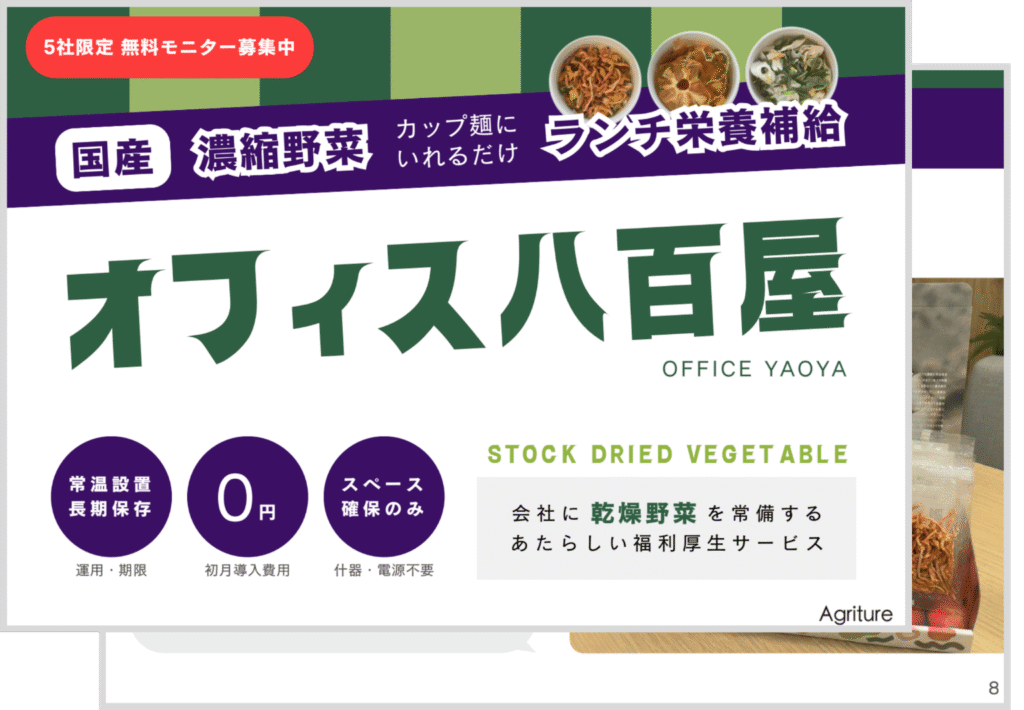
- Service details and vegetable lineup
- Pricing and plans
- How adoption and operation work
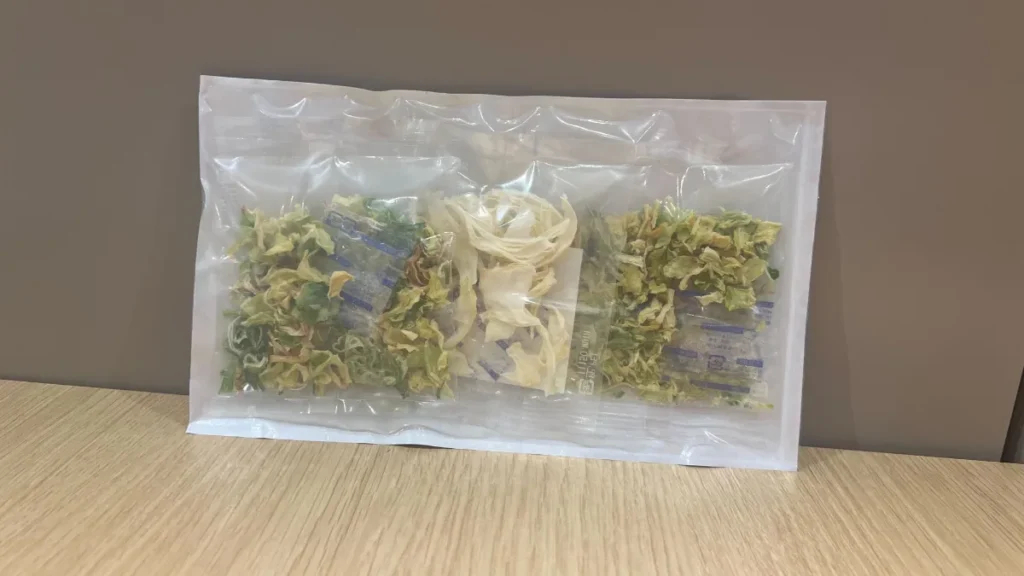
Sample sets are also available. Download the materials for details!
We offer sample sets so you can try Office Yaoya in small quantities. See the materials for details.
Four reasons dried vegetables are ideal for the office
The option drawing attention for solving all these issues at once is dried vegetables. An old-fashioned preserved food like kiriboshi daikon, but it comes with a set of features especially compatible with office-work-centered working styles.
- Nutrients are concentrated: since the moisture is driven off, it's easy to take in fiber and more per same weight.
- It has a satisfying chew: with the moisture gone, you can chew it firmly, so it's easy to feel satisfied even in small amounts, and it can replace afternoon snacking too.
- It stores long at room temperature: it doesn't take up refrigerator space and can be kept in a desk drawer. The ease of adding vegetables on the spot when the thought strikes is its strength.
- Free to arrange: whether as a snack as-is or added to a cup noodle or instant miso soup, it becomes full of ingredients in minutes. A guilt-inducing instant noodle upgrades into a vegetable-filled bowl.
How to build a vegetable habit that lasts at the office
What matters isn't "willpower" but "a mechanism." We organize tricks for keeping it up without relying on will, from the two viewpoints of the individual and the company.
Tricks you can do as an individual
- Keep dried vegetables in your desk drawer so you can add them the moment there are "no vegetables"
- Set a rule to add one bag to your usual cup soup or miso soup, making it a form that continues without thinking
- Swap afternoon snacking from sweets to nibbling on dried vegetables
Make it a mechanism at the company
There's a limit to individual effort. If the workplace has "an environment where you can add vegetables anytime," the hurdle to keeping it up drops all at once. An installed cafeteria or office convenience, and among them the installation of room-temperature-storable dried vegetables especially, is space-saving and light on operational burden, an option easy to start even at a small office. It suits companies considering adoption as a health-management or employee-benefit effort.
The "office greengrocer" that keeps dried vegetables on hand at the office

A realistic answer to vegetable shortfall during overtime is the Office Yaoya (office greengrocer) which the Kai Group × Agriture began offering in earnest in April 2026.
- . A dried-vegetable service of the type installed at the office — a "vegetable version of installed snacks," so to speak. By companies adopting it as an employee benefit, they can cover employees' vegetable shortfall in one go.
- Upcycling off-grade vegetables: it uses domestic off-grade vegetables that are plenty tasty and nutritious but hard to reach the market because of their shape, dried at Agriture's own factory in Kyoto. There's a story where you can take part in food-loss reduction just by eating.
- No sugar or additives: the ingredient's taste is concentrated by low-temperature drying. As a snack replacement too the guilt is small, and you can choose it in place of a convenience-store treat.
A lunch ally: a pinch in your usual cup soup or miso soup. Rehydrated with hot water, a texture close to fresh vegetables returns. The less time you have to go shopping, the easier it is to keep up. Managers and HR staff, please consider adopting it, viewing employee health as an investment in performance. Regular staff can start by sharing with general affairs, "I'd be glad to have this kind of employee benefit." For details,.
FAQ
Summary
Yes. At Agriture, we accept consultations on office plans using domestic dried vegetables made at our own factory in Kyoto. Proposals matched to headcount and installation location are possible, so please feel free to inquire.
Learn about Office Yaoya
We have prepared materials
- Service details and vegetable lineup
- Pricing and plans
- How adoption and operation work
Sample sets are also available. Download the materials for details!
We offer sample sets so you can try Office Yaoya in small quantities. See the materials for details.
Download the office dried vegetable materials
We will send the materials to your email address based on the information you provide.
- Solving the office vegetable shortfall | How to choose a placed dried-vegetable service
- 16 Popular Healthy Office Snacks! How to Choose Them for Health & Productivity Management
Author of this article
Related articles
-
 [2026 edition] What is a meal subsidy as an employee benefit? A guide to adoption steps and a comparison of popular services
 -
[2026 edition] Meal-subsidy benefits usable at convenience stores | 3 ways to adopt them tax-free
-
[2026 edition] 6 disadvantages of placed staff meals and how to avoid them | An adoption checklist to avoid failure
-
 A Must-See for HR: 12 Measures to Raise Employee Satisfaction Through Benefits
 -
 Food Questions in the Health and Productivity Management Survey: What to Write to Score Points
 -
Summary of tax benefits for dining subsidies | Tax-exemption requirements and expense booking
-
Food Programs for Health and Productivity Management: How Much Will It Actually Cost for a Company Our Size?
-
Meal-benefit plans that even small offices of 10 or fewer people can start