
Drying Is Another Kind of Cooking

Summary of this article
This is a column in which the chef Yu Yoneyama considers the potential of Kyoto vegetables from the viewpoint that drying is "another kind of applying heat" to vegetables. When moisture is drawn out by sun-drying, the weight drops to about one-tenth, while the density of umami rises. It introduces changes in flavor through drying and their culinary applications—the shift to a savory note in Manganji togarashi, the earthy aroma of Horikawa burdock, the use of Shogoin turnip and kiriboshi daikon, and the increased umami of dried shiitake.
When I cook, I feel something special in the word "applying heat." Whether searing over high heat all at once, or slowly infusing warmth over low heat—by the sense of distance from the fire and the time you spend, the same ingredient shows an entirely different expression.
But at some point I realized: even without using fire, there's an act that can be called another kind of "applying heat." That was "drying."
TOC
The "Applying Heat over Time" That Drying Teaches
How Sun and Wind Change a Vegetable
A vegetable spread out under the sun lets go of its moisture, wrapped in the searing light and the gently flowing wind. When moisture is drawn out, the flavor concentrates and the aroma takes on a clear outline. This change isn't simple evaporation but a chemical reaction that occurs as the sugars and amino acids within the cells concentrate. The vegetable's weight drops to about one-tenth of before drying, yet the density of umami in fact rises.
The Science of Umami Seen in Dried Shiitake
For example, Commercial dried shiitake. Fresh, their charm is a juicy aroma and bite, but dried, the umami component guanylic acid increases, and the depth when you take dashi from them is incomparable. This, I think, is a change through "applying heat over time."
The chemical reactions that fire causes in an instant, the sun and wind accumulate slowly but surely. In that quiet process there is a strength and a beauty different from flame.
The difference between sun-drying and machine drying
Today food dryers and freeze-drying technology are widespread too, but sun-drying has its own merits. The sunlight and wind draw out moisture slowly and change the fibers without strain, so the texture on rehydration finishes naturally. On the other hand, at Commercial dried vegetables, technology to minimize nutrient loss through temperature-controlled low-temperature drying is also advancing.
Listening to the Vegetables
The Change in Manganji Togarashi
Facing dried vegetables, I feel my senses as a cook shift a little.
For example, Manganji togarashi Dry and that grassy aroma turns into a somewhat savory depth. Thick-fleshed summer-harvested Manganji, dried, shifts its balance of sweetness and heat, and added to a winter simmered assortment, a flavor that transcends the season is born.
The Earthy Memory of Horikawa Burdock
Horikawa gobo Shave thin and dry, and the earthy aroma and sweetness come more to the fore, and the savory depth when simmered grows a notch richer.
This is proof that a vegetable "changes within itself, even without being put to the fire." Rather than forcing a finish with flame, it entrusts itself to the natural rhythm of wind and sun. It's work that reminds even a cook of the posture of "waiting."
The Expression That Drying Widens
The Affinity of Dried Turnip with Dashi
A vegetable that has been through drying widens the range of cooking considerably.
Shogoin kabura Dry and rehydrate it in dashi, and distinctive wrinkles born only of drying form on the surface, and flavor soaks in there well. Because you can enjoy a texture and rich sweetness different from fresh turnip, it comes in handy when you want to add depth to a winter simmered dish.
The Texture and Sweetness of Kiriboshi Daikon
Shogoin daikon Kiriboshi daikon made from has an exquisite crunchy texture and concentrated sweetness. Beyond simmered and dressed dishes, you can also rehydrate it as-is for use in salads.
A cook's work isn't only to "read the heat." Even without fire, you read the change in the ingredient and find new uses. Drying, I truly feel, is another kind of "cooking method."
The Resonance of Fire and Drying
Charcoal-Grilled Dried Shiitake
What's fascinating is that when you further put a vegetable changed by drying to the fire, an entirely new expression appears. Grill dried shiitake over charcoal and a rich aroma spreads that fresh shiitake could never yield. The Maillard reaction and the concentration of umami through drying combine to draw out the ingredient's potential to the fullest.
Oil-Fried Dried Manganji
Slowly stir-fry dried Manganji in oil and sweetness and bitterness overlap exquisitely, making you crave a glass of wine. Layering the fire of cooking onto the "preliminary applying of heat" that drying brings—doing so deepens the ingredient's layers and gives the flavor another notch of depth. It's an expression unique to drying, in which the delicacy and strength of Kyoto vegetables are felt at once.
Carrying the Culture of "Drying" into the Future
The Wisdom of Preservation Before the Refrigerator
Japan has long held the wisdom of preservation in dried fish and dried vegetables.
In an age without refrigerators, people protected ingredients relying on the sun and wind. It was not mere preservation but also "another kind of applying heat" that amplified umami. In Kyoto temples, dried vegetables have long been used as part of shojin cuisine, a technique handed down together with the tradition of Kyoto vegetables.
The Fusion of Tradition and Innovation
When we cooks now inherit that wisdom, it isn't mere nostalgia but connects to new culinary expression. Pairing dried tomato with a Kyoto-style dashi, or slowly simmering dried Kamo eggplant in Saikyo miso. Borrowing the traditional technique, we can explore new combinations. sustainable food In an age of rising interest in , the value of drying technology is being reappraised from a food-loss-reduction standpoint too.
The Luxury of Waiting
The Flavor That Time Creates
Amid busy days, a cook tends to prioritize "finishing quickly."
But facing dried vegetables reminds me of the importance of waiting. Just imagining vegetables lined up under the sun slowly changing softens the flow of time in cooking a little.
Making Dried Vegetables at Home
Dried vegetables can be started easily at home too. Kujo green onion Chop , spread it on a colander, and dry it for about half a day on a fine day, and you have dried green onion that keeps as a condiment. A Seasonal Calendar Referring to and trying drying Kyoto vegetables by season is a fun experiment too.
Cooking isn't only "putting in effort" but also "entrusting to time," drying quietly teaches.
In Closing | Another Fire Given by Nature
Drying is another kind of applying heat.
Not the heat of flame but the flavor of time, born by borrowing the power of sun and wind. Holding this viewpoint as a cook widens the joy of facing vegetables many times over.
Today too, dried vegetables in hand, I think: this isn't mere preserved food but "another kind of applying heat" that nature has bestowed. And when I layer fire onto such vegetables, the world of cooking spreads ever deeper.
Frequently Asked Questions About Dried Vegetables and Applying Heat
Recommended reading
List of Kyoto vegetable varieties / Kyoto vegetable calendar / Commercial dried vegetables / The Technology to Lock In the Season. The Seasonal Story Dried Vegetables Connect. / Kyoto Vegetables and Dashi —The Resonance Between the Ingredient's Voice and the Dashi—
We have materials available to help you understand dried processing OEM
Agriture OEM, flexibly handling everything from small lots to large lots
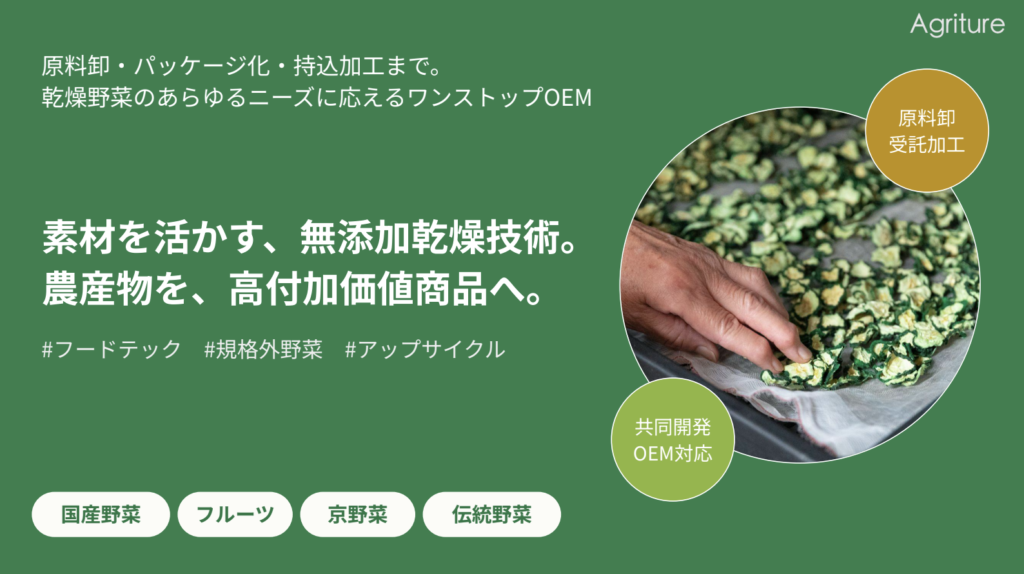
- OEM available from small lots of 10 kg
- Drying of brought-in raw materials also possible
- Support from processing to filling in one place
Download the OEM contract processing materials
We will send the materials to your email address based on the information you provide.
- The Technology to Lock In the Season. The Seasonal Story Dried Vegetables Connect.
- [Kyoto Vegetable Calendar] Seasonal Kyoto Vegetables That Color the Four Seasons and Famous Kyoto Cuisine
Author of this article
Related articles
-
 京野菜は何品目あるのか、読み方の一覧と認定の枠組みから確かめる
 -
 The Technology to Lock In the Season. The Seasonal Story Dried Vegetables Connect.
 -
 The Cut Face of a Vegetable. The Difference the Cut Makes.
 -
 Tasting Kyoto Vegetables by Aroma. The Pleasure of Cooking That Begins at the Tip of the Nose
 -
 Vessels and Kyoto Vegetables. Creating the Scenery of Plating.
 -
 Vegetables and Heat Control. Between High and Low Flame
 -
 Kyoto Vegetables and Sake. The Happy Relationship of a Dish and a Cup.
 -
 Kyoto Vegetables and Dashi —The Resonance Between the Ingredient's Voice and the Dashi—