
As If Meeting a Different Vegetable—Manganji Togarashi and the Story of "Season"

Summary of this article
A column in which Michelin Bib Gourmand chef Tamotsu Yoneyama speaks about the shifting "season" of the Kyoto vegetable Manganji pepper. A brand Kyoto vegetable originating in Maizuru City, Kyoto Prefecture, its shipping period is late May to early October. The first crop in June has thin skin and a fresh, green aroma, while the midsummer crop in August changes to a thick-fleshed, melting sweetness. It also introduces the differing cooking methods and storage methods for early summer versus midsummer, and tips for choosing.
A column written by Tamotsu Yoneyama, a chef who runs "Potsura Potsura" and "Utsura Utsura" in Shinsen, Tokyo, and earned a Michelin Bib Gourmand at both stores. Tamotsu Yoneyama. Manganji togarashi Through it, he speaks of the shifting "season" and the depth of Kyoto vegetables.
TOC
The Manganji pepper that changes between early summer and midsummer
It was one summer. As usual, I picked up the Manganji peppers that had arrived and suddenly thought, "Is this really the same vegetable?"
Around June, when you pick up a Manganji pepper it has a moist gloss, and when you cut it a fresh, green aroma wafts up softly. When you apply heat, the skin bursts lightly, faintly bitter, with a taste that somehow feels cool. It becomes a fresh dish, as if it had sealed in the air of an early-summer morning.
But come August, its expression changes completely. The flesh grows thicker, with a softness that seems to draw in the blade of the knife. Apply heat and the sweetness spreads into a melting texture. Combined with the toastiness of the char, one bite reminds you of the dense air of the height of summer.
The same "Kyoto vegetable," the same "Manganji pepper," yet it transforms this much — it was a surprise like meeting a different vegetable altogether.
Basic data on the Manganji pepper
Manganji togarashi is a brand Kyoto vegetable originating in Maizuru City, Kyoto Prefecture. Large, about 15–20 cm long, with thick flesh and little capsaicin, so it has almost no pungency.
The shipping period is late May to early October. The first crop in June is characterized by thin skin and a crisp texture, and the midsummer crop in August by thick flesh and a melting sweetness. JA Kyoto Ninokuni carries out quality control, and it is distributed under the "Manganji Amato" brand.
"The season" is the moment a vegetable becomes most itself
Whenever I hear the word "season," I think of it not merely as "the peak of shipping" but as the "moment" when that vegetable most fully expresses its own character.
Kamo eggplant, in early summer, has soft skin and falls apart easily when simmered, but in midsummer the flesh firms up and stands up even to dengaku. Kujo scallion, too, changes in both aroma and mucilage between spring and winter. Horikawa gobo As for it, the real thing comes after the frost falls. That flavor is a winter-only feast.
To sense this "shifting of the season," there is really no way but to touch the vegetables in daily purchasing. Weight, color, aroma. Gently confirming "the day's air," which cannot be measured in numbers, you build it up.
Using different cooking methods for early summer and midsummer
Because the June Manganji pepper has thin skin and much moisture, raw or half-cooked preparations shine — finely chopping it and combining it with salad or a dashi jelly. Because the skin scorches easily when seared over high heat, medium heat for a short time is appropriate.
Because the August Manganji pepper has thick flesh and rising sugar content, a standard is "yakibitashi" — grilling it strongly over charcoal to add a char, then soaking it in bonito dashi. The difference in heat control greatly changes how the sweetness is drawn out.
FOR BUSINESS
乾燥万願寺とうがらしを、原料としてお探しですか
国産の万願寺とうがらしを乾燥・粉砕してお出ししています。カット形状や粒度の指定、継続してのお取引もご相談ください。規格は Dried Manganji pepper・Manganji pepper powder に掲載しています。
少量でのご購入は、姉妹ブランドの通販サイト OYAOYA で承っています。
The "season that is only now" appearing in the cooking
What I find interesting while cooking is the moment I think, "Today's Manganji pepper — how shall I use it?"
In June, finely chop it and combine it with a dashi jelly for a refreshing appetizer. In August, grill it golden over charcoal and steep it in bonito dashi. Both are "the season," but that is not a single form — it is "an expression only of that moment" that changes within the season.
That is why I want to convey the words "it is in season now" not as an assertion but like a wish: "Please, do savor this face that is only now."
A five-senses check to discern the shifting of the season
There are five points a chef confirms at purchasing. (1) Color: the deeper the green, the more mature. (2) Gloss: whether the surface is taut. (3) Weight: for the same size, the heavier the thicker the flesh. (4) Aroma: the stronger the fresh, green aroma, the higher the freshness. (5) Firmness: those with elasticity when pressed lightly with a finger are good.
These checks can be applied to Kujo green onion and Kamo eggplant and other Kyoto vegetables as well.
FOR BUSINESS
乾燥万願寺とうがらしを、原料としてお探しですか
国産の万願寺とうがらしを乾燥・粉砕してお出ししています。カット形状や粒度の指定、継続してのお取引もご相談ください。規格は Dried Manganji pepper・Manganji pepper powder に掲載しています。
少量でのご購入は、姉妹ブランドの通販サイト OYAOYA で承っています。
The season is a living presence
When you face ingredients, "the season" comes to seem not a mere time or schedule but a living presence. And when you can notice those small changes, your sense as a chef gradually grows as well.
Today, too, when a vegetable arrives, first I gently pick it up.
"Now then, what face will this year's Manganji pepper show me?" — thinking that, I quietly take up the knife.
How to store and prep the Manganji pepper
After purchase, putting it in a plastic bag and storing it in the vegetable compartment keeps its freshness for about five days. To freeze, remove the calyx, wrap it whole in plastic wrap, and quick-freeze. Grilling it directly without thawing keeps the moisture from escaping and retains the texture.
The prep is just cutting off the calyx and removing the seeds. Even grilled with the seeds there is almost no pungency, and the crisp texture becomes an accent. Fushimi togarashi can also be cooked with the same prep.
Hints for bringing the "season" of Kyoto vegetables into daily life
Kyoto vegetable calendar Posting on the refrigerator makes it easier to be conscious of seasonal vegetables when shopping. Seasonal Kyoto vegetables have a rich flavor and need little seasoning, which also leads to reduced salt.
Kyoto vegetables past their season, when dry processing, have their umami concentrated and can be enjoyed year-round. There is also commercial Manganji pepper powder, made by finely grinding dried Manganji pepper, used as a base for furikake and seasonings. Shogoin kabura and Shogoin daikon dried chips are also handy as a soup ingredient.
Kyoto vegetable columns to read together
For those who want to know the appeal of the Manganji pepper even more deeply, Subtractive cooking methods and How to build a seasonal course. What are Kyoto vegetables is also helpful for those who want to know it systematically.
Recipe for yakibitashi of Manganji pepper
We introduce how to make yakibitashi using midsummer Manganji peppers. First, grill the Manganji peppers whole over strong heat on charcoal or a grill. When the surface is charred and the skin puffs up, it is done. While hot, steep them in a marinade combining 200 ml of bonito dashi, 1 tablespoon of usukuchi soy sauce, and 1 tablespoon of mirin, and chill in the refrigerator for at least two hours. To finish, adding Kujo green onion thinly sliced rounds and grated ginger completes a summery dish.
By the same method, you can also make yakibitashi of Fushimi togarashi and Kamo eggplant. A fun point of Kyoto-vegetable yakibitashi is that the taste changes completely just by changing the type of dashi. Vegetable aroma, as a cooking method that seals it in — please do try it.
We have materials available to help you understand dried processing OEM
Agriture OEM, flexibly handling everything from small lots to large lots
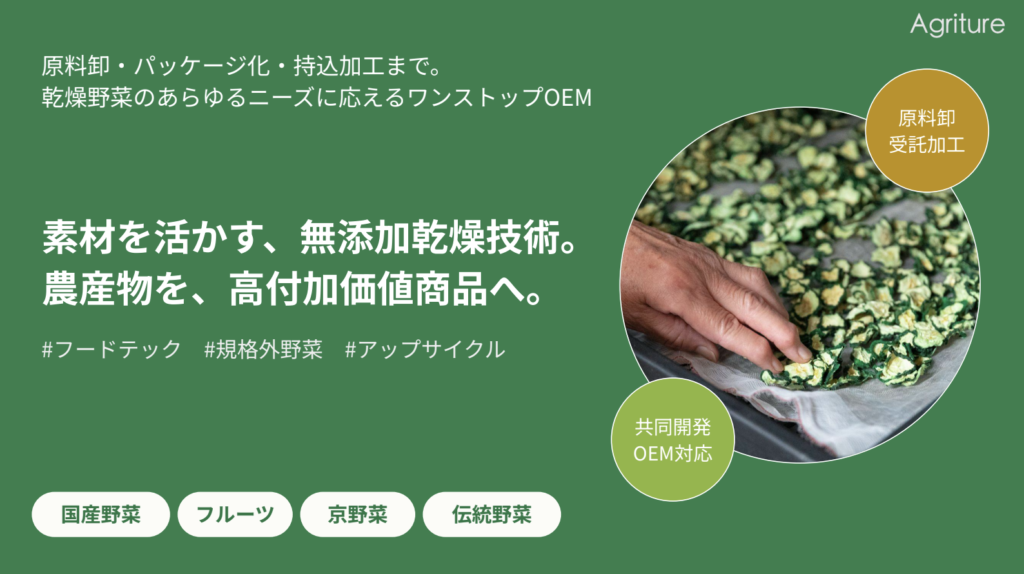
- OEM available from small lots of 10 kg
- Drying of brought-in raw materials also possible
- Support from processing to filling in one place
Download the OEM contract processing materials
We will send the materials to your email address based on the information you provide.
- [Kyoto Vegetable Calendar] Seasonal Kyoto Vegetables That Color the Four Seasons and Famous Kyoto Cuisine
- Mibuna: The Characteristics and History of a Kyoto Vegetable with Little Heat
Author of this article
Related articles
-
 京野菜は何品目あるのか、読み方の一覧と認定の枠組みから確かめる
 -
 Drying Is Another Kind of Cooking
 -
 The Technology to Lock In the Season. The Seasonal Story Dried Vegetables Connect.
 -
 The Cut Face of a Vegetable. The Difference the Cut Makes.
 -
 Tasting Kyoto Vegetables by Aroma. The Pleasure of Cooking That Begins at the Tip of the Nose
 -
 Vessels and Kyoto Vegetables. Creating the Scenery of Plating.
 -
 Vegetables and Heat Control. Between High and Low Flame
 -
 Kyoto Vegetables and Sake. The Happy Relationship of a Dish and a Cup.