
Solve picky eating too! 3 ideas for commercializing vegetable powder you can keep up every day

Summary of this article
Vegetable powder is a food material made by powdering dried vegetables, usable for coloring, nutritional addition, and adding flavor. This article explains the features by kind of pumpkin, ginger, beet, and spinach; three productization ideas—vegetable stick cookies, a porridge mix for baby food, and a add-a-little soup; and measures against the drawbacks of unclear origin, clumping, and vitamin loss.
Taking in plenty of vegetables every day is the basis of health. But in reality, for reasons such as "I'm too busy to spend effort cooking," "my child dislikes vegetables and won't eat them," and "I just don't like the taste,"many people cannot take in enough vegetables—that is the reality.
Against such a backdrop, what is now drawing attention as a means to take in vegetables easily is "vegetable powder."Unlike raw vegetables, it has features such as keeping well, being easy to cook with, and making taste and color easy to adjust, and it is used not only for home use but also in OEM products such as bakery, snacks, and baby food. This article, while organizing the features, uses, suited product genres, and cautions of vegetable powder, introduces
ideas that lead to hints for productization. Vegetable powder is, as its name suggests, "a food material made by processing vegetables into powder form." It is made by drying raw vegetables and grinding them fine. Of course as an ingredient, but it can also be used in a way close to a seasoning—coloring, nutritional addition, adding flavor.

TOC
What is vegetable powder?
For example, it can make the fullest use of "strengths" hard to control with raw vegetables—the natural sweetness of pumpkin, the green color of spinach, the aroma of ginger. In particular, needs for it as
an upcycled material small-lot support and are also rising, and it is drawing attention as a material for OEM product development as well. Features of vegetable powder by kind
There are many kinds of vegetable powder, and each has different features and uses. In this part, we introduce popular powders often used in actual food development and their characteristics.
Main features
Vegetable powder | Use example | Use example |
|---|---|---|
Warms the body / richly fragrant | Soups, black tea, baked goods | |
Natural sweetness / vivid yellow | Bread, pudding, curry | |
Vivid red / high nutritional value | Smoothies, yogurt | |
Rich in iron / green color stands out | Pasta, cookies, gift noodles |
The appeal of every powder is that it lets you take in vegetables—which tend to be avoided as they are—deliciously and easily. In particular, for a hidden flavor or aroma in a product, ginger powder and the like are recommended.
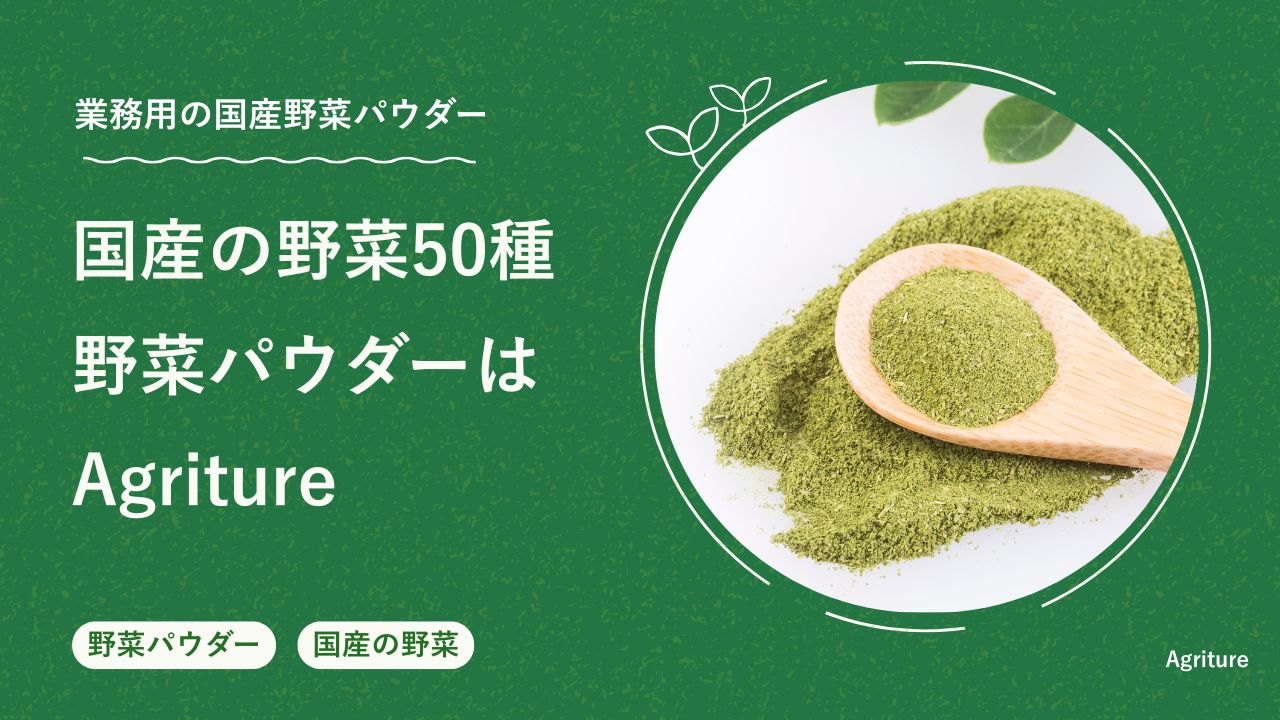
3 ideas for using vegetable powder | Examples of product development in OEM
By powdering dried vegetables, vegetable powder becomes storable at room temperature and, as a material that makes it easy to appeal to color, nutrition, and flavor, is rising in popularity in OEM product development as well. It is especially easy to use when aiming at a segment wanting to make up for a vegetable shortage, or differentiation of products for children, and its strength is "being able to take in vegetables deliciously."
Here we introduce three "product ideas using vegetable powder" that are actually in high demand in OEM development.
1. Vegetable stick cookies | Guilt-free veggie sweets
Proposal background: Dispel the image of snacks = guilt
Carrot Using powders with sweetness and color—pumpkin, purple sweet potato, and the like—you can develop cookies and baked goods that put vegetables front and center. A "guilt-free snack" that gives satisfaction while keeping down the amounts of sugar and wheat demand can be expected especially from women in their 20s–40s, but it can also be rolled out as a snack for children.
OEM point:
Upcycling appeal using off-spec vegetables from your own cultivation, and the like
Gluten-free support combined with rice flour and soy milk is also possible
2. A porridge mix for baby food
Proposal background: In the baby-food market, "effortless & nutrition-focused" is expanding
Mixing vegetable powders such as spinach, pumpkin, and corn with rice flour and mixed grains makes a baby-food base that only needs hot water added. By adjusting particle size and the kind of vegetable according to the infant's age in months, you can roll it out by target—for babies, for kids, and for the elderly.
OEM point:
Retains flavor with freeze-dry or spray-dry processing
Design support such as no chemical seasonings or additives
3. Add-a-little vegetable powder for soup
Proposal background: Health-conscious "ingredient-based instant soups" for adults are popular
broccoli Based on vegetable powders such as beet and tomato, you can productize them as stick-type or cup-type soups. Because they can make use of the vegetable's own color and taste, they are also suited to development without synthetic colorants or fragrances.
OEM point:
Can also be rolled out as winter-limited gift products or plans for employee cafeterias and welfare programs
Functional appeal is also possible by combining with chia seeds or soy milk powder

Drawbacks and cautions of vegetable powder
Things to know before adoption
No matter how convenient a material is, the challenges aren't zero. In handling vegetable powder, caution is needed on the following three points.
● Some products have unclear origin or production method
Among commercial vegetable powders, some do not clearly state where the vegetables used were grown. Especially when conscious of products for children or functional appeal, you are required to chooseTraceabilitya domestic product with a clear origin.
● Clumping of the powder and degradation from moisture absorption
Vegetables high in sugar (e.g., pumpkin, corn) can cause the powder to harden over time. During storage, including an oxygen absorber and highly airtight packaging is required. At the manufacturing stage too, ingenuity such as "a particle-size design that makes the powder easy to dissolve" is needed.
● Risk of vitamin loss
In the drying and grinding process, some nutrients weak to heat and oxidation, such as vitamin C, decrease. Meanwhile, dietary fiber, minerals, and polyphenols remain almost entirely, so by devising the appeal axis, the drawbacks can be covered.
Hints for vegetable powder OEM
In product planning, vegetable powder is attractive as a material with the three qualities of differentiation, low cost, and shelf stability. In categories like the following, a high adoption effect can be expected.
Nutritional-function foods (protein bars, diet support)
Sweets particular about appearance (colorful vegetable cookies)
VegetarianVegan-friendly foods (as substitute materials for eggs and dairy)
are also rising, and it is drawing attention as a material for OEM product development as well.Brand products (powdering off-spec vegetables)
At Agriture, according to such needs, with the upcycling use of domestic, off-spec vegetables as the axis, we help with OEM development. Because small lots are also possible, it is ideal for developing a new lineup.
How about product development using off-spec vegetables?
Toward an era of overcoming "disliking vegetables" with ideas
As a key to changing images such as "vegetables = take effort / children dislike them," vegetable powder is a highly effective material. With high freedom in cooking and easy to support in OEM development, vegetable powder will become a "new option" in product design going forward.
By using off-spec vegetables, environmental consideration × value-added proposals also become possible.
If you are considering product development with off-spec or your own farm's vegetables:From planning to processing, materials, package printing and novelties, you can consult us through a single point of contact. → Learn more about one-stop product development
- What is vegetable paste? The difference from powder, dried vegetables, purée, and extract
- A Thorough Comparison of Strawberry Drying Methods: The Characteristics and Uses of Freeze-Drying, Sun-Drying, and the Oven
Author of this article
Related articles
-
 Original coffee marketing strategy | Ways to grow sales
 -
 ベジタリアンとは?国の規格が分けている4つの区分と食べられないもの
 -
 長ねぎと白ねぎは同じもの?ねぎの種類と呼び名を国の資料で確かめる
 -
 柚子の種類は何種類あるのか、公の資料で名前が残る系統を数えた
 -
 ゆずの時期は年に二度、青ゆずは7月から黄ゆずは10月から
 -
 ゆずの産地は高知が半分を占め、二位は徳島から愛媛に変わった
 -
 Preventing Food OEM Failures: Common Failure Cases and Countermeasures for Success
 -
 How to find a food OEM | How to efficiently find the best manufacturing partner