
Make Baby Food Easy with Vegetable Powder: Safe Uses and Recipes by Age

Summary of this article
A systematic guide by developmental stage for making baby food simpler with vegetable powder. From a usage matrix by stage (gokkun, mogumogu, kamikami, pakupaku periods), the golden ratio of powder to liquid, the vegetables edible at each stage, a comparison of fresh vegetables, frozen stock, and powder, the 3 conditions for choosing (domestically grown, single-ingredient, additive-free), how to choose infant OEM (HACCP, baby-food track record, allergen management, additive-free production line, residual-pesticide testing), through to the nutrients easily supplemented with vegetable powder — content usable both by households wanting to use it safely and by companies considering OEM.
Vegetable powder is a convenient ingredient that lets you achieve both time-saving and nutritional supplementation in making a baby's food. Choosing a domestically grown, additive-free powder lets you take in vegetables such as pumpkin, spinach, carrot, and lotus root little by little to match the developmental stage, while being mindful of powderiness and allergy risk. This article explains, based on knowledge from Agriture's contract-processing site, the guideline amounts for each of the 4 baby-food stages (early, middle, late, and completion), the differing uses by vegetable, recipes by stage, and precautions for storage.
For the lineup and specifications of the commercial powders Agriture handles, please see the product page for commercial vegetable powder as well. Domestically grown powder made with no glucose and using off-spec vegetables, it's also used for OEM of baby food and infant products.

TOC
Why vegetable powder is suited to baby food
The process of "boiling, straining, and mashing" fresh vegetables every time is a heavy burden amid busy childcare. Vegetable powder lets you nearly omit this prep step, and because nutrients are concentrated per unit weight, you can boost nutrition even with a small amount per meal. Being storable at room temperature for a long time and letting you take out just the amount you need, it's also well matched to the small-quantity, multi-item meal design of baby food.
Choosing between fresh vegetables, frozen stock, and powder
| Form | Benefits | Cons | Main use |
|---|---|---|---|
| Fresh vegetables | Can teach texture and a sense of the ingredient | The hassle of prep work, prone to waste | The main dish from the middle stage on |
| Frozen stock | Can be made ahead, prep done in bulk | Takes up freezer space | A staple for the main dish and side dishes |
| Vegetable powder | Time-saving, long-term storage, usable in small amounts | Texture doesn't come across | Boosting nutrition, adding color, covering a dislike of vegetables |
Using powder in a supplementary position added to the main dish or side dishes — rather than as the "main vegetable" — makes it easier to keep the balance with texture and chewing practice.
The conditions for vegetable powder to choose for baby food
- The ingredient list is vegetable names only (no additives such as dextrin or glucose)
- Domestically grown raw material with clear traceability
- Manufactured at a factory with an allergen-management system (whether the cross-contamination management procedures are disclosed)
- Single-ingredient vegetable only (a mix of multiple vegetables isn't suited to the period when you want to start with single ingredients at the allergy-confirmation stage)
- Fine powder (80 mesh or more) that resists clumping
*For babies with a history of allergies or eczema, or with allergy concerns in the family, please consult your regular doctor before starting. In the unlikely event of any abnormality such as itching, rash, or vomiting, seek medical attention promptly. Since the specified raw materials subject to labeling are updated by law, we recommend checking the latest information on the Consumer Affairs Agency's allergy-labeling page.
The domestically grown vegetable powder Agriture provides for commercial use is designed as 100% vegetable, without using glucose or additives, and is adopted as an ingredient for baby food and nursing-care food.
By developmental stage|the appropriate amount and use of vegetable powder
Baby food is generally advanced in four stages. For each stage, we've organized the guideline amount of powder per meal, how to dissolve it, and what to mix it into. The basic rule is to always try a new vegetable one kind at a time, in a small amount, on a weekday morning.
| Stage | Age in months | Guideline per meal | Recommended way to dissolve | What to mix into |
|---|---|---|---|---|
| Early stage | 5–6 months | First time 0.1–0.3g (one ear-pick scoop) / once used to it, up to 0.5–1g | Make a paste with hot water, cooled boiled water, breast milk, or formula | 10-to-1 rice porridge |
| Middle stage | 7–8 months | 1–2g (1/4–1/2 tsp) | Dissolve in a small amount of hot water first | 7-to-1 rice porridge, tofu, white fish |
| Later stage | 9–11 months | 2–3g (1/2–1 tsp) | Can be kneaded directly into dough or ingredients | Soft rice, oyaki, pancakes |
| Completion stage | 12–18 months | 3–5g (1–2 tsp) | Mixed into ingredients such as hamburg steak | Soft rice, hamburg steak, okonomiyaki |
Vegetable powders easy to use by developmental stage
| Vegetables | Early stage | Middle stage | Later stage | Completion stage |
|---|---|---|---|---|
| kabocha | ◎ (easy to eat thanks to sweetness) | ◎ | ◎ | ◎ |
| Carrot | ◎ (beta-carotene supply) | ◎ | ◎ | ◎ |
| Spinach, | △ (a small amount possible from the latter half of the early stage) | ◎ (iron supply, full-scale introduction) | ◎ | ◎ |
| Komatsuna | △ | ◎ (iron and calcium) | ◎ | ◎ |
| Lotus root | × | ◎ (ideal for adding thickening) | ◎ | ◎ |
| beets, | × | △ (recommended from the late stage on) | ◎ (color) | ◎ |
Lotus root powder has the property of thickening when dissolved in water, and adding about 1/4 tsp to finish rice porridge or vegetable soup makes it easier for the baby to swallow. This is a property confirmed in the case of turning Sakura Renkon (Chiba Prefecture) lotus root into powder too, and it's a use increasingly adopted in the baby-food and nursing-care-food markets.
Simple vegetable-powder recipes by developmental stage
We introduce 4 simple recipes you can actually make, one for each stage. Adjust the amounts while watching your baby's response.
Early stage|smooth pumpkin paste
- Ingredients: 1/4 tsp pumpkin powder, 2 tbsp cooled boiled water
- Steps: put the powder in a bowl and add the cooled boiled water little by little, dissolving until smooth
- Use: mix into 10-to-1 rice porridge, or give it on its own
Middle stage|colorful vegetable 7-to-1 rice porridge
- Ingredients: 2 tbsp 7-to-1 rice porridge, 1/4 tsp carrot powder, 1/4 tsp spinach powder, 10g tofu
- Steps: dissolve the powders in a little cooled boiled water, then mix into the rice porridge. Crumble the tofu and place it on top
- Point: the orange and green colors stimulate the appetite. The tofu supplies protein too
Late stage|vegetable-packed oyaki
- Ingredients: 100g soft rice, 1 tsp pumpkin powder, a pinch of aonori
- Steps: mix the powder and aonori into the soft rice and shape into ovals. Grease a frying pan lightly and cook both sides
- Storage: freezable (portioned in plastic wrap). Handy for breakfast or a snack
Completion stage|vegetable mini hamburg steaks
- Ingredients: 100g ground chicken, 50g tofu, 1 tsp carrot powder, 1 tsp spinach powder, 1 tsp potato starch
- Steps: mix everything, roll into small balls, and cook both sides in a frying pan (over medium heat for 5–6 minutes)
- Point: for adults, seasoning with salt, ketchup, and the like lets the whole family share them
Precautions for safe use and allergy response
A baby's digestive organs and allergy tolerance are still developing. Sticking to the amount used and choosing products made on an allergen-compliant production line become important.
The iron rules for the first time you use it
- Try one kind at a time (multiple at once makes it impossible to identify the cause)
- Give it on a weekday morning (so you can readily seek medical care if there's an abnormality)
- For the first time, start with one ear-pick scoop (about 0.1–0.3g)
- Watch the response with the same vegetable for 2 to 3 days before moving to the next vegetable
The 4 items to check on the package
| Item | Details to confirm |
|---|---|
| Ingredient labeling | Whether it's "vegetable name only" (no additives such as dextrin) |
| Raw-material origin | Whether there's a prefecture or country name shown |
| Allergen information | The presence of specified-raw-material contamination, and whether it's made on a dedicated line |
| Best-before date and after opening | Whether the unopened best-before date and the usage period after opening are stated |
Points for storage and hygiene management
- After opening, transfer it to an airtight container and keep it away from direct sunlight and high heat and humidity
- In summer, refrigerated storage is also fine (watch for condensation and take out only the amount you use)
- Always use a dry spoon dedicated to the powder
- Use it up within 2 to 3 months after opening as a guide
- If there's discoloration, off odor, or clumping, stop using it
A quick reference to baby-food stages by age in months
Baby food 4 stages It advances in, and the amount of vegetable powder you can use and the texture change with the age in months. We've compiled the appropriate way to use powder at each stage in a quick-reference table.
| Stage | Age in months | Texture | How to use powder |
|---|---|---|---|
| Gokkun period | 5–6 months | Smooth paste | Mix one ear-pick scoop (0.3g) into 10-to-1 rice porridge |
| Mogumogu period | 7–8 months | A firmness you can crush with your tongue | Mix 1/4 tsp into 7-to-1 rice porridge or tofu |
| Kamikami period | 9–11 months | A firmness you can crush with your gums | 1/3 tsp into 5-to-1 rice porridge or udon |
| Pakupaku period | 12–18 months | A firmness you can bite with your gums | 1/2–1 tsp into soft rice or oyaki |
The golden ratio of powder to liquid
With vegetable powder, the ratio to the liquid amount makes paste, furikake, or thickening— you can make those 3 states. Use the ratio differently by age in months and application.
| State | Powder : liquid | Suited age / application |
|---|---|---|
| Paste | 1:10 | Gokkun period, single-ingredient vegetable |
| Thickening | 1:5 | Mogumogu period, mixing with dashi stock |
| Furikake | No liquid | Kamikami period on, color for soft rice |
Vegetable powders edible by developmental stage
| Age in months | Easy-to-use vegetables | Vegetables that need caution |
|---|---|---|
| 5–6 months | Pumpkin, carrot, potato, sweet potato | Spinach (latter half) / tomato (skinless) |
| 7–8 months | Spinach, broccoli, turnip, daikon | Vegetables with strong harshness (shungiku, burdock) |
| 9–11 months | Mushrooms, tomato, bell pepper, eggplant | Fresh-vegetable-based products need heating |
| 12–18 months | Broadly usable | Presence of salt or allergen contamination |
Comparison of fresh, frozen, and powder
For the vegetable intake of baby food, there are 3 options — fresh vegetables, frozen stock, and powder. Since each has different merits and demerits, using them differently to match the application is practical.
| Form | Effort | Nutrient retention | Time-saving | Cost |
|---|---|---|---|---|
| Fresh vegetables | Prep work required | ◎ (fresh) | △ | Medium to high (seasonal variation) |
| Frozen stock | Batch cooking | ◯ | ◯ | Medium (bulk buying) |
| Powder | Minimal | ◯ (additive-free products) | ◎ | Medium (a little goes a long way) |
Fresh vegetables vs. powder, seen by nutrient
With vegetable powder, some nutrients decrease during the drying process, but dietary fiber, beta-carotene, and iron tend to be relatively well retained. Since vitamin C and B vitamins are heat-sensitive, freeze-dried products are said to retain them better.
| Nutrients | Fresh vegetables | Hot-air-dried powder | FD powder |
|---|---|---|---|
| Dietary fiber | ◎ | ◎ (concentrated) | ◎ (concentrated) |
| Beta-carotene | ◯ | ◯ | ◎ |
| Iron and minerals | ◎ | ◎ (concentrated) | ◎ (concentrated) |
| Vitamin C | ◎ | △〜◯ | ◯ |
| Enzymes | ◎ | △ | ◯ |
The 3 conditions for choosing baby-food powder
When choosing vegetable powder at a supermarket or online, to tell whether it can be used for baby food, 3 conditions are the surest way to judge. Commercial vegetable powder often has seasonings, sweeteners, dextrin, and the like added, and using it as-is for baby food may burden a baby's internal organs. Choosing a product that meets all three of the conditions below lets you use it with peace of mind even from the early stage (5–6 months).
✅ Baby-food powder: 3 conditions for choosing
- Domestically grown: clear residual-pesticide standards and traceability
- Single-ingredient: not a blend of multiple vegetables — one vegetable = one product (to identify allergens)
- Additive-free: no glucose, dextrin, salt, flavoring, or sweetener
Condition ①: being domestically grown
Domestically grown vegetables are managed under Japan's residual-pesticide standards (the Positive List system), and traceability can be secured all the way to the growing region, cultivation method, and harvest timing. Because baby food is fed at a time when the baby's gut environment isn't yet established, it's a domain where you want to minimize the risks of residual pesticides and nitrates. Among domestically grown ones, products with clear contract farms or in-house farms offer even greater peace of mind.
Imported products (from China or Southeast Asia) are cheap, but their residual-pesticide testing standards and transport-management systems differ from domestically grown ones. For continued home use or product development, make domestically grown your default option.
Condition ②: being single-ingredient (no blends)
Products in which multiple vegetables are mixed, like a "vegetable mix powder," should be avoided in the early to middle stages of baby food. The reason is that if an allergy appears, you can't identify the culprit vegetable. The basic rule for introducing baby-food ingredients is "one kind every 3 days, and for anything new, start with 1 tsp," built on the premise of checking allergic reactions to each ingredient individually.
It's safe to gather several single-ingredient powders —1 bag = 1 vegetable— such as spinach, carrot, and pumpkin, and introduce them one at a time to match the age in months. After multiple-ingredient allergies can be confirmed from the kamikami period (9–11 months) on, using mixed products for time-saving also becomes an option.
Condition ③: being additive-free
Some commercial and home-use powder products have glucose, dextrin, salt, sugar, flavoring, sweetener, or antioxidants added. Even in amounts that are no problem in adult foods, these are components unnecessary for a baby eating baby food.
| Components to avoid | Reason |
|---|---|
| Glucose and sugar | Tooth decay, excess sugar, effect on taste formation |
| Salt and soy sauce | Burden on the kidneys. Almost no salt is needed until age 1 |
| Dextrin | A bulking agent. No nutritional meaning |
| Flavoring and flavor adjusters | Hinder the taste experience of natural ingredients |
| Artificial sweeteners | Risk of dependence on sweetness |
Choose a product whose ingredient column reads "vegetable name only."A simple listing of only the ingredient name plus the growing region — like "spinach (domestically grown)" — is the most desirable state for baby-food use.
FOR BUSINESS
乾燥野菜を業務用でお探しですか
国産の野菜・果物を乾燥し、必要に応じて粉砕してお出ししています。扱っている品目は100種前後で、規格は 乾燥品の一覧・パウダーの一覧 に掲載しています。
少量でのご購入は、姉妹ブランドの通販サイト OYAOYA で承っています。
How to choose infant OEM
Food OEM for baby food and products for infants and toddlers is a field with hygiene standards one notch stricter than general food OEM. Choosing a company with a track record in baby food production and a solid certification framework is the starting point for making a safe product.
| Item to confirm | What to check specifically |
|---|---|
| HACCP Certification | Effectively essential for infant and toddler products. A company that also holds FSSC 22000 is even stronger |
| Baby food track record | Years and number of cases of experience producing baby food and products for infants and toddlers |
| Allergen management | Cross-contamination prevention lines and cleaning procedures for the 7 major allergens |
| Additive-free production line | Process separation from other products, cleaning frequency, and validation |
| Pesticide residue testing | Inspection frequency at raw-material intake and use of public testing agencies |
| Strengthened Food Sanitation Act standards | Level of compliance with processing standards for infant and toddler products |
| Ingredient traceability | Management of growing region, cultivation method, harvest date, and lot number |
⚠️ Caution|Companies you should not choose
- Companies that don't hold HACCP certification, or are vague about it being "in progress"
- Companies with no production track record for baby food or infant and toddler products
- Companies that can't explain their allergen management framework
- Companies that don't attach an ingredient list or production history to prototype samples
At the quotation stage, "Do you have a production track record for infant and toddler products?" "How many stages are your allergen cross-contamination measures?" "How often do you test raw materials for residual pesticides?"It's safest to ask specific questions like these and get answers in writing. A company that gives vague answers can be judged a high-risk choice as a manufacturing partner.
FOR BUSINESS
乾燥野菜を業務用でお探しですか
国産の野菜・果物を乾燥し、必要に応じて粉砕してお出ししています。扱っている品目は100種前後で、規格は 乾燥品の一覧・パウダーの一覧 に掲載しています。
少量でのご購入は、姉妹ブランドの通販サイト OYAOYA で承っています。
Nutrients that are easy to supplement with vegetable powder
The weaning period is when you begin supplementing through meals with nutrients that tend to run short on breast milk or formula alone, such as iron, calcium, and vitamin A (β-carotene). Because vegetable powder concentrates nutrition even in small amounts, it suits boosting nutrition on busy mornings or on days when a child eats little.
| Nutrients | Suitable powders | What it may support |
|---|---|---|
| β-carotene | Carrot / kabocha | Maintaining skin and mucous-membrane health, supporting growth |
| Iron | Spinach, komatsuna | Supplementing nutrients that tend to run short after 6 months of age |
| Calcium | Komatsuna, spinach | Supporting the formation of bones and teeth |
| Dietary fiber | Lotus root, kabocha squash, spinach | Supporting bowel rhythm |
| Vitamin C | Kabocha squash, broccoli | Helping the absorption of iron |
From the middle stage of weaning onward, iron is said to run short easily, and Spinach,powder, or Komatsuna combining powder with tofu or white fish lets you supplement iron along with protein. β-carotene is converted into vitamin A to support skin and mucous-membrane health, and Carrot・kabocha it is the component responsible for the yellow and orange color of the powder.
Quick reference: base-food combinations
We've put together a quick-reference table of frequently used combinations so you can make them fast even on busy mornings. Use it as a guide for nutritional balance.
| Base | Easy-to-pair powders | Nutrition and function to aim for |
|---|---|---|
| Okayu | Kabocha squash, carrot, spinach | Boosting vitamins and dietary fiber |
| Tofu | Spinach, komatsuna | Supplementing iron and calcium |
| White fish | Carrot / kabocha | Protein plus β-carotene |
| Yogurt (from the middle stage onward) | Kabocha squash, beets (later stage) | Adding color and softening tartness |
| Udon, pasta | Spinach, carrot | Supplementing green and yellow vegetables |
| Pancakes, oyaki | Kabocha squash, beets, spinach | Finger foods plus adding color |
We have materials available to help you understand dried processing OEM
Agriture OEM, flexibly handling everything from small lots to large lots
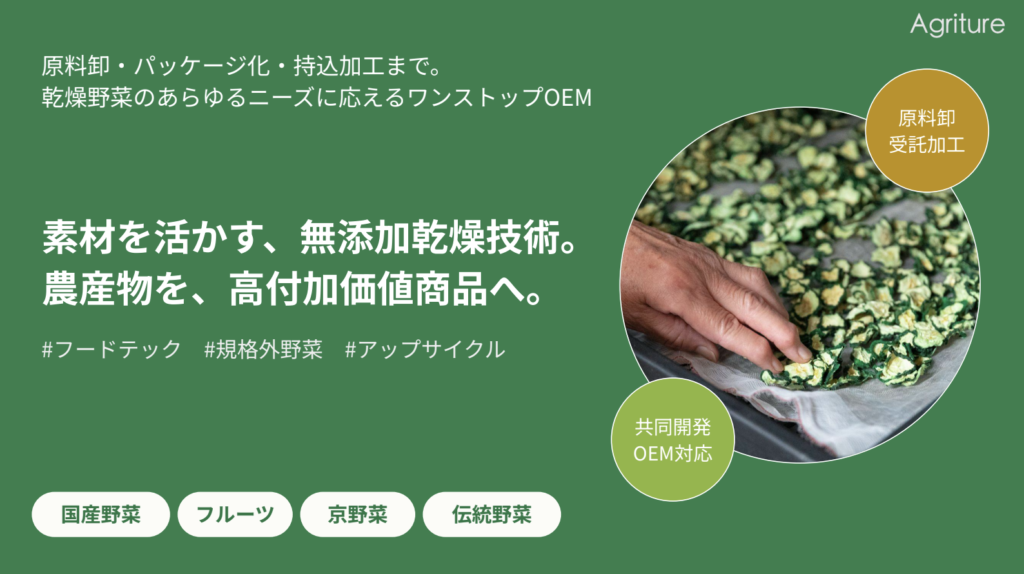
- OEM available from small lots of 10 kg
- Drying of brought-in raw materials also possible
- Support from processing to filling in one place
Weaning Food Vegetable Powder Q&A
Can vegetable powder be used from the early weaning stage (5–6 months)?
If it's a domestically grown, additive-free, single-vegetable powder, you can use it from the early stage. Start by dissolving about an ear-pick's worth (0.3g) in cooled boiled water or hot water into a paste and mixing it into 10-to-1 rice porridge. Choosing a product made on an allergen-conscious production line gives added peace of mind.
I'm worried about allergies. What kind of powder should I choose?
Choose a domestically grown, single-item powder whose ingredients list only the vegetable name. Products that mix several vegetables make it impossible to pinpoint an allergen, so they're unsuited to the early-to-middle stage. Whether the packaging clearly states the allergen management framework (production-line separation, cleaning procedures, cross-contamination control) is also a point to check. For a baby with a history of allergies or a family history, consult your regular doctor before starting, and see a medical institution if anything unusual occurs.
From what age can spinach powder be used?
The guideline is from the middle weaning stage (7–8 months) onward. Spinach is excellent for supplementing iron, but because it contains oxalic acid, many families try it little by little from the latter half of the early stage. Mixing it into 7-to-1 rice porridge or tofu is recommended; start from about 1/4 teaspoon per serving.
How long can it be used after opening?
It depends on the product, but the guideline is to use it up within 2–3 months after opening. Transfer it to an airtight container and store it away from direct sunlight and high heat and humidity. Refrigeration is effective in summer, but the trick is to take out only what you'll use and return it quickly so condensation doesn't form.
Is vegetable powder alone enough for nutrition?
Powder is a supplementary ingredient meant to "boost nutrition." For the development of texture and chewing too, the ideal balance is to make dishes cooked from fresh or frozen-stock vegetables the main course, and use powder for adding color, covering vegetable dislikes, and supplementing nutrients such as iron.
Summary|Three selection criteria and hygiene standards
For vegetable powder used in weaning food, if you choose a product that meets three points—domestically grown, single-item, and made on an allergen-conscious production line—you can use it with confidence from the early stage. By keeping to the amount guidelines by month of age while balancing with fresh and frozen-stock vegetables, you can support both nutrition and the development of texture.
Based in Kyoto, Agriture produces commercial vegetable powder made with 100% domestic vegetables, using out-of-spec produce, and free of glucose. For inquiries about baby food OEM or contract processing of ingredients for weaning food, Agriture's page on Food OEM no Madoguchi.
Download the OEM contract processing materials
We will send the materials to your email address based on the information you provide.
If you are considering product development with off-spec or your own farm's vegetables:From planning to processing, materials, package printing and novelties, you can consult us through a single point of contact. → Learn more about one-stop product development
- Vegetable sweets OEM | The complete guide to designing color, flavor, and nutrition with vegetable powder
- The complete guide to choosing vegetable powder: also explaining the difference between commercial and household use
Author of this article
Related articles
-
 ベジタリアンとは?国の規格が分けている4つの区分と食べられないもの
 -
 柚子の種類は何種類あるのか、公の資料で名前が残る系統を数えた
 -
 柚子の皮の使い道は干すと広がる、果汁と種まで使い切る手順
 -
 How to Use OEM Matching Sites: Efficiently Finding the Optimal Manufacturing Partner
 -
 How to proceed with hometown-tax product development | OEM techniques that make the most of local ingredients
 -
 Creating a regional brand with a Kyoto-vegetable OEM | The complete flow from planning to sales
 -
 How to source commercial vegetable powder in small lots, and how to use it
 -
 What Is Vegetable Powder? Features, Shelf Life, Uses and a Guide to OEM