
How to Use Fruit Powder | Substitution Design for Confectionery and Sweets
Tea
Raw materials & ingredients
Dried fruit
Powder
Recipes & uses
Health & nutrition
Raw material sales
Food OEM

Summary of this article
A guide to using fruit powder in confectionery and sweets. Fruit-by-fruit suitability for strawberry, mango, blueberry, apple, pear, yuzu, banana, and more; differences by processing method (freeze-drying, spray drying, cryogenic grinding); formulation examples by sweets category (cookies, cakes, macarons, ice cream, pudding); how to think about substitution; designing additive-free appeals; common pitfalls; the practicalities of moisture absorption and storage; material affinities and best-before dates; and Agriture's fruit-powder usage ranking.
Fruit powder is strawberry・mango・blueberry・apples・pear・Yuzu a material made by powdering fruits such as banana. In confectionery, sweets, drinks, and nutritional foods, it can be used in place of fruit (as a substitute) in formulations where fresh fruit or pulp is hard to use—doughs and creams where you don't want to add moisture, products that assume heating or long-term storage, and so on. Because it lets you add the color and flavor of the fruit itself without synthetic colorants or flavorings, it's also chosen in additive-free product development.
This article brings together fruit powder's processing methods (freeze-drying / spray drying / cryogenic grinding), formulation examples in confectionery and sweets, fruit-by-fruit suitability, how to think about substitution, and designing additive-free appeals. Fruit powder is a material whose character changes with the upstream processing method, so getting a picture of the processing methods first makes it easier to choose. Agriture handles nearly 100 kinds of dried vegetables and fruits, but individual fruit-powder OEM is premised on proceeding on a prototype basis according to the product concept. The practicalities of lots and sourcing for commercial fruit powder are covered in detail in The complete guide to choosing commercial fruit powder. Related article: Commercial freeze-dried strawberries/Using vegetable powder in sweets/Vegetable powder, natural coloring, additive-free。

TOC
Recommended ranking for using fruit powder
We've organized, in ranking form, the applications where fruit powder is especially chosen on the front lines of confectionery, sweets, and drink development. Based on fruit-by-fruit suitability and processing method, they're arranged in order of adoption frequency. Use it for reference when planning new products or considering substitute materials.
| Rank | Use | Suitable fruit powders | Representative uses |
|---|---|---|---|
| 1 | Macarons and ganache | Strawberry, raspberry, mango | Delivering flavor and color at once |
| 2 | Cookies and pound cake | Apple, blueberry, banana | Adding aroma by kneading into the dough |
| 3 | Protein drinks and smoothies | Mango, strawberry, banana | Adding a sense of fruit without increasing moisture |
| 4 | Wagashi and jelly | Yuzu, pear, strawberry | Adjusting flavor with Japanese ingredients |
| 5 | Granola and cereal | Apple, blueberry | Reinforcing color and aroma in combination with dried ingredients |
The top-ranked uses are all "situations where fresh fruit is hard to use due to moisture or shelf-life issues." Details by processing method are organized in the next section.
Fruit-powder processing methods and how to choose
With fruit powder, the processing method greatly changes how flavor is retained, solubility, and cost. If you're using it in sweets or confectionery, checking which processing method the material came from first is the basic approach.
Features by processing method
| Processing method | Retention of flavor and color | Solubility | Cost |
|---|---|---|---|
| Freeze-dried and ground | ◎ Just like the fruit | Medium | High |
| Spray drying | △ Aroma weakens | ◎ Dissolves easily | Medium |
| Hot-air dried and ground | △ Weak color and aroma | ○ | Low |
| Cryogenic grinding (fruit frozen, then ground) | ○ A sense of the fruit remains | △ | Medium |
Use them for different purposes: freeze-dried and ground for high-priced, premium-appeal sweets, and spray drying for mass-produced drinks and processed foods.
Situations where you use it in place of fresh fruit or pulp
- You don't want to add moisture: Since fresh cream, dough, and chocolate slump with moisture, powder is suitable as a substitute
- You want to supply it outside the season too: Fresh fruit is strongly seasonal, while powder can be used year-round
- You want to reduce formulation unevenness: Pulp varies greatly by lot, while powder disperses uniformly
- You want to improve shelf stability: It keeps 1–2 years at room temperature and can be handled without refrigeration or freezing
FOR BUSINESS
乾燥野菜を業務用でお探しですか
国産の野菜・果物を乾燥し、必要に応じて粉砕してお出ししています。扱っている品目は100種前後で、規格は 乾燥品の一覧・パウダーの一覧 に掲載しています。
少量でのご購入は、姉妹ブランドの通販サイト OYAOYA で承っています。
How to use it in confectionery and sweets
In confectionery and sweets, the way you use it changes with moisture content and whether heat is applied—doughs, creams, chocolate, candy, gummies, and so on. We organize the usage and formulation amounts for each representative sweets category.
Usage by sweets category
| Category | How to use | Formulation guideline |
|---|---|---|
| Baked goods (cookies, muffins, pound cake) | Mix into the flour and knead in | 3-8% of the flour |
| Macarons, meringues | Blend into powdered sugar or almond flour | 2–5% of the flour |
| Fresh cream and ganache | Sift in and mix (substitute: doesn't add moisture the way fresh fruit does) | 1–3% of the base |
| Chocolate and bonbons | Sprinkle into melted chocolate | 1-2% of the base |
| Candy and hard candy | Knead into the candy base | 0.5–2% of the base |
| Gummies and jelly | Dissolve before gelling | 1–3% of the base |
| Ice cream and sorbet | Mix into the base (delivering both fruit character and color) | 1–3% of the base |
The basic rule for the amount: more if you want strong color and flavor, less if you want just a hint. If you don't want to disrupt the sweet's texture, it's safest to prototype with a small amount first and vary the formulation.
Common pitfalls
- Color fades during baking: Beet- and blueberry-type powders lose color with heat. Move them to post-bake decoration
- Clumping: Strawberry and mango contain sugar, so sifting them together with powdered sugar reduces clumping
- Flavor changes from moisture absorption: After opening, seal in an aluminum-laminate bag and use a desiccant
- Flavor is too strong: Overdoing the formulation brings tartness and astringency to the front. Adjust in prototyping
Fruit-by-fruit suitability and how to choose
Fruit powder has different strong uses depending on the type of fruit. Choosing to match the color, flavor, and price range you're aiming for in your sweet's design speeds up the decisions on the way to commercialization.
Suitability chart for major fruit powders
| Fruit | Color and flavor | Suitable sweets and uses |
|---|---|---|
| strawberry | Pink, sweet-tart | Macarons, chocolate, fresh cream, pudding |
| mango | Yellow, tropical | Baked goods, mousse, smoothies |
| Blueberry | Purple, tart | Muffins, yogurt, protein |
| apples | Pale brown, sweet | Pound cake, tart, granola |
| pear | Pale color, gentle sweetness | Wagashi, baked goods, gift sweets |
| Banana | Pale yellow, sweetness and richness | Cookies, pancakes, drinks |
| Yuzu | Pale yellow, Japanese-citrus aroma | Wagashi, baked goods, drinks |
| Raspberry | Vivid red | Macarons, fresh cream, chocolate |
| Passion fruit | Yellow, strong tartness | Mousse, ice cream, chocolate |
Combining with matcha powder
Matcha powder isn't strictly a fruit, but it's a standard material combined in sweets as a "powder that adds color and flavor." Pairing the sweet-tartness of fruit powder with the astringency of matcha gives a combination usable in East-meets-West sweets design.
- Strawberry × matcha: the standard pair for macarons and nama-choco
- Yuzu × matcha: wagashi and fresh cream
- Mango × matcha: an unusual twist for baked goods
Using it as an additive-free colorant alternative
Fruit powder is a naturally derived material that can be used in place of synthetic colorants and flavorings. Because you can list it on the ingredients label by material name—"strawberry powder," "mango powder," and so on—it's an area with good affinity for additive-free sweets design.
Replacing synthetic materials with fruit powder
- Red colorant → strawberry or raspberry powder: It changes with heat and pH, so review the mixing process
- Yellow colorant → mango or yuzu powder: Relatively heat-resistant and usable in baked goods too
- Purple colorant → blueberry powder: The color shifts with pH, so verify an acidic design
- Synthetic flavoring → increase fruit-powder amount: Raise the formulation to 3–5% to bring up the aroma
Cautions when substituting
- Since the amount is larger than with synthetic colorants, there's an impact on texture and nutritional value
- Because color moves with pH and heat, verify color change before and after baking and after storage in prototyping
- If you want to claim "no colorants added" on the label, all ingredients must have zero synthetic colorants
- Don't forget to check for allergens (such as soy-derived processing aids)
The practicalities of moisture absorption and storage for fruit powder
Because fruit powder contains sugar, it's a material more prone to moisture absorption and caking than vegetable powder. The operational rules for storage, packaging, and handling tie directly to maintaining taste, color, and usability.
Causes of moisture absorption
- The hygroscopicity of sugar: Fructose and glucose readily absorb moisture from the air
- The surface area of fine particles: Powdering increases surface area and raises the rate of moisture absorption
- Storage temperature and humidity: Moisture absorption and caking accelerate in hot, humid environments
- Number of times opened: Each re-opening lets outside air in and advances moisture absorption
Best practices for preventing moisture absorption
- Aluminum-laminate packaging plus an oxygen absorber and silica gel
- Transfer large commercial bags into use-up portions to reduce the number of times opened
- Store in a cool, dark place (around 20°C, humidity 50% or below)
- Make prompt use after opening (a guideline of 1–2 months) an operational rule
Materials with good affinity for fruit powder in confectionery
Fruit powder is easier to balance for color, flavor, and texture when combined with other materials rather than used alone. We organize the combination patterns for confectionery.
Affinity by material type
- Dairy: Fresh cream, milk, butter. Mellows the tartness of the fruit and adds depth to the flavor
- Chocolate and cacao: Three types—dark, milk, and white. The contrast of the fruit's tartness with the bitterness adds dimension
- Nuts: Almond, hazelnut, pistachio. The nut's oils add depth to the fruit's tartness
- Herbs and spices: Basil, mint, cinnamon, cardamom. Adds variation to the fruit's flavor
- Vegetable powder: Beets, kabocha squash, purple sweet potato. An East-meets-West combination that adds depth of color and flavor
Standard combination examples
- Strawberry powder × milk chocolate: the classic pairing
- Mango powder × coconut: a tropical direction
- Blueberry × white chocolate: a contrast of tartness and sweetness
- Raspberry powder × pistachio: a European pâtisserie standard
Designing the best-before date for fruit-powder products
The best-before date for a product formulated with fruit powder is thought about differently for the powder alone versus the final product as a whole. You design it in line with the base dough's best-before date while also factoring in the color- and flavor-retention limits.
Factors that affect the best-before date
- Water activity (Aw): The dough's moisture content changes the mold and microbial risk
- Color-retention limit: Anthocyanin types fade with light and oxygen
- Flavor-retention limit: The fruit's aroma weakens over time
- Maintaining texture: The powder's moisture absorption changes the dough's texture
The practicalities of setting the best-before date
- After prototyping, use accelerated testing (40°C, 75% relative humidity) to grasp the product's degradation curve
- Record sensory evaluation (color, taste, aroma) over time, and set the date at the point it falls below the standard value
- If color retention is the priority, use light-blocking packaging plus an oxygen absorber; if flavor is the priority, strengthen the oxygen barrier
- Set the best-before date individually according to the distribution channel (room temperature, refrigerated, frozen)
Fruits and related materials Agriture handles
Agriture is a processing manufacturer with dried vegetables at its core, but we also have a track record of processing dried fruit. We proceed with individual fruit-powder OEM on a prototype basis according to the product concept, raw-material sourcing, and processing method.
Related fruit-processing track record
- dry-pear (Letters from a Pear): A D2C brand that gently dries "Nijisseiki pears" grown in Kyotango, Kyoto, without sugar or additives. A dried-fruit line
- One's Daily dried-apple sticks: An example of drying and processing Nagano-grown "leaf-kept apples" into sticks, sugar-free, for a brand by cooking researcher Mayuka Morisaki (stick shape, not powder)
- Design know-how on freeze-dried strawberries is covered in Commercial freeze-dried strawberries.
*The above are dried-fruit processing records, not concrete adoption cases for fruit "powder." Powdering is premised on proceeding with individual design and prototyping according to the product concept.
Information needed when consulting on OEM
- The fruit you want to use and your image of its color and flavor
- Product category (macarons / fresh cream / chocolate / drinks / baked goods, etc.)
- Preferred processing method (freeze-drying / spray drying / cryogenic grinding)
- Distribution channel, expected lot, and planned sales launch date
- Whether you want an additive-free appeal (no colorants, no flavorings, etc.)
We have materials available to help you understand dried processing OEM
Agriture OEM, flexibly handling everything from small lots to large lots
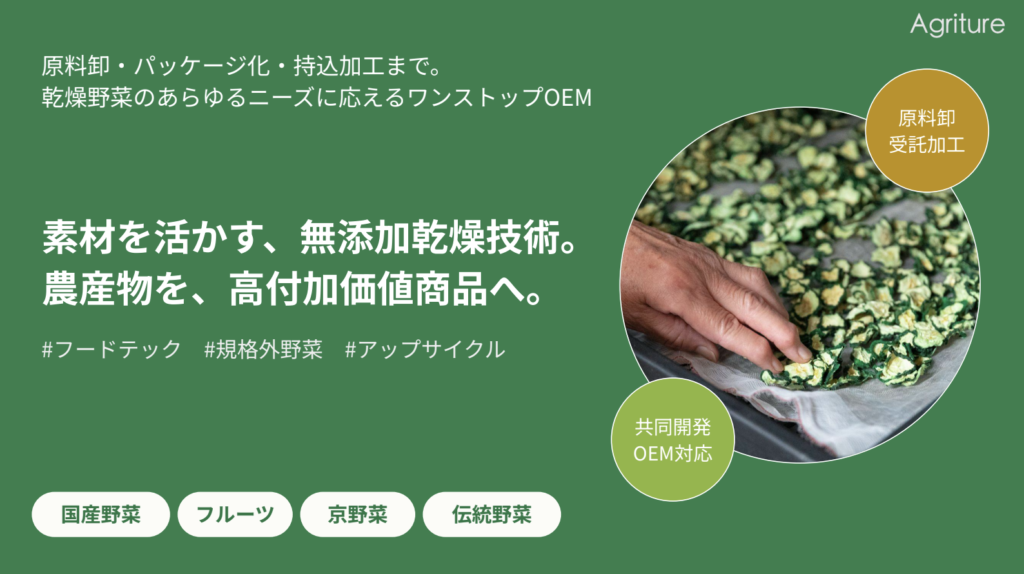
- OEM available from small lots of 10 kg
- Drying of brought-in raw materials also possible
- Support from processing to filling in one place
FOR BUSINESS
乾燥野菜を業務用でお探しですか
国産の野菜・果物を乾燥し、必要に応じて粉砕してお出ししています。扱っている品目は100種前後で、規格は 乾燥品の一覧・パウダーの一覧 に掲載しています。
少量でのご購入は、姉妹ブランドの通販サイト OYAOYA で承っています。
FAQ
Can fruit powder be used in place of fresh fruit?
Yes. Especially in sweets where you don't want to add moisture (fresh cream, dough, chocolate), it's a material easier to handle as a substitute than fresh fruit. It can't reproduce the pulpy texture of fresh fruit, but it can carry plenty of color and flavor.
Can it replace synthetic colorants?
It can be used as a replacement. However, since the amount is larger than with synthetic colorants, factor in the impact on texture and nutritional value at the design stage. If you want to claim "no colorants added" on the label, it's premised on using no synthetic colorants in any of the ingredients.
Which sweets is it easiest to use in?
Macarons, fresh cream, chocolate, and baked goods are the standards. It's especially effective in sweets where you don't want to add moisture. Just note that in candy and gummies, the texture breaks down easily unless you keep the formulation low.
Can it be combined with matcha powder?
Yes. Strawberry × matcha and yuzu × matcha are pairings used in East-meets-West sweets design. Since both are powders, the easy-to-handle procedure is to sift them together with powdered sugar or almond flour and knead them into the dough.
Can I consult about OEM?
We can accommodate this. Agriture handles OEM consultations for sweets and confectionery, centered on processing dried vegetables and fruits. Concrete adoption of fruit powder proceeds on a prototype basis according to the product concept. Food OEM no Madoguchi (Agriture) Please consult us.
Summary
Fruit powder is a versatile material usable in place of fresh fruit in confectionery, sweets, and drinks. By working backward from the application to the processing method (freeze-drying / spray drying / cryogenic grinding), the fruit's characteristics, and the formulation amount, it can also be used in additive-free sweets design and as a substitute for synthetic colorants and flavorings.
Related article: Commercial freeze-dried strawberries・Using vegetable powder in sweets・Vegetable powder, natural coloring, additive-free. For fruit-powder OEM inquiries, Food OEM no Madoguchi (Agriture).
Download the OEM contract processing materials
We will send the materials to your email address based on the information you provide.
If you are considering product development with off-spec or your own farm's vegetables:From planning to processing, materials, package printing and novelties, you can consult us through a single point of contact. → Learn more about one-stop product development
- Freeze-Dried Material Ranking | Popularity and How to Choose by Use
- What is freeze-dried? A gentle explanation of the drying technology spreading to miso soup, vegetables, and strawberries
Author of this article
Related articles
-
 Original coffee marketing strategy | Ways to grow sales
 -
 ベジタリアンとは?国の規格が分けている4つの区分と食べられないもの
 -
 長ねぎと白ねぎは同じもの?ねぎの種類と呼び名を国の資料で確かめる
 -
 柚子の種類は何種類あるのか、公の資料で名前が残る系統を数えた
 -
 柚子の皮の使い道は干すと広がる、果汁と種まで使い切る手順
 -
 ゆずの時期は年に二度、青ゆずは7月から黄ゆずは10月から
 -
 ゆずの産地は高知が半分を占め、二位は徳島から愛媛に変わった
 -
 Preventing Food OEM Failures: Common Failure Cases and Countermeasures for Success