
How to Request Tea OEM Manufacturing: A Complete Guide to the Industry's 5 Types and a Cost Breakdown

Summary of this article
A thorough explanation of how to commission tea OEM manufacturing. This is a practical guide for not failing on your first tea OEM order—covering the five-type industry classification (contract-only, own-brand-plus-contract, major subcontractor, regional cooperative, research-institute type), the five steps from request to delivery with a guide to timing, the cost breakdown (raw material, blending, processing, packaging, inspection), the difference between beverage OEM and tea-leaf OEM, the potential of vegetable tea OEM, how to choose an OEM manufacturer, cautions on using rankings, the 35 tea companies listed on Food OEM Madoguchi, and tips for success.
An original tea brand you want to launch. For you who hold such a wish, there is the option of tea OEM. OEM is an abbreviation for “Original Equipment Manufacturer,” a mechanism for commissioning another manufacturer to produce products of your own brand. In the tea industry, because you can entrust everything from raw-material procurement through manufacturing to packaging in one stop, even companies without manufacturing equipment can roll out original tea products.
The tea market is a mature category subdivided by form and appeal axis—green tea, black tea, matcha, herbal tea, foods with function claims, PET-bottle beverages, and so on. Since the start of the foods-with-function-claims system, teas appealing to functional components such as tea catechins and GABA have increased, widening the room to design differentiated products. Tea OEM can be advanced in one stop from small-lot prototyping to mass production to sales channels, so it is a mechanism that makes it easy to lower the hurdle for new entry.
In this article, the flow from request to delivery, cost benchmarks, manufacturer industry types, how to choose, and points for success of tea OEM we organize it so even beginners can understand. We have also included a ranking of domestic tea OEM companies (listed on Food OEM Madoguchi) at the end.
What you'll learn in this article
- The 5 steps from tea OEM request to delivery and a guide to timing
- The 5 industry types of tea OEM manufacturers and their strengths and weaknesses
- The benchmark cost breakdown (raw material, blending, processing, packaging, inspection)
- The difference between beverage OEM and tea-leaf OEM (RTD/tea bag/leaf/PET bottle)
- A list of 35 tea OEM companies listed on Food OEM Madoguchi

We have materials available to help you understand dried processing OEM
Agriture OEM, flexibly handling everything from small lots to large lots
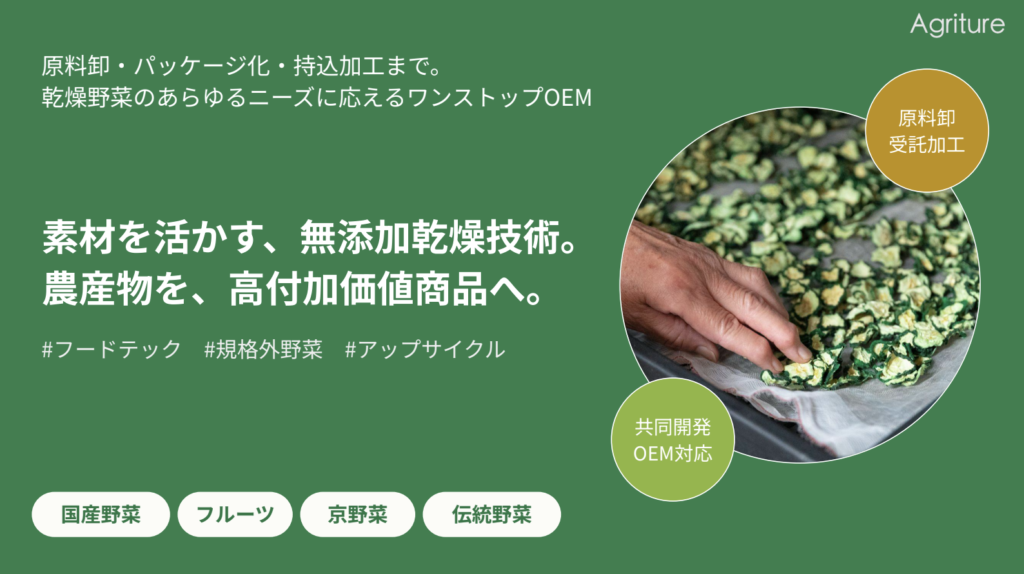
- OEM available from small lots of 10 kg
- Drying of brought-in raw materials also possible
- Support from processing to filling in one place
TOC
Merits and demerits of tea OEM
The biggest merit: you can start without manufacturing equipment
The biggest advantage of tea OEM is you can develop products without having a factory or production line of your own. Because you can greatly hold down the initial investment, it is easy even for startups and small-to-medium enterprises to enter. The point that you can receive blend design by experts such as Japanese tea instructors is also not to be missed.
Furthermore, tea bags, leaf, powdered tea, matcha, gift boxes, PET-bottle beverages and other diverse forms can be accommodated. Flexible product-making according to use is possible—for tourist souvenirs, hotel guest rooms, café menus, and so on. Manufacturers that handle small lots are also increasing, and there are cases where you can produce from around 1,000 sachets, making it suitable for test sales and novelty production as well.
Demerits to watch out for and countermeasures
On the other hand, because manufacturing and quality depend on the contractor, clear concept design is essential. To prevent product overlap with other companies, unique objective-setting and packaging strategy become necessary. Even with small-lot support, a minimum order quantity and initial cost arise, and prototype costs can run from about 5,000 to 50,000 yen.
Adjusting taste and aroma requires a number of prototype rounds, generating time and back-and-forth. That’s exactly why firmly firming up the product concept at the first stage and close communication with the OEM manufacturer become the keys to success.
The 5-type classification of the tea OEM industry
Tea OEM manufacturers split into five types by business form. Which type you choose greatly changes proposal capability, price range, small-lot support, and area of strength. Discern the type that suits your concept.
| Type | Features | Suitable orderer |
|---|---|---|
| Contract-only type | OEM-manufacturing specialist, no own brand | Companies that want to make faithfully to spec |
| Own-brand-and-OEM type | Also operates its own tea brand | Emphasizes proposal capability and market insight |
| Major-subcontractor type | Mainly OEM for major beverage manufacturers | Emphasizes quality control and certification (medium-to-large lots) |
| Regional-cooperative type | Tea-growing-region cooperative / joint manufacturing | Growing-region appeal / regional brand |
| Lab / venture type | Functionality and new technology at the core | Function claims / differentiated products |
FOR BUSINESS
乾燥野菜のOEM・受託加工を承ります
国産の野菜・果物の乾燥、100メッシュ相当までの粉砕、10g以上の小袋充填までをお受けしています。小ロットの試作から量産までご相談ください。寄せられた相談の実例は OEM・卸のご相談 に掲載しています。
乾燥品の賞味期限は、出荷日から6ヶ月程度を目安にご案内しています。
The 5 steps from tea OEM request to delivery
| Step | Details |
|---|---|
| Inquiry and hearing | Share the objective, target, budget, and package image (1–2 weeks) |
| Concept design and formulation proposal | Decide raw-material selection, blend ratio, and processing method (steaming/roasting/fermentation) (2–4 weeks) |
| Prototyping and adjustment | Nail down taste, aroma, color, and mouthfeel over 3–5 prototype rounds (4–8 weeks) |
| Quote and contract | Agree on mass-production specs, lot, unit price, and delivery date (1–2 weeks) |
| Manufacturing, quality control, delivery | Lot quality check, packaging, labeling, and delivery to the specified location (4–8 weeks) |
The whole thing is a guide of 3–6 months. For notification of foods with function claims and special forms such as matcha and PET-bottle beverages, allow several more months.
Tea OEM cost benchmarks and breakdown
Tea OEM costs are composed of five parts: raw material, blending, processing, packaging, inspection. When taking quotes, taking them in a format that shows the breakdown of each part makes comparison between manufacturers and budget adjustment more precise.
| Item | Benchmark guide | Variable factors |
|---|---|---|
| Prototype cost | 5,000–50,000 yen | Number of prototype rounds, how special the material is |
| Manufacturing unit price | 10–100 yen / sachet | Raw-material grade, form |
| Minimum lot | 1,000–5,000 sachets | Manufacturer, form, matcha/PET bottle, etc. |
| Package design | 0 to tens of thousands of yen | Supplied material, custom label |
| Inspection cost | Several thousand to tens of thousands of yen | Certification acquisition, function-claim notification |
The difference between beverage OEM and tea-leaf OEM
Tea OEM greatly differs in equipment, lot, and unit price between “tea-leaf OEM (tea bags, leaf, matcha powder)” and “beverage OEM (PET bottle, can, carton RTD)”. Even for the same “tea,” the business scale changes with how you choose the form.
| Aspect | Tea-leaf OEM | Beverage OEM (RTD/PET bottle) |
|---|---|---|
| Form | Tea bags, leaf, matcha powder, powder | PET bottle, can, carton |
| Minimum lot | 1,000–5,000 sachets | 10,000–50,000 units or more |
| Unit price | 10–100 yen / sachet | 50–150 yen / unit + container cost |
| Best-before date | 1–3 years | 6 months to 1 year |
| Logistics | Room temperature / lightweight | Room temperature/refrigerated / heavy item |
| Suited sales channel | Gift / EC / souvenir | Vending machine / convenience store / supermarket |
We have materials available to help you understand dried processing OEM
Agriture OEM, flexibly handling everything from small lots to large lots
- OEM available from small lots of 10 kg
- Drying of brought-in raw materials also possible
- Support from processing to filling in one place
Agriture’s vegetable tea OEM case study
As an option for differentiating tea OEM, there is a design that combines vegetable materials with tea leaves. At Agriture, we accept contract work that blends dried vegetables and vegetable powder processed by low-temperature drying at 45°C with tea leaves. Vegetable tea OEM we accept. Spinach,・kale,By combining materials such as carrot, beet, and Kujo green onion・burdock with tea leaves in tea-bag, leaf, or powder form, you can create an appeal axis different from ordinary green tea, black tea, or herbal tea.
In developing vegetable tea OEM, the flavor, color, mouthfeel, and dissolvability of the vegetable material are verified while looking at compatibility with the tea leaves. At the prototype stage, it’s required to specify the supply, processing, and blend specifications of the vegetable material and adjust thoroughly. For details, see How to start vegetable tea OEM development or Agriture's wholesale / OEM information.
How to choose an OEM manufacturer
Confirm the breadth of supported items and specialization
Manufacturers that can handle a wide range of items—Japanese tea, black tea, herbal tea, health tea, matcha, wild-herb tea, PET-bottle beverages, and so on—a manufacturer with a broad range of supported items tends to also have high proposal capability. Especially if you’re considering a new genre such as vegetable tea, whether vegetable-material support is possible is an important checkpoint. A manufacturer with tea-evaluation-technique dan-holders on staff also has a solid reputation for flavor design.
Small-lot support and prototype-proposal capability
For a first tea OEM, whether you can start from a small lot is a big point. Choosing a manufacturer that can handle from around 1,000 sachets lets you do test sales while holding down risk. Also, prototype speed, the number of taste revisions, and the flexibility of proposals are elements to compare. Sparing neither time nor budget on prototyping raises the final product quality.
Confirming the quality-control system and certification
FSSC 22000 and Organic JAS certification whether it is manufactured at a factory that has acquired these is proof of safety and reliability. If you have overseas export in view, also confirm certification support such as HALAL/KOSHER. A manufacturer with a well-organized quality-control system also has thorough per-lot checks, so stable quality can be expected.
Branding support and EC-expansion support
Whether proposals suited to your company’s branding are possible, and the capability to handle package design and promotional materials, are also essential. A manufacturer that allows you to bring in your own raw materials and packaging lets you make highly distinctive products. If they have the flexibility to also support EC expansion and overseas export, future business expansion is smooth too.
How to read tea OEM rankings
Cautions on using rankings
Many “tea OEM ranking” sites are in order of paid placement. Individually confirm whether they match your product category, lot, and certification requirements.
If you search “tea OEM ranking” on the web, multiple comparison articles appear, but inquiring with the top-ranked manufacturer as-is is dangerous. Always confirm whether the ranking’s basis is “breadth of supported items,” “minimum lot,” or “certification,”and check it against your own requirements.
More reliable than rankings is the listing information of industry-association member lists and specialized platforms like Food OEM Madoguchi. Listed companies have in many cases undergone screening, and their track record and scope of support are organized, making them suitable for comparison.
Points for tea OEM success
The key to differentiation is material × packaging × story
To succeed at tea OEM, a clear differentiation strategy is needed. In material selection, use of domestic tea leaves, organic cultivation, and off-spec vegetables and other SDGs-oriented proposals are also effective. For packaging, by dividing the form according to the sales channel—kraft paper, zipper bags, gift boxes, and so on—the appeal to the target segment increases.
And above all, what’s important is a sense of story. By putting forward the story of “one-stop from raw material through planning to manufacturing” and clarifying the brand worldview, you can deliver it to consumers not as a mere product but as “content that can be talked about.”
Thorough adjustment at the prototype stage
Sparing neither time nor budget on prototyping decides the final product quality. Taste, aroma, color, mouthfeel, dissolvability, and shelf life are also important elements. Especially for vegetable tea, you need to verify many times how the flavor of the vegetable material harmonizes with the tea leaves, and find the optimal blend ratio.
Sales strategy and KPI design
Once the product is complete, Sales strategy and KPI design is the next step. Set EC-site inflow, product-page PV, number of inquiries, number of OEM orders, repeat rate, and so on, and turn the PDCA cycle. As an SEO measure, content dispatch conscious of keywords such as “domestic vegetable blend tea” and “dried-vegetable tea” is also effective.
Representative tea OEM companies
| Company name | Area of strength |
|---|---|
| Agriture Inc. | Vegetable tea / vegetable-powder blends |
| Encha Inc. | Tea planning, development, and sales |
| Be in Museum Co., Ltd. | Tea, herbs, health teas |
| Nitto Foods Co., Ltd. | Powdered tea, matcha processing |
| Foodie Connect Inc. | Beverage and tea OEM |
| Kurohime Wakan-yaku Research Institute Inc. | Health teas, herbal teas |
You can find all tea OEM companies from the Food OEM Portal "Coffee & Tea" list you can confirm from here. 35 companies—from green tea, black tea, matcha, and herbal tea to the beverage type—are registered, and you can compare according to your product category, minimum lot, and certification requirements.
FOR BUSINESS
乾燥野菜のOEM・受託加工を承ります
国産の野菜・果物の乾燥、100メッシュ相当までの粉砕、10g以上の小袋充填までをお受けしています。小ロットの試作から量産までご相談ください。寄せられた相談の実例は OEM・卸のご相談 に掲載しています。
乾燥品の賞味期限は、出荷日から6ヶ月程度を目安にご案内しています。
Summary of tea OEM success
Tea OEM is a product-development method that holds down risk, letting you launch an original brand without owning manufacturing equipment. By making use of specialist manufacturers’ know-how—from raw-material selection through blend design, packaging, and quality control—you can efficiently bring high-quality products to market.
As an option for differentiation, vegetable tea OEM that blends vegetable materials into tea leaves is promising. At Agriture, we support blend design that makes use of domestic vegetables and off-spec vegetables, enabling content appeal that also fits the SDGs context well.
The keys to success are clear concept design and a partnership with a trustworthy OEM manufacturer. Choose a contractor that suits your company from the 5 industry types, grasp the cost breakdown precisely, and adjust thoroughly at the prototype stage—do this, and the probability of success rises even for a first OEM. Realize your ideal tea brand while minimizing risk with a flexible approach: start from a small lot, run test sales, and expand toward mass production while watching the market response.
Download the OEM contract processing materials
We will send the materials to your email address based on the information you provide.
Recommended reading
If you are considering product development with off-spec or your own farm's vegetables:From planning to processing, materials, package printing and novelties, you can consult us through a single point of contact. → Learn more about one-stop product development
- Tea OEM Price Ranges: 5 Ways to Keep Costs Down and 7 Points for Quotes
- Tea Gift OEM: 10 Points for Making Products That Get Chosen and an Ordering Guide
Author of this article
Related articles
-
 Original coffee marketing strategy | Ways to grow sales
 -
 ベジタリアンとは?国の規格が分けている4つの区分と食べられないもの
 -
 長ねぎと白ねぎは同じもの?ねぎの種類と呼び名を国の資料で確かめる
 -
 柚子の種類は何種類あるのか、公の資料で名前が残る系統を数えた
 -
 ゆずの時期は年に二度、青ゆずは7月から黄ゆずは10月から
 -
 ゆずの産地は高知が半分を占め、二位は徳島から愛媛に変わった
 -
 Preventing Food OEM Failures: Common Failure Cases and Countermeasures for Success
 -
 How to find a food OEM | How to efficiently find the best manufacturing partner