
Tea Gift OEM: 10 Points for Making Products That Get Chosen and an Ordering Guide

Summary of this article
Tea gift OEM is a method that lets you plan and sell original tea gift products without owning your own manufacturing facilities. This article organizes everything so that even beginners can design products that get chosen—industry basics, a design map by price range and occasion, the difference in planning axes between gift items and novelties, 10 points for making products that get chosen, differentiation strategies (functionality, personalized customization, RTD rollout), and 5 pitfalls easily overlooked in OEM ordering (lots, box costs, noshi wrapping, delivery, best-before dates).
Tea Tea gift OEM is a method that lets you plan and sell original tea gift products without owning your own manufacturing facilities. You can design products to match the gifting occasion and price range—midyear and year-end gifts, thank-you gifts, corporate novelties, and more—and roll out a wide lineup from small quantities: green tea, black tea, tea bags, premium blends, even vegetable tea.
This article organizes everything about tea gift OEM, from the basics, 10 planning points, differentiation strategies, and pitfalls when ordering, including a non-manufacturer perspective. From a premium line using carefully selected ingredients to novelties for corporations, you'll understand how to choose what fits your brand.
What you'll learn in this article
- The basic flow of tea gift OEM (concept → prototype → mass production)
- A gift design map by price range and occasion
- The difference in planning axes between gift items and novelties
- 10 points for making products (raw materials, blend, packaging, quality)
- 5 pitfalls easily overlooked in OEM ordering

We have materials available to help you understand dried processing OEM
Agriture OEM, flexibly handling everything from small lots to large lots
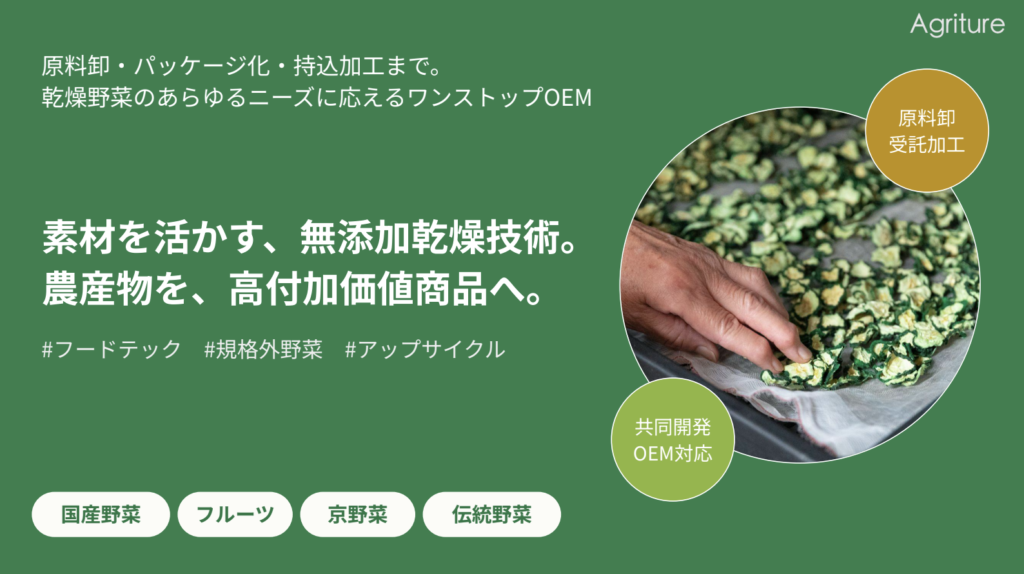
- OEM available from small lots of 10 kg
- Drying of brought-in raw materials also possible
- Support from processing to filling in one place
TOC
Basic knowledge of tea gift OEM
What OEM is: benefits and risks
OEM is a form in which you outsource the manufacturing of products sold under your own brand to another manufacturer. Without holding tea-leaf cultivation through production lines in-house, you can roll out original products by leveraging a specialist manufacturer's technology and know-how.
| Aspect | Benefits | Risks / cautions |
|---|---|---|
| Initial investment | No equipment or sourcing routes needed | Constraints of lots and minimum order amounts |
| Speed | Quick market launch with existing resources | Takes several months depending on prototype back-and-forth |
| Quality | Leverage the specialist manufacturer's know-how | Dependence on the contractor; disappointing if specs aren't nailed down |
| Originality | Can differentiate through blend and packaging | Competition with other companies' similar products |
The typical flow of tea OEM
| Step | Details |
|---|---|
| Concept design | Decide the target, use (gift/novelty), price range, and packaging image |
| Specification meeting | Nail down raw material selection, blend ratio, tea bag/leaf, and packaging form |
| Prototyping and adjustment | Repeat samples, adjusting taste, aroma, color, and packaging |
| Quote and contract | Agree on mass-production specs, minimum lot, unit price, and lead time |
| Manufacturing and delivery | Manufacturing, quality control, packaging, shipping, and launch of sales |
Overall it usually takes 3 to 6 months. When using vegetable materials, processes for powdering and flavor verification are added, so it's safest to allow ample time.
Design by price range and occasion
For tea gifts, the product type that gets chosen changes with "to whom, when, and at what price you give it."As a starting point for OEM planning, clarifying the zone you're targeting with a table of price ranges and occasions speeds up decisions on raw materials, packaging, and tea-bag form.
| Price range | Typical occasion | How to choose the form |
|---|---|---|
| Up to ¥1,000 | Small gifts, novelties, promotions | 2–5 tea bags / simple pouch |
| ¥1,000–3,000 | Thank-you gifts, presents, casual gifting | 10 tea bags / tin or small box |
| ¥3,000–5,000 | Midyear/year-end gifts, corporate gifts | Leaf + tea bag set / gift box |
| ¥5,000–10,000 | Premium gifts, business-partner gifts | Premium tea leaves, wooden box, noshi support |
| ¥10,000 and up | Formal gifts, special commemorations | Carefully selected tea leaves, paulownia box, with carrying handle |
FOR BUSINESS
乾燥野菜のOEM・受託加工を承ります
国産の野菜・果物の乾燥、100メッシュ相当までの粉砕、10g以上の小袋充填までをお受けしています。小ロットの試作から量産までご相談ください。寄せられた相談の実例は OEM・卸のご相談 に掲載しています。
乾燥品の賞味期限は、出荷日から6ヶ月程度を目安にご案内しています。
The difference between gifts and novelties
In tea gift OEM, the design axis differs fundamentally between gift items and novelties. If you order while confusing the two, cost, quality, and appeal all tend to end up half-baked.
| Aspect | Gift items | Novelties |
|---|---|---|
| Main axis | Quality of contents, sense of premium | Ease of distribution, impression |
| Lot | Medium to small lots | Large lots, low unit price |
| Packaging | Gift box, noshi, carrying handle | Mini envelope, individual pouch |
| Raw materials | Emphasis on origin, brand, rarity | Emphasis on cost, standard blend |
| Ordering timing | 2–3 months before midyear/year-end gifts | 1–2 months before an event/trade show |
Tea gift OEM: 10 points
Point 1: Build the foundation of quality through raw material selection
The tea variety, growing region, cultivation and plucking time, and processing method (steaming, roasting, fermentation) directly determine tea's taste, aroma, and quality. Quality can be divided into three: "raw material quality," "processing quality," and "storage quality."Raw material quality is the quality when cultivating the tea leaves, processing quality is the handling and finishing before and after tea manufacturing, and storage quality refers to storage conditions and management during transport. Not compromising at each stage becomes the foundation of a product that gets chosen.
Point 2: Bring out individuality through blend and processing design
Green tea, oolong tea, and black tea differ greatly in their processing steps. By adjusting steps such as the degree of oxidation, rolling, and drying, you can create a unique flavor. Original blends achieve an aroma and taste found nowhere else by combining tea leaves of multiple varieties. It's important to confirm whether the OEM contractor can handle blend and processing design as well, and to adjust at the prototype stage until you're satisfied.
Point 3: Differentiate with vegetable materials
Vegetables or vegetable-derived materials (dried vegetables, vegetable powder, vegetable extract) added to blended tea can strongly appeal to the health-conscious and function-oriented market. Spinach,・kale,・carrots・beets,and the like, dried and powdered and blended with tea leaves, complete a "vegetable + tea leaf" hybrid product. The key to success is verifying the flavor, color, mouthfeel, and solubility of the vegetable material at the prototype stage and confirming its compatibility with the tea leaves.
Point 4: Raise appeal through packaging and form
Tea bags, leaf, gift boxes, outer pouches—specifications suited to your sales channel and target are needed. Because many popular products exist in the market, ingenuity and care that make people want to pick it up are required. Consider designs and materials (kraft paper, zipper bags, gift boxes) that can convey the vegetable-derived material, and it's also effective to separate forms for everyday use and for gifting.
Point 5: Win trust through quality control and certification
When looking ahead to safety (HACCP, FSSC22000, Organic JAS, HALAL/KOSHER, etc.) and export support, confirming the OEM contractor's setup is essential. Added value such as using organically grown tea leaves or obtaining Organic JAS certification is supported by consumers amid rising health and beauty needs. Quality certification is an important element that raises a brand's credibility.
Point 6: Grasp minimum order quantity and lead time
OEM manufacturing requires a certain volume and lead time. If you want to roll out from a small scale, it's essential to confirm whether prototype and small-quantity support is possible. Because beverage OEM requires making large quantities at once compared with other foods, small-lot production is said to be difficult. By keeping this in mind from the planning stage and choosing a manufacturer capable of small-lot support, you can achieve a low-risk market launch.
Point 7: Clarify the product concept
With the "vegetable × tea leaf" combination as the axis, clarify your target segment. For desk-bound business people,a refreshing blend with an invigorating effect; for families, a sweet vegetable tea easy even for children to drink; for gifts, combining premium packaging with rare tea leaves—design tailored to the concept is required.
Point 8: OEM contractor selection determines 80% of success
Compare domestic and overseas tea OEM manufacturers and confirm whether they can handle vegetable materials, small-quantity and custom blends, and whether their quality control and certification systems are in place. Domestically there are manufacturers with a track record of original blends, small-lot support, and design support. Whether the OEM contractor can handle everything "one-stop, from raw materials to planning to manufacturing" determines the project's success or failure.
Point 9: Raise completeness through prototyping and package rollout
At the prototype stage, verify the vegetable material's flavor, color, mouthfeel, and solubility (especially for powder types), and confirm compatibility with the tea leaves. It's important to adjust the blend ratio and processing so the vegetable powder doesn't spoil the tea's flavor. By adopting packaging designs that convey the vegetable-derived material and separating forms by sales channel, you can maximize appeal.
Point 10: Devise a sales and marketing strategy
Put forward the story of "one-stop, from raw materials to planning to manufacturing," and make use of SEO and e-commerce strategies. By keeping keywords such as "domestic vegetable blend tea," "tea using dried vegetables," and "carefully selected vegetable tea"in mind and using blogs, product pages, and social media, you can increase search-driven traffic. In KPI design, set metrics such as e-commerce site traffic, product-page PV, number of inquiries, number of OEM orders, and repeat rate, and turning the PDCA cycle is the path to success.
We have materials available to help you understand dried processing OEM
Agriture OEM, flexibly handling everything from small lots to large lots
- OEM available from small lots of 10 kg
- Drying of brought-in raw materials also possible
- Support from processing to filling in one place
Differentiation strategies for tea gift OEM
Rollout into functional vegetable tea
"Functional vegetable tea" that appeals to functional materials (polyphenols, β-carotene, and the like contained in leafy vegetables) is seeing expanding demand along with rising health consciousness. Considering registration as a food with functional claims enables further differentiation. As consumer health awareness rises, appeal grounded in scientific evidence becomes a powerful weapon that raises brand value.
Rollout into personalized and customized gifts
A strong point in tea gift differentiation is "personalization and customization support". Wedding return gifts, corporate anniversary items, corporate gifts to business partners—packaging bearing the recipient's name, date, or message creates a value not found in mass-produced goods: "a single item made for this person." Some OEM contractors handle individual printing of package labels, outer boxes, and noshi from small lots of 50–100. The more clearly the gift recipient is decided—weddings, thank-you gifts, corporate anniversaries—the higher the unit price of customized gifts, making it an area where OEM profitability tends to rise.
| Customization element | Main use | Minimum lot guideline |
|---|---|---|
| Personalized label | Return gifts, commemorative items | 30–100 units |
| Custom-ordered outer box | Corporate anniversaries, brand collaborations | 100–500 units |
| Noshi / tanzaku printing | Midyear/year-end gifts, thank-you gifts | Small lots possible |
| Message card | Weddings, opening celebrations | Small lots possible |
Rollout into RTD (can / PET bottle) type
Some OEM manufacturers handle multiple forms—RTD (Ready to Drink), tea bags, leaf. Can and PET-bottle vegetable teas are suited to sales at convenience stores and supermarkets and can reach a broader consumer base. Products that combine convenience with health answer the needs of busy modern people.
5 pitfalls of OEM ordering
5 items to confirm before ordering
Lots, box costs, noshi support, delivery form, and best-before date design. If these aren't nailed down in advance, cost gaps tend to arise after mass production.
| Pitfall | Problem that occurs | Advance measure |
|---|---|---|
| Exceeding the minimum lot | The first order becomes excess inventory | Set it in line with the annual sales plan |
| Box costs / gift boxes billed separately | A gap between the quote and the final price | Get a full quote for contents plus outer packaging |
| No support for noshi / tanzaku | Can't be shipped for gift use | Confirm options for noshi/tanzaku/wrapping paper |
| Mistaken assumption about delivery form | Cost differences for refrigerated/room-temperature and direct/via-warehouse | Confirm the unit price of small-lot delivery in advance |
| Short best-before date | Doesn't match the sales period for midyear/year-end gifts | Work backward from manufacturing date and best-before date |
FOR BUSINESS
乾燥野菜のOEM・受託加工を承ります
国産の野菜・果物の乾燥、100メッシュ相当までの粉砕、10g以上の小袋充填までをお受けしています。小ロットの試作から量産までご相談ください。寄せられた相談の実例は OEM・卸のご相談 に掲載しています。
乾燥品の賞味期限は、出荷日から6ヶ月程度を目安にご案内しています。
Summary of tea gift OEM success
Tea gift OEM is an attractive method that lets you launch original products to market without owning manufacturing facilities. The key to success lies in designing raw material selection, blend design, package specifications, quality certification, and sales strategy in an integrated way. In particular, differentiation using vegetable materials can strongly appeal to the health-conscious and function-oriented market, and synergy with existing businesses can also be expected.
Close communication with the OEM contractor, thorough verification at the prototype stage, and a clear marketing strategy produce a product that gets chosen. Looking ahead, by also keeping in view rollout into functional vegetable tea, vegetable tea for pets, and RTD types,further market expansion is possible.
If you keep in mind the table of price ranges and occasions, the difference in planning axes between gift items and novelties, and the 5 pitfalls when ordering, the probability of success rises greatly even on a first OEM. Why not deliver your brand story to consumers in the form of tea?
Download the OEM contract processing materials
We will send the materials to your email address based on the information you provide.
Recommended reading
How to request tea OEM manufacturing
If you are considering product development with off-spec or your own farm's vegetables:From planning to processing, materials, package printing and novelties, you can consult us through a single point of contact. → Learn more about one-stop product development
- How to Request Tea OEM Manufacturing: A Complete Guide to the Industry's 5 Types and a Cost Breakdown
- How to make an herbal tea blend | Formulation design balanced with bitterness, tartness, and umami
Author of this article
Related articles
-
 Original coffee marketing strategy | Ways to grow sales
 -
 ベジタリアンとは?国の規格が分けている4つの区分と食べられないもの
 -
 長ねぎと白ねぎは同じもの?ねぎの種類と呼び名を国の資料で確かめる
 -
 柚子の種類は何種類あるのか、公の資料で名前が残る系統を数えた
 -
 ゆずの時期は年に二度、青ゆずは7月から黄ゆずは10月から
 -
 ゆずの産地は高知が半分を占め、二位は徳島から愛媛に変わった
 -
 Preventing Food OEM Failures: Common Failure Cases and Countermeasures for Success
 -
 How to find a food OEM | How to efficiently find the best manufacturing partner