
How many minutes to rehydrate kikurage? 5–6 hours in water or 15 minutes in warm water is enough

Summary of this article
乾燥きくらげの戻し時間は冷水で5〜6時間、ぬるま湯なら15〜30分、熱湯を注ぐ方法で20〜25分が目安です。戻すと7〜10倍に膨らみます。分数を示した公的資料は見当たらないため産地の案内が重なる範囲で示し、加熱の要否は厚生労働省の食中毒予防の資料、常温で長時間置かないことは米国FDAと香港の食品安全当局の公表資料で確かめました。
Have you ever bought dried kikurage and then, right before cooking, stopped short wondering, "how many minutes does this take to rehydrate?" It is not unusual for the back of the bag to say only "rehydrate in water before use," with no number of minutes written.
To put the conclusion first, 5 to 6 hours in cold water, 15 to 30 minutes in lukewarm water around 40°C, 20 to 25 minutes if pouring on boiling water is the answer. In this article we first lay out a list of times, and then verify "why rehydrate in the refrigerator" and "whether heating is needed after rehydrating," going back to materials published by the Ministry of Health, Labour and Welfare and overseas food authorities.
From the standpoint of hot-air drying domestically grown vegetables and mushrooms and supplying them for commercial use, we have also woven in things we have come to understand by measuring on-site. It is written so that you can take home the figures and the basis together.
TOC
How many minutes does dried kikurage take to rehydrate? For those who want to know just the time first
The rehydration time for kikurage is almost entirely determined by "what you rehydrate it in." The higher the water temperature the faster, the lower the slower. And the faster you rehydrate it, the softer the texture leans. First, so you can work backward from the time you have on hand, here are the figures by rehydration method.
Rehydration time changes this much with water, lukewarm water, and boiling water
Even with the same dried kikurage, cold water and boiling water differ by 20 times in the time required. The table below sums up the range where the rehydration guidance published by growing-region producers and specialty shops overlaps with the times we actually measured at our company.
| Rehydration method | Approximate time | Finish | Well-suited dishes |
|---|---|---|---|
| Cold water (refrigerator) | 5–6 hours | The thickness returns Strongly crunchy | Dressed dishes Stir-fry |
| Cold water (from the night before) | 8 hours to overnight | Close to fresh Plump | Any dish |
| Lukewarm water, around 40°C | 15 to 30 minutes | Somewhat Somewhat soft | Soups Stir-fry |
| Pour in boiling water | 20 to 25 minutes Sliced is around 15 minutes | Soft 早い | Soup Ankake |
| Microwave | 3 to 5 minutes + letting the heat subside | Uneven Easy to develop | A small amount When using right away |
What we want you to note in this table is that the difference between boiling water and lukewarm water is small. Pouring on boiling water does not make it usable instantly; you wait around 20 minutes. Dried kikurage absorbs water slowly from the surface, so even raising the water temperature does not make it "done in a few minutes."
Choose by how many minutes you have left now
Working backward after deciding the menu keeps you from getting stuck. Depending on how much time is left until dinner, the method you choose is narrowed down to pretty much one.
- Remembered it the night before: soak it in cold water and put it in the refrigerator. It reaches its best state the next day
- Decided as of the morning: cold water + refrigerator for 5 to 6 hours, usable in the evening
- 30 minutes left: lukewarm water around 40°C. In 15 minutes it reaches a thickness you can move on to cooking
- 25 minutes left: pour on boiling water from a pot. Sliced type is enough in around 15 minutes
- 10 minutes left: microwave. But it comes out uneven, so only for small amounts
Pre-sliced dried kikurage rehydrates one step faster than whole. In households where there are many days without time to spare, keeping the sliced type on hand from the start is the more realistic approach.
The time needed changes with black, white, and sliced
Even when we say dried kikurage in one word, several kinds line the shelves. The times in the table are all based on the black whole kind. If the shape or kind differs, the time shifts accordingly.
- Black kikurage, whole: the thickest, and the times in the table apply as they are
- Sliced: water enters from the cut surface, so it rehydrates in 60 to 70% of the time for whole
- White kikurage: a flower-like, divided shape, rehydrates faster than black and crumbles easily
- Thick-type that sells on its thickness: figure on adding 10 to 20% to the times in the table
White kikurage is a different thing from black in both texture and use, and is used in soups and desserts. It crumbles to pieces if over-rehydrated, so it is better not to soak it long with the same feel as black. What is used for everyday stir-fries and dressed dishes is mostly the black kind.
The call of "rehydrated" is decided by feel rather than time
The time is a guide, and the actual call is made with your fingers. Dried kikurage rehydrates at the thickest central part last, so that is what you check.
- No hard core remains when you pinch it
- It spreads out fluttering like an ear, and the shrunken wrinkles have smoothed out
- The edges do not snap crisply even when lifted
- When pressed with a finger it has elasticity and pushes back
If you stir-fry it with the core still in, that part alone keeps a hardness that hits the teeth. If you bought a thick one, looking at it with the intention of adding 10 to 20% to the times in the table keeps you from failing.
The basic procedure for rehydrating slowly in cold water
When you have time, cold water is best. Both growing-region producers and specialty shops unanimously cite cold water as the basis. This is the method where the thickness returns most easily and the crunchy bite distinctive of dried kikurage comes out most.
Prepare 60 times the water to the dried amount
What you often see in specialty shops' guidance is "300 ml of water for 5 g of dried kikurage"the ratio. By weight that is 60 times. It feels like too much, but because kikurage swells greatly with the water it absorbs, unless you put in about this much, it ends up poking out above the water partway through.
- Choose a container with a depth at least 3 times the rehydrated volume
- A lidded storage container is easier to handle than a bowl
- Use the water cold. If lukewarm, rehydration speeds up and the texture changes
Why you rehydrate in the refrigerator

With a rehydration method that takes a long time, the place you put it becomes an issue before the flavor does. The Ministry of Health, Labour and Welfare cites, as a guideline for preventing food poisoning at home, "the refrigerator should be 10°C or below"and alongside it writes, "food before cooking and food after cooking must not be left at room temperature for long." The length of 5 to 6 hours is a time that falls under this "left for long."
That is why cold-water rehydration is done inside the refrigerator. Leaving a bowl beside the kitchen sink for half a day is the form most to be avoided. The details of the reason are dealt with again in the section on leaving it at room temperature.
When you put it in the refrigerator, cover it with a lid or plastic wrap. The inside of the fridge is drier than you'd think, so if left open the water level drops and the part sticking out on top does not fully rehydrate. With a lid you can also prevent odor transfer. Specialty shops' guidance, too, is written with the procedure of covering with wrap or a lid and putting it in the refrigerator.
A small trick to submerge the whole thing in water
Dried kikurage is light, so left as is it floats and the top half comes out of the water. Only the part that comes out fails to rehydrate, and hard spots remain. There are several ways to submerge it.
- Turn a small plate upside down and use it as a drop lid
- Lay a paper towel over the water surface and let it absorb water
- Close the lid of the storage container and shake it once partway through to circulate the water
- When the amount is large, rehydrate in two batches
What happens when it exceeds 6 hours
It is not the case that the longer you soak it the better. Kikurage that has absorbed too much water loses that crunch, and comes to feel watery when bitten. Recipe sites caution that "soaking for more than 6 hours absorbs too much water and spoils the texture."
On the other hand, there are producers who recommend "from the night before, overnight." It seems contradictory, but the texture being aimed for is simply different. If you want to maximize the crunch, 5 to 6 hours; if you want to bring out a plumpness close to fresh kikurage, overnight. Either way, inside the refrigerator is common to both.
Kikurage that has absorbed too much shows it when you stir-fry it. The moment you put it in the frying pan water comes out, the other ingredients end up like a braise, and the oil does not coat. The reason the finish turns hazy with the same ingredients is usually over-rehydration. In that case, wringing out the water firmly before adding it recovers it somewhat.
When in a hurry, you can rehydrate it in 15 to 25 minutes
The realistic choice on a day you forgot to rehydrate it is lukewarm water. The mapo tofu recipe using kikurage distributed by Nakano Ward, Tokyo, also starts its preparation from the single line "rehydrate the kikurage in lukewarm water." As a household routine, this is the least strained method.
15 to 30 minutes in lukewarm water, 20 to 25 minutes with boiling water, a few minutes in the microwave. These three are the options when in a hurry. All come out one step softer in texture than cold-water rehydration, but if you are moving on to cooked dishes, almost no difference remains. Let's look at them in order.
Make around 40°C with 1 part boiling water to 2 parts water
There is no need even to get out a thermometer. Mix 1 part boiled water with 2 parts water and it settles at roughly around 40°C. In specialty shops' guidance you also see ways of putting it like 36 to 38°C or 30°C to body temperature, but all are the band where, putting a finger in, you feel a "lukewarm bath."
- Mix 1 part hot water to 2 parts water. With kettle hot water, 1 tablespoon to 2 tablespoons of water
- Pour until there is enough to fully submerge the kikurage
- Check once at 15 minutes, and if a core remains, another 10 minutes
- Once rehydrated, lift it into a colander and drain the water
How the texture changes when rehydrated in lukewarm water
Kikurage rehydrated in lukewarm water shows the difference when lined up next to one rehydrated in cold water. The thickness is a little lacking, and the rebound when bitten is weak. It is a difference small enough that you won't notice once it goes into a stir-fry or soup, but in dishes where the texture takes the lead, like dressed dishes or salads, the difference shows.
Put the other way around, if you are using it for cooked dishes, lukewarm water is plenty. In simmered dishes like soup or mapo tofu, the difference in rehydration method remains almost not at all in the final mouthfeel.
What is the method of adding a pinch of sugar doing?
A time-saving method of dissolving a little sugar in lukewarm water to rehydrate it faster is introduced. It is the idea of drawing in water using the difference in osmotic pressure, and an amount of around 1/2 teaspoon of sugar per 100 ml of water is circulating as a guide.
As far as we tried at our company, rather than shortening it dramatically, the feel was that rehydration unevenness decreased and the whole became uniform. It is not an amount where the taste of sugar remains, so there is no problem even if you plan to use it in a dressed dish. It is enough to remember it as a small trick you can add when in a hurry.
From here on is the method for when even lukewarm water is not fast enough. Boiling-water rehydration also has a hygienic advantage. US food authorities clearly recommend rehydrating dried mushrooms in boiling water.
Pour on boiling water for 20 to 25 minutes, around 15 minutes if sliced
The time-saving procedure published by a producer in Kochi Prefecture is specific. Put dried kikurage in a bowl and pour plenty of boiling water from a pot. It becomes usable in 20 to 25 minutes, and around 15 minutes if sliced. If you want to reconstitute them completely, the guidance is to allow 40 to 50 minutes.
With boiling water, it is important not to skimp on the amount. If you use too little water, the wood ear draws the heat away and the temperature drops quickly, so it ends up taking as long as a lukewarm-water soak.
Why US food authorities recommend reconstituting with boiling water
In September 2020, an outbreak of Salmonella food poisoning caused by dried wood ear mushrooms occurred in the United States. According to the investigation report by the US Food and Drug Administration (FDA), 55 people were infected across 12 states, 6 were hospitalized, and there were zero deaths. The cause was commercial dried wood ear imported from China, which was recalled on September 23 of that year. It had been distributed only to restaurants and was not a product that general consumers could buy directly.
At that time, the FDA also gave guidance on handling dried mushrooms that were not subject to the recall. The original text reads "should always be reconstituted using boiling water to kill any pathogens" — in other words, they should always be reconstituted with boiling water to kill pathogens. Reconstituting with boiling water is both a time-saving trick and a choice that is meaningful for hygiene.
What is worth keeping in mind here is that the problem in this case was commercial large bags. They were 5-pound bags supplied to restaurants, not the small packs that line household store shelves. That does not mean households are unaffected, but it is worth keeping the facts straight: this was not a case of products on supermarket shelves being recalled.
Pitfalls when reconstituting in the microwave
This method puts the dried wood ear and water in a heatproof container, covers it loosely with plastic wrap, and heats it. It is the fastest, but when we tried it at our company, unevenness was unavoidable. Only the parts near the rim of the container tend to cook and shrink, while the center stays firm at the core.
- Keep the amount you reconstitute to about what fits in one hand
- Take it out once partway through, stir, and circulate the water
- Heating too long makes it shrink and lose texture, so break it into shorter intervals
- After taking it out, let it sit for a few minutes and let the residual heat reconstitute it to the core
Think of it as a method limited to situations where you need just a small amount right away. If you are reconstituting a sizable amount, pouring boiling water is more reliable.
Lining up the three options for when you are in a hurry makes the basis for choosing clear. Decide not only by the time required but also by how you will handle it after reconstituting.
- Lukewarm water around 40°C takes 15 to 30 minutes. Since it sits at room temperature, do not forget it and let it drag on
- Pouring boiling water takes 20 to 25 minutes. Skimping on the water lets the temperature drop and extends the time
- The microwave takes 3 to 5 minutes plus letting the heat settle. It comes out uneven, so use it only for small amounts
- In every case, once reconstituting is done, drain the water and move straight to cooking
Of the three methods, boiling water has the fewest failures when the amount is sizable. Lukewarm water is harder to judge because the temperature keeps dropping, and the microwave heats unevenly inside the container. Pouring plenty of boiling water and leaving it alone turned out to be the most consistent.
FOR BUSINESS
Looking for dried kikurage as a raw material?
We dry and grind domestically grown kikurage and supply it. Please also consult us about cut-shape and particle-size specifications and ongoing transactions. For specifications, dried kikurage・kikurage powder listed at.
Small-quantity purchases are available through our sister brand's online store, OYAOYA.
How many times does it expand? A guide to how many servings
The most common mistake with dried wood ear is misjudging the amount and reconstituting too much. What looks like a pinch when dry becomes a full bowl once reconstituted. Do not think in terms of the markings on the bag you bought; think in terms of how it looks after reconstituting.
7 to 10 times by weight, and even more in volume
The weight after reconstituting becomes 7 to 10 times the dried weight. Specialty shops often list it as "about 7 times," and some producers write that it "swells to 10 times." Since the range varies with variety, thickness, and reconstitution method, we estimate it within a range of 7 to 10 times.
Closer to the felt experience than weight is the "bulk." What was pressed flat when dry spreads out like an ear, so the volume it occupies in the container feels larger than the increase in weight.
| Dried amount | Reconstituted weight | Bulk guide | Best uses |
|---|---|---|---|
| 3g (about 3 pieces) | 20〜30g | In a small bowl, a light serving | Ingredients for 2 servings of soup |
| 5g | 35〜50g | 1 small bowl 強 | Dressed dishes 2 to 3 servings |
| 10g | 70〜100g | Donburi bowl half | Stir-fry 3 to 4 servings |
| 20g | 140〜200g | Donburi bowl 1 bowl | Happosai (eight-treasure stir-fry) 4 to 6 servings |
One piece is about 1 g; counting by pieces prevents misjudging
In a recipe from Nakano Ward, 6 g of dried wood ear is written as "6 pieces." For whole dried wood ear, one piece is roughly 1 g is the reckoning. Since you can count by pieces without getting out a scale, it makes a handy guide at home.
- Adding to miso soup or soup as an ingredient: 3 pieces
- Dressed dishes or vinegared dishes in a small bowl for 2 to 3 servings: 5 pieces
- Adding texture to a vegetable stir-fry: 8 to 10 pieces
- Making a batch of happosai or chuka-don: around 20 pieces
Freeze any that you reconstituted too much
Even if you misjudge and reconstitute too much, there is no need to throw it away. Wipe off the moisture thoroughly with kitchen paper, divide it into portions, and freeze it, and it will keep for about a month. If you are using it in a stir-fry or soup, you can add it straight from frozen.
However, when you use frozen wood ear in a dressed dish, thaw it in the refrigerator, drain the moisture, and heat it through before using. The need for heating is covered in the next section.
Is heating needed after reconstituting? We checked against official materials
Some pages state that "if you reconstitute it properly, you can eat it as is without heating," so opinions are divided. Going back to national materials to check, the evidence pointed toward it being better to assume heating.
The Ministry of Health, Labour and Welfare's heating guide is a core temperature of 75°C for at least 1 minute
The Ministry of Health, Labour and Welfare's "Six Points for Preventing Food Poisoning at Home" says, regarding heating, "The guide is to heat the core to 75°C for at least 1 minute"is written. It is not a point limited to specific ingredients but a guide aimed at home cooking in general.
For dishes that heat thoroughly in a pot or frying pan, such as stir-fries or soups, this condition is naturally met. The Nakano Ward recipe also had a step of adding the reconstituted wood ear to soup and simmering it for 2 to 3 minutes.
- The heating guide is a core temperature of 75°C for at least 1 minute
- When reheating leftovers, likewise heat to 75°C or above
- The refrigerator at 10°C or below, the freezer at minus 15°C or below
- Both before and after cooking, do not leave it at room temperature for long
These four are not points limited to wood ear but are aimed at home cooking in general. When handling dried wood ear too, you do not need to do anything special; it is enough just to keep it within this framework.
How Salmonella was confirmed in import inspections
Materials published by the Imported Food Safety Office of the Ministry of Health, Labour and Welfare record the response regarding dried wood ear. In September 2020, upon learning that Chinese-grown dried wood ear linked to Salmonella food poisoning was being recalled in the United States and Canada, they strengthened import inspections. Subsequently, "Because Salmonella was confirmed multiple times in import inspections, all-lot inspection of Chinese-grown dried wood ear was begun", such as Kyoto-grown pear, Ehime-grown mandarin orange, and domestic apple.
This statement carries a note, and "items processed for heat-processing use at domestic processing facilities" are excluded from the all-lot inspection. The structure is that items on a flow where they are certain to be heated before use are not subject to it. From this it can be read that heating is positioned as a means of control.
The same material also describes the order of the response. First, when an import notification of a recalled product was filed, measures were taken to reship the cargo; next, the monitoring plan was revised and import inspections were strengthened; and because it was still confirmed multiple times, they moved to all-lot inspection. In response to the US case, the record remains of how they tightened the net step by step.
| Material | Published by | What is written |
|---|---|---|
| Imported food monitoring material | How do you store it? Imported food Safety Office | For Chinese-grown dried wood ear, all-lot inspection begun. Heat-processing use excluded |
| Food poisoning investigation report | US FDA | 55 people in 12 states, 6 hospitalized. Dried mushrooms should be reconstituted with boiling water |
| Food hygiene journal paper | National Institute of Health Sciences and others | Not isolated from domestically distributed products. Care is needed when eating |
| Food poisoning prevention Six points Point | How do you store it? | Heat the core to 75°C for at least 1 minute. Do not leave at room temperature for long |
What a study of domestically distributed products found
Since we do not want to turn this into fearmongering, let us also look at a study that examined the domestic situation. The Journal of the Food Hygienic Society of Japan, Vol. 65, No. 3 (2024), carries a study by researchers at the National Institute of Health Sciences and others. It combined serotyping of Salmonella isolated in voluntary import inspections with a survey of domestically distributed products.
The abstract states "In the survey of domestically distributed dried wood ear products, no samples were positive for Salmonella per 25 g"is written. On that basis, the conclusion is: "Although Salmonella was not isolated from domestically distributed products, since serotypes with reported food poisoning were also isolated in voluntary import inspections, it was shown that care is needed in Japan as well when eating dried wood ear."
The abstract also lists the isolated serotypes, including Weltevreden, London, Typhimurium, Saintpaul, Stanley, Potsdam, and Newport. The quantitative results had a wide range: of the 10 samples with remaining material, 3 were negative per 25 g, 6 were low values near the detection limit, and only 1 was a clearly high value. It is a picture that varies from lot to lot.
The way to read it is this. It is not a story that dried wood ear on store shelves is dangerous. Even so, it is at the level where there is a reason not to skip the one extra step of heating. There is no need to be excessively afraid, but avoid treating it as an ingredient meant to be eaten without heating — that is the line the materials allow us to draw.
If you use it in dressed dishes or salads, boil it first

The problem is dishes that are not heated. If you put reconstituted wood ear straight into a dressed dish or salad, there is no heating step anywhere. In this case, apply heat separately after reconstituting.
- Put it into boiling water and boil it thoroughly
- Drain it in a colander, cool it in cold water, then drain the moisture
- Just a quick dip may not reach the center
- Thick pieces cook to the core faster if you cut them before boiling
It is an extra step, but boiling also makes the color more vivid and helps the dressing cling better. There is no need to worry about the texture declining.
Avoid reconstituting by leaving it at room temperature for more than a day
The one reconstitution method we can flatly say is "better not to do" is leaving it at room temperature for a long time. There is a concrete case for this, published by an overseas food authority. However, the conditions are clear, so it does not mean that wood ear in general is a frightening ingredient.
A case of black wood ear cited by Hong Kong's food authority
Newsletter No. 213, issued in April 2024 by the Centre for Food Safety of Hong Kong's Food and Environmental Hygiene Department, carries a report on a toxin called bongkrekic acid. It is a heat-stable toxin produced by bacteria found in soil and plants; the temperature range in which the bacteria multiply is 30 to 37°C, and the temperature range in which they produce the toxin is 22 to 30°C is written.
In Guangdong and Zhejiang provinces in China, poisoning cases have occurred from eating soaked, reconstituted mushrooms. The report identifies the mushrooms involved as white wood ear (snow fungus) and black wood ear, noting that cases involving black wood ear were more numerous. Japan's Food Safety Commission has also translated this report and introduced it as food safety information.
The direct trigger for this report was a food poisoning incident at a restaurant in Taipei at the end of March 2024. However, the food suspected there was rice noodles, not wood ear. The mushroom matter is organized separately as "another food for which a risk became apparent." To avoid mixing up the facts, this needs to be read as distinct.
The main organs affected by the toxin are the liver, brain, and kidneys, and the incubation period is said to be 30 minutes to 20 hours. The numbers alone sound serious, but we will confirm in the next section that the conditions under which it occurs are limited.
The difference between soaking for 2 or more days and soaking briefly
This is the part that is easy to skip over. The same report states that the mushrooms in these cases were "soaked for more than two days" — those soaked for 2 or more days were typical. And it "under normal conditions, when soaked only for a short time, bongkrekic acid is unlikely to form"is also explicitly stated.
In other words, it is not a story that a 5-to-6-hour cold-water soak or a 15-minute lukewarm-water soak is dangerous. The problem is "leaving it at room temperature for more than a day." The report also says the main cause of toxin formation is long-term storage at room temperature, especially storage exceeding 24 hours.
If you soak overnight, do it in the refrigerator
The same report also gives countermeasures. If you need to soak white wood ear or black wood ear overnight, "they should be soaked under refrigeration" — the wording is that they should be reconstituted in the refrigerator. If you prepare them from the night before, put the container and all into the refrigerator. That alone takes you out of the conditions.
The toxin is heat-resistant, so once it has formed it is hard to break down even by heating. That is why "preventing it from forming" is more reliable, and the means for that is temperature control — that is how it is organized.
- If you soak overnight, put the container and all into the refrigerator
- In summer, even for a short lukewarm-water soak, make sure not to leave it and forget it
- Once reconstituting is done, drain the water and move straight to cooking
- Do not use anything that has been left reconstituted at room temperature for more than half a day
Put another way, there is only one line to keep. Either put it in the refrigerator, or use it up in a short time. As long as you do not stray from these two choices, you may choose the reconstitution method itself by preference.
| Where to reconstitute | Temperature guide | In public sources What is written | The practical judgment |
|---|---|---|---|
| Refrigerator | 10°C or below | If soaking overnight, it should be reconstituted in the refrigerator (Hong Kong Centre for Food Safety) | Preparing from the night before only here |
| Room temperature | 20〜30℃ | The temperature range that produces the toxin is 22 to 30°C | Finish it in a short time |
| Pour boiling water | Right after pouring it is high-temperature; after that it drops | Dried mushrooms should be reconstituted with boiling water (US FDA) | Once reconstituted, move it straight to cooking |
| At room temperature for more than a day | — | Storage exceeding 24 hours at room temperature is the main cause of toxin production | Do not do this |
A product catalog that shows around 100 items we handle
Agriture, flexibly handling everything from small lots to large lots
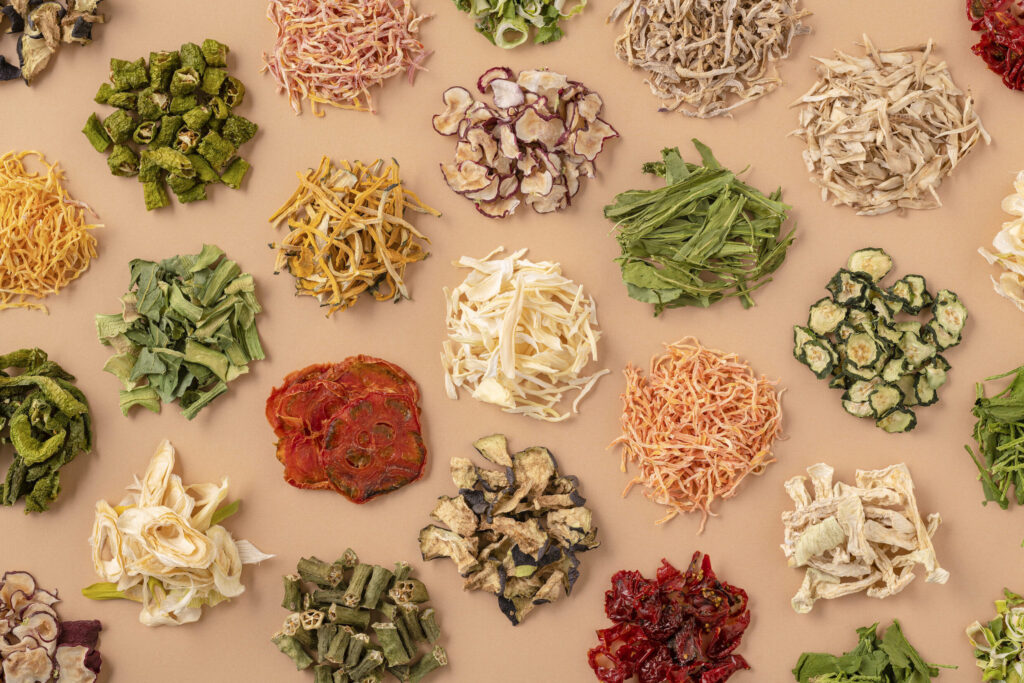
- Available for purchase in small lots from 1 kg
- We handle heirloom vegetables from across Japan
- Dried fruit and herbs also supported
Can the soaking water be used, or should it be thrown away?
For how often it is searched, the soaking water is where the answers split right down the middle. Some producers recommend "use it in miso soup or soup," while others write that "it is not used much in cooking." Both are written by people in the growing regions, so rather than one being wrong, their premises differ.
Its role differs from the soaking water of dried shiitake
The soaking water of dried shiitake is used as dashi itself, because its aroma and umami come out clearly. Wood ear differs there. One producer writes that "unlike shiitake, umami components are not released," assessing that color comes out but there is no core of flavor.
The difference between the two can be organized like this.
- Dried shiitake: the soaking water becomes dashi. Using it rather than discarding it is the basic rule
- Wood ear: color comes out but the core of flavor is weak. Do not count on it as dashi
- Neither should be used without heating; bring it to a boil before adding it to a dish
The idea of counting on the soaking water as dashi does not apply to wood ear. The handling in the case of dried shiitake is How to reconstitute dried shiitake and take dashi is described in detail there. Read it as an example where, even among the same "dried mushrooms," the positioning of the soaking water is reversed.
If you use it, bring it to a boil; if in doubt, throw it away
Even so, if you want to use it, there is one condition: do not use it raw; always bring it to a boil. The soaking water has whatever was on the surface of the wood ear dissolved into it. Given how Salmonella was confirmed in import inspections, avoiding putting it in your mouth unheated is the reasonable course.
- Add it to the pot as the liquid for miso soup or soup, and use it after bringing it to a boil
- Do not divert it to uses that are not heated, such as dressing or dressing sauce
- Do not use soaking water that has been left at room temperature for long
- If you are in doubt, throw it away. It is not dashi worth sparing
The color of the soaking water varies considerably by product. Turning brown is because the wood ear's pigment comes out, and that itself is not abnormal. However, when it turns cloudy white or has a lot of powdery sediment, there may be a lot of surface residue.
Dried wood ear sometimes still has sawdust used in cultivation remaining on it. Rinsing it quickly with water before reconstituting visibly reduces the cloudiness of the soaking water. The washing procedure is covered in the preparation section.
Some producers write that the color of the soaking water differs by growing region, but we were unable to corroborate, with official materials, the reasons they cite for that cause. Judging quality by the depth of color alone is a stretch. What can be confirmed is the hands-on fact that washing before reconstituting reduces the cloudiness.
Preparation: the stem base, how to wash, and how to cut
The preparation after reconstituting is only three things: remove the hard part, wash, and cut to suit the dish. Each takes only tens of seconds, but skipping them leaves them in the mouthfeel.
Where to cut the stem base
The stem base is the center of the wood ear, the base that was attached to the log or substrate block. It stays firm even after reconstituting, and touching it with a finger makes the difference from the surrounding area clear. Cut it off with a knife.
- After reconstituting, turn it over and look for the raised center
- Cut out only the hard part in a V shape. Do not remove too much
- Depending on the product, the stem base is already removed and this step is not needed
- What you cut off is hard, so do not use it
The stem base is easier to find after reconstituting than before, so the order is "reconstitute, then cut." If you look for it while dry, it cracks and breaks into pieces.
Wash it quickly before reconstituting
The timing to wash is before reconstituting. Dried wood ear sometimes has sawdust and the like on it, so put it in a bowl, rinse it quickly under running water, and then soak it in the reconstituting water. Specialty shops in the growing regions also advise washing it lightly with water before use.
もみ洗いは不要です。乾いた状態でこすると割れてしまい、細かい破片になって使いにくくなります。表面の汚れを流す程度で足ります。
ちぎるか、千切りにするか
切り方は料理で決まります。農林水産省の「うちの郷土料理」に載っている福島県のこづゆでは、きくらげの下処理が「戻して、ひと口大にちぎる」と書かれています。汁物ではちぎるほうが縁が不規則になり、汁がからみます。
一方、炒め物や和え物では2〜3cmの千切りが扱いやすい。断面がそろうので火の通りが均一になり、箸でも取りやすくなります。麻婆豆腐のように他の具が細かい料理では、4分の1に切るだけでも足ります。
| Dish | Cutting method | 火の入れ方 | Guideline |
|---|---|---|---|
| Stir-fry Happosai (eight-treasure stir-fry) | 2〜3cmの 千切り | 他の具と 一緒に炒める | 中心75℃・ 1分以上 |
| みそ汁 Soup | ひと口大に ちぎる | 汁に入れて Simmer | 2〜3分 |
| Dressed dishes 酢の物 | Fine-cut | 先に別で 茹でる | 沸騰した湯で Firm |
| Mapo tofu Ankake | 4分の1に 切る | スープと 一緒に煮る | 2〜3分 |
| 炊き込み ご飯 | 細かく 刻む | 米と一緒に 炊く | 炊飯の加熱 で足りる |
| Tsukudani 作り置き | 千切り | 煮詰める | 汁気が なくなるまで |
生きくらげと乾燥きくらげ、扱いの違い
店で見かける機会が増えた生きくらげは、乾燥品と手順がまるで違います。戻す工程がないぶん楽ですが、日持ちがしません。どちらを選ぶかは、その日の段取りで決まります。
国内で流通しているのは乾燥品が中心
県の研究機関の資料に、流通の実態が書かれています。三重県の資料は「アラゲキクラゲは国内消費の大半を乾燥輸入品に頼っており、生食用の流通は極めてまれです」としています。徳島県の栽培マニュアルにも「現在は、国内流通のほとんどが乾燥品の輸入物であり」という記述があります。
スーパーの棚で乾燥きくらげのほうをよく見かけるのは、こうした構造の反映です。国産の生きくらげは菌床栽培が広がって少しずつ増えていますが、まだ通年でどこでも買えるものではありません。
生は水戻し不要、その代わり日持ちしない
生きくらげは洗って石づきを落とせばすぐ使えます。肉厚でぷりぷりした食感は乾燥品では出ません。ただし冷蔵で数日が限度で、買った週のうちに使い切る前提になります。
- 生:戻し不要、食感はぷりぷり、日持ちは数日
- 乾燥:戻しが必要、食感はコリコリ、常温で長く置ける
- 常備して思い出したときに使うなら乾燥
- 食感を主役にした一皿を作るなら生
乾燥きのこ全体の使い分けはGuide to Using and Rehydrating Dried Mushroomsでまとめています。しいたけ、まいたけとの戻し時間の差もそちらで比べられます。
加熱しない料理に使うときの下ごしらえ
生きくらげを和え物やサラダに使う場合、産地の専門店や食品メーカーの下処理案内では、沸騰した湯で30秒ほど湯通しする手順が共通して示されています。石づきを落として洗い、湯にくぐらせてざるに上げる、という流れです。
炒め物や汁物のように調理で火が通る料理なら、湯通しは省いて構いません。この点は乾燥きくらげと同じで、火を通さない料理のときだけ別に加熱の工程を挟む、と覚えておけば迷いません。
A product catalog that shows around 100 items we handle
Agriture, flexibly handling everything from small lots to large lots
- Available for purchase in small lots from 1 kg
- We handle heirloom vegetables from across Japan
- Dried fruit and herbs also supported
保存と使い切り、業務用で使うとき
乾燥きくらげの利点は、思い出したときに使えることです。その利点を生かすには、開封後の置き方が要になります。湿気を吸った乾燥きくらげは戻りが悪くなり、固まって取り出しにくくなります。
未開封と開封後の置き場所
未開封なら常温の冷暗所で、袋の賞味期限までが目安です。直射日光とコンロ周りの熱を避けます。開封後は袋のままクリップで留めるだけにせず、密閉容器か保存袋に入れ替えるほうが確実です。
- 乾燥剤が入っていたら捨てずに一緒に保存する
- シンク下や炊飯器の近くは湿気が回りやすいので避ける
- 袋を開けたら日付を書いておく
- 固まって割れにくくなったものは戻りが鈍くなる
戻したあとの冷蔵と冷凍
戻したきくらげは水気を拭いてから保存します。冷蔵なら数日から1週間、冷凍なら1ヶ月ほどが専門店の案内で示されている範囲です。においやぬめりが出たものは使いません。
| State | Storage space | Estimated time | Note |
|---|---|---|---|
| 未開封の Dried product | 常温の 冷暗所 | 袋の賞味期限 or earlier | 直射日光と 熱を避ける |
| 開封後の Dried product | 密閉容器+ 冷暗所 | 早めに 使い切る | 吸湿すると 固まる |
| 戻した items | Refrigerated | A few days to 1 week | においや ぬめりが出たら 使わない |
| 戻した items | Frozen | 1ヶ月 | Straight from frozen 加熱調理に When to add |
業務用・原料として国産の乾燥きくらげを使う
当社は国産の野菜・きのこ・果物を温風乾燥し、業務用の乾燥品として供給しています。乾燥キクラゲも取り扱いがあり、規格や仕様は乾燥キクラゲの製品ページにまとめています。乾燥品の賞味期限は出荷日から6ヶ月程度, contained in burdock and cocoa.
粉砕は100メッシュ相当まで対応できます。食感ではなく素材として配合に使う用途ならKikurage powderのほうが扱いやすい場面もあります。小袋充填は10g以上の単位から承っています。
なお当社ではフリーズドライ、焙煎、チップス、レトルトは扱っていません。温風乾燥と粉砕、充填の範囲でできることをお伝えしています。
FOR BUSINESS
Looking for dried kikurage as a raw material?
We dry and grind domestically grown kikurage and supply it. Please also consult us about cut-shape and particle-size specifications and ongoing transactions. For specifications, dried kikurage・kikurage powder listed at.
Small-quantity purchases are available through our sister brand's online store, OYAOYA.
FAQ
Summary
乾燥きくらげの戻し時間は、冷水で5〜6時間、ぬるま湯40℃前後で15〜30分、熱湯を注いで20〜25分。スライスなら熱湯で15分前後です。戻ると重さで7〜10倍になるので、乾燥5gで和え物2〜3人分、20gで八宝菜4〜6人分と見ておけば量を読み違えません。
戻したあとは加熱して使うのが基本です。厚生労働省は加熱のめやすを中心部75℃で1分以上としており、輸入時の検査でサルモネラ属菌が確認された経緯もあります。炒め物や汁物なら自然に条件を満たしますが、和え物やサラダに使うなら別に茹でる工程を挟んでください。
そして常温で一日以上置いたままにしないこと。香港の食品当局の報告では、事例になったきのこは2日以上浸けられていたもので、通常の短時間の浸け戻しでは問題が起きにくいとされています。一晩かけるなら冷蔵庫へ。これだけ守れば、乾燥きくらげは手元にあると助かる常備品として長く使えます。
Download the product catalog
We will send the materials to your email address based on the information you provide.
Recommended reading
- We checked the difference between chili pepper, takanotsume, and shishito against the national crop classification
- A Guide to Using and Rehydrating Dried Mushrooms: Characteristics by Type and Recipes Using Mixes
Author of this article
Related articles
-
 Preventing vegetable shortfall while dieting | Add dietary fiber with dried vegetables
-
 Aojiru vs. vegetable juice vs. dried vegetables, thoroughly compared | Which method truly works for beating vegetable deficiency?
-
 What is yakuzen? Its meaning, the difference from kampo, and the basics of starting with familiar ingredients explained
-
 What's the Difference Between Yakuzen and Kampo? A Gentle Look at Food vs. Crude Drugs, Purpose, and Philosophy
-
 Complete guide to using dried mugwort | From rehydrating to popular recipes and storage tips
-
 Assembling domestically grown yakuzen ingredients: the difference between familiar vegetables and imported crude drugs
-
 We checked how to make and use yuzu shichimi against long-established makers' blend charts and ingredient labels
-
How to make yomogi mochi with dried mugwort | Ingredients, amounts, and foolproof tips explained