The Complete Rolling Stock Guide 2026 | 7 Recommended Foods and How to Use Dried Vegetables

Summary of this article
Rolling stock is the standard style for 2026—stockpiling while consuming in everyday use—and is recommended by the Ministry of Agriculture, Forestry and Fisheries and the Cabinet Office. This article compiles everything—the basics, the three-step method, seven recommended foods, using dried vegetables and dry goods, corporate use for BCP × health management (Office Yaoya), failure cases and common worries, and an FAQ—into a complete guide usable for both households and companies.
Rolling stock is a system of stockpiling while consuming in everyday use, and it’s the standard style for 2026, recommended by the Ministry of Agriculture, Forestry and Fisheries and the Cabinet Office. This article compiles everything—the basics, the method, and three steps to start rolling stock; “seven recommended foods”; concrete examples of practicing it with dried vegetables and dry goods; corporate use for BCP × health management (Office Yaoya); common failures and their solutions; and an FAQ—into a complete guide usable for both households and companies.
TOC
What Rolling Stock Is | The Basics and Mechanics for 2026
Rolling stock is a method of keeping a somewhat larger stock of the foods and drinking water you use daily at home or work, replenishing only what you consume, and always maintaining a fresh stockpile. It’s a coined term (roughly “stock that keeps rolling”), and it’s the modern stockpiling standard recommended by the disaster-prevention guides of the Ministry of Agriculture, Forestry and Fisheries and the Cabinet Office.
How It Differs from Traditional Stockpiling
| Method | Features | Challenge |
|---|---|---|
| Traditional stockpiling | Bulk-buying long-storing goods and storing them in a warehouse | Mass disposal when dates lapse; high cost |
| Rolling stock | Maintaining an always-fresh stockpile through everyday consumption + replenishment | Won’t last without operating rules |
Three Reasons It’s Getting Attention in 2026
- The September 2025 revision of the Nankai Trough long-term evaluation and The December 2025 update of the Tokyo inland earthquake damage projection has households and companies advancing their stockpile reviews
- food loss reduction As social demand rises, rolling stock—which avoids disposal—is becoming standard
- Linkage with health management Adoption as a corporate employee-benefit service is also expanding
FOR BUSINESS
乾燥野菜のミックスを、まとめてお探しですか
用途に合わせて複数の品目を配合した乾燥野菜ミックスをお作りしています。法人の備蓄やローリングストックのご相談も承っています。配合の考え方は 法人向けローリングストック に掲載しています。
少量でのご購入は、姉妹ブランドの通販サイト OYAOYA で承っています。
How to Do Rolling Stock | Three Steps to Get Started
- Buy 3 days’ worth extra of everyday foods: Stock a bit more of what your family normally eats—retort rice, canned goods, dried vegetables, cup noodles, Calorie Mate, and so on
- Consume starting with the nearest best-before dates: Manage by first-in, first-out, and restock what you consume within that week
- Monthly inventory check: Check best-before dates, and review the types to match changes in family makeup and preferences
For a household of four with 3 days’ worth, a guideline is 12–36 items. For companies, it’s number of employees × 3 days’ worth. Detailed required amounts and how to choose are in Corporate disaster stockpile list, 2026 edition.
7 Recommended Foods for Rolling Stock
For rolling stock, the point is to choose foods with a good balance of best-before date, ease of cooking, and nutritional value. We introduce, in order, the staples usable for both households and companies.
| We organize in a list the 22 Miyagi heirloom vegetables certified by the Japan Heirloom Vegetable Promotion Association, and in the following section explain 7 representative items in detail. First, let us grasp the whole picture. | Food | Best-before guideline | Reason for selection |
|---|---|---|---|
| No.1 | Dried vegetables (daikon, carrot, spinach, shiitake, etc.) | 6 months–1 year | Lightweight, room-temperature, easy to cook, nutrition retained |
| No.2 | Retort rice / alpha rice | 1–5 years | Core of the staple; edible with just reheating |
| No.3 | Canned goods (tuna, mackerel, corn, etc.) | 2–3 years | Protein source; room-temperature; ready to eat once opened |
| No.4 | Dry goods (kiriboshi daikon, hijiki, dried sardines, umeboshi) | 6 months–several years | Becomes a Japanese-style side dish; can be rehydrated and reused |
| No.5 | Long-storing bread / hardtack | 1–5 years | A staple substitute in emergencies |
| No.6 | Cup noodles and instant noodles | 6 months | Ready with just hot water; combinable with dried vegetables |
| No.7 | Room-temperature vegetable juice | 9 months–1 year | For replenishing vitamin C; complements dried vegetables nutritionally |
For multiple search needs—“rolling stock recommendations,” “recommended foods,” “recommended emergency food,” “recommended disaster prep,” and so on—these seven items serve as the answer directly. Adjust the combination to your family’s preferences, allergies, and dietary restrictions.
Practicing Rolling Stock with Dried Vegetables and Dry Goods
The dried vegetables and dry goods in No. 1 and No. 4 are the “stars” of rolling stock. With the trifecta of lightweight, long-storing, and easy-to-cook, and being usable every day in home miso soup, simmered dishes, cup noodles, pasta, and more, they’re the ingredients that keep the rolling stock system turning most naturally.
Five Benefits of Dried Vegetables
- Long-term storage:常温で6ヶ月程度が目安(密封袋+冷暗所で保管)
- Lightweight: Because moisture is removed, the weight is about 1/10 of fresh vegetables. Even 50 people’s worth of stockpile fits on a tabletop
- Nutrition is retained: Dietary fiber, minerals (iron, potassium), and vitamins A/D are mostly preserved through heat and the drying process (vitamin C decreases easily, so complement it with vegetable juice)
- Easy to cook: Many types need no rehydrating and can go straight into miso soup, soup, or cup noodles
- food loss reduction: Many products are made by upcycling off-spec vegetables, so they can be linked to CSR initiatives
Use Dry Goods (Umeboshi, Kiriboshi Daikon, Hijiki, Dried Sardines) Alongside
Alongside dried vegetables, traditional dry goods (umeboshi, kiriboshi daikon, hijiki, dried sardines, katsuobushi) are also materials suited to rolling stock. Since they’re used daily as Japanese-style side dishes, the consumption cycle turns naturally, and they can be served straight to the table in a disaster too. Combining dried vegetables and dry goods lets you rotate stockpiles across both Western and Japanese menus, and reduces stress in a disaster with tastes your family or employees are used to.
Comparing Dried Vegetables with Other Stockpile Foods
| Food | Best-before date | Weight | Cooking | Nutritional replenishment |
|---|---|---|---|---|
| Dried vegetables | 6 months–1 year | Light (1/10 of fresh vegetables) | Just rehydrate / add straight in | Dietary fiber, minerals, vitamins A/D ◎ |
| Canned vegetables (corn, etc.) | 2–3 years | Heavy and bulky | Just open | Dietary fiber, minerals ○ (vitamins reduced by heating) |
| Freeze-dried vegetables | 3–5 years | Very light | Rehydrate in hot water | Nutrition retained almost intact ◎ |
| Vegetable juice (room-temperature storage) | 9 months–1 year | Heavy | Drink as is | Vitamin C ◎, fiber △ |
3 Dried-Vegetable Recipes Useful in a Disaster
- Instant Dried-Vegetable Miso Soup: Just mix 200 ml hot water + 1 tbsp miso + 2 tbsp dried vegetables. Done in 3 minutes
- Cup Noodles + Dried-Vegetable Topping: Add 2 tbsp dried vegetables to regular cup noodles and pour hot water, and the nutritional value jumps at once
- Vegetable Rice Porridge with Retort Rice: Add dried vegetables, water, and chicken stock granules to reheated retort rice and simmer. Gentle on the stomach
Corporate BCP × Rolling Stock | Using Office Yaoya
Rolling stock is effective not only for households but also for corporate BCPs (business continuity plans) and health management. Office Yaoya (office greengrocer), which Agriture operates as part of the Kai Group, is an employee-benefit service that keeps dried vegetables, dried fruit, and instant miso soup stocked in the office, where the same stock that employees consume daily doubles as disaster stockpile.
| Item | Details |
|---|---|
| Ingredient | Dried vegetables (a cumulative lineup of about 100 items, delivered as seasonal combinations), dried fruit, instant miso soup |
| Specifications | Individually wrapped 3–8 g portions, no rehydration needed, room-temperature storage of 3 months or more |
| Price | Per serving From 100 yen (The split between company-paid and employee-paid portions can be customized) |
| Setup Cost and Monthly Fee | Free (a plan with zero cost to the company is available) |
| Target Scale | Supported from small offices of 10 people or fewer |
For the challenge of “it’s hard to keep running rolling stock in-house,” using an employee-benefit service with an automated delivery cycle reduces the manager’s effort and lets you hand off the risk of best-before-date lapses to the service side. The detailed mechanics are in What is corporate disaster preparedness? 2026 edition (parent article) and 10 examples of corporate disaster-preparedness initiatives.
Estimating the Disposal Cost of Preventing “Waste”
If you replace traditional stockpiles all at once on a 5-year cycle, even for 50 employees, a year’s worth of cost becomes “trash.” From an SDGs / food-loss-reduction standpoint, it’s a minus for corporate image, too.
| Item | Cost for 50 people | Discarded over 5 years |
|---|---|---|
| Alpha rice | About 50,000 yen | Entire amount discarded |
| Hardtack | About 25,000 yen | Entire amount discarded |
| Canned goods | About 30,000 yen | Entire amount discarded |
| Drinking water | About 40,000 yen | Entire amount discarded |
| Total | About 145,000 yen | Discarded every 5 years |
Just by switching from a model of discarding it all at once every 5 years to rolling stock, where you consume a little at a time each month, you can bring the disposal cost close to effectively zero.
Three Tips for Turning Over Consumption In-House
Rolling stock won’t turn over unless employees consume the food. Just setting it out labeled “disaster stockpile” won’t get people to reach for it, so you need to be clever about presentation.
- Set It Out as a “Free Vegetable Corner”: “These are disaster stockpiles—help yourself” tends to create an atmosphere that’s hard to reach into. Setting it out casually as an “office vegetable corner” near the pantry or water kettle raises the usage rate
- Attach Recipe Cards: Attaching simple recipe cards like “Pour hot water and wait 3 minutes! Miso soup with dried spinach” makes the use clear and raises the usage rate. Rotating them monthly keeps people from tiring of them
- Build Awareness with an Event During September’s Disaster-Prevention Month: Holding a tasting event and telling people “the dried vegetables you eat regularly actually double as disaster stockpile” also raises disaster awareness. Communicating it as an HR-led employee benefit makes it easier to get cooperation
Put these three tips into practice, and you can run it with about 15 minutes a month of inventory counting and ordering. If consumption still doesn’t advance, reduce the stock amount to optimize turnover.
Learn about Office Yaoya
We have prepared materials
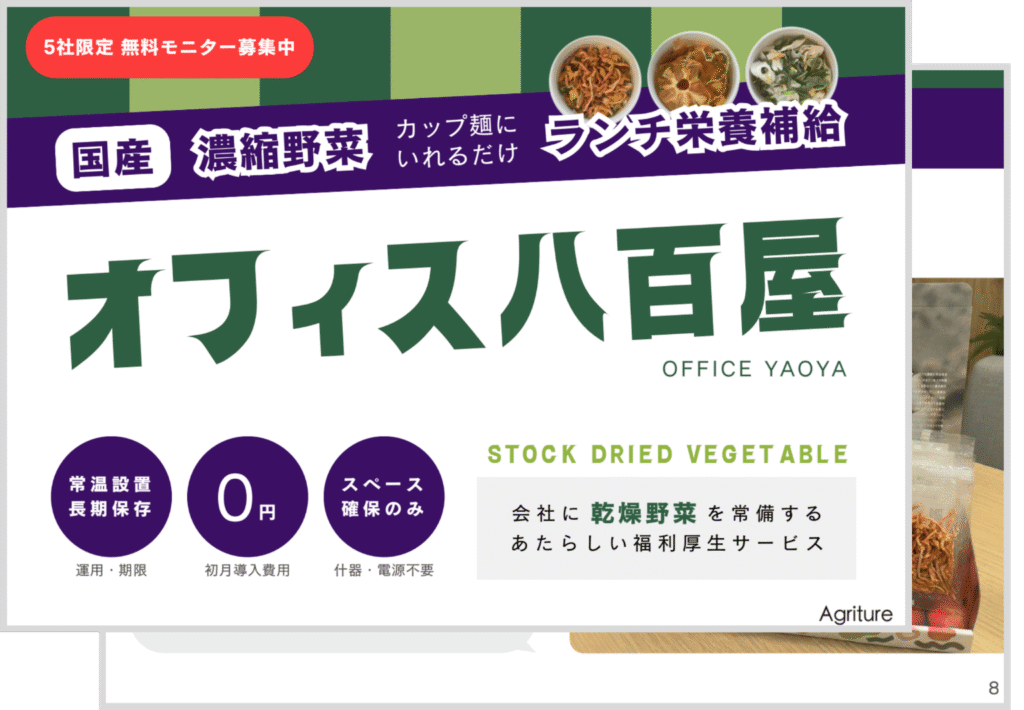
- Service details and vegetable lineup
- Pricing and plans
- How adoption and operation work
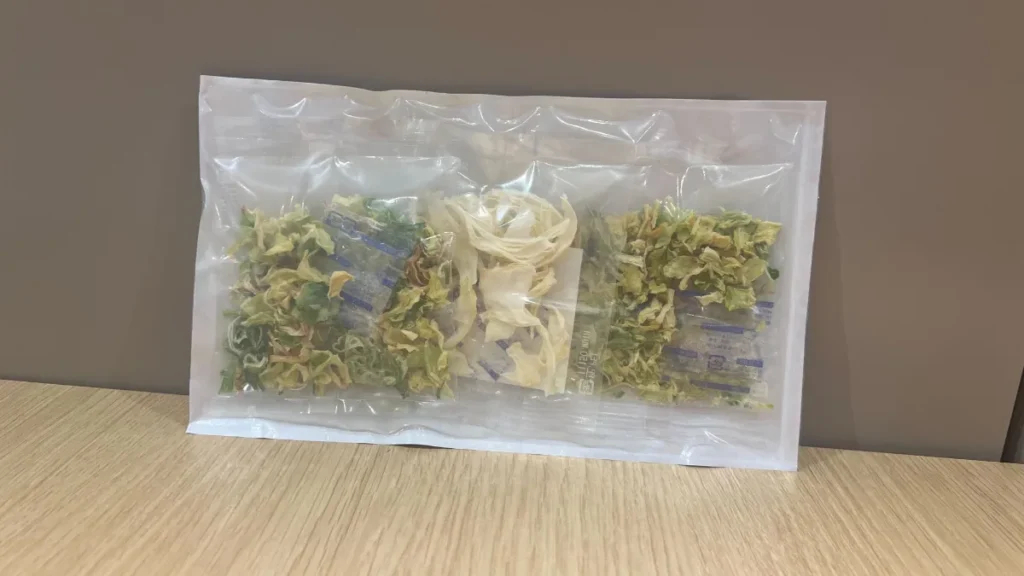
Sample sets are also available. Download the materials for details!
We offer sample sets so you can try Office Yaoya in small quantities. See the materials for details.
Failure Cases and Common Worries with Rolling Stock
As there’s a certain volume of searches for “rolling stock, quit,” some people find it hard to keep up. We’ve summarized common failures and how to avoid them.
Failure 1: Best-Before Dates Lapse Before You Notice
The pattern where what was supposed to be “everyday consumption” ends up expiring because you bought items you don’t like and never ate them. The way to avoid it is to stockpile only what your family or employees normally eat. Starting with universally liked items (cup noodles, retort rice, dried vegetables) is the safe bet.
Failure 2: Management Is Too Complicated to Keep Up
The case where Excel management of best-before dates doesn’t last. The way to avoid it is “fixing a storage location” and “first-in, first-out”. Make it a simple rule of just putting new items at the back and old ones at the front. Combining it with best-before-date management via a smartphone app (reminder function) makes it easier.
FOR BUSINESS
乾燥野菜のミックスを、まとめてお探しですか
用途に合わせて複数の品目を配合した乾燥野菜ミックスをお作りしています。法人の備蓄やローリングストックのご相談も承っています。配合の考え方は 法人向けローリングストック に掲載しています。
少量でのご購入は、姉妹ブランドの通販サイト OYAOYA で承っています。
Failure 3: In Companies, It Isn’t Handed Over When the Person in Charge Changes
A failure that tends to happen with corporate rolling stock. The way to avoid it is to put it on a service that systematizes the operation. Using an employee-benefit service like Office Yaoya lets you outsource both delivery and replenishment, so it doesn’t stop even when the person in charge changes.
FAQ | Rolling Stock Q&A
Summary | Run Rolling Stock as a “System You Can Keep Up”
Rolling stock is the 2026 stockpiling standard. With the three-step operation of everyday consumption + replenishment, you can reduce the risk of best-before-date lapses while maintaining a reassuring stockpile for both households and companies. Starting from the core of the 7 recommended foods (dried vegetables, retort rice, canned goods, dry goods, long-storing bread, cup noodles, vegetable juice) and expanding to match your family’s or employees’ preferences is an approach that takes hold easily.
Corporate rolling stock can be made even more effective by integrating it with health management. Office Yaoya (office greengrocer) Using an employee-benefit service like this lets you reconcile disaster stockpiling and everyday dietary-improvement measures in a single system, while also reducing the manager’s burden.
Related article:
- What is corporate disaster preparedness? 2026 edition | A practical guide advanced through BCP × health management (parent article)
- [2026 Edition] 7 Recommended Emergency Foods | How to Choose, Checked by Preserved-Food Category
- Corporate disaster stockpile list, 2026 edition
- 10 Corporate Disaster-Preparedness Case Studies | 2026 Edition
- Solving the Vegetable Shortfall in Corporate Disaster Prep | 7 Stockpile Vegetables
- Office Yaoya | Just-place-it dried vegetables for disaster preparedness × health management

Download the office dried vegetable materials
We will send the materials to your email address based on the information you provide.
- 規格外野菜とは?どれだけ発生していて、どこまで加工に使えるのか
- How to Choose Genuine Fair Trade Products: 5 Criteria and How to Tell