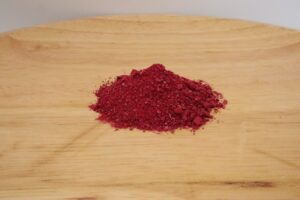
Red shiso powder

Red-shiso powder is a raw material made by drying and finely powdering domestic red-shiso leaves, intended to spread a vivid reddish-purple color and a refreshing aroma evenly into furikake, Japanese-style seasonings, drinks, and confectionery dough. Agriture achieves the coloring from anthocyanin pigment and the refreshing aroma characteristic of shiso, dried red shiso (a type that keeps the leaf shape), we powder it by adding a fine-powdering step.
TOC
Three points of care behind Agriture's red-shiso powder
The quality of red-shiso powder is determined by the vividness of the color and how well the aroma remains. Agriture manages the drying and grinding conditions in-house, aiming for a finish with little lot-to-lot variation.
1. Low-temperature drying and grinding that protects the anthocyanin pigment
Red shiso's reddish-purple comes from anthocyanin pigments (such as shisonin), which fade easily with heat and light. By finishing in a low-temperature range from the raw-material drying stage and operating under conditions that suppress heat generation even in the grinding process, we make it easier to keep the vivid reddish-purple even after powdering. Color shifting toward brown from frictional heat during grinding is a common failure with red-shiso powder, so we record temperature, grinding time, and lot size from prototyping. Prototypes with varied blending ratios — furikake of red shiso + salt + yuzu-peel powder, Japanese-style herb salt of red shiso + sansho, and so on — are possible.
Product catalog showing the items we handle
Flexible support from small lots to large lots
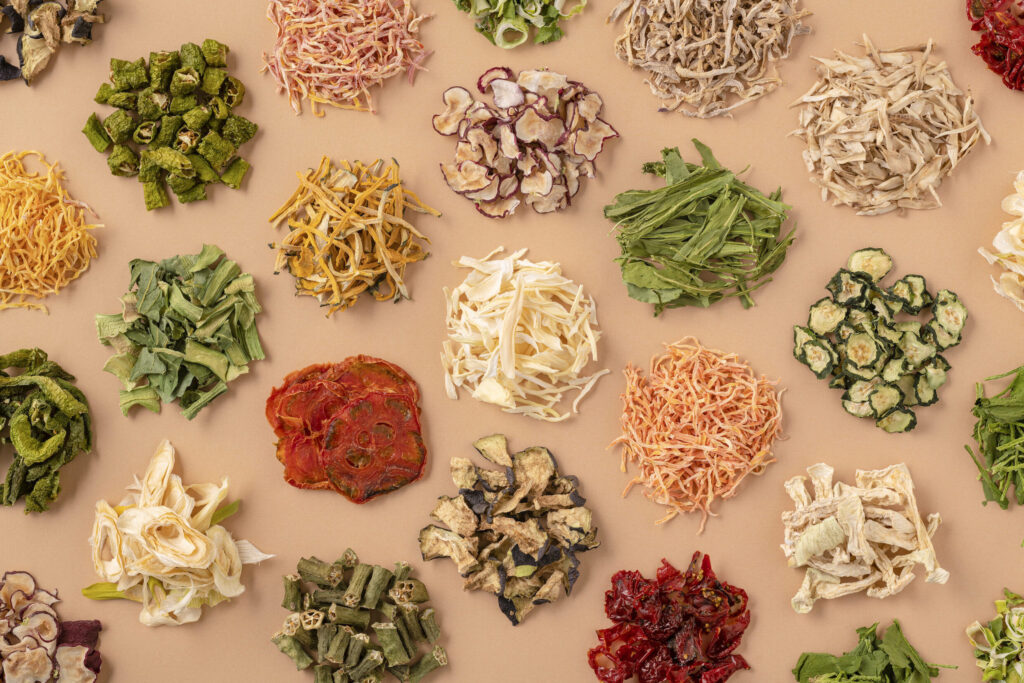
- Sold in small lots from 1 kg
- Handling heirloom vegetables from across Japan
- Dried fruits and herbs also supported
Features of commercial red-shiso powder
A vivid reddish-purple color
The reddish-purple derived from anthocyanin pigment spreads evenly into powder mixes, dough, and dressings. It is one of the few Japanese-style powder materials that can be used to aim for color.
A refreshing shiso aroma
Aromatic components characteristic of shiso, such as perillaldehyde, are concentrated, adding a refreshing accent to furikake, dressings, and confectionery dough.
Dispersibility in liquids and powders
It enables even dispersion into dressings, beverages, and dough, which is difficult with the leaf form. It suits uses that spread only color and aroma without a grainy feel.
Easy to build into Japanese-style blends
It is easy to blend with Japanese ingredients such as salt, sugar, sansho, and yuzu peel, and we can handle pre-blending as a raw material for furikake, Japanese-style seasonings, and herb salt.
Use together with the ingredient-shape version
You can use dried red shiso for uses where you want to retain the leaf texture, and powder for uses where you want to spread color and aroma evenly. A design using both in the same recipe to achieve both appearance and aroma is also possible.
Product specifications (commercial)
The basic specifications at the prototype stage are as follows. Procurement lots, delivery dates, and packaging forms for mass production and OEM are settled through individual consultation.
| Item | Details |
|---|---|
| Product name | Red shiso powder |
| Raw material | Red-shiso leaves (domestic) |
| Shape | Fine powder (leaves dried and ground) |
| Appearance | A vivid reddish-purple fine powder |
| Aroma | A refreshing green-leaf aroma characteristic of shiso, with faint sweetness |
| Net content | Individual quote according to use and lot |
| Best-before date | About 6 months from the shipping date |
| Storage method | Avoid high temperature, high humidity, and direct sunlight; after opening, seal and store in a cool, dark place |
| Minimum prototype lot | From 1 kg of raw material |
Customization support
| Item | What we support |
|---|---|
| Proportion adjustment | Red shiso alone / premix with salt or sugar / Japanese-style spice blend |
| Blend design | Pre-blend prototyping with sansho, yuzu peel, sudachi peel, chenpi, and shichimi |
| Packaging form | Commercial bulk, sticks and small bags, spice jars, canisters, and more |
| OEM productization | Integrated handling from furikake, seasonings, and dressings to Japanese-style sweets |
| Raw material supply | In addition to our own raw material, we also handle contract drying and grinding with a specified growing region and specified variety |
For those who want to make use of the leaf texture (raw-material shape version)
For furikake toppings, umeboshi pickling, red-shiso juice raw material, Japanese-style herbal tea, and the like, uses that make use of the leaf texture and appearance, we recommend dried red shiso (a type that retains the leaf shape). The leaf texture and visual, which cannot be obtained with powder, come alive.
Commitments to variety, grower, and growing region
Red shiso is an annual of the family Lamiaceae, genus Perilla, with variety lineages such as chirimen red shiso, chirimen red perilla, and green-stem red shiso. The harvest peak is June to August, and drying and grinding the in-season leaves brings out strong aroma and color.
Main growing region
| Growing region | Features |
|---|---|
| Kyoto Prefecture | Red shiso from Ohara, Kyoto is famous. Long used as a raw material for umeboshi and shibazuke |
| Aichi Prefecture | A main growing region for commercial red shiso. Suited to stable supply and large-lot handling |
| Shiga Prefecture | Red shiso from the Koto region. Strong in aroma, distributed as a raw material for shiso juice |
| Gunma Prefecture | A growing region for chirimen red shiso. The leaf crinkle is strong and the aromatic components are dense |
Using varieties differently
Because chirimen red shiso has strong leaf crinkle and dense aromatic components, it suits furikake and seasonings. Green-stem red shiso is somewhat paler in color with a gentle aroma, so it suits confectionery and bakery. We also handle prototyping with variety specification matched to the use.
Powdering technology and quality control
Red-shiso powder's quality is determined by the retention of color and aroma. Agriture manages drying, grinding, and packaging in an integrated way, with a system in place to suppress lot-to-lot variation.
Countermeasures against anthocyanin fading
Anthocyanin pigment fades easily with heat, oxygen, and light, and if the reddish-purple shifts toward brown from frictional heat during grinding, the product value drops greatly. We adjust the grinding lot's size, rotation speed, and rest time, operating under conditions that keep the powder temperature from rising too much. Because we record the conditions at the prototype stage, we can reproduce the same coloring in mass production. We adopt light-blocking aluminum bags for commercial bulk and light-blocking film for small bags and sticks, proposing specifications that assume storage at stores and warehouses.
TIPS: Blends that make the most of red-shiso powder
When used in furikake, . In a dressing, adding 1–2% powder to 100 g of oil and vinegar makes a faint pink color and a refreshing aroma rise up. In confectionery dough, kneading in about 0.5–1% against the flour leaves a reddish-purple after baking. It has the property that combining it with an acidic liquid (lemon juice, vinegar) makes the color more vivid.
Use cases and adoption examples
Because the powder disperses evenly into liquids and powders, it extends to uses the leaf form cannot reach. We organize the uses we are often consulted about. If you specify the blending ratio you aim for in the final product, we handle mixing and bagging at that ratio. As furikake, seasoning, or dressing material, it can reduce on-site compounding labor.
Related articles / other Japanese-style raw materials
Japanese-style powders and related raw materials handled by Agriture. Please use them in blend design with red shiso.
- dried red shiso: a type that retains the leaf shape
- yuzu powder: a bright Japanese-citrus aroma
- Sudachi powder: sharp acidity and freshness
- Dried summer orange peel: a Japanese-citrus blend raw material
- Food OEM Directory: A consultation window for OEM projects
Product catalog showing the items we handle
Flexible support from small lots to large lots
- Sold in small lots from 1 kg
- Handling heirloom vegetables from across Japan
- Dried fruits and herbs also supported
Frequently asked questions
What is the difference between dried red shiso (leaf form) and powder?
Dried red shiso is a type that retains the leaf shape, suiting uses that make use of the leaf texture and appearance — furikake toppings, umeboshi pickling, red-shiso juice, herbal tea, and the like. The powder, being a fine powder, suits uses where you want to spread color and aroma evenly — dressings, beverages, dough kneading, seasonings. There are also cases of using both together in the same recipe. Combining it with an acidic liquid (lemon juice, vinegar) makes the color more vivid, while under neutral to alkaline conditions it shifts toward blue-purple. If you want to bring out strong color in confectionery dough or beverages, we recommend combining it with acidic conditions.
Can you deliver it pre-blended with salt or other spices?
Yes. We handle pre-blended delivery at specified ratios, such as a yukari-style premix with salt or sugar, or a Japanese-style herb salt blended with sansho and yuzu peel. If you share the blend you aim for in the final product, we carry out mixing and bagging at that ratio.
What is the minimum prototype lot?
We accept prototyping from 1 kg of raw material. For mass production and OEM, we propose a quotation and delivery time individually. You can consult us consistently through to final commercialization for furikake, dressings, Japanese-style sweets, and the like.
Please tell me the best-before date and how to store it.
The best-before date is about 6 months from the shipping date. Because red-shiso powder fades easily in color with light, when unopened store it in a cool, dark place at room temperature away from high heat, humidity, and direct sunlight. After opening, we recommend transferring it to a sealed container and using it up within 1–2 months as a guide.
What applications are you consulted about often?
We are often consulted for furikake and Japanese-style seasonings, dressings, red-shiso-juice-style drinks, coloring for Japanese and Western confectionery, kneading into noodles, herb salt, and more. Because it can make use of both color and aroma, it is prototyped in a wide range of final products, Japanese and Western alike.