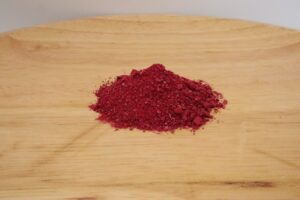
Cabbage powder

Cabbage powder is a raw material made by drying and micro-pulverizing cabbage, spreading natural sweetness and a vegetable presence evenly into okonomiyaki flour, soup powders, kamaboko-type products, and bread dough. It's finished to a size that easily disperses in liquids and powders the cabbage-derived vitamin U (commonly known as cabagin) and other functional components, along with the gentle sweetness drawn out by heating. At Agriture, Dried cabbage, we powder it by adding a fine-powdering step.
Whereas cabbage in raw-material shape suits "okonomiyaki and soup ingredients that want to keep texture and an ingredient feel," cabbage powder suits uses that "want to spread sweetness and flavor evenly." It's a raw material seeing wider adoption as the base of okonomiyaki flour and takoyaki flour, for flavoring bread dough, and for care-food bases.
TOC
Agriture's cabbage powder: three points of care
1. Low-temperature drying that draws out sweetness
Cabbage's sweetness concentrates as moisture leaves during the drying process. Raise the temperature too high and a scorched smell can develop or vitamin U (methylmethionine sulfonium) can break down, so we finish it at low temperature over time. The guide is a state where you sense cabbage's natural sweetness the instant you taste the powder.
3. Pre-blend support to simplify mass-production lines
For products that combine cabbage powder + wheat flour + yam flour + dashi powder, like okonomiyaki flour, delivery as a premix helps simplify mass-production lines. By deciding the blend ratio, lot, and packaging in advance, we can supply it in a state close to the final product.
Product catalog showing the items we handle
Flexible support from small lots to large lots
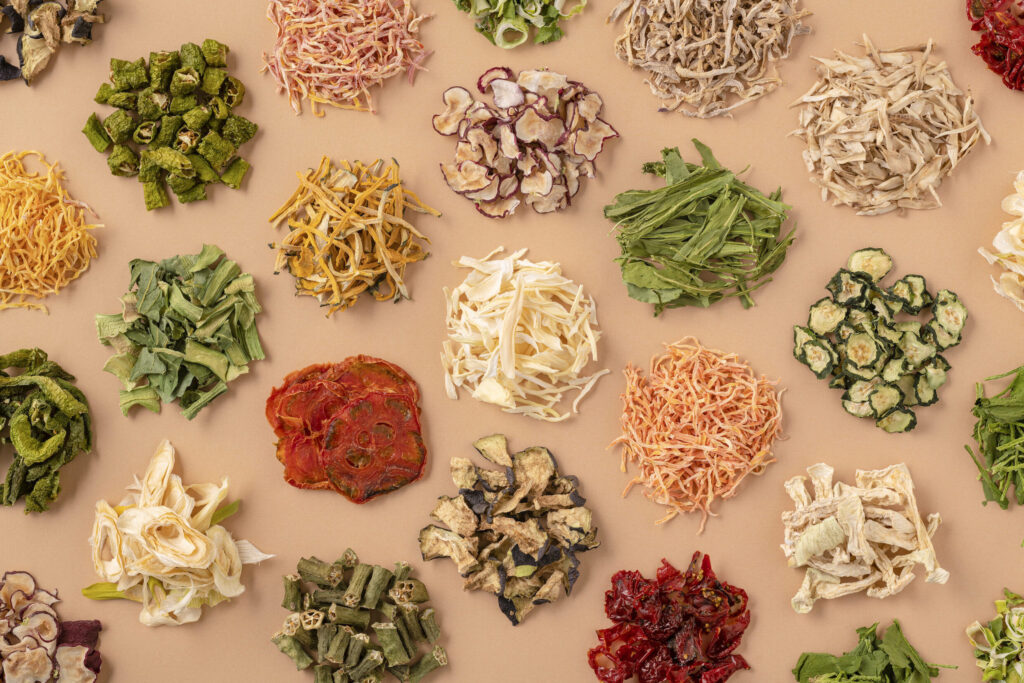
- Sold in small lots from 1 kg
- Handling heirloom vegetables from across Japan
- Dried fruits and herbs also supported
Features of commercial cabbage powder
Gentle sweetness and vegetable presence
Concentrates the cabbage sweetness drawn out by heating. Lends a natural vegetable presence to soup powders, okonomiyaki flour, and bread dough.
Vitamin-U-containing material
Because it contains vitamin U (cabagin), known for protecting the stomach's mucous membrane, it's a raw material often inquired about for functional foods and care-food bases that appeal to gastrointestinal health.
Dispersibility in liquids and powders
The graininess is barely noticeable even dissolved in okonomiyaki flour or soup, dispersing evenly into powder mixes. Usable as is without rehydration.
Premix-compatible
Handles pre-blending with wheat flour, yam flour, and dashi powder. You can design okonomiyaki-flour and takoyaki-flour OEM all in one go.
Use together with the ingredient-shape version
Using it together with dried cabbage lets you achieve both sweetness and flavor (powder) and texture (raw-material shape).
Product specifications (commercial)
Basic specifications at the prototype stage are as follows. Purchase lot, lead time, and packaging format are worked out through individual consultation.
| Item | Details |
|---|---|
| Product name | Cabbage powder |
| Raw material | Cabbage (domestic) |
| Shape | Micro-powder (dried cabbage ground) |
| Appearance | Pale cream to yellow-green micro-powder |
| Aroma | A vegetable aroma with the sweetness distinctive to cabbage |
| Net content | Individual quote according to use and lot |
| Best-before date | About 6 months from the shipping date |
| Storage method | Avoid high temperature, high humidity, and direct sunlight; after opening, seal and store in a cool, dark place |
| Processing plant | Our own processing plant within Kyoto Prefecture |
| Minimum prototype lot | From 1 kg of raw material |
Customization support
| Item | What we support |
|---|---|
| Pre-blending | Premix support with wheat flour, yam flour, dashi powder, and salt |
| Blend design | Composite recipes with other vegetables such as onion, carrot, and celery, plus dashi powder |
| Packaging form | Commercial bulk, large bags for okonomiyaki flour, small bags and sticks, canisters |
| OEM productization | Deployment into okonomiyaki flour, takoyaki flour, soup powders, bread mixes, and care-food bases |
| Raw material supply | Besides our own raw material, we also handle contract drying and milling of designated-origin and non-standard produce |
For uses where you want to keep texture and a sense of ingredient presence, the raw-material form is recommended
For okonomiyaki fillings, soup ingredients, stir-fry bases, and other uses that leverage cabbage's texture, dried cabbage (raw-material shape) is suitable. Its strength is that it can be rehydrated and used straight as an ingredient.
Commitments to variety, grower, and growing region
Cabbage is a representative vegetable of the Brassicaceae family, grown year-round nationwide. As a powder raw material, you can select varieties to match the use—spring cabbage, with soft leaves and strong sweetness; winter cabbage, dense-bodied and sweetened by heating; and summer-autumn cabbage, with firm heads that release moisture well.
Main growing region
| Growing region | Features |
|---|---|
| Gunma Prefecture (Tsumagoi Village) | A major growing area for summer-autumn cabbage. The cool highland climate firms up the head |
| Aichi Prefecture | A major growing area for winter cabbage. Strong sweetness, suited to heated uses |
| Chiba Prefecture | A major growing area for spring cabbage. Soft leaves, easy to powder |
| Nagano Prefecture | A growing area for summer cabbage. Moisture releases quickly, giving high drying efficiency |
Using varieties and lineages differently
Winter cabbage (kandama lineage) is strongly sweet, suited to bases for heated uses such as soups and okonomiyaki flour. Spring cabbage (sato-cabbage lineage) has soft leaves and a delicate aroma, suited to flavoring bakery dough and confectionery. Summer-autumn cabbage releases moisture well, suited to mass-production lots.
Powdering technology and quality control
How cabbage powder draws out sweetness changes with the drying conditions. At Agriture we manage everything from prep to packaging in-house, curbing lot-to-lot variation.
Draw out sweetness with low-temperature drying
Sugars concentrate as moisture leaves during the drying process, but if the temperature is too high the Maillard reaction advances too far, producing bitterness and a scorched smell. Taking time at low temperature keeps a natural sweetness in the powder.
Heat control during grinding
Blend management premised on premix
For composite raw materials like okonomiyaki flour, we can also deliver in a state blended with the ratio decided in advance. This lets the user skip the measuring and mixing steps, simplifying the mass-production line. We keep a lot-management sheet for each blend ratio to ensure reproducibility.
TIPS: Blend design for okonomiyaki flour
Use cases and adoption examples
Cabbage powder is a material that combines sweetness with a functional appeal. We organize the uses we're most often asked about into five categories.
1. Okonomiyaki flour / takoyaki flour
- Base blend for commercial okonomiyaki flour
- Blending into home-use takoyaki flour and monjayaki flour
- Dough improvement for frozen okonomiyaki and takoyaki
- Application to chijimi and chijimi flour
2. Soup powders / instant foods
- Raw material for cabbage potage and vegetable minestrone
- Base material for instant soups
- Cabbage-roll-style soup mix
- Blends for freeze-dried foods
3. Bread / bakery
- Kneading into vegetable bread and filled bread
- Cabbage focaccia and pizza dough
- Flavoring crackers and grissini
- Blending into scones and muffins
4. Kamaboko-type / processed meat
- Blending into hamburg steak and meatballs
- Vegetable flavoring for sausages and ham
- Kneading into the filling of frozen gyoza and shumai
- Blending into satsuma-age and tsukune batter
5. Health foods / care foods
- Functional foods appealing to gastrointestinal health (vitamin U appeal)
- Aojiru mixes and vegetable-powder health foods
- Vegetable flavoring for care-food and dysphagia-food bases
- Diet foods and low-sugar soups
For composite designs of soup powders and kamaboko-type products, we can also propose combining it with Onion powder・Celery powder. In the medicinal-food and health-food areas, linkage with Yasai Yakuzen is also possible.
How to use the powder and design blends
The raw-material form requires a reconstitution step, but the powder's advantage is that it can be formulated directly into powdered goods. We organize the operational points specific to powders.
Basics of use
- Okonomiyaki flour: blend 3–5 g per 100 g of wheat flour
- Soup: dissolve 2–4 g per 200 ml
- Bread dough: blend 1–3 g per 100 g of wheat flour
- Kamaboko-type: knead in 1–2 g per 100 g of ground meat
- Care food: blend 1–2% relative to the base soup
Example blend formulas
- Okonomiyaki flour: wheat flour 90% + cabbage 4% + yam flour 3% + dashi powder 2% + salt 1%
- Cabbage potage: cabbage 40% + onion 20% + skim milk 25% + salt, pepper, dextrin 15%
- Vegetable bread mix: wheat flour 85% + cabbage 5% + onion 3% + salt, sugar, yeast 7%
- Care-food base: cabbage 30% + onion 25% + carrot 25% + flour 10% + dextrin 10%
How to store
- Before opening: store in a cool, dark place at room temperature, away from heat, humidity, and direct sunlight
- After opening: because it readily absorbs moisture, transfer it to a resealable bag or airtight container; refrigerated storage is also fine
- The best-before date is roughly 6 months from the shipping date. After opening, use it up within 1–2 months as a guide
- If lumps form, sift through a tea strainer before use to disperse it evenly
Related articles and other vegetable raw materials
These are the vegetable powders and related raw materials Agriture handles. Use them when designing premixes and soup powders.
- Dried cabbage: raw-material shape for okonomiyaki and soup ingredients
- Onion powder: a staple for soup bases and seasonings
- Celery powder: for Western-style soups and processed meats
- Mizuna powder: a Kyoto vegetable green
- Winter melon powder: mild flavor, suited to care foods
Product catalog showing the items we handle
Flexible support from small lots to large lots
- Sold in small lots from 1 kg
- Handling heirloom vegetables from across Japan
- Dried fruits and herbs also supported
Frequently asked questions
How do you use dried cabbage (raw-material shape) versus cabbage powder?
Raw-material shape suits uses that want to keep texture and an ingredient feel—okonomiyaki, soup ingredients, stir-fries, cabbage-roll-style dishes. Powder suits uses that want to spread sweetness and flavor evenly—the base of okonomiyaki flour, soup powders, bread dough, care foods. In some cases both are used together in the same recipe to achieve both flavor depth and texture.
How far can you handle the premix for okonomiyaki flour?
We can deliver the full blend of wheat flour, cabbage powder, yam flour, dashi powder, salt, and so on in a pre-blended state. If you decide the blend ratio, lot, and packaging in advance, the user's measuring and mixing steps become unnecessary, greatly simplifying the mass-production line. This is an approach we're often asked about by okonomiyaki-flour makers who outsource their production via OEM.
Does vitamin U remain?
Because vitamin U (methylmethionine sulfonium) breaks down easily with heat, we take measures to raise the residual amount through low-temperature drying and by curbing heat generation during grinding. That said, quantitative assurance of the residual amount requires separate analysis fees, so if you're planning use in Foods with Function Claims or Foods for Specified Health Uses, please consult us separately on the scheme. After hearing the specifications, blend, lot, and schedule of the intended final product, we propose quotes and lead times individually. You can consult us consistently through to finished products such as okonomiyaki flour, soup powders, and bread mixes.
Please tell me the best-before date and how to store it.
The best-before date is roughly six months from the shipping date. Before opening, store it in a cool, dark place at room temperature, away from high heat, humidity, and direct sunlight. Because powder absorbs moisture easily, after opening transfer it to a zip bag or sealed container and use it up within a guide of 1–2 months.
Can you do contract drying of off-spec cabbage?
Yes. We accept contract processing that dries and grinds off-spec items—poorly headed, uneven in size, and so on—into powder. It's an area we're often asked about as an initiative to turn raw material that would become waste at the growing region into OEM products. After hearing the growing region, quantity, and schedule, we propose how to proceed individually.