
5 benefits to resolve the vegetable shortage of telework employees

"Since going remote, our employees' health-checkup numbers have gotten worse"; "they eat nothing but convenience-store bento, so I worry about vegetable shortfalls"—these are voices often heard from HR staff running a telework program. According to MHLW's "National Health and Nutrition Survey," Japanese people's daily vegetable intake averages about 280 g, a full 70 g short of the 350 g target. In a telework environment this tendency is even more pronounced; in one company's internal survey, about 65% of remote workers answered that they "eat almost no vegetables at lunch." In this article, we organize—from a practical standpoint—five employee-benefit measures to resolve teleworking employees' vegetable shortfalls, cost guidelines for adoption, methods of measuring effectiveness, and even dried-vegetable services that also support home delivery, such as the one run by the Kai Group × Agriture, Office Yaoya (office greengrocer) which we cover here.
TOC
Teleworking employees' diets: "vegetable shortfalls" are quietly getting serious
"Since going remote, our employees' health-checkup numbers have gotten worse"—we hear voices like this from HR staff more and more.
According to MHLW's "National Health and Nutrition Survey," Japanese people's daily vegetable intake averages about 280 g, a full 70 g short of the 350 g target. In a telework environment this tendency becomes even more pronounced; in one company's internal survey, about 65% of remote workers answered that they "eat almost no vegetables at lunch."
This article introduces, for HR staff running a remote-work program, five employee-benefit measures to resolve employees' vegetable shortfalls. From adoption cost to measuring effectiveness, we've compiled information you can use in practice.
- Causes of teleworking employees' disordered diets and the health risks
- Five employee-benefit measures effective against vegetable shortfalls
- Adoption cost and operational points for each measure
- Return on investment from a health-management perspective
Three reasons vegetable shortfalls worsen with telework
Why does vegetable intake fall when you work from home? Pick up voices from the field and three factors emerge.
Cooking is surprisingly high-hurdle
You'd think "you're home, so you can cook," but in reality it's the opposite. With no commute, the boundaries of work blur, and many employees can't take a proper lunch break.
In a survey by the Recruit Works Institute, about 40% of remote workers answered that they "don't want to spend 10 minutes or more preparing lunch." As a result, the pattern of getting by on cup noodles, retort foods, and sweet rolls takes hold.
The skew of convenience-store / delivery dependence
What the non-cooking crowd relies on is convenience stores and delivery. But convenience-store bento salads are small in quantity, and very few people choose vegetable-centered menus when ordering delivery.
| Lunch pattern | Vegetable intake (estimated) | Share of teleworkers |
|---|---|---|
| Cup noodles / sweet rolls | Nearly 0 g | About 25% |
| Convenience-store bento | 30〜50g | About 30% |
| Delivery | 20〜60g | About 15% |
| Home cooking (simple) | 50〜100g | About 20% |
| Proper home cooking | 100〜150g | About 10% |
Lowered awareness from "eating alone"
When eating with colleagues in the office, there was a peer effect of "that person ordered a salad, so I will too." With a solo meal that doesn't kick in, and you tend to choose food on convenience alone.
The health risks of vegetable shortfalls and their impact on the company
You might think "it's just a vegetable shortfall," but it carries an impact company management can't ignore.
Employees' declining performance and presenteeism
The B vitamins and folate in vegetables are nutrients tied directly to the brain's cognitive function. A shortfall leads to declining concentration, increased fatigue, and worsening mental health.
In METI's estimate, the loss from presenteeism (being at work but low in productivity) is about 600,000 yen per person per year. In a telework environment, where a supervisor's eye is less likely to reach, this figure may grow even larger.
The abnormal-finding rate on health checkups and insurance costs
Vegetable shortfalls are a risk factor for hypertension, dyslipidemia, and rising blood sugar. If the abnormal-finding rate on health checkups rises, the company's health-insurance premium burden also increases.
| Health risk | Link to vegetable shortfalls | Impact on the company |
|---|---|---|
| Hypertension | Potassium shortfall raises blood pressure | Increased risk of leaves of absence |
| Dyslipidemia | Dietary fiber shortage | Increased medical costs |
| Mental distress | Shortfall of B vitamins / folate | Rising turnover |
| Constipation / skin problems | Shortfall of fiber / vitamin C | Everyday malaise |
It also bears on Certified Health & Productivity Management Outstanding Organization designation
The certification criteria for Certified Health & Productivity Management Outstanding Organization include "initiatives toward dietary improvement." Meal support in a telework environment can also become an appeal point for obtaining certification.
Five employee-benefit measures to resolve remote workers' vegetable shortfalls
Here's the main topic. We introduce five measures with actual adoption examples.
Measure 1: Regular dried-vegetable delivery service
A measure of delivering a dried-vegetable set to remote workers each month. Dried vegetables keep long at room temperature and can be used in soup or miso soup just by pouring hot water, so the hurdle of home cooking drops dramatically.
Kyoto's Agriture manufactures dried vegetables made by low-temperature-drying domestic vegetables. Because it dries nutritious vegetables such as spinach, carrots, and pumpkin as they are, employees can take in vegetables easily even in the gaps of busy remote work.
Points for adoption
| Item | Details |
|---|---|
| Monthly cost guide | 1,500–3,000 yen per person |
| Ease of introduction | Just provide a delivery-address list |
| Employee acceptance | High (keeps well, easy to prepare) |
| Effectiveness measurement | Year-over-year comparison of usage rate and health-checkup values |
Measure 2: Introducing a meal-subsidy app or tickets
A mechanism where a subsidy is provided when employees buy foods including vegetables at convenience stores or supermarkets. Services such as Ticket Restaurant and Bizmeshi apply here.
That said, honestly there are challenges. Whether people buy vegetables even with a subsidy is up to them. Cases of "I ended up spending it on potato chips" are not rare.
Measure 3: Online nutrition-guidance program
A method of providing online consultations with a registered dietitian as an employee benefit. Because people can get individual dietary advice, its strength is that it tends to lead to behavior change.
A 30-minute online consultation once a month runs about 5,000–8,000 yen per person per month. For a company of about 50, that's an investment of 3–4.8 million yen a year.
Measure 4: Corporate contract for vegetable delivery
A method of signing a corporate contract with a vegetable home-delivery service such as Oisix or Radish Boya and providing it to employees at a discounted price. Fresh vegetables arrive, so satisfaction is high, but the catch is that it presumes home cooking.
Measure 5: Running an internal "food" community
An initiative of creating a "healthy lunch" channel on Slack or Teams where employees share photos of their lunches. Cost is nearly zero, and you can aim at both resolving solitary eating and raising health awareness at the same time.
Learn about Office Yaoya
We have prepared materials
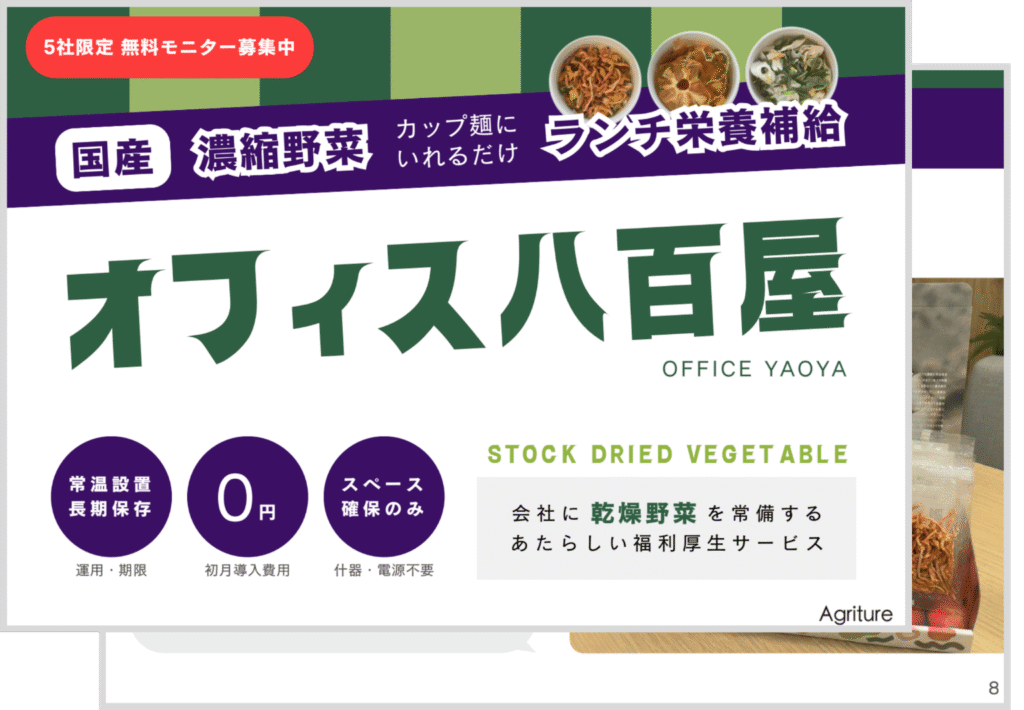
- Service details and vegetable lineup
- Pricing and plans
- How adoption and operation work
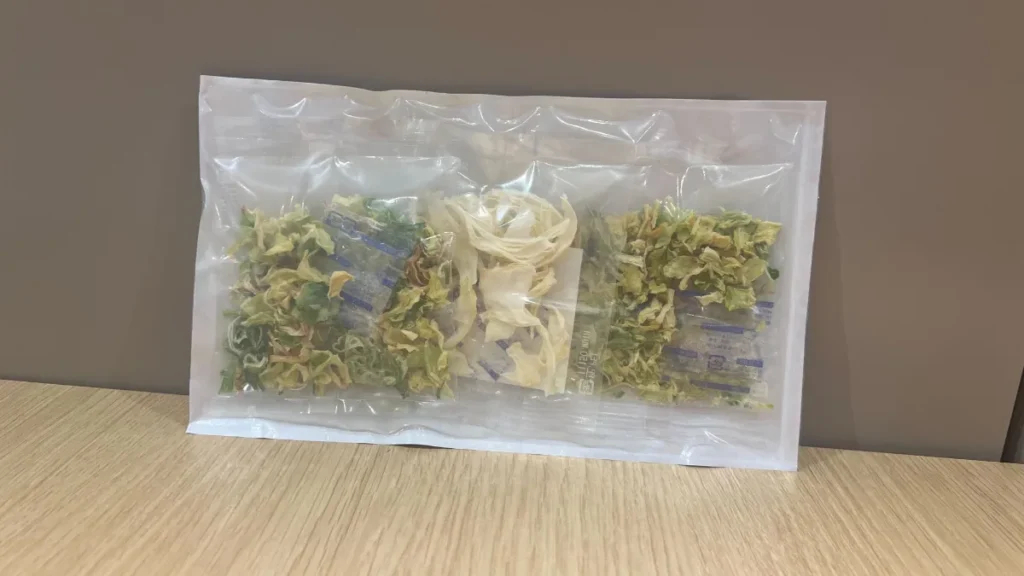
Sample sets are also available. Download the materials for details!
We offer sample sets so you can try Office Yaoya in small quantities. See the materials for details.
Comparison table of measures: cost, effect, and ease of adoption
If you're unsure which measure to choose, refer to the comparison table below.
A thorough comparison of the five measures
| Measure | Monthly cost / person | Adoption difficulty | Vegetable-intake effect | Employee satisfaction |
|---|---|---|---|---|
| Regular dried-vegetable delivery | 1,500–3,000 yen | Low | High | High |
| Meal-subsidy app | 3,500–6,000 yen | Moderate | Moderate | High |
| Online nutrition guidance | 5,000–8,000 yen | Moderate | Medium to high | Moderate |
| Corporate vegetable-delivery contract | 2,000–4,000 yen | Low | High | High |
| Running a food community | Roughly 0 yen | Low | Low to medium | Moderate |
Recommended combination patterns
Personally, I feel the combination of "regular dried-vegetable delivery + a food community" has the best cost performance. Dried vegetables have a low cooking hurdle, and if people share "I made soup with this dried vegetable today" in the community, the habit of taking in vegetables spreads naturally.
Steps from adoption to measuring effectiveness
Employee-benefit measures aren't "adopt and done." Run a PDCA cycle to maximize the effect.
Step 1: Grasp the current state (month 1)
Survey the reality of employees' diets with a questionnaire. Be sure to ask three things: "daily vegetable intake," "lunch pattern," and "meal-related troubles."
Step 2: Select and adopt a measure (months 2–3)
Select a measure based on the survey results. First pilot it with a small group and gather feedback.
Step 3: Measure effectiveness and improve (after 6 months)
Measure the effect with periodic health-checkup data and another survey. Tracking the following indicators makes it easy to understand.
| Measurement indicator | Measurement Method | Guideline target value |
|---|---|---|
| Self-reported vegetable intake | Questionnaire | +50 g/day |
| Abnormal-finding rate on health checkups | Annual checkup data | 5% improvement year over year |
| Presenteeism | WHO-HPQ, etc. | Score improvement |
| Usage rate of the measure | Usage data | 70% or more |
| Employee satisfaction | Engagement survey | 4.0/5.0 or higher |
Why dried vegetables suit employee benefits
Among the five measures, dried-vegetable delivery pairs exceptionally well with remote workers.
Room-temperature storage means no hassle receiving deliveries
Refrigerated and frozen ingredients pose a problem for receiving when no one's home, but dried vegetables can even be dropped in the mailbox. The shelf life is long too, so there's no problem even if you don't use them when they arrive.
Nutritional value is maintained
Agriture's dried vegetables use a low-temperature drying method that minimizes the loss of vitamins and minerals. Because fiber is concentrated to about 10 times per unit weight compared with fresh vegetables, you can take in nutrition efficiently even in small amounts.
Cooking time is nearly zero
Just add them straight to miso soup or soup. Even just adding dried vegetables to a cup soup greatly boosts vegetable intake. What matters most is that it disarms remote workers' biggest excuse: "I'm too busy to eat vegetables."
Download the office dried vegetable materials
We will send the materials to your email address based on the information you provide.
A dried-vegetable service to start with at low cost
A representative example is this, which Kai Group's Agriture Inc. began offering in earnest in April 2026: Office Yaoya (office greengrocer). Individually wrapped dried vegetables—100% domestic vegetables, no added sugar or additives, low-temperature dried to concentrate flavor and nutrition—are designed so you can top up vegetables just by adding them straight to cup noodles or miso soup. Because it buys off-spec vegetables that are misshapen and can't go to market from producers at a fair price and upcycles them, it's a structure that lets you implement both health management and food-loss reduction in a single service.
There's also a plan that can deliver to teleworking employees' homes, so it accommodates both in-office and at-home ways of working.
Learn about Office Yaoya
We have prepared materials
- Service details and vegetable lineup
- Pricing and plans
- How adoption and operation work
Sample sets are also available. Download the materials for details!
We offer sample sets so you can try Office Yaoya in small quantities. See the materials for details.
Summary
Teleworking employees' vegetable shortfalls are not an individual problem but a corporate health-management issue. Leave them unaddressed and they come back to bite management in the form of declining performance and rising medical costs.
Here are the key points of the countermeasures.
- About 65% of remote workers eat almost no vegetables at lunch
- Vegetable shortfalls cause presenteeism, leading to a loss of about 600,000 yen/person a year
- Among employee-benefit measures, "regular dried-vegetable delivery" excels in the balance of adoption cost and effect
- After adopting a measure, measure effectiveness on a 6-month cycle and run a PDCA loop
Start with an employee survey and consider a measure that fits your company. Agriture also takes inquiries about dried-vegetable sets for corporations.
FAQ
Recommended reading
Sustainable initiatives / Commercial dried vegetables / Product lineup / The foods Gen Z chooses. An era when environmental consideration becomes brand strength / Stockpile Food for Stranded Commuters | A Practical Guide Compliant with Tokyo Metropolitan Ordinances
- 16 Popular Healthy Office Snacks! How to Choose Them for Health & Productivity Management
- Five tips for getting a health-management meal measure approved | Data and cost-effectiveness
Author of this article
Related articles
-
 [2026 edition] What is a meal subsidy as an employee benefit? A guide to adoption steps and a comparison of popular services
 -
[2026 edition] Meal-subsidy benefits usable at convenience stores | 3 ways to adopt them tax-free
-
[2026 edition] 6 disadvantages of placed staff meals and how to avoid them | An adoption checklist to avoid failure
-
 A Must-See for HR: 12 Measures to Raise Employee Satisfaction Through Benefits
 -
 Food Questions in the Health and Productivity Management Survey: What to Write to Score Points
 -
Summary of tax benefits for dining subsidies | Tax-exemption requirements and expense booking
-
Food Programs for Health and Productivity Management: How Much Will It Actually Cost for a Company Our Size?
-
Meal-benefit plans that even small offices of 10 or fewer people can start