Dried karashina


TOC
Dried Karashina: product overview
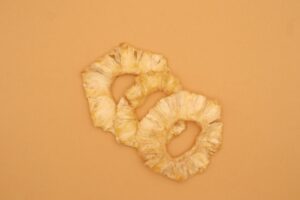
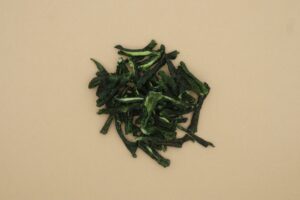
Karashina is a vegetable characterized by a sharp pungency and a faint aroma. Kyoto-grown karashina in particular is strongly aromatic, and its distinctive pungency enhances a dish. Drying concentrates the pungency and aroma and allows long-term storage. Because the pungency is felt firmly even after rehydration, it is ideal as an ingredient for pickles and dressed dishes.
Also, processed into powder, it can be used for flavoring dressings and soups, or as an accent in processed foods.
Three commitments Agriture values
01 Aromatic Kyotango-grown karashina cultivated by partner farmers
Karashina is a leafy vegetable in the Brassicaceae family, also known as the raw material for Japanese mustard. Using aromatic karashina harvested in early spring by partner farmers in Kyotango, we dry-process it without losing the pungency and aroma.
02 Low-temperature processing that makes the most of the pungent components
Karashina's characteristic sharp pungency comes from pungent components that volatilize easily, and if the heating temperature is too high, it is quickly lost. At Agriture, by drying slowly at low temperature, we achieve a finish where the aromatic-vegetable character with its sharp pungency remains even after rehydration.
03 An additive-free primary-processed raw material
We use no spice blends to emphasize pungency, or glucose coating for color retention, whatsoever. Because we make the most of the ingredient as-is, it can be used with confidence in product development that appeals to domestic and additive-free.
Product catalog showing the items we handle
Flexible support from small lots to large lots
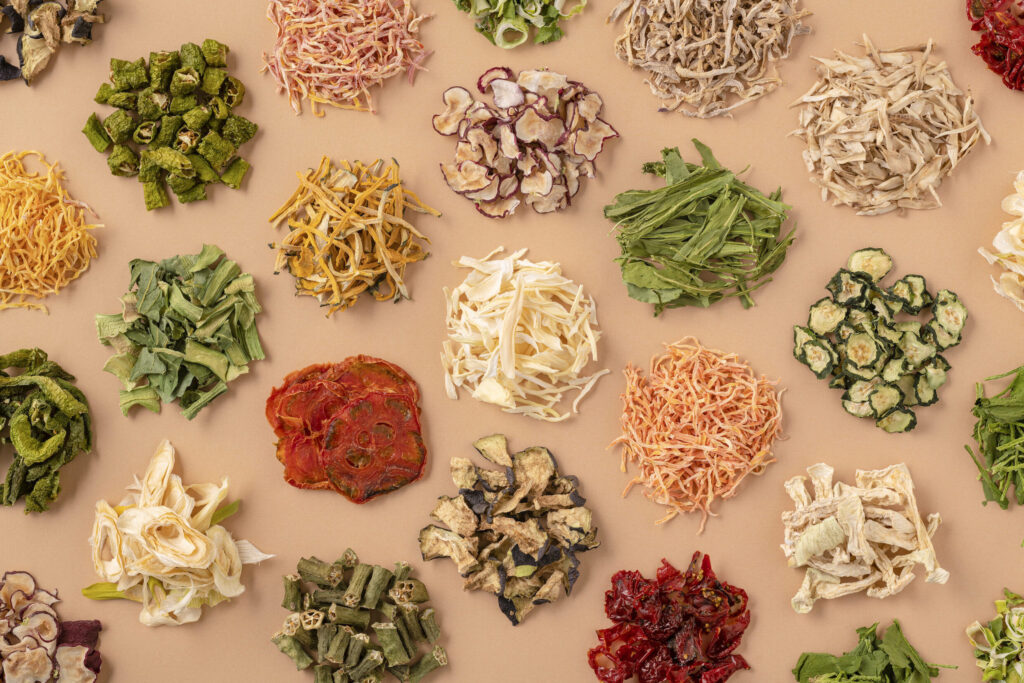
- Sold in small lots from 1 kg
- Handling heirloom vegetables from across Japan
- Dried fruits and herbs also supported
Characteristics as a commercial raw material
Scarce domestic karashina
A leafy vegetable with little domestic distribution and hard to secure in commercial lots, supplied stably in partnership with partner farmers in Kyotango. It supports product development with originality.
Differentiation as a spicy aromatic vegetable
Because it has a pungency akin to Japanese mustard, its appeal is being usable positioned as a spice substitute rather than just a leafy vegetable. It lets you add unique character to menu development.
Ease of use with no rehydration needed
Just adding it dried straight to soups or stir-fries brings up aroma and pungency. A commercial-oriented design easy to build into store operations.
Turned into seasoning through powdering
Pulverized, it can also be used as a raw material for dressings, Japanese-style sauces, and spice mixes. An easy material to build into the development of original seasonings.
Year-round supply stabilizes product development
Because a leafy vegetable with a short harvest season can be stocked year-round as a dried product, you can operate without slowing the pace of new-product development.
Small-lot OEM support too
Small-lot support from 100g units / 10 bags is possible, making it an easy raw-material setup to use for prototyping new spicy menus and limited OEM products.
Product specifications
Item | Details |
|---|---|
Raw material growing region | Kyoto Prefecture (partner farm) |
Specification | Rough cut |
Storage method | Room temperature (store away from high heat and humidity) |
Best-before date | 6 months from the shipping date |
Minimum lot | From 10 bags / 100 g |
Powder | Available |
Manufacturing period | Spring |
Customization and OEM support
Through cooperation with partner farmers and our own processing facilities, Agriture achieves stable raw material supply and high-quality manufacturing. We can flexibly accommodate OEM manufacturing and also handle consultations on specification changes and packaging.
- Custom-size support (cut-thickness changes, shape adjustments): consultation available for orders of 10 kg or more
- OEM support: available (from small-lot prototyping to mass production)
- Large-lot manufacturing: available (consultation required 3 months before the manufacturing period)
POWDER
We also offer powder products
Agriture offers not only dried vegetables but also a wide range of commercial vegetable powders. If you want to use them as an ingredient for dressings, sauces, or bakery products, please also see the powder product list.
Commitments to variety, producer, growing region, and cultivation
BRAND
Variety:Karashina (mustard greens). A leafy vegetable in the Brassicaceae family, also known as the raw material for Japanese mustard, characterized by a sharp pungency and distinctive aroma.
PRODUCER
Producer:Partner farmers centered on Kyotango, Kyoto. Adjusting the cultivation schedule to coincide with the early-spring harvest season, they harvest it in an aromatic state.
REGION
Growing region:Kyotango, Kyoto-grown. The day-night temperature swings of spring and the sea breeze are an environment that brings out pungency and aroma.
CULTIVATION
Cultivation method:Mainly open-field cultivation. Harvested all at once to coincide with the short spring harvest period, it is brought into the processing facility the same day and moved into the drying process.
*Reference: OYAOYA product page
Low-temperature drying that preserves the ingredient's character
At Agriture, to make the most of karashina's flavor, color, and texture, we use a drying method that draws out moisture slowly over time at low temperature. While high-heat hot-air drying can remove moisture in a short time, it has the drawback that aroma components, pigments, and heat-sensitive vitamins are easily lost. Low-temperature drying can raise the raw material's shelf stability while retaining these components as much as possible, characteristically bringing up the ingredient's natural flavor when rehydrated.
💡 TIPS | Drying-processing trivia
Karashina's pungent component is a volatile compound called allyl isothiocyanate. Because too much heat makes the aroma fly off all at once, at Agriture we use a drying design that removes moisture at low temperature in a short time, adjusting it so that a sharp flavor revives when rehydrated.
Use cases for dried karashina
Karashina is a dried leafy vegetable well suited to product development that makes the most of a sharp pungency and aroma. It can be widely used for differentiating restaurants' standard menus and for processed-food OEM such as seasonings and furikake.
Ingredient for spicy Japanese-style pasta and ramen
Rehydrated and stir-fried in oil, it becomes a lead material for Japanese-style pasta where a sharp aroma rises. As a topping for ramen or udon too, it pairs well with salt- or soy-sauce-based soups.
Raw material for spicy lightly-pickled and takana-style pickles
Pickled with salt, vinegar, or soy sauce, it finishes into spicy lightly-pickled dishes or takana-style pickles. It is used as a rice-friendly side dish in boxed-lunch and set-meal-shop menus.
Raw material for spice mixes and furikake
Pulverized and combined with other spices or dried vegetables, it can be processed into Japanese-style spice mixes and takana-style furikake. An easy material to build into an OEM brand's seasoning lineup.
Accent material for meat dishes
It also shines as a topping for pork or chicken stir-fries and tsuke-soba. With karashina's characteristic sharp pungency and aroma, it can add variation to a menu prone to monotony. Because the dried product keeps pungency and aroma stable, and only the needed amount can be used at room temperature, it also suits commercial use.
Ingredient for dressings and Japanese-style sauces
Combined with oil or vinegar and processed into dressings or sauces, it lets you make a seasoning that becomes an accent for salads, grilled dishes, and steamed dishes. Recommended for new dressing development too.
About commercial and OEM consultations
At Agriture, in partnership with karashina partner farmers in Kyotango, we build a processing schedule timed to the short spring harvest season. We flexibly handle small-lot prototyping from 100g units, cut-specification changes, and powder processing.
Past initiatives and adoption projects can also be seen on the following pages.
- Past initiative case studies are here
- Commercial dried vegetable OEM here
- Commercial vegetable powder here
Product catalog showing the items we handle
Flexible support from small lots to large lots
- Sold in small lots from 1 kg
- Handling heirloom vegetables from across Japan
- Dried fruits and herbs also supported
FAQ about dried karashina
Q. Please tell me the minimum lot for dried karashina and the volume per bag.
A. For commercial use, we can do business from a minimum of 10 bags at 100 g per bag. We can accommodate small lots even at the prototyping and test-adoption stage, and for mass production you can consult with us on package specifications and lot quantities.
Q. What is the commercial price range?
A. The price varies with the raw material market, specifications, lot size, and cut specifications. When you inquire, we will propose a quote to match your desired specifications and lot, so first let us know your required conditions.
Q. What is the lead time from order to delivery?
A. Stocked items can be shipped in about a few days to a week. For made-to-order or custom specifications, there are cases where we ask for a lead time of about two weeks to a month, including raw material preparation and the drying process. Consulting early provides reassurance.
Q. Can you obtain a certificate of origin for the raw material?
A. Depending on the client's request, we can prepare a certificate of origin for the raw material. Since there are cases where we can provide it together with the cultivation information of partner farmers, please let us know the documents you need in advance.
Q. Can you handle food-sanitation and HACCP compliance and export-oriented support?
A. Agriture's processing carries out hygiene management in line with the HACCP approach, and you can consult us on dried vegetable raw materials for export as well. Please also consult us on confirming requirements by destination country and label support when you inquire.
Q. For an OEM request, in what flow should I consult?
A. First, let us know your product image, lot quantity, and desired delivery date via the inquiry form. After a hearing, we propose prototyping, a quote, and a production plan, and once you approve, we schedule mass production—this is the general flow.
Q. Can you handle custom specification changes such as cut size and shape?
RETAIL
For those looking to purchase in small packs
For those who want to check the flavor starting small, our partner brand OYAOYA is selling retail packs of 20g, 80g, 200g, and 500g. They can also be used for prototyping at restaurants or as samples for retail rollout to households.
Recommended reading
- Kaga vegetables: Kanazawa brand vegetables where tradition lives on (traditional vegetable)
- Mustard greens powder
Download the product catalog
We will send the materials to your email address based on the information you provide.