A Guide to Drying Mushrooms: Making Dried Mushrooms in the Sun or Oven and Preventing Mold

Summary of this article
A guide to drying mushrooms at home. It covers the steps by method -- sun-drying, indoor drying, oven, and food dryer -- tips by variety such as shiitake and maitake, points to note for preventing mold, and how to rehydrate and store home-dried mushrooms.
You bulk-bought mushrooms when they were cheap, or can't use up mushrooms you were given -- at times like that, "drying" is a useful method. Dried, mushrooms keep well, and their umami and stock grow richer. On the other hand, many people puzzle over "which is better, sun or oven?", "I'm worried about mold," and "how long do I dry them to finish?"
This page puts together how to dry mushrooms at home, by method: sun-drying, indoor drying, oven, and food dryer. It explains tips by variety such as shiitake and maitake, points to note for preventing mold, and how to rehydrate and store home-dried mushrooms.
TOC
How do mushrooms change when dried?
When you dry mushrooms, the moisture leaves and shelf life improves. At the same time the umami concentrates, and stock can be drawn from the soaking liquid. Amounts you can't use up fresh can be dried and rehydrated just as needed, which also helps reduce food loss. The aroma and texture change too, giving depth to dishes -- that's the strength of dried mushrooms.
- Dry them thoroughly and seal them, and they become easy to store
- The umami concentrates, and the soaking liquid becomes stock
- You can rehydrate just what you use, so they're easy to use up
- The aroma and texture change, giving depth to dishes
How to dry mushrooms | 4 methods
There are broadly four ways to dry mushrooms: sun-drying, indoor drying, oven, and food dryer. Choose to suit the weather, your time, and your preferred finish. In every case, the common prep is to wipe off dirt, remove the stem base, and break into small pieces or slice thin before drying. First, grasp the overall picture with the comparison table below.
| Method | Suited situations | Guideline | Points to note |
|---|---|---|---|
| Sun-drying | A sunny, dry day | A few days | Bring them in at night, watch for rain |
| Indoor drying | Rainy weather, pollen, insect control | A few days | Blow air with a fan |
| Oven | When in a hurry | 1 to several hours | Low temperature, leave the door slightly open |
| Food dryer | Want a stable finish | A few hours | Set the temperature and time |
Sun-drying
The most convenient basic method, and umami comes out readily too. It suits sunny days when the air is dry.
- Arrange them on a colander or drying net without overlapping
- For shiitake, cap gills (the underside) facing up dries them more easily
- Turn them over partway, and bring them in at night or in rain
- If fine weather continues, they finish crisp in a few days
Indoor drying
A method suited to rainy days, or when pollen or insects bother you. Moving air is the key point.
- Arrange them on a drying net in a well-ventilated spot
- Blow a fan's weak breeze on them to drive off the moisture
- On humid days they dry slowly, so allow more time
- If dampness remains, finish them in the oven or a dryer
Oven
Convenient when you want to finish in a short time, unaffected by the weather. Use it with the image of drying rather than roasting.
- Slice thin or break into small pieces and arrange on the tray without overlapping
- At a low temperature, leave the door slightly open to let moisture escape
- Swap top and bottom partway to prevent unevenness
- Dry while watching so as not to scorch them
Food dryer
You can set temperature and time, and it's the most stable finishing method. It suits large amounts too.
- Arrange them on the tray without overlapping
- Set the temperature and time per the machine's guide
- The finish is stable, unaffected by weather or room temperature
- Running it a bit longer at the end raises shelf life
A product catalog that shows around 100 items we handle
Agriture, flexibly handling everything from small lots to large lots
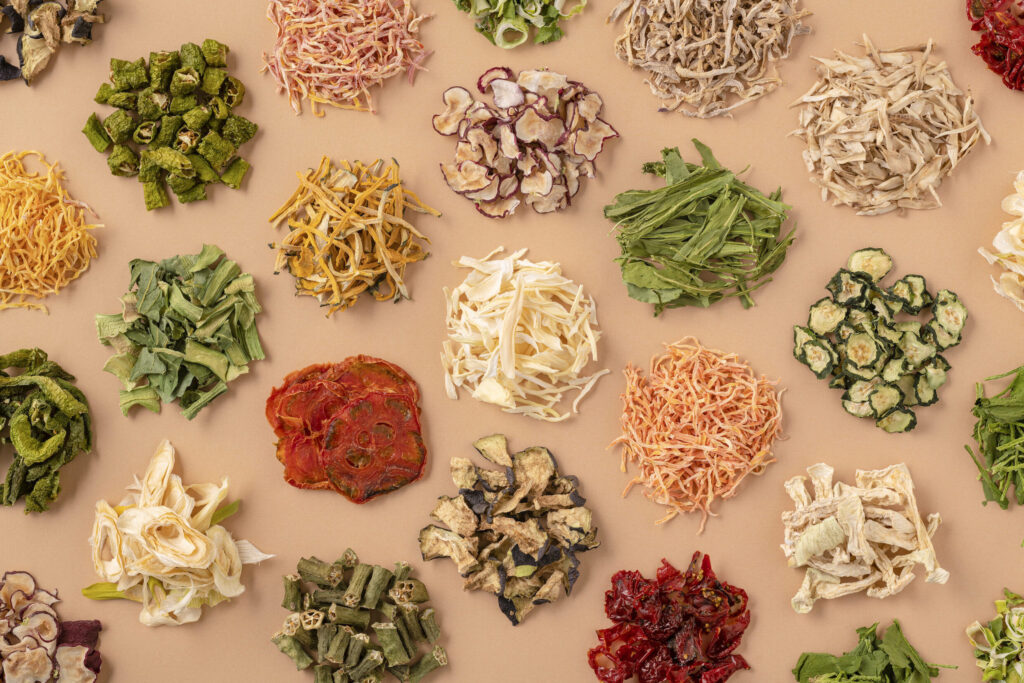
- Available for purchase in small lots from 1 kg
- We handle heirloom vegetables from across Japan
- Dried fruit and herbs also supported
FOR BUSINESS
乾燥野菜を業務用でお探しですか
国産の野菜・果物を乾燥し、必要に応じて粉砕してお出ししています。扱っている品目は100種前後で、規格は 乾燥品の一覧・パウダーの一覧 に掲載しています。
少量でのご購入は、姉妹ブランドの通販サイト OYAOYA で承っています。
Drying tips by variety
Since mushrooms differ by variety in moisture content and shape, there are a few tricks to drying too. Here we introduce how to dry representative mushrooms.
Shiitake, maitake, and kikurage
Even the same "drying" changes a little in how you cut and dry by variety. Handling the three representative kinds as follows makes failure less likely.
- Shiitake: whole or sliced is fine. Drying with the cap gills facing up dries them more easily
- Maitake: breaking into small pieces to dry dries them faster and keeps the aroma
- Kikurage: it shrinks when dried, so cut it a bit large. Always heat it after rehydrating before use
For how to use them after drying, see Dried shiitake・Dried Maitake・dried kikurage for detailed explanations in each article.
Enoki, shimeji, and bunashimeji
For enoki and shimeji, since the clusters are fine, there's a knack to the prep. They finish easy to dry and easy to use in cooking.
- Enoki: divide the cluster finely, and cutting long ones in half dries them more easily
- Shimeji, bunashimeji: cut off the base and break into small clusters
- Dry several kinds mixed together for a dried mushroom mix good for miso soup and soups
For using different mushrooms in general, see Dried mushroom usage guide is also a helpful reference.
Points to note when drying, and how to prevent mold
What to watch out for in drying mushrooms is mold from under-drying. Master judging the finish and the storage tips.
Dry them completely and avoid under-drying
Stored while still under-dried, the remaining moisture causes mold. The guide is to dry them until no limp parts remain to the touch and they snap crisply. Large ones dry slowly to the center, so slice them thin or take time to dry them. On rainy or humid days they dry slowly, so don't force it; using the oven or a dryer alongside gives peace of mind.
- Dry them firmly until they snap crisply
- Slice large ones thin so they dry to the center
- On humid days, use a dryer or oven alongside
- Once dried, let them cool, then seal and store with a desiccant
How to rehydrate and store home-dried mushrooms
Once the mushrooms are dried, mastering the rehydration and storage tips lets you use them deliciously to the last.
Rehydration and storage tips
Home-dried mushrooms are rehydrated in water and used just like store-bought ones. Soak them in plenty of water, and the soaking liquid can be used as stock. For miso soup or mixed rice, adding them as is without rehydrating and simmering is easy too. For storage, seal them away from moisture and direct sunlight, put in a desiccant, and use them up soon. For details on rehydrating, see A guide to rehydrating dried vegetables, and for storage, how to store dried vegetables and their best-before date.
For fuss-free use, store-bought dried mushrooms and commercial-grade too
If drying them yourself is a hassle, or you want consistent quality, using store-bought dried mushrooms or commercial-grade is also an option. If you use large amounts at a restaurant, buying commercial-grade in bulk is efficient. When you want to make them an ingredient for your own product using mushrooms, contract processing that handles everything from drying to milling the raw material is convenient. For commercial OEM of mushrooms, see the Commercial Mushroom OEM Guide, and for contract processing of dried vegetables in general, see Dried vegetable OEM and contract processing. You can inquire about domestic ingredients from small lots.
FOR BUSINESS
乾燥野菜を業務用でお探しですか
国産の野菜・果物を乾燥し、必要に応じて粉砕してお出ししています。扱っている品目は100種前後で、規格は 乾燥品の一覧・パウダーの一覧 に掲載しています。
少量でのご購入は、姉妹ブランドの通販サイト OYAOYA で承っています。
Frequently asked questions
Summary: dry mushrooms and use them up
If you dry them thoroughly by any of sun, indoor drying, oven, or food dryer, you can easily make dried mushrooms even at home. The umami concentrates, the soaking liquid becomes stock, and you can rehydrate just what you use, so they're easy to use up. The trick to avoiding failure is to avoid under-drying, dry them completely, and store them sealed.
If drying them yourself is a hassle, or you want to use dried mushrooms of stable quality at a restaurant or in your own products, do consider commercial-grade and contract processing of domestic raw materials too.
Download the product catalog
We will send the materials to your email address based on the information you provide.
- 山椒の種類は?実山椒・粉山椒・青山椒の違いを一覧で
- Prepping and Removing Bitterness from Green Sansho: Boiling Time, Freezing, and Salt-Curing Tips