Dried garland chrysanthemum (shungiku)

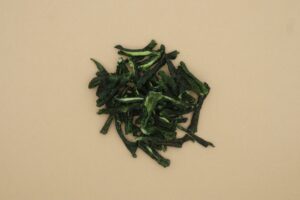
Shungiku (garland chrysanthemum) is a leafy vegetable of the Asteraceae family, a Japanese-cuisine staple ingredient characterized by a distinctive bitterness and a gorgeous aroma. Dried shungiku is a commercial raw material that carefully dries domestic fresh shungiku at low temperature and retains the aroma and green color unique to shungiku in a dried-leaf form. It is an ingredient we are often consulted about for food development wanting to make the most of the flavor and aroma of Japanese cuisine, such as an ingredient for hot-pot dishes, an ingredient for dressed dishes and ohitashi, and kneading into tempura batter. It has the characteristic that the aroma is concentrated through drying, and even a small amount brings out a shungiku-like flavor. For consultations on dried vegetable and powder OEM here and let us know your intended use and desired cut form.
TOC
Agriture's dried shungiku, three commitments
01 Concentrating the distinctive aroma with low-temperature drying
Shungiku's aroma comes from terpene-type components such as alpha-pinene and perillaldehyde, which have the property of volatilizing easily under high-temperature drying. At Agriture, we dry it over time using a low-temperature hot-air method, sealing the gorgeous aroma unique to shungiku into the dried leaf in a concentrated state. Because the aroma is more concentrated than fresh after drying, being able to bring out shungiku's presence with a small amount is a feature.
02 Supplying a flavor vegetable indispensable to Japanese cuisine year-round
Shungiku is a staple hot-pot ingredient, but its season is limited to autumn to winter, and the fresh product is a vegetable that spoils quickly. Dried shungiku can be stored at room temperature for about six months, enabling stable year-round supply. Hot-pot broth manufacturers and prepared-food factories can achieve raw-material procurement unaffected by season.
03 Integrated support from small-lot prototyping to mass production
At Agriture, we handle from small-lot prototyping in 1 kg units, and can also ship in parallel samples with different cut shapes and drying temperatures. Because for shungiku the balance of bitterness and aroma determines the product's completeness, we have a system in place to compare and consider the finish at the prototype stage.
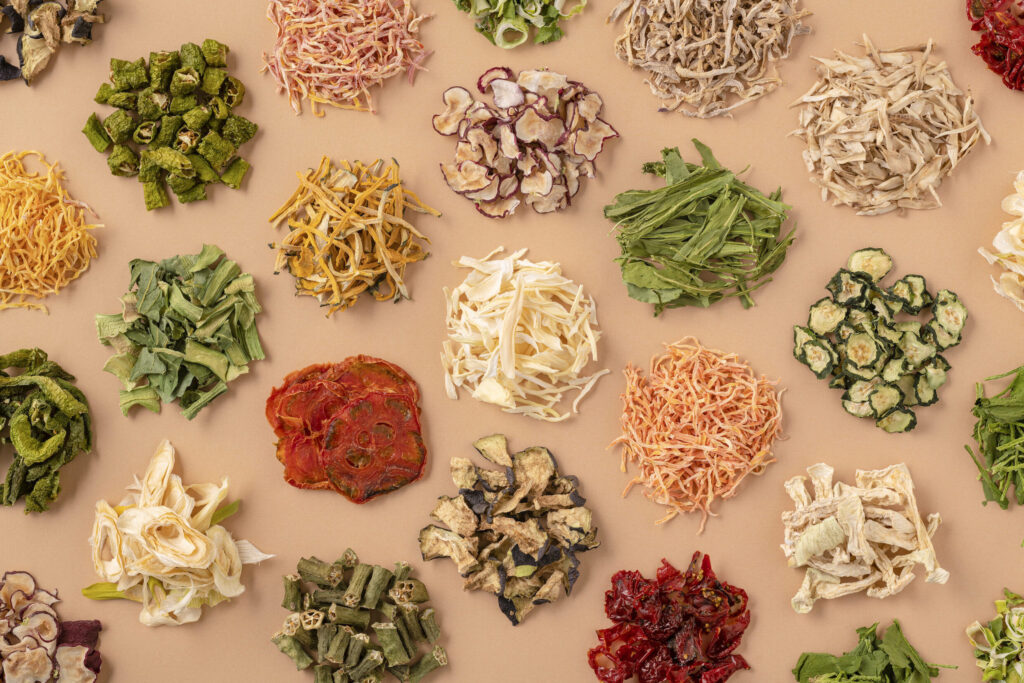
Product catalog showing the items we handle
Flexible support from small lots to large lots
- Sold in small lots from 1 kg
- Handling heirloom vegetables from across Japan
- Dried fruits and herbs also supported
Features of commercial dried shungiku
The distinctive aroma concentrated by drying
The terpene-type aroma components unique to shungiku become relatively concentrated as moisture is removed by drying. Because it can bring out shungiku's presence even in a small amount, it can efficiently impart flavor when blended into soup bases and seasonings.
The bitterness and freshness indispensable to Japanese cuisine
Shungiku's slight bitterness is an element that adds depth to the flavor of Japanese cuisine. It can be utilized as a commercial raw material for staple Japanese dishes that make the most of bitterness and aroma, such as hot-pot dishes, dressed dishes, and tempura.
Retention of vivid green color
Low-temperature drying suppresses the fading of chlorophyll and maintains the vivid green characteristic of shungiku. The color stands out when added to hot pots and soups, for a finish with high visual appeal.
Year-round supply with room-temperature storage
Fresh shungiku is a vegetable skewed to its season (autumn to winter) and quick to spoil, but the dried product can be stored at room temperature for about six months, enabling stable year-round supply. It can reduce the inventory-management burden as a commercial raw material.
Additive-free, domestic ingredients
It is finished with only shungiku leaves, without using colorings, preservatives, or flavorings. It is a specification well-suited to clean-label-oriented product design that wants to keep the ingredient list simple.
Powder development also accommodated
We also offer shungiku powder, made by milling dried shungiku. It suits uses where you want to spread shungiku's aroma evenly, such as blending into hot-pot broth bases and Japanese-style dressings.
Product specifications (commercial)
Item | Details |
|---|---|
Raw material | Shungiku (domestic) |
Shape | Dried leaf (choose from whole / coarsely crushed / crushed) |
Production method | Low-temperature hot-air drying |
Best-before date | About 6 months from the shipping date |
Processing plant | Our own processing plant within Kyoto Prefecture |
Shipping unit | 100g〜 |
Minimum-lot OEM | Prototype from 1kg / full production from 10kg |
Customization support
Item | Available | Details |
|---|---|---|
Cut form changes | ◎ | Selectable from whole leaf, coarsely crushed, and crushed |
Powdering | ◎ | Handles fine-milling processing as shungiku powder |
Small-lot OEM prototyping | ◎ | Prototyping available from 1kg |
Mixed materials and blends | ◎ | Blending with other dried vegetables is available |
Packaging changes | ◎ | Both commercial and small-portion individual packaging are available |
POWDER
A powder type is also available
We also stock shungiku powder, made by further finely milling dried shungiku. It is ideal for uses where you want to blend shungiku's aroma evenly, such as hot-pot broth bases and Japanese-style dressings.
Commitments to variety, grower, and growing region
The raw material used for dried shungiku is domestic shungiku purchased directly from partner farmers in Japan. Shungiku is a vegetable of the genus Glebionis in the Asteraceae family, and in Japan the Kanto large-leaf type and the Kansai medium-leaf type are mainstream. Leaf shape and the strength of bitterness differ by variety, and variety selection matched to the application determines the quality of the finish.
BRAND
Variety: Shungiku (genus Glebionis, Asteraceae family, Glebionis coronaria). A staple Japanese-cuisine leafy vegetable with a distinctive bitterness and gorgeous aroma. The large-leaf type has mild bitterness and is easy to eat, while the medium-leaf type is characterized by a firm aroma.
PRODUCER
Producer: We purchase from partner farmers linked with domestic shungiku growing regions. Because shungiku's freshness deteriorates quickly after harvest, we organize operations to shorten the lead time from harvest to processing.
REGION
Growing region: We procure raw material from growing regions suited to shungiku cultivation, centered on domestic warm regions. Because temperature difference affects the accumulation of bitter components, we also pay attention to growing-region selection.
CULTIVATION
Cultivation method: Under managed cultivation with reduced pesticide use, we have arranged a record-keeping system that can also meet the raw-material origin certification food manufacturers require.
Low-temperature drying technology and quality control
Alpha-pinene and perillaldehyde, which make up shungiku's aroma, are highly volatile, and under high-temperature drying much of the aroma is lost. At Agriture, we adopt a low-temperature hot-air method with finely controlled temperature and airflow, organizing a drying program that removes only moisture while suppressing the volatilization of aroma components. Shungiku has the characteristic of the aroma being concentrated by drying, and with appropriate low-temperature treatment it finishes as a dried leaf with a stronger aroma than fresh.
Manufacturing is managed in an integrated way at our own processing facility in Kyoto Prefecture, securing traceability from raw-material receiving to shipment. We have standardized the process of packing after a foreign-matter removal step, and we also accommodate the issuance of analysis reports and raw-material origin certificates required for OEM projects.
TIPS | Trivia on drying shungiku
Shungiku is a vegetable with the distinctive aroma characteristic of the Asteraceae family, and in Europe it is called garland chrysanthemum, with ornamental use being mainstream. Using it routinely as food is a food culture unique to East Asia, and dried shungiku is a rare flavor ingredient usable in both Japanese and Chinese cuisine. At Agriture, making the most of the aroma-concentrating effect of drying, we propose raw-material design that brings out a shungiku feel with a small amount, which is hard to achieve with fresh shungiku.
Use cases and adoption examples
As an ingredient for hot-pot dishes and sukiyaki
Dried shungiku can be used as a staple ingredient for hot-pot dishes and sukiyaki simply by putting it directly into the pot. Steeped in hot soup, it rehydrates soft in 2-3 minutes, and shungiku's aroma spreads throughout the pot. It is an area we are often consulted about for incorporation into hot-pot broth manufacturers' dried-ingredient sets.
As an ingredient for dressed dishes and ohitashi
Rehydrating dried shungiku in water and making it into sesame-dressed dishes or ohitashi lets you offer shungiku dressed-dish menus year-round. Fresh shungiku is a vegetable with a limited season and quick to spoil, but the dried product lets prepared-food factories manufacture side dishes of stable quality.
As an ingredient for kneading into tempura batter and coating
Mixing shungiku powder or finely crushed dried shungiku into tempura batter transfers shungiku's aroma to the coating and can be utilized for variation development of kakiage and tempura. With the dried product, weighing is easy and prep efficiency can be raised.
As an ingredient for miso soup and Japanese-style soups
Adding dried shungiku to miso soup or clear soup makes the chrysanthemum aroma spread softly throughout the soup. It can be utilized as an ingredient for instant miso soup and as one ingredient in Japanese-style soup kits, and it also pairs well with freeze-dried-method soups.
As an ingredient for pickles and tsukudani
Half-rehydrating dried shungiku and then soaking it in a seasoning liquid makes it possible to offer shungiku tsukudani or light pickles year-round. The development of processed products that was difficult because fresh shungiku spoils quickly can also be manufactured at stable quality with the dried product.
Blend development with other dried vegetables
We also handle the design of Japanese-style dried-vegetable mixes combining it with dried spinach, dried komatsuna, dried negi, and more. List of dried vegetables We can propose combinations with other ingredients from .
Commercial usage and rehydration
Dried shungiku rehydrates in about 2-3 minutes when put directly into hot water or soup. When using it as an ingredient for hot-pot dishes or soup, the ease of putting it in directly without rehydration is an advantage. When using it in dressed dishes or ohitashi, soak it in room-temperature water for about 10-15 minutes to rehydrate before seasoning.
For storage, airtight storage avoiding high temperature and high humidity is best. Because chlorophyll in particular fades easily with light, we recommend storage in light-blocking packaging material. Using it up promptly after opening, or reducing air contact with a zip bag, keeps the quality longer.
Related cases and articles
- Shungiku powder (powder-version product page)
- List of dried-vegetable and herb products
- For consultations on dried vegetable and powder OEM here
Product catalog showing the items we handle
Flexible support from small lots to large lots
- Sold in small lots from 1 kg
- Handling heirloom vegetables from across Japan
- Dried fruits and herbs also supported
Frequently asked questions
Q. What is the minimum lot and prototype handling?
A. We accept prototyping from 1 kg and main production from 10 kg. Simultaneous prototyping of multiple shapes such as leaf, coarsely crushed, and powder is also possible. We can also prepare samples with an adjusted balance of bitterness.
Q. Can the bitterness of shungiku be adjusted?
A. Through variety selection (the large-leaf type is mild, the medium-leaf type has firm bitterness) and adjustment of drying temperature, the intensity of bitterness can be controlled to some degree. We can also propose a variety with a firm aroma for hot-pot use and a mild variety for dressed-dish use.
Q. What is the lead time?
A. In-stock items can be shipped 1-2 weeks after order. For new processing to a customized specification, a guideline is 1-2 weeks for prototyping and 3-4 weeks for main production. We can also consult about advance handling timed to the autumn-to-winter harvest season.
Q. Can you issue a raw-material origin certificate?
A. We can issue a certificate of raw-material origin proving it is domestic shungiku. Regarding microbial test reports as well, we proceed with issuance after consultation on each project.
Q. Doesn't the aroma weaken when dried?
A. Because shungiku's aroma components are mainly volatile terpenes rather than water-soluble, appropriate treatment with low-temperature drying concentrates the aroma in proportion to the moisture removed. A feature is that the aroma intensity per weight becomes higher than fresh shungiku, bringing out shungiku's presence even in a small amount.
Q. Can it be blended with other dried vegetables?
A. We handle pre-blending with dried spinach, dried komatsuna, dried negi, and more. Consultations on blend design combining multiple ingredients, such as ingredient sets for hot-pot broth and ingredient mixes for miso soup, are possible.
Q. Please tell me the OEM consultation flow
A. The flow is: consultation via the inquiry form → concept hearing → sending samples → paid prototyping → finalizing the specification → main production. Because for shungiku the balance of bitterness and aroma determines the product's completeness, we handle it with a system that can compare and consider multiple patterns at the prototype stage.
Recommended reading
- Shungiku powder (details of the powder version)
- List of dried-vegetable and herb products
- For consultations on dried vegetable and powder OEM here
- We prototyped “dried garland chrysanthemum” using domestic garland chrysanthemum
Download the product catalog
We will send the materials to your email address based on the information you provide.