Dried radish


TOC
Product Overview of Dried Radish
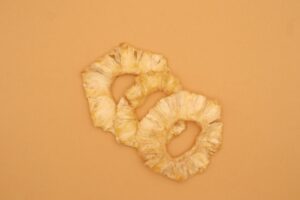
Uses radishes carefully grown by young farmers in Kyotamba, Kyoto. Radishes, characterized by juicy sweetness and a glossy red appearance, have their sweetness drawn out even further by drying, and their flavor firmly remains even in heat-cooked dishes.
Unlike the light, crisp ”crunch” that fresh radishes have, after rehydration they transform into a firm texture you can really chew. Because the aftertaste lingers in both taste and texture, they are used broadly as an accent material for color and sweetness.
The red color characteristic of radishes can add gorgeousness to dishes even after drying, so they can also be used for prepared dishes, salads, and sweets-type toppings. Put them to use in building differentiated menus that make the most of sweetness and color.
Three Commitments Behind Our Dried Radish
01 A regional-production project by young farmers in Kyotamba
Kyotamba is a growing region where young farmers, our partner-farmer contacts, work on regional revitalization centered on radishes. Agriture works with this regional-production project, "Kyotamba Radish," and continuously procures raw material in a form that includes the use of off-spec produce.
02 A surprising sweetness drawn out by drying
Fresh radishes have a light, crisp texture and a sharp pungency as their selling points, but when dried, moisture is removed and the sugar content concentrates, finishing surprisingly sweet. Helped by the varietal character that grows even sweeter when heated, it becomes a material that also works for sweets applications.
03 A color-fixing design that makes the most of the vivid red
Radish's red color has very high value as an accent for dishes, and we manage temperature thoroughly so the color does not fly off even in the drying process. It is a material well suited to visual-focused product development such as sweets, salads, and colorful mixes.
Product catalog showing the items we handle
Flexible support from small lots to large lots
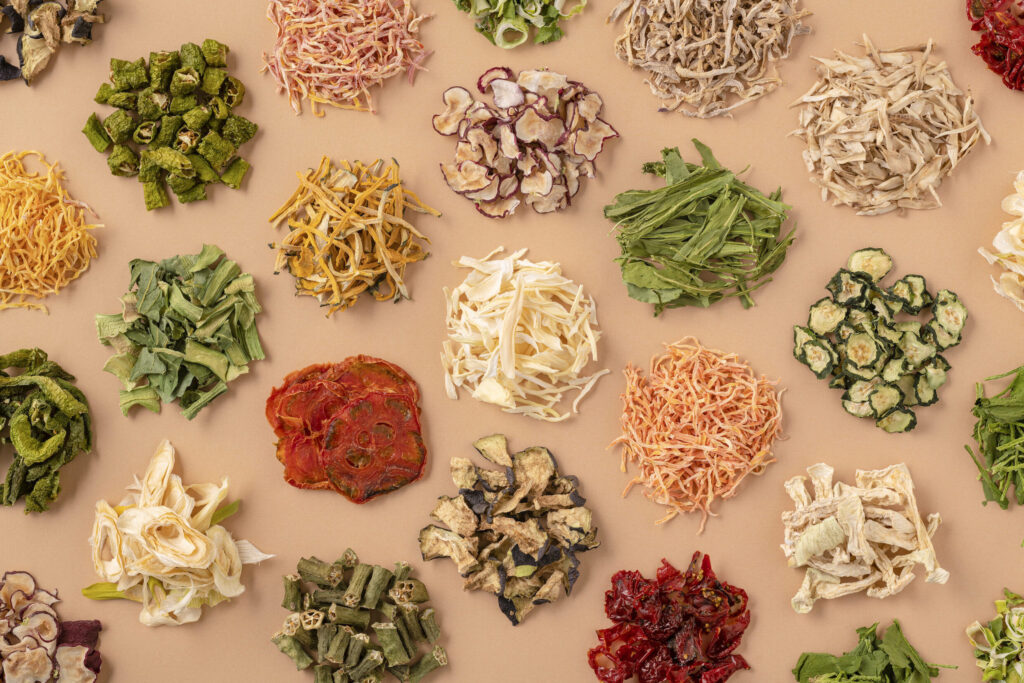
- Sold in small lots from 1 kg
- Handling heirloom vegetables from across Japan
- Dried fruits and herbs also supported
Features of Commercial Dried Radish
Produced in Kyotamba, Kyoto
Uses radishes with deep redness and appealing juicy sweetness. It is a raw material from limited cultivation through collaboration with young farmers.
Chewy texture
Drying transforms it, after rehydration, into a chewy, satisfying texture. It is a texture with a different kind of satisfaction from the raw form.
Red color development
A red glossiness firmly remains even after drying, adding a natural accent color to dishes. Vegetable-derived red is also useful as a substitute for synthetic coloring.
No glucose added
A specification that dries the ingredient just as it is, with no post-treatment such as sugar-syrup soaking.
Vegetable-sweets ingredient
It holds a distinctive position as an ingredient for vegetable sweets, such as rapee, baked goods, scones, and jellied dishes.
Direct collaboration with young farmers
Because it is purchased directly from a regional project that supports young farmers' activities, it is a raw material well suited to product plans accompanied by a story.
Main use
It can be used as a color material for salads, marinades, and cold dishes, as an ingredient for baked goods, scones, and bread that make the most of the sweetness, as a material for vegetable snacks and dried-mix OEM, and as a raw material for vegetable sweets and rapee.
Product specifications
Item | Details |
|---|---|
Raw material growing region | Kyoto Prefecture (partner farm) |
Specification | Round slices |
Storage method | Room temperature (store away from high heat and humidity) |
Best-before date | 6 months from the shipping date |
Minimum lot | From 10 bags / 100 g |
Powder | △ |
Manufacturing period | Spring and from autumn on |
Customization support
Custom size support (cut-thickness change, shape adjustment): can be discussed for orders of 10kg and up. OEM support: available. Large-lot production: available (consultation required 3 months before the production period). Past initiative case studies are here。
Variety, grower, origin
BRAND
Cultivar:Red-daikon-type radish (twenty-day radish). We use varieties that are large-bulbed and tender-fleshed compared with other regions, delicious to eat even sauteed or in tempura.
PRODUCER
Producer:Partner farmers in Kyotamba, Kyoto. Having made a U-turn back to farming in the food town of Kyotamba, they work on regional revitalization centered on radishes as the successor to their grandfather.
REGION
Production area:Kyotamba, Kyoto. A major Kyoto-vegetable producing area, and a region where young farmers' efforts toward regional production of radishes are advancing.
CULTIVATION
Cultivation method:Harvested twice a year, in spring and from autumn on, under the careful management of young farmers. For detailed origin information, see the Kyotamba Radish project page .
*Reference: OYAOYA product page
Low-temperature drying that draws out radish's sweetness
Drying radishes concentrates the starch and sugars, making them feel far sweeter. At Agriture, we assess the temperature range that draws out sweetness while keeping the red color, and dry them sliced one by one into rounds.
💡 TIPS | Drying-processing trivia
Radish's red color comes from anthocyanin-type pigments, which have the property of being easily affected by heat, light, and pH. Because rapid drying at high heat browns the color, removing moisture slowly at low temperature keeps both color and sweetness.
Use cases
Color for salads and marinades
This is a use easy to adopt as a color material at restaurant chains that run salad bars and at delis and prepared-food makers. Fresh radishes tend to pose challenges of freshness management and yield, but with the dried product you can curb inventory loss with room-temperature storage while rehydrating only the needed amount. Soaked in marinade liquid, the liquid dyes faintly pink, and it can be used to differentiate the visuals of bento, appetizer plates, and buffet lines. Because slice thickness and cut shape can also be handled in specifications to your requirements, please consult us to match your delivery format.
Vegetable-sweets ingredient
At food makers and EC brands handling OEM of baked goods and sweets or developing their own brands, radish-derived pale pink can be put to use in product-making that differentiates by using it as a natural-color substitute. Fresh radishes tend to pose on-site challenges of stable color development and prep labor, but with the dried product, bulk room-temperature storage is possible, and blending it into scones, pound cakes, and mousse bases is simple. Because we can supply it in specifications to suit the shape and purpose, such as ground powder or slices, we can also accommodate material design matched to the product concept.
Jellied dishes and pickles
It has a track record of adoption as a color-developing material for catering and delis handling hotel buffets and appetizer plates. Fresh radishes pose on-site challenges of freshness management and discoloration risk, but with dried slices, soaking them directly into pickle liquid or jelly base lets the red naturally dissolve out, stably reproducing an eye-catching finish. Because bulk room-temperature storage and using up only the needed amount are possible, it achieves operation that raises the prep efficiency of appetizer menus while curbing disposal loss.
Making use of the rehydration liquid for soups
This is a use drawing attention as a raw-material yield improvement measure at food makers and restaurant chains handling soup and broth menus. The rehydration liquid produced when rehydrating dried radish has ingredient-derived sweetness and red pigment dissolved into it, and diverting it to the flavoring of soup bases and stews enables zero-waste raw-material operation. In commercial sites where cost consciousness is rising, the ability to make full use of the whole ingredient becomes a differentiating point on both fronts of raw-material cost reduction and sustainability appeal.
How to Use Commercial Dried Radish
At the core of the Kyotamba Radish brand are young farmers' passion and their regional-revitalization efforts. With media coverage and a project page, it suits companies that want to send out the brand story together with the product.
Product catalog showing the items we handle
Flexible support from small lots to large lots
- Sold in small lots from 1 kg
- Handling heirloom vegetables from across Japan
- Dried fruits and herbs also supported
Frequently asked questions (FAQ)
Q. About what is the minimum lot?
A. You can consult us from 10 bags / 100 g. For full-scale development, we supply in units of 1 kg and 10 kg.
Q. Can you give me a rough price?
A. Because radish is a rare material, the price varies with lot and timing. We will provide a quote together with a sample request.
Q. How much lead time is needed?
A. Around two weeks for stocked items. For planned production, we recommend consultation from three months ahead, timed to the spring and autumn harvests.
Q. Can you disclose the origin of the raw material?
A. We can prepare documents certifying that it is produced by partner farmers in Kyotamba, Kyoto.
Q. Are you HACCP-compliant?
A. At our own plant we carry out hygiene management based on HACCP principles, and we have a track record of accommodating client audits as well.
Q. Is OEM consultation including a brand story possible?
A. Making the most of our collaboration track record with partner farmers, we can also propose product development accompanied by a regional-origin story.
RETAIL
For those looking to purchase in small packs
For those who first want to check the flavor or use it for home cooking, we introduce the online shop of our sister brand OYAOYA. It handles small packs from 20 g and 80 g.
Recommended reading
- Kyotamba radish(Project)
- Kyotamba Radish featured in BranD Magazine(News)
- Kyotamba radish(News)
- Radish powder
Download the product catalog
We will send the materials to your email address based on the information you provide.