
Case studies of vegetable powder use | Success patterns by industry and a framework for adoption decisions

Summary of this article
We thoroughly explain vegetable-powder use cases by food makers, with industry-specific success patterns and an adoption-decision framework. Across five industries—noodles/soup, sweets/bread, beverages/drinks, prepared foods/retort, and novelty/campaign—we cover the established playbook for each, a 4-step adoption-decision framework (appeal axis, form, blend, cost), commonly used items by adoption reason (color, nutrition, umami), 5 points common to successful products, 5 failure patterns of adoption gone wrong, a Q&A, and Agriture use cases—a practical guide for product developers and PB-brand managers.
Use cases for vegetable powder differ greatly in their success patterns by industry. Color enhancement in noodles/soup, dough kneading in sweets/bread, functional appeal in beverages/drinks, nutritional fortification in prepared foods/retort, buzz creation in novelty/campaign—the item, particle size, and blend design a product developer adopts change with the effect they’re aiming for.
This article organizes, from a product-development perspective, what food makers should know when incorporating vegetable powder into product planning: industry-specific success patterns, an adoption-decision flow, 5 learning points, and common failures. While also organizing the difference between dried vegetables (cut, whole) and vegetable powder (powdered), we’ll make clear which form suits which industry.
For product developers like these
- Want to slot vegetable powder into an existing product line
- Want to know the success patterns by industry
- Want a framework for the adoption decision
- Want to systematically learn how to proceed from prototyping to mass production
- Want to grasp failure cases and pitfalls in advance

We have materials available to help you understand dried processing OEM
Agriture OEM, flexibly handling everything from small lots to large lots
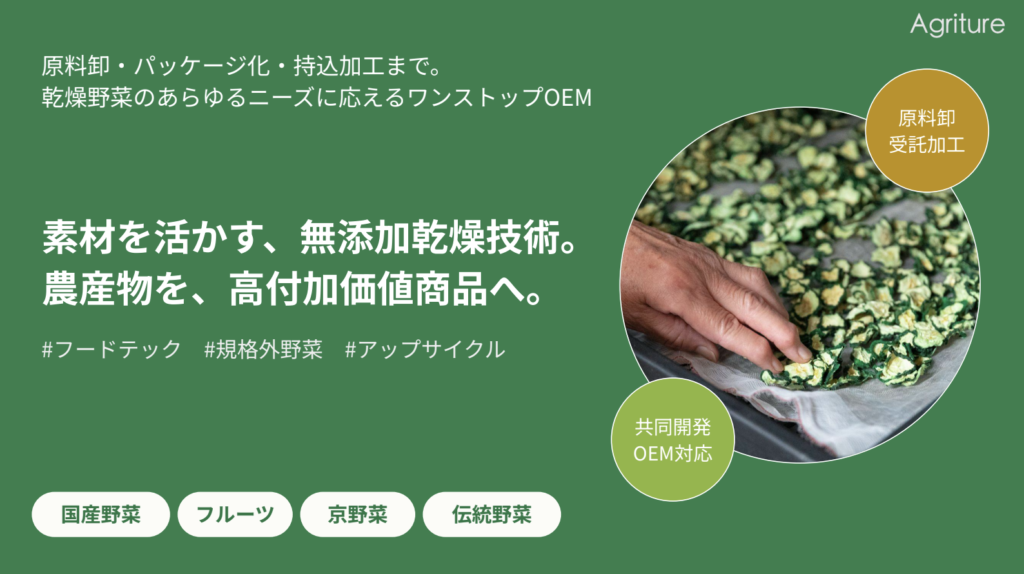
- OEM available from small lots of 10 kg
- Drying of brought-in raw materials also possible
- Support from processing to filling in one place
TOC
Why vegetable powder is chosen
The reasons food makers adopt vegetable powder can be organized along four axes: color, nutrition, storability, and workability. The main adoption merits are uniform color that’s hard to achieve with fresh vegetables, stable supply through long-term storage, and processing suitability such as kneading-in and dissolving.
| Adoption reason | Benefits | Suited product genre |
|---|---|---|
| Color presentation | Uniform color, seasonal limited colors | Noodles, sweets, lattes, prepared foods |
| Nutritional enhancement | Boosting micronutrients | Baby food, care food, functional beverages |
| Shelf stability | Room-temperature, long-term storage | RTD, retort, emergency food |
| Workability | Being powdered makes measuring and blending easy | Mass-production lines, blend recipes |
Success patterns by industry
Success patterns for vegetable-powder use have an established playbook for each industry. Working backward from the pattern closest to your own industry makes it easier to settle on a product-planning angle.
Success patterns in noodles/soup
In industries like instant noodles, ramen, pasta, and retort soup, vegetable powder is adopted for “color” and “flavor depth.”for yellow pasta, spinach powder for green noodles, Kabocha squash powder for red soup, beetroot powder for pink tones—since it can be blended at any stage of fresh noodles, dried noodles, soup base, or soup ingredients, it’s a field suited to expanding a product lineup. The blend ratio is around 1–5% of the flour as a guide. Tomato Powder Success patterns in sweets/bread
In Western sweets, Japanese sweets, bread, and baked goods,
it’s adopted for coloring and differentiation appeal. Purple cookies with purple-sweet-potato powder, pink macarons with beetroot powder, green croissants with spinach powder, orange cakes with Kintoki-carrot powder—products are born that satisfy both visual impact and an appeal to the ingredient at once. The blend ratio is 3–8% of the flour, with dough-moisture adjustment (a 5–10% increase) required as a set. Success patterns in beverages/drinks
In smoothies, aojiru, functional beverages, and protein drinks,
functional appeal and ease of blending through powdering are the adoption points. green types with ingredients like young barley grass as the main material, Moringa red types with carrot, matcha × vegetable blends, and the like—the appeal of getting multiple vegetables in a single sachet resonates strongly. A particle size of fine powder at 100 mesh or above is basic, and dispersibility in water, milk, and soy milk becomes the single most important selection point. beets,Success patterns in prepared foods/retort
In retort curry, meat sauce, frozen foods, and bento side dishes,
it’s adopted for nutritional fortification and storability. Invisible vegetable additions for the vegetable-averse, nutritional appeal touting one serving’s worth of vegetables, long-storage emergency-food products—it’s used in mass production for mass retail. Hot-air-dried products are mainstream, with a medium particle size of 40–80 mesh; the blend ratio of around 1–3% makes big nutritional effects difficult, but it’s effective for brand appeal. Success patterns in novelty/campaign
In food makers’ sales-promotion and novelty domains,
vegetable powder (or dried vegetables) is adopted for social-issue appeal and buzz. Cases of using it as a material to convey a maker’s social character—food-loss reduction, regional revitalization, health management, the SDGs—are increasing. Rather than product sales,communicating a brand message is the main aim, with diverse rollouts such as pop-ups, collaboration projects, prizes, and crowdfunding. The 4-step adoption-decision framework
FOR BUSINESS
乾燥野菜を業務用でお探しですか
国産の野菜・果物を乾燥し、必要に応じて粉砕してお出ししています。扱っている品目は100種前後で、規格は 乾燥品の一覧・パウダーの一覧 に掲載しています。
少量でのご購入は、姉妹ブランドの通販サイト OYAOYA で承っています。
When deciding whether to adopt vegetable powder in product development, considering it through
a 4-step framework reduces hesitation in the design. Decision content
| Step | ① Deciding the appeal axis | Things to confirm |
|---|---|---|
| Which to compete on—color / nutrition / storability / story | Narrow to one axis / don’t be greedy | ② Selecting the form |
| Powder / dried vegetables (cut, whole) | Alignment of the processing step and the final form | ③ Blend testing |
| Combination tests of blend ratio, particle size, color, and flavor | Small-lot prototype → validation → mass-production decision | ④ Cost fit |
| Cost ratio, retail price, gross-margin design | Estimate of mass-production unit price × sales plan | 💡 POINT | Reverse-lookup for the adoption decision |
The rule is to decide first
“which appeal axis to compete on,”not “which powder to use.” Once the appeal axis (color / nutrition / storability / story) is decided, the optimal item, particle size, and blend are automatically narrowed down..
Commonly used items by adoption reason
In tandem with the industry-specific success patterns, the commonly used items are set by adoption reason. Working backward from the effect you’re aiming for shortens the time to select an item.
| Adoption reason | Commonly used items | Appeal scene |
|---|---|---|
| Green appeal | Spinach, kale, moringa, matcha | Health, matcha appeal, seasonal limited editions |
| Red / pink | Beetroot, radish, tomato, red shiso | Anti-aging, for women, spring-summer |
| Yellow, orange | Pumpkin, Kintoki carrot, turmeric | Warming, autumn-winter, Japanese presentation |
| Purple | Purple sweet potato, red cabbage, aronia | Premium, SNS-worthy, Japanese sweets |
| Nutritional enhancement | Kale, moringa, broccoli, aojiru types | Baby food, care food, functional |
| Umami fortification | Tomato, mushroom, onion, kelp types | Soups, sauces, dashi |
We have materials available to help you understand dried processing OEM
Agriture OEM, flexibly handling everything from small lots to large lots
- OEM available from small lots of 10 kg
- Drying of brought-in raw materials also possible
- Support from processing to filling in one place
5 points to learn from use cases
Looking across the industry-specific success patterns, products where vegetable-powder adoption succeeds have 5 things in common. These are product-development principles common to dried vegetables (cut, whole) as well.
① Link the story and the product
Powder won’t sell just because “it contains vegetables.” When you can speak to which region’s, which farmer’s, and how the vegetable was dried and processed,it becomes a product chosen apart from price appeal. Consistently communicating the raw-material background—Japanese-grown vegetables, use of non-standard vegetables, regional heirloom vegetables, reduced pesticides, contract farms—across the product package, LP, and SNS is the starting point for repeat purchases.
② Prototype in small lots with multiple patterns
Vegetable powder is a raw material where the impression changes greatly with the blend ratio. Prototyping 5 patterns in 1% increments and narrowing them down through internal tasting and sensory evaluation is the standard practice. If you don’t prepare multiple patterns here, doubts about the final product’s color and flavor remain, and “this isn’t quite right” happens after mass production. Investing in prototyping without begrudging the cost from the start actually lowers overall cost.
③ Aim to slot into an existing product line
Rather than developing a new product from scratch, adding a “with vegetables” version to an existing hit product line clears a lower adoption bar. Since you can leverage the existing brand’s awareness, sales channels, and customer base, the contribution to sales comes quickly. Simply appealing “a healthy version of the same brand” on in-store POP and product descriptions triggers cross-buying by existing customers.
④ Bring in chefs and experts
Putting an authoritative voice on the product page and POP—like “supervised by a Michelin restaurant,” “supervised by a registered dietitian,” or “recommended by a culinary researcher”—raises the flavor’s credibility all at once. Co-producing recipe videos, usage guides, and SNS posts with experts also completes the “how to use it” presentation at the same time, leading to repeat purchases after buying.
⑤ Differentiate with unusual ingredients
Using only common “spinach, carrot, pumpkin” is a field that readily commoditizes.加賀野菜・京都産柚子・モリンガ・賀茂なす・青パパイヤ・アスパラ茎function as an angle for a differentiated product. Scarcity also serves as a basis for price appeal.
Failure patterns of adoption gone wrong
Failures in vegetable-powder adoption boil down to 5 typical mistakes. Knowing them in advance makes prior countermeasures effective.
| Failure pattern | Symptom | Cause |
|---|---|---|
| Greedy appeal axis | Appealing all of color, nutrition, and story | The message scatters and doesn’t stick |
| Wrong form selection | The choice of powder or dried vegetables is vague | Doesn’t match the processing step |
| Excessive blend ratio | The flavor changes too much / color unevenness occurs | Insufficient prototyping |
| Insufficient cost calculation | The mass-production cost squeezes the selling price | Estimating at the small-lot unit price |
| No story | Gets dragged into price competition | No communication of the raw-material background |
FOR BUSINESS
乾燥野菜を業務用でお探しですか
国産の野菜・果物を乾燥し、必要に応じて粉砕してお出ししています。扱っている品目は100種前後で、規格は 乾燥品の一覧・パウダーの一覧 に掲載しています。
少量でのご購入は、姉妹ブランドの通販サイト OYAOYA で承っています。
FAQ
Q. Should I choose powder or dried vegetables?
A. Powder if blending or dissolving is needed; dried vegetables (cut, whole) if you want to retain texture. Powder suits soup bases, sauces, and drinks, while cut products suit prepared foods and instant noodles where you want the color visible as an ingredient.
Q. What’s the guide for the blend ratio?
A. It varies with the effect you want to appeal to. For color appeal, 1–5% of the flour; for nutritional fortification, 1–3%; if it contains a functional ingredient of a food with functional claims, follow the specified amount. Verification in 1% increments at the prototype stage is the rule.
Q. How long does product development take?
A. From concept design to mass-production delivery, 3 months at the fastest, 6 months as standard, and over a year if a functional-claims notification is involved. Plan the period until the prototype is finalized and the mass-production schedule separately.
Product-development summary
Success in using vegetable powder follows a standard flow: understand the industry-specific success patterns → narrow the adoption reason to one axis → decide with the 4-step framework → design to satisfy the 5 common points → avoid the NG patterns. Agriture handles contract processing of nearly 100 kinds of dried vegetables and vegetable powders, from small lots to mass production, and consultations on product development are Wholesale and OEM information from here.
Download the OEM contract processing materials
We will send the materials to your email address based on the information you provide.
Recommended reading
→ Commercial vegetable powder | Agriture’s lineup
PB development with vegetable powder
How to use commercial vegetable powder
How to choose vegetable powder
Small-lot vegetable-powder sourcing
If you are considering product development with off-spec or your own farm's vegetables:From planning to processing, materials, package printing and novelties, you can consult us through a single point of contact. → Learn more about one-stop product development
- Why dried vegetables and dried fruit suit OEM for sole proprietors: introducing small-lot cases and points of success
- A Complete Guide to Making Original PB Foods: The Steps from Planning to Manufacturing and Sales
Author of this article
Related articles
-
 Original coffee marketing strategy | Ways to grow sales
 -
 ベジタリアンとは?国の規格が分けている4つの区分と食べられないもの
 -
 長ねぎと白ねぎは同じもの?ねぎの種類と呼び名を国の資料で確かめる
 -
 柚子の種類は何種類あるのか、公の資料で名前が残る系統を数えた
 -
 ゆずの時期は年に二度、青ゆずは7月から黄ゆずは10月から
 -
 ゆずの産地は高知が半分を占め、二位は徳島から愛媛に変わった
 -
 Preventing Food OEM Failures: Common Failure Cases and Countermeasures for Success
 -
 How to find a food OEM | How to efficiently find the best manufacturing partner