
Vessels and Kyoto Vegetables. Creating the Scenery of Plating.

Summary of this article
A column in which the chef Yu Yoneyama explains how to choose vessels that suit the plating of Kyoto vegetables. From Shigaraki or Bizen ware in black or deep indigo for Shogoin turnip, to cloth-lined Kyoto lacquerware (black-lacquered over vermilion) for Kamo nasu dengaku, unglazed earthenware for Manganji togarashi, and celadon for Horikawa burdock—plus a shared serving bowl of an earthen pot for Kujo green onion duck hot pot—it introduces pairings with Kyo-yaki and Kiyomizu-yaki, the basics of choosing a color opposite the ingredient, and the rule of leaving a third of the vessel's area empty.
What always comes at the end of cooking is the step called "plating." Beyond running the knife, applying heat, and adjusting the flavor lies the moment of setting the dish on the vessel. Here the impression of a dish changes greatly. It doesn't change the taste itself. Yet when the color, texture, and form a vessel holds meet the vegetable, the voice that dish speaks to us becomes something else entirely.
TOC
Shogoin Turnip | The Beauty of White That Black Vessels Bring Out
Handling Kyoto vegetables, I feel this especially keenly.
For example, Shogoin kabura. When plating that white, round, soft form, I somehow always reach for a black vessel. The pale green within the white, and the sheen that seeps out when heated, rise up strikingly clearly when set on a black vessel. As if placed on a stage, the turnip begins to declare, "I am the star."
The Vessel Color and Material That Suit Shogoin Turnip
Shogoin kabura To bring out the white of , black or deep-indigo vessels are ideal. Matte-textured materials like Shigaraki or Bizen ware set off the white skin. Use a glossy vessel and the turnip's sheen and the vessel's sheen can clash.
Winter is large at 15–20cm in diameter, so choosing a deep plate or shallow bowl 18cm or more across allows for a roomy plating. Shogoin kabura Kamo Nasu | The Sheen of Lacquerware That Draws Out Its Glow
is also a vegetable that changes expression with the vessel.
Kamo eggplant Kamo nasu dengaku, robed in oil and gleaming. To draw out that luster, nothing beats the sheen of lacquerware. Against the deep black of lacquer, the purple and the golden miso stand out. Catching just a little light, the whole dish glows as if breathing. Here I truly feel the vessel takes on the vital role of "satisfying the sight before you eat."
How to Choose Lacquerware That Sets Off Kamo Nasu Dengaku
When plating dengaku on lacquerware, black-lacquered beats vermilion-lacquered for a beautiful contrast of the miso's gold and the purple. Lacquerware also has fine heat retention, offering the practical advantage of serving freshly grilled dengaku while still warm.
Kamo eggplant Lacquerware is one of Kyoto's traditional crafts. Kyoto lacquerware has a "cloth-lining" step of laying cloth over the base, giving it a sturdiness that resists cracking and withstands use at restaurants.
The Vessel as a Partner in Dialogue with the Vegetable
FOR BUSINESS
乾燥野菜を業務用でお探しですか
国産の野菜・果物を乾燥し、必要に応じて粉砕してお出ししています。扱っている品目は100種前後で、規格は 乾燥品の一覧・パウダーの一覧 に掲載しています。
少量でのご購入は、姉妹ブランドの通販サイト OYAOYA で承っています。
Choosing vessels, I come to feel as if I'm in dialogue with the vegetable.
When grilled, the reason the green shows more vividly on the plate is unglazed, gritty earthenware. Because the aroma of what's grilled over fire and the texture of the earthen vessel resonate.
Manganji togarashi When I fashion into a simmered assortment, a pale celadon vessel suits it. It gently receives the burdock's brown and beautifully sets off the clear color of the dashi. As if the vessel itself is arranging the "vegetable's place."Horikawa gobo When Unsure How to Plate, "Listen to the Dish's Voice"
When I'm unsure how to plate, I make a point of "listening to the dish's voice."
How does the ingredient want to be seen? In what scenery does it want to place itself? Take, for instance, a duck hot pot piled with winter Kujo green onion. When moving it to a vessel, choosing a deep serving bowl of an earthen pot feels most right. The warmth of the earth supports the green onion's sweetness and gently receives the duck's umami. Conversely, green melon or eggplant floated in a chilled summer bowl, slipped into a glass vessel, instantly takes on coolness and delights the guest's eye.
The Basics of Using Vessels by Season
A sense of season matters in choosing vessels for Japanese cuisine. Summer stages coolness with glass and white porcelain; winter brings warmth with earthenware and lacquerware.
Cross-referencing with and preparing vessels to match seasonal vegetables goes smoothly. Kyoto vegetable calendar In spring, vessels glazed in cherry-blossom pink or young-grass green; in autumn, the subdued tones of Oribe glaze and iron glaze harmonize with the autumn colors of Kyoto vegetables.
The red of sets off a black-lacquered bowl. Kintoki carrot The Moment a Vessel Completes a Dish
The power of a vessel often exceeds the cook's imagination.
A plate I'd thought "not bad, but something's missing" at the prototype stage suddenly comes back to life just by changing the vessel. This, I think, is "the moment a vessel completes a dish." Put the other way, no matter how well you harness the ingredient and gauge the heat, misjudge the vessel and the dish ends up incomplete. The presence of the vessel is that large.
When Kyoto Vessels and Kyoto Vegetables Resonate
Kyoto vegetables are nurtured within the land and its history.
That's precisely why I feel how to show that form is also part of "culture." Plating Kyoto vegetables on a vessel made by a potter of central Kyoto—there, a resonance is born between those who share the same land's climate. A dish isn't completed within a single plate; it comes together in a "setting" that includes the vessel and the scenery, I'm reminded.
In Closing | The Vessel Is the Dish's Co-Performer
FOR BUSINESS
乾燥野菜を業務用でお探しですか
国産の野菜・果物を乾燥し、必要に応じて粉砕してお出ししています。扱っている品目は100種前後で、規格は 乾燥品の一覧・パウダーの一覧 に掲載しています。
少量でのご購入は、姉妹ブランドの通販サイト OYAOYA で承っています。
My work as a cook isn't only to cook vegetables deliciously. How to make them shine on the vessel, how to show their form—I consider all of that part of "cooking." The vessel is the dish's backdrop, its stage, and at times its co-performer. To deliver the charm of Kyoto vegetables most naturally and most beautifully, I want to keep building dialogue with vessels.
Basic Plating Techniques to Practice at Home
Just being conscious of vessel choice at home changes the mood of the table. The basic is to "choose a vessel of the color opposite the ingredient." White Shogoin turnip on a black vessel, green Manganji togarashi on a brown vessel, purple
on a white vessel—each sets off the other. Kamo eggplant The empty space of the plating matters too. Leaving a third of the vessel's area empty gives the dish "breathing room" and lends an elegant look.
Let's create a table that appeals to all five senses, together with staging aroma.
Pairing Kyo-yaki / Kiyomizu-yaki with Kyoto Vegetables
Kyo-yaki and Kiyomizu-yaki are Kyoto traditional crafts characterized by delicate painting and varied glazes. Kujo green onion A deep serving bowl for duck hot pot, a flat mukozuke for furofuki—Kyo-yaki vessels come in forms and sizes just right for Kyoto-vegetable dishes. Shogoin daikon At Kiyomizu-yaki kilns, custom-made vessels are also produced to cooks' requests, supporting the "uniquely Kyoto" food culture in which ingredient and vessel are born of the same land.
Do also look at the pre-plating step of "
Kyoto vegetable columns to read together
" and "heat control" that stages the table—pairing with sake. It also touches on the relationship between a sustainable way of eating
We have materials available to help you understand dried processing OEM
Agriture OEM, flexibly handling everything from small lots to large lots
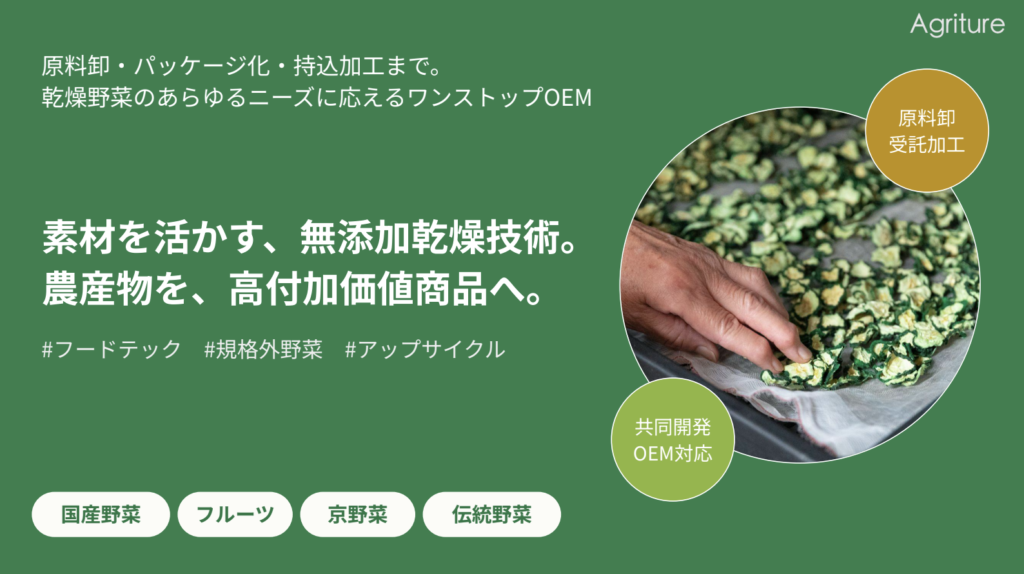
- OEM available from small lots of 10 kg
- Drying of brought-in raw materials also possible
- Support from processing to filling in one place
Download the OEM contract processing materials
We will send the materials to your email address based on the information you provide.
- Vegetables and Heat Control. Between High and Low Flame
- Tasting Kyoto Vegetables by Aroma. The Pleasure of Cooking That Begins at the Tip of the Nose
Author of this article
Related articles
-
 京野菜は何品目あるのか、読み方の一覧と認定の枠組みから確かめる
 -
 Drying Is Another Kind of Cooking
 -
 The Technology to Lock In the Season. The Seasonal Story Dried Vegetables Connect.
 -
 The Cut Face of a Vegetable. The Difference the Cut Makes.
 -
 Tasting Kyoto Vegetables by Aroma. The Pleasure of Cooking That Begins at the Tip of the Nose
 -
 Vegetables and Heat Control. Between High and Low Flame
 -
 Kyoto Vegetables and Sake. The Happy Relationship of a Dish and a Cup.
 -
 Kyoto Vegetables and Dashi —The Resonance Between the Ingredient's Voice and the Dashi—