
Vegetables and Heat Control. Between High and Low Flame

Summary of this article
Please tell me how to make shiraga negi from Kujo negi.
Cut the white part of Kujo negi into lengths of about 5 cm, slit it lengthwise, and remove the core. Stack the outer parts and cut them into ultra-fine julienne along the grain. Soaking the cut negi in cold water gives a crisp texture and softens the pungency. It comes in handy as a condiment for sashimi or hiyayakko.
TOC
Are there points to watch out for when cutting Horikawa gobo?
Because Horikawa gobo is thicker than ordinary gobo, a length of about 4–5 cm is easy to handle when cutting into cylinders. The center is often hollow, so when making sasagaki, avoid the hollow part and shave the outer flesh thin. For simmered assortments, “fukumeni,” in which the hollow scooped out is filled with stuffing, is also a Kyoto-cuisine classic. Manganji togarashi。
A column in which chef Yu Yoneyama explains how to choose heat levels for Kyoto vegetables. It introduces high-heat grilling of summer Manganji togarashi at a surface temperature of around 300°C for 90 seconds per side; fukumeni of Horikawa gobo simmered over very low heat for 2–3 hours; how Kamo eggplant changes expression between high and low heat; the option of chopping Kujo negi raw; and a two-stage heating technique for Shogoin turnip — high heat for 2 minutes, then low heat for 30 minutes. It also covers how to reproduce these on a home stove and how to rehydrate dried vegetables over medium heat.
When people talk about cooking, they tend to focus on seasonings and plating, but in truth I believe most of a chef's work is a dialogue with “heat control.” Whether to use high heat or take it slow over low heat. A single such decision utterly changes a vegetable's countenance.
Manganji Togarashi | The High-Heat Fragrance That Reflects Summer
Manganji togarashi Take, for example, a leading summer Kyoto vegetable,
I like to sear this over high heat all at once. Put to the flame, the surface skin puffs up, then bursts with a crackling sound. The moment that fragrant aroma rises is when the appeal of Manganji togarashi blooms most vividly.
Bite into it, and the flesh's moisture bursts, filling the mouth with a fresh green fragrance and a faint bitterness. Finishing it in one go over high heat makes the vegetable's “summer character” stand out.
On the other hand, Horikawa gobo Manganji Togarashi Grilled Over High Heat | Temperature and Time
When grilling
over high heat, the guideline is a surface temperature of around 300°C over charcoal or a direct gas flame. Grill 90 seconds per side, and when a faint char appears on the surface, it's done. Overgrilling makes the bitterness stronger, so take it off the heat the moment the fragrant aroma peaks.
At home, a fish grill (high heat, top-and-bottom heating) can substitute. The guideline is 2 minutes of preheating, then 2 minutes per side.
Horikawa gobo Horikawa Gobo | The Winter Richness That Low Heat Nurtures
the type of dashi Winter vegetables like Horikawa gobo are the exact opposite.
Simmer that over high heat and only the surface falls apart, while the umami never reaches the all-important core. That's precisely why it must be low heat, slow and gentle. Passing heat quietly through it in the dashi, the earthy fragrance and sweetness the gobo itself holds spread as if seeping out. No matter how many hours it takes, never rush. The very time that low heat nurtures draws out the gobo's depth.
Thinking this way, “heat control” is, for a chef, like language. High heat is an exclamation mark. Low heat is a small lingering resonance. Conversing with the ingredient, I choose the word of fire that fits that day, that moment.
For example, Kamo eggplant Horikawa Gobo Simmered Over Low Heat | Designing Dashi and Time
When simmering
over low heat, the right amount of dashi is enough to just cover the gobo. Keep the heat very low (small bubbles rising slowly from the bottom of the pot) and let it take in flavor over 2–3 hours. Don't add water partway; when the dashi reduces, top it up a little at a time.
changes the finish. Katsuo dashi gives a bold flavor, kombu dashi a gentle one.
For example, Kujo green onion is in season from November to February, with Kamigyo Ward, Kyoto City as the main growing region.
Kamo Eggplant | When You Meet the Heat of Hesitation
Working with Kyoto vegetables, you sometimes meet a “heat of hesitation.”
Kujo green onion. Let it drink in plenty of oil and sear it fragrantly over high heat, and it shows a steak-like presence. But let it take in flavor over low heat, and it reveals a sweetness so gentle it melts.
Both are the truth of Kamo eggplant, and neither is wrong. That's exactly why you must choose the fire to match the flow of the whole menu and the guest's mood that day. It's a moment that tests a chef's “decision.”Kujo Negi | The Choice of “Not Applying Heat”And fire is not only something to “add.”
. Searing it to bring up the fragrance is fine, but chopping it raw on purpose, without heat, lets that fresh green fragrance rise and become an accent for the whole dish.
In other words, the judgment of “not applying heat” is also a kind of heat control. In cooking, fire is about quality, not quantity. It becomes a choice that includes not just strong or weak, but even “to use or not to use.”
For example, Shogoin kabura Cutting Techniques That Bring Kujo Negi to Life Raw
When using
raw, the way you chop changes the impression. Small rounds (2 mm wide) suit use as a condiment, thin diagonal slices suit hot-pot ingredients, and lengthwise-split “shiraga negi” suits a garnish for sashimi.
Soaking chopped Kujo negi in water removes the pungency, but the fragrance weakens too.
If you prioritize the fragrance
, the right choice is to plate it as is, without soaking in water.
Shogoin Turnip | Exploring the Space Between High and Low Heat
What I like is exploring the expressions that lie “between” high and low heat.
When letting
take in dashi. At first apply slightly stronger heat to bring it to a boil, then immediately drop to low heat. So that the surface fibers loosen and heat reaches gently to the center. By moving between high and low heat, back and forth, you create an environment where the ingredient can breathe without strain. That kind of “fluctuation,” I feel, softens a dish's flavor.
Dried Vegetables | The “Waiting Fire” That Calls Back Umami
The handling of dried vegetables, too, is deeply tied to heat control.
Shogoin kabura Dried daikon and shishito have had their moisture drawn out compared to when fresh, so the way heat enters is entirely different. Rush it over high heat and only firmness remains; too low, and the umami escapes. So rehydrate slowly over medium heat, at just a faint simmer. That “time of waiting” is like magic that brings dried vegetables back to life.
Shogoin kabura Heat Control Is a Chef's Individuality Shogoin daikon Heat control is also a chef's individuality itself.
Even with the same vegetable, the plate that results is utterly different between a chef who takes it on over high heat and one who stays close to it over low heat. That's exactly why I always ask myself, “With what fire do I want to speak today?”
In Closing | What Dwells Between High and Low Heat
Continuing to cook, strangely enough, there are moments when I feel “I've grown close to fire.” The fragrance just before scorching, the quiet sound as something simmers to fullness. Each of these comes to feel like a signal. Fire never obeys people. But if you listen closely, it always tells you something. That's the kind of presence it is. Dried vegetables The space between high and low heat.
Kyoto vegetable columns to read together
It's precisely in that subtle territory that Kyoto vegetables show a new face. As a chef, so as not to miss that voice, I stand by the fire again today. vessels and plating A Two-Stage Heating Technique for Shogoin Turnip The heating that finishes most deliciously is two-stage: “high heat, then low heat.” First put it into boiling dashi and firm the surface for 2 minutes over high heat, then immediately drop to low heat and let it take in flavor for 30 minutes. This method makes the surface firm and the inside a melting texture. subtractive cooking tends to be confused with
We have materials available to help you understand dried processing OEM
Agriture OEM, flexibly handling everything from small lots to large lots
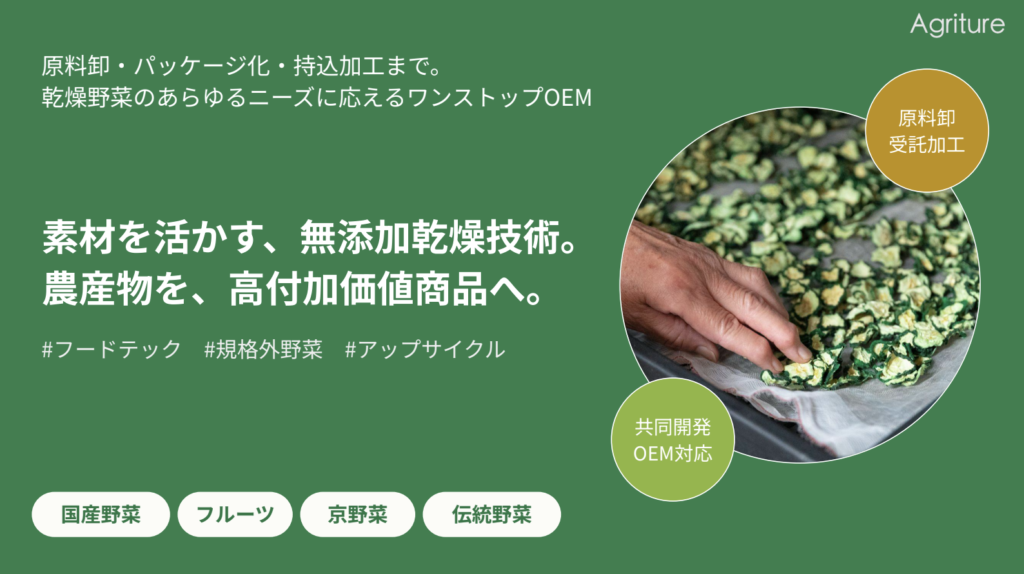
- OEM available from small lots of 10 kg
- Drying of brought-in raw materials also possible
- Support from processing to filling in one place
Download the OEM contract processing materials
We will send the materials to your email address based on the information you provide.
- Kyoto Vegetables and Sake. The Happy Relationship of a Dish and a Cup.
- Vessels and Kyoto Vegetables. Creating the Scenery of Plating.
Author of this article
Related articles
-
 京野菜は何品目あるのか、読み方の一覧と認定の枠組みから確かめる
 -
 Drying Is Another Kind of Cooking
 -
 The Technology to Lock In the Season. The Seasonal Story Dried Vegetables Connect.
 -
 The Cut Face of a Vegetable. The Difference the Cut Makes.
 -
 Tasting Kyoto Vegetables by Aroma. The Pleasure of Cooking That Begins at the Tip of the Nose
 -
 Vessels and Kyoto Vegetables. Creating the Scenery of Plating.
 -
 Kyoto Vegetables and Sake. The Happy Relationship of a Dish and a Cup.
 -
 Kyoto Vegetables and Dashi —The Resonance Between the Ingredient's Voice and the Dashi—