
Autumn Kyoto Vegetables: The Flavor and Texture of Shogoin Kabu and Kintoki Carrot

Summary of this article
We introduce autumn Kyoto vegetables with five items: murasaki-zukin, Kyo-kokabu, Tamba chestnut, Shogoin turnip, and Kintoki carrot. Murasaki-zukin, born from Tamba black soybean, is a large-grained edamame in season in September–October; Kyo-kokabu is a beautiful white small turnip 5–8 cm in diameter suited to eating raw; Tamba chestnut, with Ginyose as its representative variety, shines in chestnut rice and simmered chestnuts with the inner skin; Shogoin turnip in senmai-zuke; and Kintoki carrot in nishime (simmered dishes). The Kyoto basin’s day-night temperature difference of over 10 degrees and the fertile soil of Tamba and Kameoka concentrate the sweetness and umami.
Vegetables have a seasonal “peak (shun)” for each season, and by eating them in that period, you can enjoy more deliciousness and nutrition. Autumn Kyoto abounds in richly flavored Kyoto vegetables. In this season when it turns cool and appetite grows, why not incorporate Kyoto vegetables—with their charming warm sweetness and richness—into your daily table?
TOC
The Kyoto vegetables that color Kyoto’s autumn
Kyoto’s autumn is a season when the summer heat softens and the temperature difference between morning and evening grows, increasing the sweetness and umami of vegetables. The autumn Kyoto vegetables nurtured by the Kyoto basin’s characteristic temperature difference and the fertile soil of Tamba and Kameoka, when made into simmered or steamed dishes, bring out the ingredient’s taste all the more. Here, we introduce representative Kyoto vegetables that reach their peak in autumn.
Why autumn Kyoto vegetables are delicious
Kyoto vegetables harvested in autumn grow having basked plentifully in sunlight during summer, and store sugar with the autumn chill. Plants have the property of accumulating sugar within their cells to prevent freezing when the temperature drops, and this connects to the sweetness characteristic of autumn-winter vegetables. In the Kyoto basin, days when the day-night temperature difference exceeds 10 degrees are not uncommon, and this environment concentrates the vegetables’ umami components.
Peak-season calendar of autumn Kyoto vegetables
| Kyoto vegetables | Peak period | Main growing region | Representative ways to eat |
|---|---|---|---|
| Murasaki zukin | September–October | Tamba region | Salt-boiled / edamame rice |
| Kyo-kokabu | September–December | Outskirts of Kyoto City | Kabura-mushi / pickles |
| Shogoin turnip | November–March | Kameoka City | Senmai-zuke / simmered dishes |
| Kintoki carrot | November–February | Outskirts of Kyoto City | Nishime / kinpira |
For those who want to check the peak seasons of Kyoto vegetables all together, Kyoto vegetable calendar please be sure to see this as well.
Murasaki-zukin: an autumn-limited edamame born from Tamba black soybean
“Murasaki-zukin” is an edamame born from Tamba black soybean, which boasts representative quality. Its rounded shape wrapped in a light-purple thin skin evokes a “zukin” (hood), which is the origin of the name. Both the pods and grains are far larger than ordinary edamame, letting you enjoy the bean’s inherent sweetness and richness and a plump, springy texture. A traditional ingredient of the Tamba region, it has long been cherished locally as the “festival edamame.” A subtle sweetness stands out, letting you enjoy a luxurious flavor perfect for a long autumn night.
Characteristics and flavor of murasaki-zukin
Murasaki-zukin is an edamame harvested from Tamba black soybean in an immature state; it is larger-grained than ordinary edamame and characterized by a chewy texture and a rich bean sweetness and richness. When boiled, along with a vivid green color, the deep flavor unique to black soybean rises. Beyond salt-boiling and tasting it as is, you can enjoy autumn-only flavors by cooking it into rice or making it into zunda.
Recommended dishes and ways to eat
Simply salt-boiling is the way to eat that most brings out murasaki-zukin’s taste. Add salt to boiling water, boil for 3–4 minutes, lift into a colander, and let it cool naturally. Made into edamame rice, the bean’s sweetness and the rice’s flavor combine into an autumn-like mixed rice. Also, made into kakiage, you can enjoy a texture that’s crisp outside and fluffy inside. Scattered over a salad, it also becomes a colorful accent.
Kyo-kokabu: a beautiful white skin and fine-grained sweetness
Grown in Kyoto’s cool mid-mountain regions, it is characterized by a pure-white, beautiful skin, Q3. Can you powder-process raw material I bring in?. You can enjoy fine-grained flesh and a dense texture, and a mellow sweetness spreads in the mouth. One of the vegetables cultivated for the longest time in Japan, it is indispensable to Kyoto pickles and Kyoto cuisine. Kyo-kokabu especially brings out its deliciousness when made into kabura-mushi or pickles. It also has the characteristic of being enjoyable raw, such as in salads, and the leaf part can be enjoyed deliciously with its crisp texture too.
The harvest period is around early May to late July, and around mid-September to mid-December.
The difference between Kyo-kokabu and Shogoin turnip
Kyo-kokabu is a small turnip about 5–8 cm in diameter, with a softness suited to eating raw as its strong point. Meanwhile, Shogoin turnip becomes a large variety of even 15–20 cm in diameter, suited to simmered dishes and senmai-zuke. Both are turnips representative of Kyoto’s winter, but because there are differences in use and texture, using them according to the dish is recommended. Kyo-kokabu suits salads and light pickles as is, while Shogoin turnip suits dishes that are slowly simmered.
Recommended dishes for Kyo-kokabu
For Kyo-kokabu, kabura-mushi is especially recommended. When grated turnip is steamed, a fluffy texture and natural sweetness spread. Made into Kyoto pickles, you can enjoy a crisp bite and a faint sweetness. Also, a simple salad of raw slices eaten with olive oil and salt lets you savor the flavor of the ingredient itself. If you finely chop the leaves and stir-fry them with jako (dried baby sardines), it becomes a dish perfect as a rice companion.
Tamba chestnut: an autumn specialty of the Tamba region
*Because the Tamba chestnut is a fruit tree, it is outside the certification of the “Traditional Vegetables of Kyoto” (Kyoto Prefecture’s traditional vegetable system), but as an autumn specialty representative of the Tamba region, it is an ingredient deeply rooted in Kyoto cuisine. “Tamba chestnut” has long been an autumn taste representative of the Tamba region. Cultivated throughout the Tamba region, it has also been known as an item of tribute. In the Edo period it was even paid as land tax, and the taste produced by cultivation techniques handed down through generations is an autumn luxury. The chestnuts nurtured by the Tamba region’s climate and land are charming for their sweet, fluffy texture. Farmers repeat daily research and improvement, and even now their deliciousness continues to evolve.
Varieties and characteristics of Tamba chestnut
The representative variety of Tamba chestnut is “Ginyose,” which is large-grained with strong sweetness, ideal for chestnut rice and kanroni (candied chestnuts). The Tamba region’s clayey soil and day-night temperature difference raise the chestnut’s sugar content, producing a rich flavor not found in other growing regions. Varieties such as “Tanzawa” and “Tsukuba” are also cultivated, but the one most beloved locally is the traditional Ginyose. Because the grains are large, they are harvested one by one by hand, and quality control is thorough.
Recommended dishes for Tamba chestnut
Tamba chestnut’s chestnut rice is a classic dish that gorgeously colors the autumn table. Simply cooking peeled chestnuts together with rice, the fluffy sweetness and the rice’s flavor combine exquisitely. Shibukawa-ni is a labor-intensive dish where you carefully leave the inner skin and simmer it in sugar, letting you fully taste the chestnut’s inherent flavor. Roasted chestnuts are a simple cooking method of just scoring the tough outer skin and roasting them in the oven, bringing out the fragrance and sweetness.
Kyoto vegetables that reach their peak from autumn into winter
Among autumn Kyoto vegetables, there are also many that start appearing in autumn and reach their peak toward winter. Shogoin turnip starts lining store shelves around November and is indispensable to Kyoto’s winter as an ingredient for senmai-zuke. Kintoki carrot likewise has its peak from late autumn into winter, adding color to nishime and namasu in osechi cuisine.
Tasting Shogoin turnip and Kintoki carrot side by side
Shogoin turnip is characterized by a smooth, elegant sweetness, and when made into a simmered dish, it has a texture that seems to melt in the mouth. Meanwhile, Kintoki carrot has a vivid red color and strong sweetness as its strong points, and putting it into nishime makes the coloring gorgeous. Simmering these two together makes a dish where the white-and-red contrast is beautiful and satisfying in both appearance and flavor. Shogoin daikon adding this makes it a restaurant-like dish as a simmered assortment of three winter Kyoto vegetables.
Example menu using autumn Kyoto vegetables
As a menu using autumn Kyoto vegetables, a combination of salt-boiled murasaki-zukin as an appetizer, Kyo-kokabu kabura-mushi as a soup course, and Tamba chestnut’s chestnut rice as the staple is recommended. For a side dish, mibuna,adding an ohitashi of this lets you enjoy autumn Kyoto whole at the table. Because it’s a combination that can reproduce a restaurant’s taste at home too, it is also well received as a hospitality menu when you have guests.
Savoring in-season autumn Kyoto vegetables
Autumn Kyoto vegetables deepen in sweetness and richness amid the shift in temperature from summer to autumn. Murasaki-zukin, when boiled, offers a fluffy texture and a deep bean aroma; Kyo-kokabu, a smooth flesh and fine-grained sweetness; and Tamba chestnut, a fluffy, elegant sweetness. In this period when it turns cool and appetite grows, it’s recommended to cook the in-season Kyoto vegetables simply, making use of the ingredient’s strong points.
Why the peak season is the most delicious
Vegetables develop the most flavor at the proper harvest time—that is, in the peak season. In autumn, when the temperature drops, vegetables store sugar and umami, so even for the same variety, ones harvested in season stand out more in sweetness and flavor. Tasting autumn Kyoto vegetables in the peak season is a reasonable choice in terms of deliciousness too. For details on Kyoto vegetable varieties, see List of Kyoto vegetable varieties.
Enjoying autumn Kyoto vegetables year-round with dried vegetables
Autumn Kyoto vegetables have a limited peak season, but by making them into dried vegetables, you can enjoy them regardless of season. Because drying concentrates the umami and also enhances keeping quality, you can easily take in the nutrition of Kyoto vegetables even in a busy daily life.
How to use dried vegetables
Dried Kyoto vegetables can be used easily by just adding them straight into miso soup or soup. Because many dishes don’t require the trouble of rehydrating with water, they are handy for busy breakfasts and late-night meals too. Dried turnip and carrot in particular go excellently with simmered dishes, and using them together with the soaking liquid lets you make full use of the umami. When you want to add a vivid red to nishime or namasu, commercial dried Kintoki carrot using this lets you make use of both the color and the sweetness as they are. Dried-vegetable OEM we also handle the manufacturing of dried vegetables using Kyoto vegetables. sustainable From the perspective of a sustainable diet too, dried vegetables that can reduce food loss are drawing attention.
FOR BUSINESS
乾燥野菜を業務用でお探しですか
国産の野菜・果物を乾燥し、必要に応じて粉砕してお出ししています。扱っている品目は100種前後で、規格は 乾燥品の一覧・パウダーの一覧 に掲載しています。
少量でのご購入は、姉妹ブランドの通販サイト OYAOYA で承っています。
Frequently asked questions about autumn Kyoto vegetables
Recommended reading
List of Kyoto vegetable varieties / Kyoto vegetable calendar / Commercial dried vegetables / Vessels and Kyoto Vegetables. Creating the Scenery of Plating. / Mibuna: The Characteristics and History of a Kyoto Vegetable with Little Heat
We have materials available to help you understand dried processing OEM
Agriture OEM, flexibly handling everything from small lots to large lots
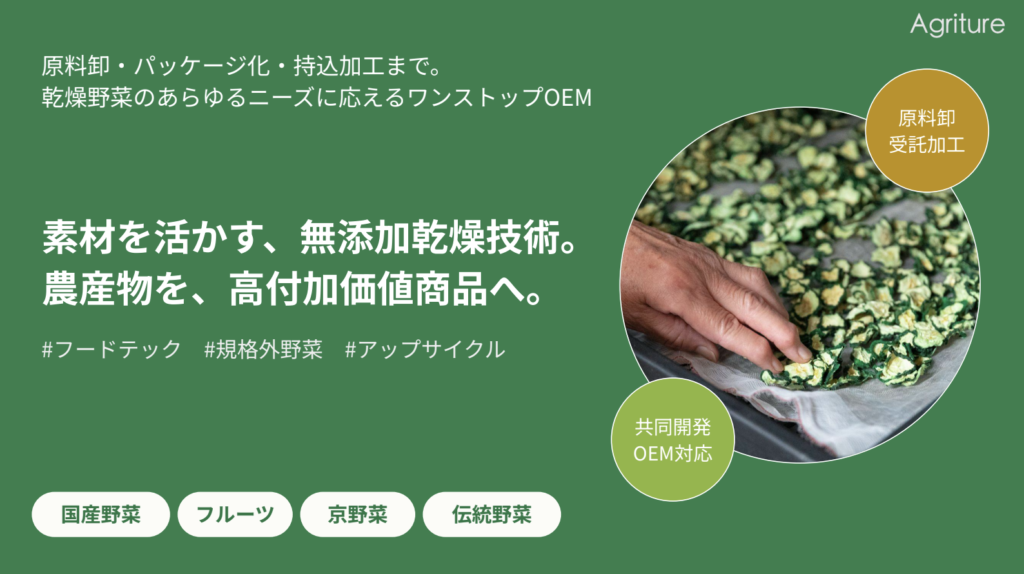
- OEM available from small lots of 10 kg
- Drying of brought-in raw materials also possible
- Support from processing to filling in one place
Related articles
- Winter Kyoto vegetables | Shogoin daikon and Kujo scallion
- Spring Kyoto vegetables | Kyo-takenoko and hanana
- Shogoin turnip | A fine autumn-winter Kyoto vegetable
- Kintoki carrot | A winter Kyoto vegetable
- Kyoto vegetable calendar — check the seasons of the four seasons at a glance
Download the OEM contract processing materials
We will send the materials to your email address based on the information you provide.
- Shishigatani Kabocha: A Kyoto Vegetable Prized for Its Distinctive Shape and Gentle Sweetness
- Spring Kyoto vegetables: the seasonal taste of Kyoto bamboo shoots, mibuna, and Kujo green onion
Author of this article
Related articles
-
 京野菜は何品目あるのか、読み方の一覧と認定の枠組みから確かめる
 -
 Drying Is Another Kind of Cooking
 -
 The Technology to Lock In the Season. The Seasonal Story Dried Vegetables Connect.
 -
 The Cut Face of a Vegetable. The Difference the Cut Makes.
 -
 Tasting Kyoto Vegetables by Aroma. The Pleasure of Cooking That Begins at the Tip of the Nose
 -
 Vessels and Kyoto Vegetables. Creating the Scenery of Plating.
 -
 Vegetables and Heat Control. Between High and Low Flame
 -
 Kyoto Vegetables and Sake. The Happy Relationship of a Dish and a Cup.