
What Are Kyoto's Traditional Preserved Foods? Inherited Wisdom and How to Use It Today

Summary of this article
Kyoto, boasting over a thousand years of history, holds a rich variety of "traditional preserved foods" born of its four seasons and the wisdom of daily life. In an age without refrigeration, dried vegetables, pickles, and fermented foods devised to use seasonal ingredients without waste still support the Kyoto table today.
This article introduces how such preserved foods came to be, what charms they hold, and how they can be put to use in modern lifestyles.
Why Kyoto's Traditional Preserved Foods Are Being Reappraised
TOC
"Senmai-zuke," "suguki-zuke," "shiba-zuke"—Kyoto pickles you've surely heard of at least once.
Kyoto's traditional preserved foods are packed with centuries of history and the wisdom of predecessors. The techniques that made the most of seasonal bounty without waste and enabled long-term storage are a treasure trove of food wisdom we today should learn from.
As interest in a sustainable diet rises, such traditional preserved foods are back in the spotlight. Hints for solving modern society's challenges—cutting food loss, using off-grade vegetables—lie dormant within tradition.
The History of Kyoto's Traditional Preserved Foods
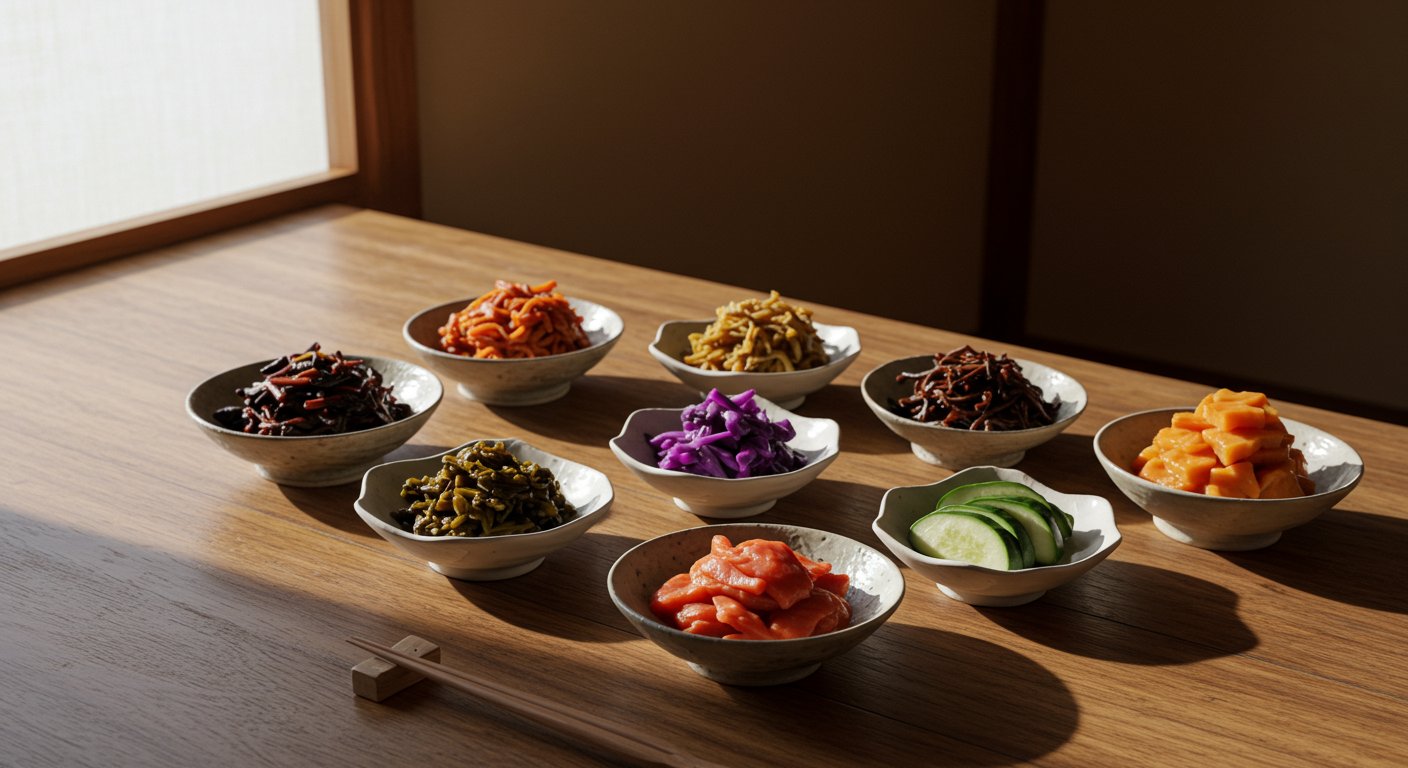
The history of Kyoto's preserved foods traces back to the Heian period. There was no refrigeration then, and the wisdom to store seasonal ingredients long-term was the linchpin of life.
Kyoto in particular, a basin surrounded on all sides by mountains, faced securing food in winter as an important challenge. Thus preservation techniques developed—drying the rich harvest of summer and autumn, or pickling it in salt, rice bran, or miso. Refined through the fusion of court food culture and common wisdom, these techniques took root as Kyoto's own food culture.
In the Edo period, pickle culture developed to a high level in Kyoto. The representative "shiba-zuke," while originating in the Heian period, spread to the common people in the Edo period. "Senmai-zuke" is said to have been devised in the late-Edo Bunkyu era by Fujisaburo Ofuji, a cook of the Imperial Palace, and soon spread among the townspeople of Kyoto.
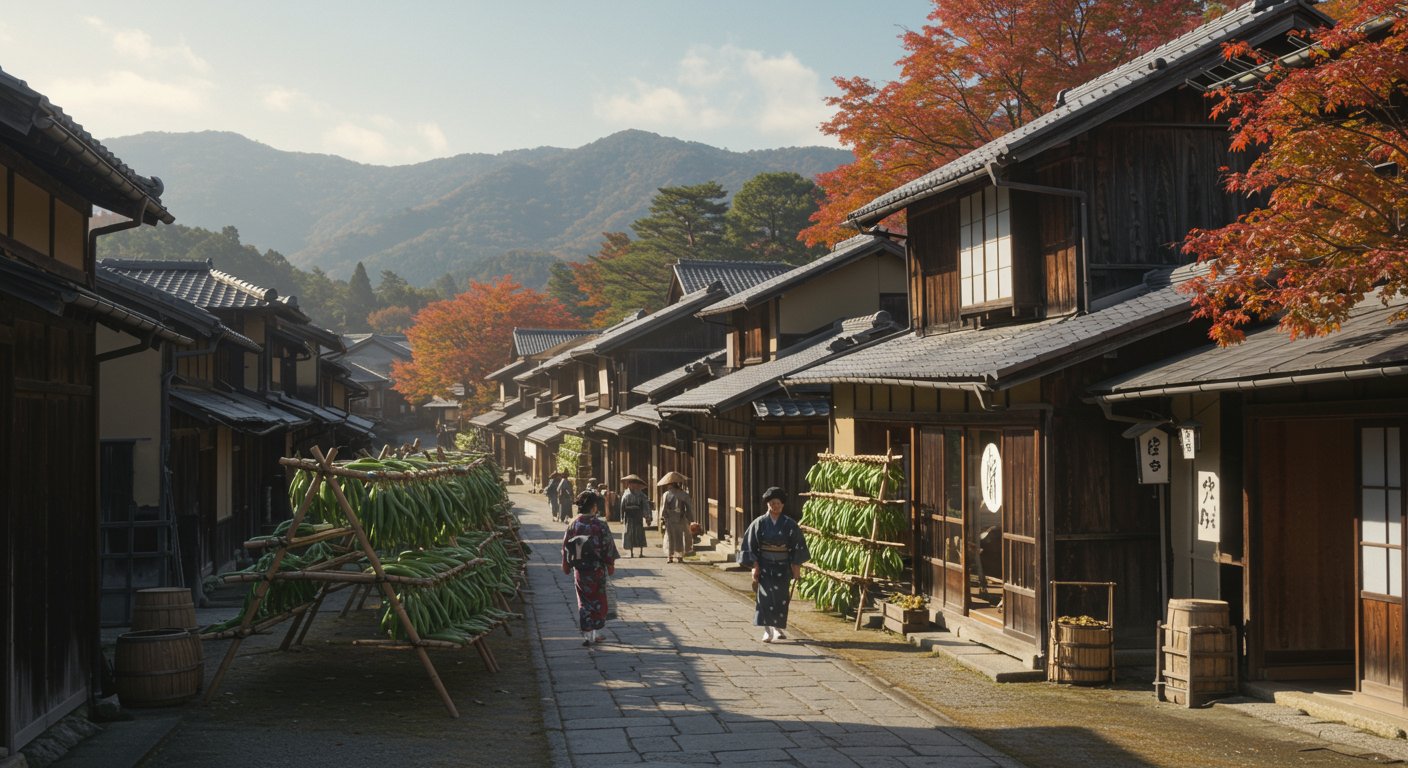
Also, as a dried preserved food, "kiriboshi daikon" spread in ordinary households from the Edo period, prized as a winter preserved food. In Kyoto it was called "nokishinobu," made with a drying technique that harnessed the cold air.
This tradition is passed on, generation after generation, in Kyoto's food culture today.
The Types and Features of Kyoto's Traditional Preserved Foods
Kyoto's traditional preserved foods divide mainly into three techniques: "drying," "pickling," and "fermenting." The change in flavor and the rise in nutritional value each technique brings offer great suggestions for how we eat today too.
The Charm of Dried Preserved Foods
Drying is one of the oldest preservation methods. Removing moisture prevents microbial growth and enables long-term storage.
In Kyoto, "kiriboshi vegetables" made by drying heirloom vegetables such as Shogoin daikon and Kujo green onion have been beloved. At Agriture too we handle Kyoto-grown
commercial dried Shogoin daikon, used as a material for simmered dishes and soups. Drying concentrates the vegetables' umami and nutrition, letting you enjoy a deep flavor different from the fresh state. The Diversity of Kyoto Pickles
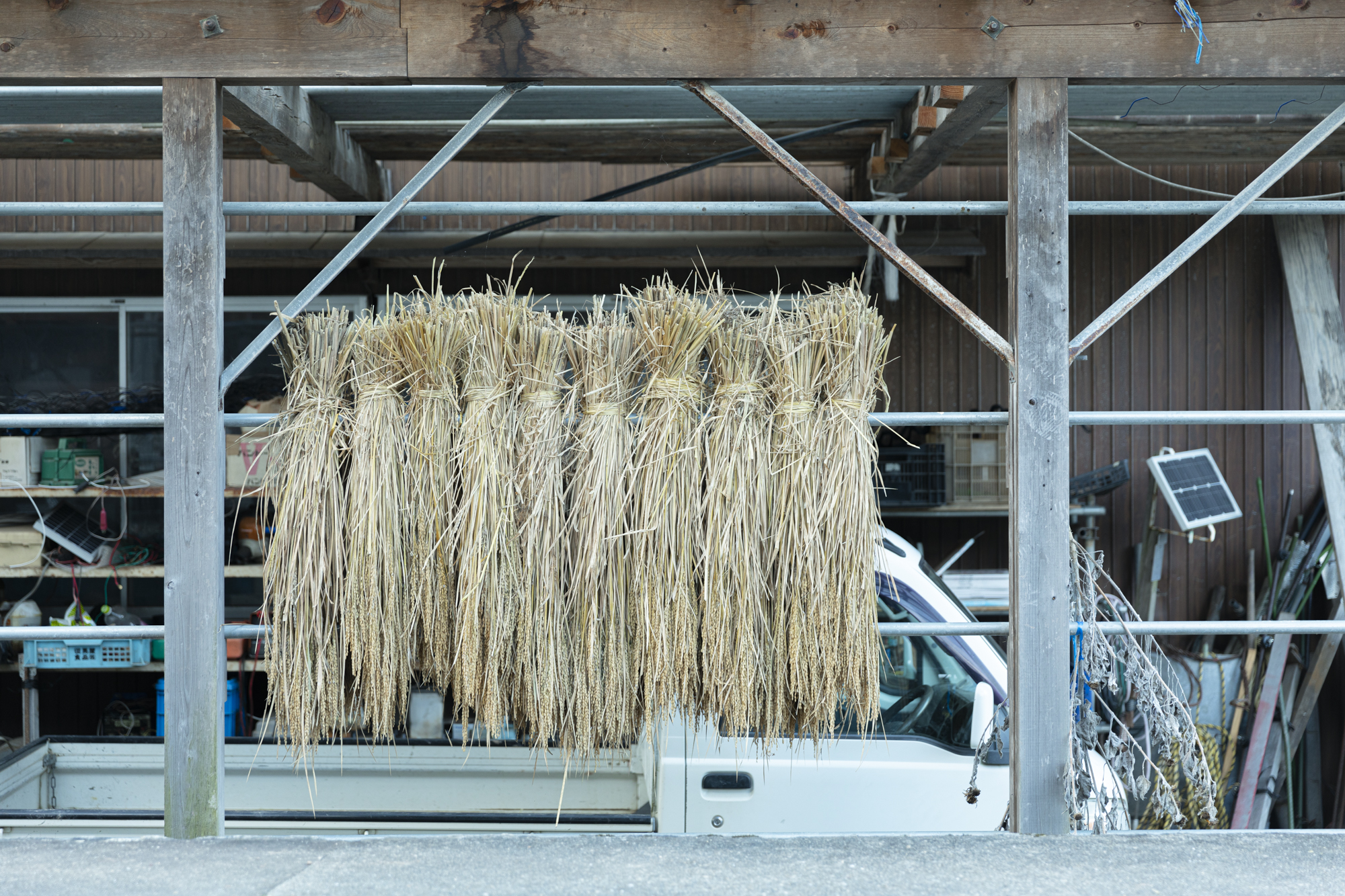
Kyoto's pickle culture is known for its diversity and depth. Representative among them is "shiba-zuke," a face of Kyoto's summer. Characterized by the color and aroma of red shiso, it's beloved as a summer tradition of Kyoto.
Also, "senmai-zuke," a face of winter Kyoto, is thinly sliced
pickled with kombu and salt, and its translucent beauty and delicate flavor could be called a gathering of the essence of Kyoto's food culture. Shogoin turnip These Kyoto pickles go beyond mere preserved food to play a major role as a "palate cleanser" in Japanese cuisine. In Kyoto cuisine, which prizes a sense of season, pickles are an important element expressing the passing of the seasons.
The Wisdom of Fermented Foods
Kyoto's fermented foods are varied, from seasonings like miso and soy sauce to preserved foods. Fermentation—preservation borrowing the power of microbes—not only draws out ingredients' umami but also has the effect of raising nutritional value.
"Saikyo-zuke" using Kyoto's Saikyo miso in particular creates a distinctive flavor by pickling fish or vegetables in sweet white miso. This technique is passed on to today's cooks and applied to a variety of ingredients.
The Contribution to a Sustainable Diet
The dried vegetables and pickles that traditional preserved foods yield contribute greatly to a sustainable diet through cutting food loss. What deserves special attention is the use of off-grade vegetables.
About 30% of the total harvest never reaches market—"off-grade vegetables," for reasons such as poor shape. These can be processed into preserved foods. And made into preserved foods, they keep even after processing, being sustainable within the household too. Such efforts can be called a fine example of applying predecessors' wisdom of not wasting food to the present.
The Relationship Between Kyoto's Heirloom Vegetables and Preserved Foods
Indispensable to discussing Kyoto's traditional preserved foods is the existence of Kyoto vegetables. Kyoto has many heirloom vegetables—Kamo nasu, Shogoin daikon, Manganji togarashi, Kujo green onion. These vegetables adapted to Kyoto's climate and were selected and improved over a long history.
The Features and Preservation Suitability of Kyoto Vegetables
Many Kyoto vegetables have properties suited to preserved foods thanks to their distinctive flavor and texture. For example, Shogoin daikon is large and high in moisture, so drying it into kiriboshi increases its sweetness and yields a distinctive texture.
is an heirloom vegetable named for the fact that its cultivation began in Manganji, Kyoto, in the Edo period. Unlike ordinary chilis, it's characterized by a sweet flavor with restrained heat, and even dried you can enjoy its texture as-is. Because the aroma shifts to a crisp note, it pairs great with yakisoba and pasta too.
Manganji togarashi is an heirloom vegetable with over 300 years of history, grown widely in Kyoto's Kamigamo district. Dried, its flesh firms up a notch more than fresh, and heated, it changes to a melting texture like grilled eggplant. Characterized by a fruit-like sweetness, it can be used in a variety of dishes.
Kamo eggplant The Future and Potential of Traditional Preserved Foods
Kyoto's traditional preserved foods are the crystallization of wisdom cultivated over a long history. But their value isn't a thing of the past; rather, it will grow more important in the diet to come.
What deserves special attention is the two aspects traditional preserved foods hold: "sustainability" and "health value."
Creating a New Food Culture
The techniques of traditional preserved foods contribute to creating a new food culture too. For example, the mail-order brand specializing in dried vegetables using Kyoto-grown off-grade and Kyoto vegetables, "
," arranges traditional preservation techniques in a modern way, proposing them as "a new feast from the field." Drying slowly at temperatures close to sun-drying to concentrate vegetables' umami and nutrition, and drawing out hidden charms one couldn't notice in fresh vegetables—it's an example of tradition and innovation fusing. OYAOYA Beyond merely making ingredients last, there's the joy of discovering new flavors. By fusing traditional technique with a modern lifestyle, a richer diet will spread.
Summary: Applying Kyoto's Food Wisdom Today
Summary: Applying Kyoto's Food Wisdom Today
Kyoto's traditional preserved foods are not mere local cuisine but a treasure trove of wisdom for realizing a sustainable diet. The techniques that use seasonal bounty to the fullest, heighten flavor, and preserve nutritional value give us many hints for the food challenges we face today.
In particular, the modern value of traditional preserved foods is immeasurable—upcycling off-grade vegetables, time-saving cooking for busy modern people, use as nutrient-rich health foods.
By knowing the charm of Kyoto's traditional preserved foods and bringing them into the daily table, our diet becomes richer and more sustainable. Carrying the food wisdom inherited from our predecessors on to the next generation—that, perhaps, is the true value of traditional preserved foods.
We have materials available to help you understand dried processing OEM
Agriture OEM, flexibly handling everything from small lots to large lots
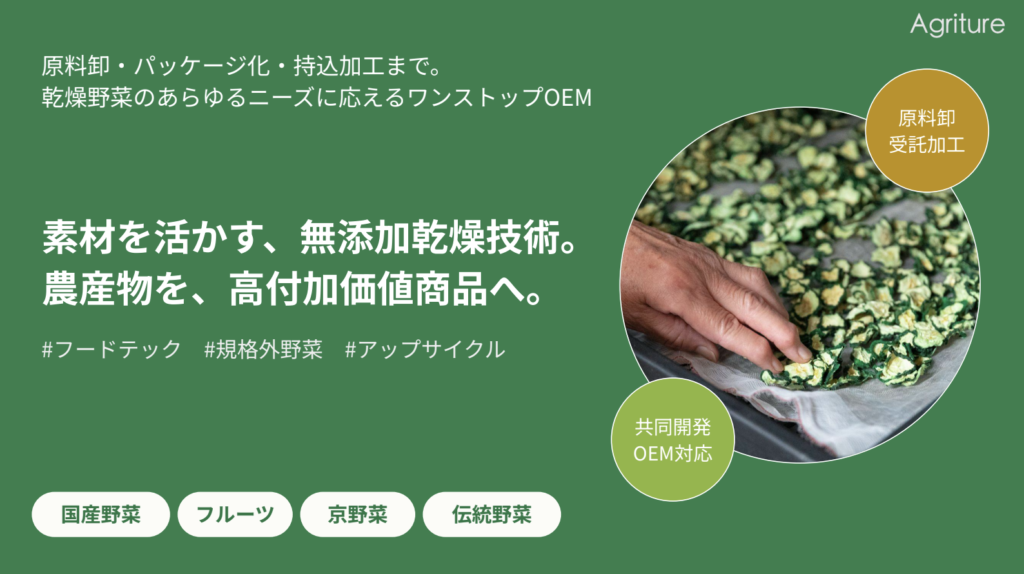
- OEM available from small lots of 10 kg
- Drying of brought-in raw materials also possible
- Support from processing to filling in one place
FOR BUSINESS
乾燥野菜を業務用でお探しですか
国産の野菜・果物を乾燥し、必要に応じて粉砕してお出ししています。扱っている品目は100種前後で、規格は 乾燥品の一覧・パウダーの一覧 に掲載しています。
少量でのご購入は、姉妹ブランドの通販サイト OYAOYA で承っています。
Frequently Asked Questions About Kyoto's Traditional Preserved Foods
Reference
Ministry of Agriculture, Forestry and Fisheries, “Kyoto Pickles (kyo-tsukemono)” (accessed 2025/08/06), https://www.maff.go.jp/j/keikaku/syokubunka/traditional-foods/menu/kyo_tukemono.html
Ministry of Agriculture, Forestry and Fisheries, “Senmaizuke” (accessed 2025/08/06), https://www.maff.go.jp/j/keikaku/syokubunka/k_ryouri/search_menu/menu/semmaizuke_kyoto.html
Illustrated Glossary of Japanese Foods, “Nokishinobu” (accessed 2025/08/06), https://japan-word.com/nokishinobu#google_vignette
Kyo-tsukemono Nishidaya, “The History of Kyoto Pickles (tsukemono): When Did They Begin? Explaining Their Origins
” (accessed 2025/08/06), https://nishidaya.com/blog/2023/02/27/kyotsukemono-history/

Recommended reading
List of Kyoto vegetable varieties / Kyoto vegetable calendar / Commercial dried vegetables / Vessels and Kyoto Vegetables. Creating the Scenery of Plating.
Download the OEM contract processing materials
We will send the materials to your email address based on the information you provide.
- What Is Kyo-Mizuna | A Guide to Its Characteristics, Varieties, and How to Eat It
- Why Are Kyoto Vegetables Expensive? History, Brand Power, and Producers' Commitment Explained
Author of this article
Related articles
-
 京野菜は何品目あるのか、読み方の一覧と認定の枠組みから確かめる
 -
 Drying Is Another Kind of Cooking
 -
 The Technology to Lock In the Season. The Seasonal Story Dried Vegetables Connect.
 -
 The Cut Face of a Vegetable. The Difference the Cut Makes.
 -
 Tasting Kyoto Vegetables by Aroma. The Pleasure of Cooking That Begins at the Tip of the Nose
 -
 Vessels and Kyoto Vegetables. Creating the Scenery of Plating.
 -
 Vegetables and Heat Control. Between High and Low Flame
 -
 Kyoto Vegetables and Sake. The Happy Relationship of a Dish and a Cup.