
Freeze-Dried vs. Dried Vegetables: A Guide to Choosing a Drying Method by Flavor, Lot Size and Cost

Summary of this article
We compare freeze-drying and hot-air drying (dried vegetables) by method, how flavor comes through, cost and lot size. Freeze-dried products rehydrate quickly and even liquids can be made into single servings, but production lots are large, around 300–1,000 kg of pre-drying raw material. Hot-air dried products release flavor when simmered and blend into dishes, and can be run in small quantities from around 1 kg of fresh produce. We explain how to choose by use, including why high-sugar fruits don't dry completely with hot air and why we choose hot-air drying for powders.
"Dried vegetables," drawing attention against the backdrop of rising health consciousness and stockpiling needs. Among them, the ones whose properties differ greatly by production method are Freeze-dried (freeze-drying) and hot-air drying (air-drying). Even if they look similar, their inner nature is surprisingly little known. Understanding the differences and the pros and cons of the two, and selecting by use, reduces failure.
This article thoroughly compares the two in manufacturing method, taste and texture, and differences in cost and shelf stability. It further explains drying methods other than freeze-drying and hot-air drying, points for selecting a manufacturer when adopting them for commercial use, and use cases.
TOC
What is the difference between freeze-drying and hot-air drying?
First, let's nail down the principle and differences of each drying method. The processing temperature and technique produce large differences in the result and cost.
|
Item |
Freeze-dried |
Hot-air drying (dried vegetables) |
|---|---|---|
|
Production method |
Freezing → vacuum drying (sublimation) |
Evaporating moisture with high-temperature air |
|
Texture |
Crisp → fluffy when rehydrated |
Firm bite |
|
Aroma / flavor |
Close to the material as it is |
Concentrated / aroma comes out strong |
|
Retention of color and aroma |
No heating, so changes are less likely |
Heat is applied, so changes are more likely |
|
Shelf stability |
Over 1 year (room temperature possible) |
About 6 months to 1 year |
|
Cost |
High (equipment, electricity) |
Inexpensive (simple equipment) |
|
Lot quantity |
Large (around 300–1,000 kg of pre-drying raw material as a guide) |
Can be small (from 1 kg of fresh produce / from 100 g of our in-stock materials) |
As the table shows, freeze-drying excels in rehydration speed and consistency, while hot-air drying excels in cost and small-lot capability. Neither is simply better; the best choice depends on the product you want to make and the order lot size.
The row most easily overlooked here is the bottom one, Lot. Freeze-drying equipment is large, and the production lots contract manufacturers quote are generally around 300–1,000 kg in terms of pre-drying raw material.At the stage of "just wanting to test a small amount first," freeze-drying is often not a realistic option to begin with, which is worth knowing early in product planning.
A familiar example is the dried toppings in instant noodles. According to an industry association's explanation, hot-air drying accounts for the largest production volume among drying methods and is used mainly for vegetables. Freeze-drying is used for protein-rich ingredients and aromatic vegetables. Rather than choosing by price, manufacturers change the method to suit the nature of the ingredient.
What is freeze-drying?
Freeze-drying, in which frozen food is dried under vacuum, is a method of removing water without heating to improve shelf life. It was originally developed as a technology for space food and emergency food, but today it's widely used in everyday foods such as miso soup and snacks. Which ingredients suit freeze-drying is covered in the ranking of popular freeze-dry materials.
At the heart of the process is sublimation. When frozen food is placed in a near-vacuum, the ice inside turns directly into water vapor and escapes without passing through liquid water. Because the water isn't driven off by heat, changes in aroma and color are less likely.
This method leaves the cell structure of vegetables almost intact, so they can be stored while keeping their shape and texture. For example, freeze-dried Spinach,miso soup rehydrates in seconds just by pouring hot water, letting you enjoy a fresh-like taste. It also enables long-term storage of over a year, making it suited as emergency food too.
FOR BUSINESS
乾燥野菜のOEM・受託加工を承ります
国産の野菜・果物の乾燥、100メッシュ相当までの粉砕、10g以上の小袋充填までをお受けしています。小ロットの試作から量産までご相談ください。寄せられた相談の実例は OEM・卸のご相談 に掲載しています。
乾燥品の賞味期限は、出荷日から6ヶ月程度を目安にご案内しています。
Pros and cons of freeze-drying
While highly functional and high-quality, caution is needed on cost and other aspects. Here we organize the representative strengths and weaknesses of freeze-drying.
| Aspect | Evaluation | Details |
|---|---|---|
| Color, aroma and shape | ◎ Pro | Dried while frozen, so changes from heat are less likely |
| Speed of rehydration | ◎ Pro | Rehydrates fluffy in an instant just by pouring hot water or water |
| Storage / transport | ◎ Pro | Light and highly shelf-stable, strong for emergency-food and export uses too |
| Cost | △ Con | Because dedicated equipment and processing time are needed, cost tends to be high (for details, see the benchmark and reduction methods for freeze-dry processing costs) |
| Flavor / dashi | △ Con | Dashi doesn't come out easily, making it somewhat unsuited for flavoring a whole dish (conversely, this is also the advantage that the material's taste doesn't transfer to others) |
Summary of pros: Its biggest strengths are fast rehydration and light weight. Suited to emergency food, export and high-value-added products.
Summary of cons: High cost and unsuited to dashi-type dishes. It's a production method that comes into its own in high-unit-price products for BtoC.
We have materials available to help you understand dried processing OEM
Agriture OEM, flexibly handling everything from small lots to large lots
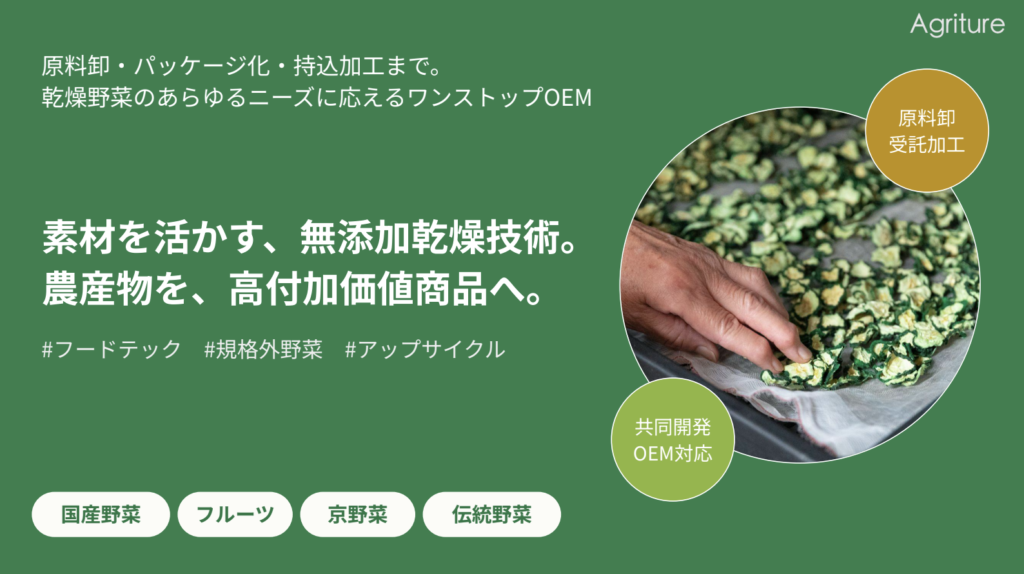
- OEM available from small lots of 10 kg
- Drying of brought-in raw materials also possible
- Support from processing to filling in one place
What is hot-air drying (dried vegetables)?
Hot-air drying (air-drying) is a method that dries food by evaporating moisture with hot air of around 40–70°C. Because processing cost is relatively low and aroma and taste are concentrated, it is adopted widely—from miso soup ingredients and snacks to commercial vegetable materials.
In the food industry, it's used for a wide range of ingredients, including fruit, vegetables, meat, fish and grains, to improve shelf life and make cooking easier. The temperature range varies by application: some products are dried slowly at low temperatures, while others are finished at higher temperatures. At Agriture, we dry at in a low-temperature range of about 45℃, aiming for a finish that retains the flavor of the ingredient itself.
Why hot-air drying is said to be suited to cooking
The strength of hot-air drying is that it releases flavor when simmered and blends into dishes. A classic example is kiriboshi daikon, which soaks up the simmering liquid and absorbs flavor while keeping a firm texture when you bite into it. Japan has a long tradition of drying ingredients for cooking, and this method is a good match for Japanese ingredients.
- Absorbs flavor in simmered dishes and soups. Also suited to ingredients for making dashi
- Keeps its bite after rehydrating, making it easy to use as an ingredient
- Equipment comes in a wide range of sizes, so it can be run from small quantities of around 1 kg of fresh produce
On the other hand, what hot-air drying handles poorly is high-sugar fruit. High sugar content makes water hard to remove, and even when you think it's thoroughly dried, it may stop at a semi-dried state. The sweetness is concentrated and the flavor itself turns out delicious, but the remaining moisture makes shelf life harder to design, which makes it difficult for export products that need a long best-before date. Freeze-drying is better suited to such ingredients.
Concrete example: hot-air-driedDried tomato
Hot-air-dried Tomato is characterized by sweetness overflowing the more you chew and a firm texture. Used as dried tomato in salads, pasta, and the like, its distinctive flavor adds an accent to dishes.
Pros and cons of dried vegetables
Thanks to their flexibility in manufacturing and ease of handling, they are an ingredient easy for restaurants and processed-food businesses to use. Let's confirm the benefits, including price advantage, and the cautions.
| Aspect | Evaluation | Details |
|---|---|---|
| Equipment cost | ◎ Pro | Equipment cost is kept down, and small-lot support is possible |
| Texture | ◎ Pro | The bite tends to remain, making it ideal for texture-focused dishes |
| How the flavor comes out | ◎ Pro | Releases flavor when simmered and blends easily into dishes |
| Color and aroma | △ Con | Heat is applied, so color and aroma change more easily |
| Storage period | △ Con | Prone to moisture, with a shorter storage period than freeze-drying |
Summary of pros: Low cost, small-lot support, and texture retention are the three reasons it's ideal for BtoB commercial use.
Summary of cons: Its weaknesses are that color and aroma change easily and the storage period is shorter. Storage conditions need to be managed and best-before dates designed accordingly.
There are 5 kinds of food-drying methods | Features, cost, and suited foods
Freeze-drying and hot-air drying are the two representative methods, but there are several other ways to dry food. Because the result, cost, minimum lot supported, and suited foods change by method, in product planning, deciding "which method to make it with" first makes manufacturer selection smooth.
| Production method | Principle | Cost | Minimum lot | Suited foods |
|---|---|---|---|---|
| Freeze-drying | Freeze → sublimate in vacuum | High | 300〜1,000kg〜 | Miso soup, soup, rice porridge, fruit, baby food |
| Hot-air drying (air-drying) | Evaporate with hot air of 40–70°C | Cheap | 100g〜 | Vegetables, green onion, mushrooms, dashi materials |
| Spray drying | Spray liquid into a mist and dry it instantly | Medium | From tens of kg | Powdered soup, seasonings, powder |
| Turbo-drying | Dry in a short time with high-speed hot air | Medium | From a few kg | Vegetable powders and raw materials where you want to preserve color and aroma |
| Superheated-steam drying | Dry with steam over 100°C | Medium to high | From a few kg | Vegetables and aromatic materials that need sterilization |
"Freeze-drying," suited to soups and fruits
Freeze-drying makes the most of fast rehydration in hot water. It suits soups such as miso soup, broth and zosui rice porridge, strawberry and other high-sugar fruits, and baby food that needs to rehydrate softly. Because the equipment is large-scale, costs are high, and production lots are around 300–1,000 kg of pre-drying raw material, so it isn't suited to very small prototypes. It's chosen for products where a certain volume can be expected.
"Hot-air drying (air-drying)," suited to vegetable materials
The most versatile is hot-air drying. It suits vegetable materials such as green onion, mushrooms, and leafy greens, and materials boiled to take dashi, and its strength is that it's easy to support small-lot prototyping in units of 100g. At Agriture too, with hot-air and low-temperature air-drying of Kyoto vegetables and off-spec vegetables as our axis, we accept prototyping from small quantities (from Agriture's experience).
"Spray-drying, turbo-drying, and superheated steam," suited to powdering
When you want to process into "powder," such as powder or powdered soup, spray-drying and turbo-drying become candidates. At Agriture too we support powder processing of Kyoto vegetables and off-spec vegetables, and you can choose the method to suit the use. For aromatic vegetables where sterilization is emphasized, superheated-steam drying is sometimes used.
Incidentally, for kneading into sweets or dissolving into drinks, we often choose hot-air dried powder. Because freeze-drying keeps the ingredient as it is, we find the flavor doesn't come through as strongly when blended. This is based on our experience in processing, but we use it as a guide when deciding where to use powders.
Why dried vegetables are convenient for commercial use
Dried vegetables are a convenient ingredient used across diverse industries. Especially at restaurants and food manufacturers, adoption is advancing at many companies thanks to their shelf stability, convenience, and cost reduction. For small-lot ordering conditions, please also check the basics of freeze-dry minimum lots.
1. Long-term storage is possible and inventory management is easy
Dried vegetables have a longer storage period than raw vegetables and easy inventory management—a major benefit. Because they reduce food loss and achieve stable supply, they are economical for restaurants and food manufacturers.
2. Reduce cooking effort and make up for labor shortages
Because washing, cutting, and pre-processing are unnecessary, cooking effort can be greatly reduced. In the restaurant industry, where labor shortages are a challenge, and the food-processing industry, which seeks efficiency, they contribute to easing the operational burden.
3. Can supply at stable quality
Raw vegetables tend to fluctuate in quality and price with weather and season, but with dried vegetables, supply at stable quality is possible. Especially for companies that use large amounts of ingredients, uniformity of quality becomes a major advantage.
4. Reduce transport and storage costs
Because dried vegetables have their moisture removed and are lightweight, transport costs can be kept down. And because refrigerated or frozen storage is unnecessary, it also leads to reduced storage costs. This is a point food manufacturers and distributors want to nail down.
5. Can be used across a wide range of industries
Not limited to restaurants and food manufacturers, they can be used in diverse fields—nursing-care food, school lunches, disaster stockpiling, outdoor food, and more. Because you can choose a suited method such as freeze-drying or hot-air drying according to the use, they can flexibly meet the needs of each industry.
By use case | How to choose a drying method
Precisely because both processing methods are excellent, a choice suited to the use and purpose is required. We have summarized the optimal drying method by scene. As a representative example of fruit materials, the complete guide to choosing commercial freeze-dried strawberries is also a helpful reference.
|
Use |
Recommended processing method |
Reason |
|---|---|---|
|
Miso soup / soup |
Freeze-dried |
Rehydrates fast, and the ingredients come out soft |
|
Fine dining / dashi use |
hot-air drying |
Flavor is concentrated, and umami-rich dashi can also be taken |
|
Snacks / instant food |
hot-air drying |
Good bite, and supports baking and frying too |
|
Emergency food / stockpiling |
Freeze-dried |
Light and capable of long-term storage, and rehydration is easy too |
|
Kneading powder into products or using it in drinks |
hot-air drying |
Flavor comes through more easily when blended |
|
Processing high-sugar fruit |
Freeze-dried |
Tends not to dry completely with hot air, stopping at semi-dried |
|
Dried fruit eaten as is |
hot-air drying |
Sweetness is concentrated and flavor develops |
|
Want to prototype in small quantities |
hot-air drying |
Can be run in small units of around 1 kg of fresh produce |
|
BtoB raw-material supply |
hot-air drying |
Can flexibly support with cost, lot, and processability |
About Agriture's dried vegetable OEM service
At Agriture, centered on Kyoto-grown heirloom vegetables, we manufacture and roll out for OEM dried vegetables that are additive-free and use no glucose. Use cases by cut form, such as freeze-dried strawberry slices, are in how to use freeze-dried strawberry slices.
Rather than comparing and searching for manufacturers, Agriture's strength is that you can consult directly about the product you want to make. Centered on Kyoto-grown vegetables, we support everything from prototyping to mass production, cut and powder processing, and packaging in an integrated way.
| Item | Agriture's support |
|---|---|
| Supported production methods | Hot-air drying, low-temperature air-drying, powder processing |
| Minimum lot | Existing materials from 100g (drying processing of client-supplied materials is also possible) |
| Cut shape | Slice, julienne, powder, and other specifications possible |
| Main raw materials | Kyoto vegetables, heirloom vegetables, off-spec vegetables (additive-free, no glucose) |
| Supported industries | Restaurants, food processing, pet-food raw-material wholesale |
| Efforts | Sustainable manufacturing through agriculture-welfare collaboration and sixth-industrialization support |
▶ For details, see the "Agriture's OEM Service" page.
FOR BUSINESS
乾燥野菜のOEM・受託加工を承ります
国産の野菜・果物の乾燥、100メッシュ相当までの粉砕、10g以上の小袋充填までをお受けしています。小ロットの試作から量産までご相談ください。寄せられた相談の実例は OEM・卸のご相談 に掲載しています。
乾燥品の賞味期限は、出荷日から6ヶ月程度を目安にご案内しています。
FAQ
We have materials available to help you understand dried processing OEM
Agriture OEM, flexibly handling everything from small lots to large lots
- OEM available from small lots of 10 kg
- Drying of brought-in raw materials also possible
- Support from processing to filling in one place
Choose the optimal drying method according to your purpose of use
Freeze-drying and hot-air drying (dried vegetables) each have their own advantages and limitations. Freeze-drying suits you if you want fast rehydration and convenience; hot-air drying suits you if you prioritize cost, cooking performance and raw material sourcing. Working backward from the method that fits the product you want to make, including spray drying and turbo drying, makes choosing a manufacturer easier.
Choose the optimal drying method according to your purpose, and achieve both operational efficiency and quality.
Download the OEM contract processing materials
We will send the materials to your email address based on the information you provide.
If you are considering product development with off-spec or your own farm's vegetables:From planning to processing, materials, package printing and novelties, you can consult us through a single point of contact. → Learn more about one-stop product development
- ベジタリアンとは?国の規格が分けている4つの区分と食べられないもの
- Medicinal tea OEM is a system that lets you plan and sell health teas combining tea leaves, crude drugs, and medicinal-cuisine (yakuzen) materials—based on the theories of the four qi and five flavors, meridian tropism, and qi-blood-body fluids in Traditional Chinese Medicine—without your own facilities. This article explains the difference between medicinal tea and herbal or health tea, the four product types of seasonal, constitutional, symptom, and vegetable-yakuzen, the practicalities of raw material selection and blend design, how to choose an OEM manufacturer, 7 leading companies handling medicinal tea and health tea OEM, the manufacturing process and lead time, and sales strategies for mail-order and cafés—delivered by Kyoto-born dried vegetable OEM company Agriture, drawing on its insights from operating a yakuzen media outlet.
Author of this article
Related articles
-
 Adding Vegetables to Your Morning with Dried Vegetables: A Guide to Getting Dietary Fiber Easily
 -
 Predicting the Dried Vegetable Market in 2030! An Explanation of Growth Fields and the Latest Trends
 -
 Freeze-Drying Processing Costs | Price Ranges by Product and Lot
 -
 Freeze-Drying Minimum Lots: Small-Lot Ordering and Choosing a Manufacturer
 -
 Freeze-Dried Material Ranking | Popularity and How to Choose by Use
 -
 What is freeze-dried? A gentle explanation of the drying technology spreading to miso soup, vegetables, and strawberries
 -
 What Are Dried Goods? The Secret of Their Nutritional Value and Uses in the Modern Diet
 -
 Seven points to avoid failure when choosing a domestic dried vegetable manufacturer