
The complete guide to choosing vegetable powder: also explaining the difference between commercial and household use

Summary of this article
A complete, practical breakdown of how to choose commercial vegetable powder. A complete guide for food makers, restaurants, and product developers covering the differences in production method (hot-air drying, freeze-drying, vacuum drying), how to choose particle size (mesh), how to judge domestic versus overseas, points for verifying additive-free status and certifications (Organic JAS, HACCP, FSSC 22000), recommended items by use, the difference between commercial and home-use, Agriture's contract-processing track record, practical points to avoid failure in OEM processing, and an eight-item pre-order checklist.
Vegetable powder is a food ingredient made by drying vegetables into a powder, and it's used commercially across a wide range, from confectionery, beverages, soups, baby food, and care food to pet food. Even for the same "vegetable powder," the flavor, color, nutritional value, and price change significantly with the production method (hot-air drying, freeze-drying, vacuum drying), particle size (mesh), raw-material origin, and presence of additives, so selecting to suit the use is essential.
This article explains, for food makers, restaurants, and product developers considering commercial vegetable-powder selection, the differences in method and particle size, how to judge domestic versus overseas, points for verifying additive-free status and certifications, recommended items by use (spinach, carrot, kabocha, lotus root, etc.), the difference between commercial and home-use, the practicalities of OEM processing, and the major makers that handle commercial vegetable powder, drawing on knowledge from Agriture's contract-processing floor. For the lineup and specs of the commercial vegetable powder Agriture handles, Commercial vegetable powder | small-lot grinding OEM using 100% domestic vegetables.

TOC
The basics and market for commercial vegetable powder
Vegetable powder is a powdered food ingredient made by drying fresh vegetables and then grinding them. Removing the moisture boosts shelf life, and the weight and volume compress to less than one-tenth of the original, so it's an ingredient well suited to commercial settings in terms of logistics and inventory management too. Major items like spinach, carrot, kabocha, tomato, and beet are supplied stably and are widely adopted for coloring confectionery, as a base for soups and baby food, and as a raw material for functional foods.
Four points valued in commercial use
- Quality stability: small drift in color, particle size, and flavor across lots
- Supply continuity: being able to buy at the same spec through the year
- Traceability: being able to trace the raw material's origin, cultivation method, and processing history
- Cost: not just the per-kg price, but the total cost including yield and shipping
Differences by production method | hot-air, FD, vacuum
The quality of vegetable powder changes significantly with the drying method. The three representative methods each have suited uses and cost tiers.
| Production method | Temperature range | Cost | Flavor and color retention | Suited use |
|---|---|---|---|---|
| Hot-air drying | Around 60-90°C | Low | Somewhat degraded | Soups, sauces, and kneading in |
| Freeze-dried (FD) | Reduced pressure below freezing | High | Relatively easy to retain | Coloring for functional foods, confectionery, and beverages |
| Vacuum drying | 30 to 60C plus reduced pressure | Medium | High retention depending on conditions | Often regarded as suited to supplements and raw materials where you want to protect functional components |
💡 Term: what is freeze-drying (FD)?
A drying method that freezes the food and then removes moisture by sublimating the ice under vacuum. Because it dries without applying heat, it retains aroma, color, and nutrients well On the other hand, the equipment investment is large and the cost is high. It's adopted for coloring confectionery and beverages, and for functional ingredients.
Even for the same item, just changing the method alters the vividness of the color and the retention rate of vitamins. If you need a "vivid green spinach powder" commercially, FD or vacuum works; on the other hand, for a soup base used in large volumes, hot-air drying is the rational choice on cost.
How to choose particle size (mesh)
| Particle size | Features | Recommended uses |
|---|---|---|
| 20 mesh (coarse) | Texture remains, visible when mixed in | Furikake, toppings, working into dough |
| 40-60 mesh (medium) | Blends evenly into dishes | Soups, sauces, bread dough |
| 80-100 mesh (fine) | Disperses easily in beverages, smooth on the tongue | Beverages, smoothies, coloring for confectionery |
| Over 100 mesh (ultrafine) | Ultrafine powder at a level usable as a supplement raw material (feasibility varies with the maker's equipment and formulation) | Supplements, functional foods |
The practical approach is to work back to the particle size from the final product's texture, dissolvability, and appearance. When there are many complaints of "clumping" in beverages or smoothies, reviewing the particle size to 80 mesh or finer often improves it.
💡 Term: what is mesh?
The number of openings in a sieve over one inch (2.54cm) square. The larger the number, the finer the particles. "80 mesh" is roughly a particle size of 180μm or less, a guide for not clumping in beverages and soups. Coarse-grind uses are generally 30-50 mesh, and beverages and confectionery are generally 80-100 mesh or finer.
FOR BUSINESS
乾燥野菜のOEM・受託加工を承ります
国産の野菜・果物の乾燥、100メッシュ相当までの粉砕、10g以上の小袋充填までをお受けしています。小ロットの試作から量産までご相談ください。寄せられた相談の実例は OEM・卸のご相談 に掲載しています。
乾燥品の賞味期限は、出荷日から6ヶ月程度を目安にご案内しています。
Six points for choosing commercial powder
We lay out the points to check when sourcing commercially. Before comparing "recommended makers," clarifying your own requirements along six axes makes negotiation smoother.
| Point | Details to confirm |
|---|---|
| 1. Raw material origin | Domestic / overseas, presence of contract farmers or own farms |
| 2. Production method | Hot-air / FD / vacuum, temperature range and drying time |
| 3. Particle size | Whether mesh can be specified, variation between lots |
| 4. Raw material labeling | Whether it's 100% vegetable, presence of additives like dextrin |
| 5. Certification | Organic JAS, HACCP, FSSC 22000, ISO 22000 |
| 6. Minimum lot | Whether small lots are supported, the range of per-kg price swings |
Differences between domestic and foreign fruit
Domestic vegetable powder has clear traceability, and pesticide-use standards are managed under domestic law. Using Kyoto vegetables or regional heirloom vegetables as the raw material can also raise the product's story value. Overseas-grown (often China, Thailand, and Southeast Asia) is 20-40% cheaper per unit and strong for large-volume supply, but you need to verify the residual-pesticide testing and foreign-matter-prevention setup yourself. Even in commercial use, a two-track operation of "domestic as the mainstay plus overseas for cost control" is common on the ground.
How to tell additive-free and certification apart
Products with dextrin or glucose added to improve flowability are on the market. If the ingredient label lists "vegetable name only," it's additive-free. Many food makers make additive-free a required condition for baby food, care food, and health-food uses, and cases naming Organic JAS-certified domestic raw materials are increasing. HACCP and FSSC 22000 are indicators of the hygiene-management setup and are all but mandatory verification items when choosing a commercial supplier.
Recommended vegetable powders by use
We've organized the items most frequently adopted commercially by use. Recommended particle size and method are noted too, so use it as a reference for RFPs and spec sheets.
| Use | Recommended items | Recommended particle size | Recommended production method |
|---|---|---|---|
| Confectionery (cookies, cakes, macarons) | Spinach, kabocha, beet, carrot | 80–100 mesh | FD, vacuum |
| Smoothies and beverages | Kale, spinach, carrot, beet | Over 100 mesh | FD |
| Soups and potages | Kabocha, corn, tomato | 40-60 mesh | Hot-air, vacuum |
| Powder raw material for turnip potage | Spinach, carrot, kabocha, lotus root | 80 mesh or finer | FD, vacuum (additive-free) |
| Functional foods, supplements | Kale, beet, green papaya, tomato | Over 100 mesh | Vacuum, FD |
| Pet food | Kabocha, spinach, carrot, green papaya | 60-100 mesh | Vacuum, FD |
Spinach,and Carrot can be used across a wide range of applications, so keeping it as a commercial staple stock broadens your product-development options. Lotus root Powder has the property of thickening when dissolved in water, and adoption is growing for thickener-like uses in baby food and care food. For details, A breakdown of vegetable-powder PB development and small-lot manufacturing.
The difference between commercial and home-use
Commercial and home-use vegetable powders have the same "vegetable inside," but the packaging volume, price, quality assurance, and sourcing route differ significantly. The basic split is commercial for product development and restaurants, home-use for home cooking and small-scale sales.
| Item | Commercial | Household use |
|---|---|---|
| Packaging volume | 1 kg, 5 kg, 10 kg | 20-100 g small bags |
| Price (per kg) | Low to medium | High |
| Particle-size specification | Can be finely specified | Fixed specification |
| Quality assurance | Lot-managed, with a test report | Package labeling only |
| Sourcing | OEM makers, wholesalers | Confectionery-supply stores, e-commerce |
💡 POINT | when to choose commercial
- You need cost compression of 20-30% or more on the per-kg price
- You want to keep particle size and method consistent across lots (quality control)
- Sales destinations that require test reports or raw-material certificates (hospitals, schools, export)
- You use 100kg or more per month on an ongoing basis
Home-use is handy for small-volume use, but adopting it commercially makes the per-kg price 2-3 times higher and the cost doesn't work. The practical flow is to verify with home-use in the early product-development stage, then switch to a commercial lot once the prototype is settled.
Practical points to avoid failure in OEM processing
When off-the-shelf products don't meet your requirements, there's the option of contract-processing vegetable powder via OEM. From three cases Agriture actually contracted, we lay out the practical points of commercial vegetable-powder OEM.
Case 1: Turning Sakura lotus root (Chiba) into powder
An OEM project turning lotus root grown with organic fertilizer only and no chemical fertilizer into powder via low-temperature drying plus particle-size adjustment. The Sakura lotus root powdering project was characterized by a design that protected the lotus root's inherent flavor and color while drawing on its property of thickening when dissolved in water. Balancing the level of ultrafine grinding against the drying temperature made it possible to roll out to the rice-porridge, baby-food, and care-food markets.
Case 2: Drying Takii Seed's Phytorich series
An OEM project drying the vegetables containing functional components brand "Phytorich" developed by the seed company Takii Seed. The collaboration with Takii Seed dried seven items, including Kyo-kurenai carrot, Orange carrot, Bentenmaru spinach, and Healthier okra. We adopted a drying design mindful of functional components like lycopene, lutein, GABA, and anthocyanin. It wasn't powdered, but it's an angle you can also apply to a development pattern that rolls one raw material out to multiple products, such as herbal tea, detox water, and green-juice powder.
Case 3: Drying Buddy’s Farm's green papaya
A project, in progress, drying and grinding the pesticide-free Buddy's Farm in Odawara, Kanagawa uses grown by the agricultural corporation Buddy’s Farm in Odawara, Kanagawa. The collaboration with Buddy’s Farm is proceeding with processing on the premise of commercialization as a pet-supplement raw material. It's a case that teaches that even an ingredient hard to sell through general distribution can have its value rebuilt by redefining the use.
A checklist for considering OEM processing
- Whether you can bring in raw materials (is bring-in from your own farm or contract farmers OK?)
- Minimum lot (guide of 100kg+ raw material, 10kg+ for powder)
- Particle-size specification and prototype support (can you prototype at several particle sizes?)
- Packaging support (is it one-stop through commercial 1kg bags, small pouches, and stick filling?)
- Retention of functional components (can they design a temperature that protects enzymes and vitamins?)
Representative examples of capable makers
From the companies listed on the Food OEM Portal, we've compiled the major makers that handle manufacturing and contract-processing of commercial vegetable powder. We've organized the characteristics based on the information on their official pages.
| Company name | Base | Area of strength | Features |
|---|---|---|---|
| Agriture Inc.(Product page) | Kyoto | Contract processing of dried vegetables and powder | 100% domestic vegetables, off-spec utilization, no glucose, bring-in raw materials accepted, original blends from small lots |
| Okisu Co., Ltd. | Kanoya City, Kagoshima Prefecture | Vegetable drying and powder manufacturing | 20 ha own farm plus over 100 ha contract farms; a sixth-industry model for burdock, sweet potato, broccoli, etc. |
| Nikka Foods Co., Ltd. | — | Integrated hot-air drying and milling | 50+ years of hot-air drying track record, 40+ drying-machine units, one-stop from prototype to mass production |
| Yasai Yakuzen | Kyoto | Powders of vegetables x medicinal-diet ingredients | Supervised by a yakuzen specialist; can develop powdered dashi, non-caffeine teas, furikake, and more |
If you want to broaden your candidates to include other categories as well, you can Food OEM Directory you can search by specifying conditions (small-lot support, Organic JAS, powder processing).
We have materials available to help you understand dried processing OEM
Agriture OEM, flexibly handling everything from small lots to large lots
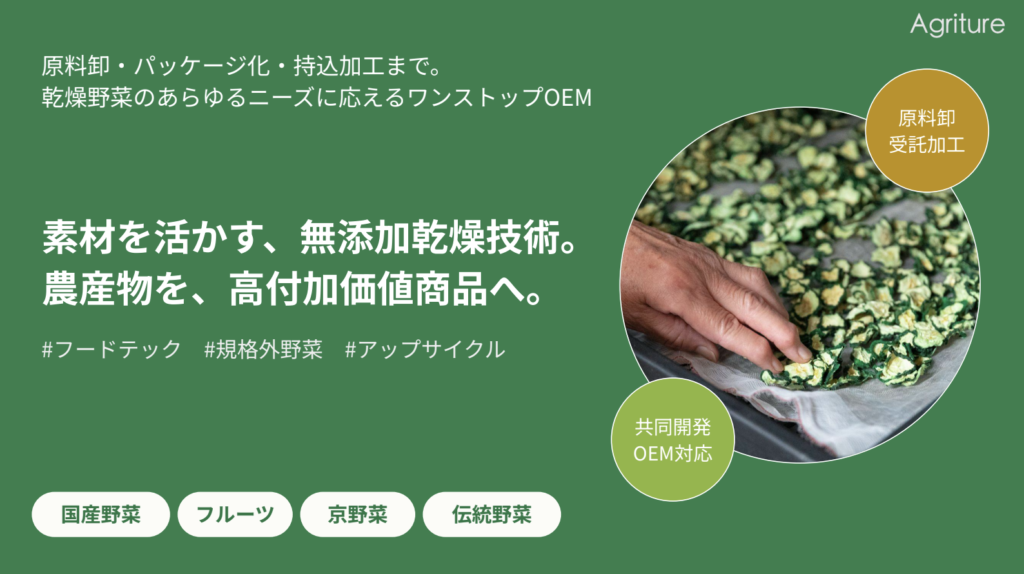
- OEM available from small lots of 10 kg
- Drying of brought-in raw materials also possible
- Support from processing to filling in one place
A final pre-order checklist
Before requesting a quote or placing an order, check the eight items below. Gaps make cost differences or quality trouble more likely to surface after mass production.
✅ Eight pre-order checks
- Is the raw-material origin (domestic / overseas) clearly specified?
- Does the method (hot-air / FD / vacuum) suit the use?
- Is the particle size (mesh) specified as a number?
- Is the ingredient label (100% vegetable / presence of additives) confirmed?
- Are the certification (Organic JAS / HACCP / FSSC 22000) requirements sorted out?
- Do you grasp the minimum lot and the range of unit-price swings?
- Do the best-before date and storage conditions match the sales plan?
- Are the prototype-sample terms (number of rounds, cost) agreed?
FOR BUSINESS
乾燥野菜のOEM・受託加工を承ります
国産の野菜・果物の乾燥、100メッシュ相当までの粉砕、10g以上の小袋充填までをお受けしています。小ロットの試作から量産までご相談ください。寄せられた相談の実例は OEM・卸のご相談 に掲載しています。
乾燥品の賞味期限は、出荷日から6ヶ月程度を目安にご案内しています。
FAQ
About how small is the minimum lot for commercial vegetable powder?
For off-the-shelf products, many makers sell from 1kg bags; for a fully original formulation via OEM, the minimum is generally 100kg for raw material and 10-50kg for the finished product. Adding particle-size or additive-free specifications tends to raise the lot.
Which do you recommend, hot-air drying or freeze-drying?
Choose by the final use. For soup and sauce bases used in large volumes, hot-air drying is the rational choice on cost. On the other hand, if you need vivid color or retention of functional components, freeze-drying or vacuum drying suits. Even for the same item, the price varies 2-4 times.
The color of our spinach powder varies by lot. Can it be improved?
Color varies with the raw material's harvest timing and drying conditions. If you prioritize color stability, it's effective to specify a single variety from the same farm, contracted growing with a specified harvest timing, and low-temperature drying (FD, vacuum). In commercial use, agreeing in advance on the allowable range of color difference per lot in a written agreement prevents trouble.
How do I tell additive-free vegetable powder apart?
Check the ingredient label. If only the vegetable name is listed, like "spinach (domestic)," it's additive-free. If other components are listed alongside, like "spinach, dextrin," additives for improving flowability are included. For baby-food and care-food uses, additive-free is a basic requirement.
Can you turn vegetables from our own farm into powder?
More and more makers can. Agriture handles OEM processing with bring-in raw materials and has collaboration cases with agricultural corporations and seed companies such as Sakura lotus root, Takii Seed, and Buddy’s Farm. If you discuss the raw-material volume, drying conditions, particle size, and packaging format in advance, prototyping from small lots is possible too.
Summary | method, particle size, additive-free, certification
For commercial vegetable-powder selection, the efficient flow is to organize your requirements along four axes, method, particle size, additive-free status of the raw material, and certification, and inquire with a maker that suits the use. For staple items like spinach, carrot, and kabocha, take competing quotes from several companies and compare quality and price. For a product aiming at functionality or differentiation, also consider the option of designing your own spec via OEM rather than off-the-shelf.
From its base in Kyoto, Agriture handles the whole chain one-stop, from bring-in raw materials to small-lot prototyping, particle-size adjustment, and filling and packaging. You can check the items handled and their specs at the product page for commercial vegetable powder. For inquiries about powdering vegetables from your own farm or contract farmers, or OEM development, Agriture's page on Food OEM no Madoguchi.
Download the OEM contract processing materials
We will send the materials to your email address based on the information you provide.
If you are considering product development with off-spec or your own farm's vegetables:From planning to processing, materials, package printing and novelties, you can consult us through a single point of contact. → Learn more about one-stop product development
- Make Baby Food Easy with Vegetable Powder: Safe Uses and Recipes by Age
- Additive-free design with vegetable powder | How to choose natural colorants for use as coloring food
Author of this article
Related articles
-
 Creating a regional brand with a Kyoto-vegetable OEM | The complete flow from planning to sales
 -
 How to source commercial vegetable powder in small lots, and how to use it
 -
 What Is Vegetable Powder? Features, Shelf Life, Uses and a Guide to OEM
 -
 What is vegetable paste? The difference from powder, dried vegetables, purée, and extract
 -
 Solve picky eating too! 3 ideas for commercializing vegetable powder you can keep up every day
 -
 How to Use Fruit Powder | Substitution Design for Confectionery and Sweets
 -
 Case studies of vegetable powder use | Success patterns by industry and a framework for adoption decisions
 -
 Forecasting the vegetable powder market in 2030! An explanation of growth fields and the latest trends