
A must-read for e-commerce businesses: how to make a dried vegetable mix through OEM

Summary of this article
This article organizes dried vegetable mix OEM for Amazon and e-commerce from both market data and practical experience. It shows that what people search for on Google Trends is not "dried vegetable mix" but "miso soup ingredients," and that top Amazon listings sell on the scale of 1,000 units a month. It then explains best-selling formulations, how to choose a drying method (hot-air, low-temperature or freeze-dried), volume and packaging, cost structure and the price range to target, the schedule from order to delivery, designing for consistent flavor throughout the year, yield and inventory, documents required for direct FBA shipping, Rakuten, your own online store and furusato nozei (hometown tax donations), and 8 points for evaluating OEM manufacturers.
Dried vegetable mix OEM is contract manufacturing in which multiple dried vegetables are blended to match a product concept and sold under your own brand. It is used for products rehydrated with hot or cold water, such as miso soup ingredients, soups, cup noodle toppings, mixed rice and emergency food.
This article is written for businesses that want to launch their own brand of dried vegetable mix on Amazon and other e-commerce channels. It is structured to answer, with numbers, the three questions that always come up when actually commercializing a product: what formulation to use, how much each bag costs and the minimum number of bags, and whether products can be shipped directly to an FBA warehouse.
Based in Kyotango, Kyoto Prefecture, Agriture processes nearly 100 kinds of dried vegetables in-house. We have been commissioned to manufacture dried vegetable mixes such as dried vegetable sets for major food manufacturers and sets used as prizes in corporate campaigns. We handle everything from sourcing raw materials to formulation design, filling and direct shipping to FBA warehouses, and the figures in this article are based on actual contract terms.
Related article: Custom processing of dried vegetables: cut shapes, blends and moisture content/The complete guide to making original private-brand foods
TOC
What you can outsource with dried vegetable mix OEM
The client decides four things: product concept, volume, lot size and sales channel. Since the manufacturer handles everything from procuring raw materials to bagging, you can have your own product even without drying equipment or a filling line.
5 processes you can outsource
Unlike single dried vegetables, a dried vegetable mix involves a formulation step. Whether you can leave this to the manufacturer greatly changes the burden on the client.
| Process | What you can outsource | What the client decides |
|---|---|---|
| Raw-material sourcing | Selecting growing regions and varieties, coordinating with contract farmers | Domestic or overseas, and whether to highlight the origin |
| dry processing | Hot-air drying, low-temperature drying, cutting, milling | Final cut shape |
| Recipe | Weighing and blending multiple items | Which items to use and the overall direction |
| Filling | Weighing and filling into pouches, applying seals | Volume and packaging specifications |
| Shipping | Delivery to designated warehouses, direct FBA shipping | Delivery destination and shipping date |
You can choose either to design the formulation in-house and buy only the raw materials, or to leave the formulation to us as well. The former lets you buy at raw material cost, but the weighing and blending work stays with you. If you are starting small on e-commerce, outsourcing everything including the formulation takes more off your hands.
Product categories that adopt it readily
- Miso soup and soup ingredients: ready to use just by adding hot water. The biggest seller in e-commerce
- Cup noodle and instant noodle toppings: use small pieces that rehydrate quickly
- Mixed rice and risotto: uniform piece size that can be cooked with the rice
- Emergency food and rolling stock: lightweight with long shelf life
- Baby food and care food: fine pieces with short rehydration time
- Gifts and novelties: assortments of several kinds packaged as sets
Of these, miso soup and soup ingredients are the most common both in what we observe on Amazon and in inquiries we receive. The reasons are covered in the market data below.
The dried vegetable mix market seen through search data and actual sales data
Before designing a product, check where the market is headed. Placing Google search demand side by side with Amazon sales results shows that the two do not match. This gap becomes a direct guide for product naming and package design.
People search for "miso soup ingredients," not "mix"
We compared four terms on Google Trends for Japan over the past 5 years: "dried vegetables," "dried vegetable mix," "miso soup ingredients" and "freeze-dried vegetables."
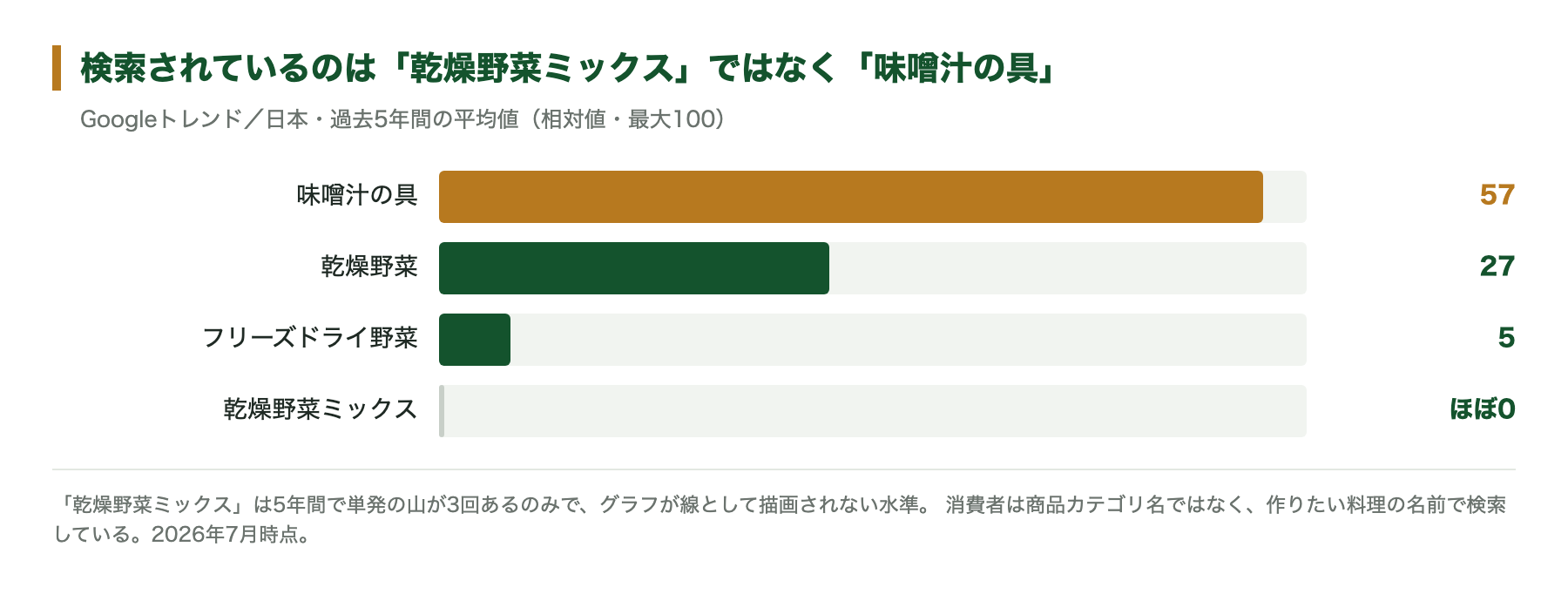
| Search term | 5-year average (relative value) | Trend |
|---|---|---|
| Miso soup ingredients | About 57 | Flat, slightly rising recently |
| Dried vegetables | About 27 | Flat |
| Freeze-dried vegetables | About 5 | Flat |
| Dried vegetable mix | Nearly 0 | Too low for a line to be drawn |
"Miso soup ingredients" has roughly twice the search demand of "dried vegetables." Meanwhile, the term "dried vegetable mix" shows only three isolated spikes over 5 years and does not form a line on the graph.
In other words, consumers do not search by product category name. They search by the name of the dish they want to make. If you build product names and Amazon ad keywords around "dried vegetable mix," the entry point is narrow from the start.
Top Amazon listings sell on the scale of 1,000 units a month
Small search demand does not mean the product does not sell. Searching "dried vegetables mix" on Amazon returns 460 results as of July 2026. The top products display the number of units purchased per month.
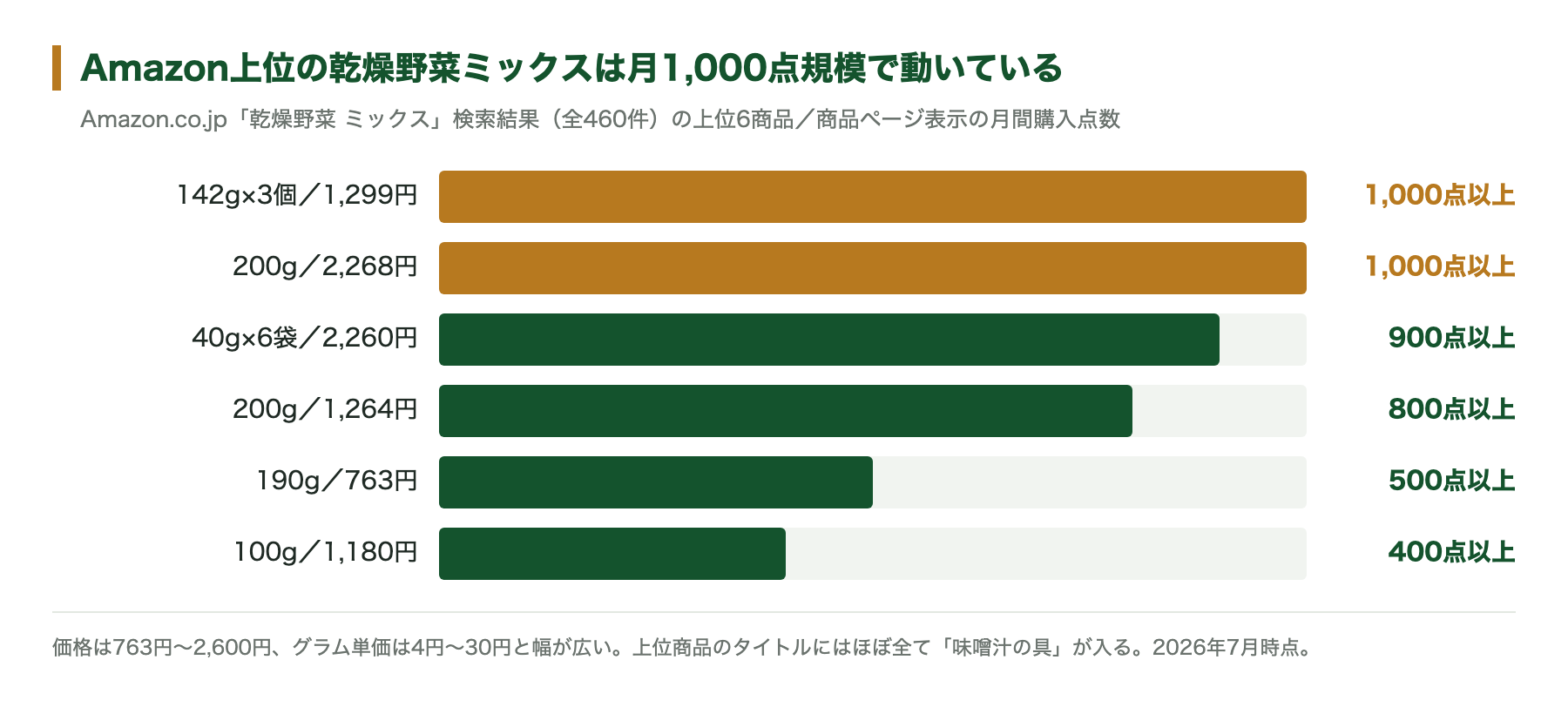
| Volume | Price range | Monthly units purchased |
|---|---|---|
| 142g x 3 packs | 1,299 yen | 1,000+ units |
| 200g | 2,268 yen | 1,000+ units |
| 40g x 6 bags | 2,260 yen | 900+ units |
| 200g | 1,264 yen | 800+ units |
| 190g | 763 yen | 500+ units |
| 100g | 1,180 yen | 400+ units |
This display shows a lower limit of "X or more," so actual sales are higher. Just adding up the lower limits of the top 6 products gives 4,600 units a month.
Calculating the price per gram, even these 6 products range from 3.0 yen to 11.8 yen, a gap of nearly 4 times. Across all search results, prices range from the 30-yen level for small packs of around 50g to about 6 yen for 1kg commercial packs. This means that even within "dried vegetable mix," the market lets you create different price ranges depending on how you design raw materials and volume.
What this data tells us
Looking at the titles of the top products, almost all of them include "miso soup ingredients." The structure of getting products found by use rather than category name is reflected in what actually sells.
- Build product names around use. "Miso soup ingredients" is a wider entry point than "dried vegetable mix"
- 100g and 200g are the standard volumes. Run small 40 to 60g packs alongside them for trial and gift use
- Set sales are common among top products. 3-pack and 6-bag sets raise the average order value
- Selling points are concentrated on domestic, additive-free, no added glucose and supervised by a registered dietitian
It is worth noting that several products stating "no added glucose" rank near the top. Some dried vegetable production methods add glucose for workability or appearance, which means there is a certain segment of buyers who want to avoid it. For details, see Why glucose is added to dried vegetables.
We have materials available to help you understand dried processing OEM
Agriture OEM, flexibly handling everything from small lots to large lots
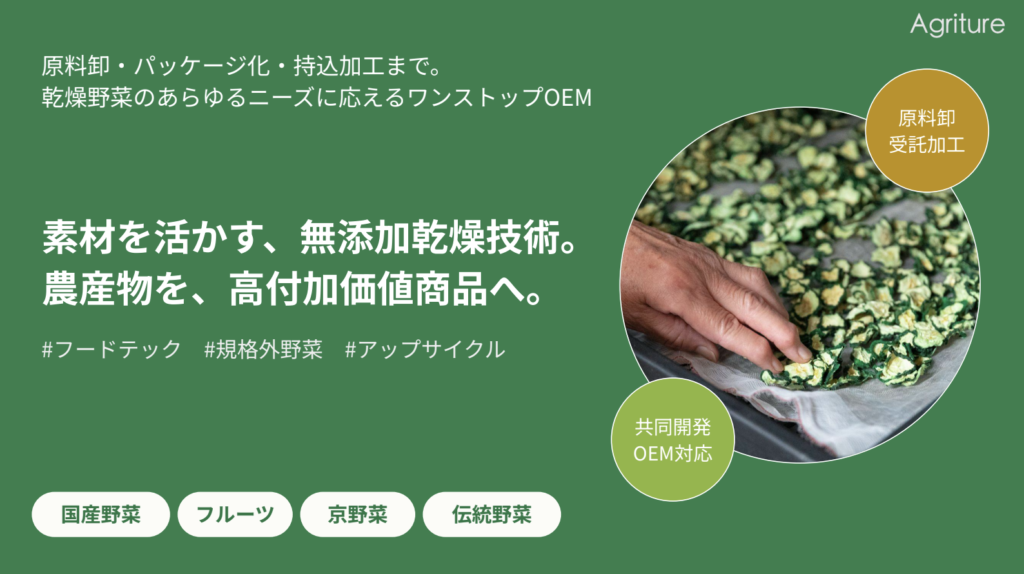
- OEM available from small lots of 10 kg
- Drying of brought-in raw materials also possible
- Support from processing to filling in one place
FOR BUSINESS
乾燥野菜のミックスを、まとめてお探しですか
用途に合わせて複数の品目を配合した乾燥野菜ミックスをお作りしています。法人の備蓄やローリングストックのご相談も承っています。配合の考え方は 法人向けローリングストック に掲載しています。
少量でのご購入は、姉妹ブランドの通販サイト OYAOYA で承っています。
How to make a miso soup ingredient mix
Looking at the lineup of top Amazon products, there is good reason to design your first product as miso soup ingredients. It is a competitive category, but breaking down the specifications of top products reveals room to stand out.
Why miso soup ingredients take center stage
The more effort it takes to rehydrate dried vegetables, the less they get used. Miso soup is one of the few dishes where you can put them directly into a pot or bowl without thinking about rehydration. Buyers use up what they buy, which leads to repeat purchases.
- No rehydration step needed. They rehydrate naturally in the soup
- An everyday dish, so the consumption cycle is fast
- Only a small amount is used at a time, giving the impression that one bag lasts a long time
- Easy to link to the purchase motivation of making up for a lack of vegetables
Conversely, selling them for stir-fries or salads requires explaining rehydration time, and reviews tend to say rehydrating is a hassle. Limiting your first product to soups helps prevent ratings from slipping.
Specifications common to top products
Looking at the top miso soup ingredient mixes on Amazon, their component items have strong similarities.
| Element | Trends among top products |
|---|---|
| Number of items | 4 to 6 kinds. Some have 9 or 10, but they are few |
| Items always included | Cabbage, carrot |
| Items often included | Onion, shiitake mushroom, komatsuna, spinach, napa cabbage, daikon |
| Color design | A combination including green, orange and white |
| Origin appeal | Kyushu-grown, domestic, prefecture name stated |
Cabbage and carrot are included in almost every product. They are inexpensive, rehydrate quickly and add color. The basic structure is to use these two as the base and differentiate with the rest.
Room for differentiation
Because the base is shared, the product is defined by how the remaining 30 to 40% is designed. In our actual contract work, consultations most often go in these 4 directions.
- Narrow the origin. Source from a single prefecture or single farm to increase the information you can put on the label
- Remove additives. State no added glucose and no added salt to clear the exclusion criteria buyers use when comparing
- Subdivide by use. Lean toward ingredients that add umami or root vegetables to give each a distinct role among soups (see the use table in the next section)
On the other hand, increasing the number of items to 10 or more is harder to recommend. The more items you add, the more raw material minimum lots pile up, and the smaller the amount used per item, leaving inventory sitting idle. This also affects the cost structure discussed later. If you want to promote variety, securing enough colors with 5 to 6 kinds keeps both cost and inventory under control.
Expanding blends by use
After establishing one miso soup ingredient product, expanding sideways by reusing the same raw material inventory increases procurement volume per item and lowers cost. An advantage of dried vegetable mixes is that simply changing the use creates a separate SKU.
Dividing uses within soups
Variations on miso soup can be made simply by shifting the center of gravity of the ingredients. The base of cabbage and carrot stays the same, and the lead ingredient is swapped.
| Use | Lead ingredient | Key design points |
|---|---|---|
| Tonjiru and kenchinjiru | Burdock, lotus root | Cut thicker to prevent falling apart during cooking. Longer rehydration time is acceptable |
| Vegetable soup and pot-au-feu | Broccoli, kabocha squash | Make green and yellow stand out. Photogenic appeal affects purchase decisions |
| Mushroom soup and hot pot | Enoki, shiitake mushroom | They release umami, so less miso and seasoning is needed |
| Takikomi rice | Carrot, burdock, mushrooms | Keep piece size small and uniform since they cook together with the rice |
| Cup noodle toppings | Cabbage, green onion | Slice thin enough to rehydrate in 3 minutes in boiling water |
| Powder raw material for turnip potage | Pumpkin, carrot | Fine pieces with short rehydration time |
| Emergency food and outdoor | Burdock, lotus root, root vegetables | Prioritize shelf life and design them to rehydrate even in water |
Burdock and lotus root rehydrate slowly even among root vegetables, and in miso soup they can remain firm at the core. Shifting them to products meant to be simmered, such as tonjiru, turns this weakness into a strength. Selling with a clearly stated use also helps keep review ratings stable.
Agriture's standard blends
We have organized the formulations most requested for e-commerce into 5 standard blends. We do not disclose the blend ratios, but the items used are as follows. All are domestically grown and can be made from existing inventory, so there is no prototype fee.
| Blend | Items used | Intended Use |
|---|---|---|
| Miso soup ingredient mix | Cabbage, carrot, burdock, komatsuna, kabocha squash | Place in a bowl and pour hot water |
| Tonjiru and kenchinjiru mix | Burdock, carrot, lotus root, cabbage, kabocha squash | Simmer in a pot |
| Vegetable soup and pot-au-feu mix | Cabbage, carrot, komatsuna, broccoli, lotus root, kabocha squash | Consomme and Western-style soups |
| Umami mix with mushrooms | Enoki, shiitake mushroom, cabbage, carrot, burdock | Soups, hot pots, mixed rice |
| Cost-focused mix | Cabbage, carrot, burdock, kabocha squash | SKU that competes on price |
These 5 can be used as is, or with just one item swapped out. The most common swap requests are adding more shiitake for a stronger umami flavor, and adding another green item for color.
The drying method changes the finish and cost
Before deciding on a formulation, you need to settle which drying method to use. Even for the same item, color, aroma, rehydration time and cost differ by method, and this defines the product's price range itself.
Differences between the 3 methods
| Method | Finish | Cost | Suitable items |
|---|---|---|---|
| Hot-air drying | Color and aroma weaken. Rehydrates quickly | Low | Root vegetables, mushrooms, cabbage |
| Low-temperature drying (45–60°C) | Flavor and aroma tend to remain | Medium | Leafy greens, aromatic vegetables, Kyoto vegetables |
| Freeze-dried | Retains shape, color and aroma. Rehydrates fastest | High | Leafy greens, premium products |
Even when Amazon product titles say "freeze-dried," many are actually products dried with hot air or low temperature. The difference between the two is explained in The Difference Between Dried Vegetables and Freeze-Dried. If you want to keep the price in the 1,000-yen range, choose hot-air or low-temperature drying; if you are aiming for the premium range of 2,500 yen or more, choose freeze-drying.
Agriture's standard blends are low-temperature dried. They sit in the middle range, preserving the color and aroma of leafy greens without raising costs as much as freeze-drying. If you would like freeze-dried production, please contact us separately.
How to choose the growing region
The growing region affects both the information you can put on the label and the cost. There are 4 directions.
| Direction | Effect | Points to note |
|---|---|---|
| Domestic, with the growing region stated | Reassurance and differentiation. Can also be included in Amazon titles | Raises cost. Requires securing inventory for the off-season |
| Combined with overseas-grown | Year-round supply and lower cost. Suited to large-volume products | Cannot be promoted as domestic |
| Specifying variety and farm | High reproducibility of flavor | Lot size and price must be agreed in advance |
| Organic and specially cultivated | Can raise added value | Organic JAS labeling requires 95% or more of the formulation to be certified raw materials, and the manufacturing site must also be a certified facility |
Promoting domestic origin has a predictable effect, but vegetables have limited harvest seasons. For a product sold throughout the year, plan on the assumption that you will prepare it in bulk during the harvest season and hold inventory.
How to build the formulation
A formulation is not decided by preference; it is work that satisfies cost, rehydration time and appearance at the same time. Following the order reduces uncertainty.
Build it in 3 layers: base, color and texture
Thinking of the formulation in terms of 3 roles makes it easier to balance cost and appearance.
| Layer | Guideline ratio | Role | Applicable items |
|---|---|---|---|
| Base | 50 to 60% | Creates bulk and keeps cost down | Cabbage, carrot |
| Color | 20 to 30% | Adds color to create visual appeal | Komatsuna, broccoli, kabocha squash |
| Texture / flavor | 10 to 20% | Adds bite and umami | Burdock, lotus root, enoki, shiitake mushroom |
Taking 50% or more for the base is a cost measure. Cabbage and carrot have low unit prices even among dried vegetables, and the more of them you use, the lower the raw material cost per bag. Conversely, the texture and flavor layer has high unit prices, so unless you keep it to 10 to 20%, it will push up the selling price.
Formulate with matching rehydration times
The most common complaint in reviews of dried vegetables for e-commerce is uneven rehydration time. When quick-rehydrating leafy greens and slow root vegetables are mixed in the same bag, the root vegetables are still hard by the time the leafy greens start falling apart.
- Group items with similar rehydration times. Decide whether to center on leafy greens or root vegetables
- If including root vegetables, cut them thin to match the leafy greens
- Do not mix powders, which tend to shed fine particles, with chips in the same bag
- Avoid combinations with large differences in specific gravity, as they cause ingredients to settle unevenly in the bag
At Agriture, we blend before filling, which keeps item imbalance between bags to a minimum. However, differences in specific gravity themselves can only be resolved at the formulation design stage, so items need to be aligned when choosing them.
Cut shape changes usability
Even for the same item, cut shape changes rehydration time and appearance. As a guide, about 20mm for miso soup ingredients, 5mm or less for cup noodle toppings, and about 3mm for mixed rice. For the characteristics of each shape, see Custom processing of dried vegetables laid out in detail on.
How to decide on volume and packaging
Volume and packaging directly affect not only cost but also review ratings. Dried vegetables in particular are prone to absorbing moisture and fading, so the choice of bag changes the product's lifespan.
The market uses 100g and 200g; our standard is 60g and 200g
Among top Amazon products, 100g and 200g are mainstream, with small 40 to 60g packs sold alongside them. Dried vegetables increase 5 to 10 times in weight when rehydrated, so even 200g amounts to a considerable quantity in fresh vegetable terms. Our standard blends come in two volumes, 60g and 200g, and if you would like 100g, it can be built on the same approach.
| Volume | Positioning | Actual price range on Amazon |
|---|---|---|
| 40〜60g | Trial, gifts, novelties | 1,000 to 1,600 yen |
| 100g | Main product for first-time purchases | 1,000 to 1,200 yen |
| 200g | For repeat customers, raising order value | 1,264 to 2,582 yen |
| Around 1kg | Commercial use, large-volume appeal | Around 6,000 yen |
Small packs incur fixed costs for the bag and bagging, making them more expensive per gram. When 60g and 200g are compared, the 60g pack can cost nearly 3 times as much per gram. A realistic approach is to build order value through set sales rather than single items. 200g has the widest price range, and the raw material design changes depending on which segment you target.
Pouch and label specifications
The standard for e-commerce is a flat pouch with a zipper. A transparent material that shows the contents, with a label sticker in the center, is the least expensive way to launch.
- The zipper allows storage after opening. This helps review ratings
- With transparent pouches and label stickers, you can create multiple SKUs without paying for printing plates
- Labels are about 62 x 70mm and include the ingredient name, net content, storage method, seller, manufacturer, best-before date, nutrition facts and barcode
- Adding SKUs only requires swapping the label
Transparent pouches also have a weakness. Light causes fading, and carrots, kabocha squash and leafy greens in particular lose their color easily. If you want a long best-before date, we recommend enlarging the label area or using a structure with aluminum vapor deposition or solid white printing on one side.
Best-before date and moisture protection
The best-before date of dried vegetables is determined by moisture content and packaging. Even with an additive-free design that uses no sugars or antioxidants, keeping the final moisture content low and including a desiccant in a zippered pouch keeps the product stable.
The date itself is set after actual measurement through shelf-life testing, not by estimation. If you are aiming for 6 months, the process is to first request a test at 6 months.
How lot size and price are determined
This is the area where we get the most inquiries from people who cannot make sense of quotes. We first lay out the general cost structure and then show Agriture's terms with concrete numbers.
In general, what determines cost?
The unit price per bag breaks down into 4 main cost items. This structure is common to all manufacturers; what differs is the level of each cost item and how the minimum lot is set.
| Item | What determines it | How to lower it |
|---|---|---|
| Raw material cost | Unit price of items used x blend ratio x volume | Raise the proportion of base vegetables, consolidate quantities |
| Bag cost | Pouch size and material | Use a general-purpose pouch with a label |
| Bagging fee | A flat rate per bag. Does not change with volume | Increase volume to reduce the number of bags |
| Initial cost | Formulation design, prototyping, various tests | Build with items from existing inventory |
What matters here is that bag cost and bagging fees are fixed regardless of volume. Filling costs per bag are the same for 60g and 200g, so the smaller the volume, the more the price per gram jumps. Most cases of stumbling on pricing for small-volume SKUs come from not factoring in this structure.
Another pitfall is the minimum lot for each item. Dried vegetables have a minimum purchase unit per item, so if you try to make only a small amount of a 10-item mix, the minimum lots for each item pile up and you end up with excess inventory. The fewer items you use, the easier it is to run in small lots.
Decide first which price range to compete in
Once you understand the cost structure, the next thing to decide is the selling price. Actual prices for 200g range from 1,264 yen to 2,582 yen, and the lower end at 1,264 yen is a mass-market product from contract farming at 6.3 yen per gram. This range is a contest of scale, where you need to secure raw materials in bulk.
On the other hand, a 2,268-yen product promoting Kyushu origin and supervision by a registered dietitian sells more than 1,000 units a month at the same 200g. If you are making a domestic, additive-free product, this is the range to aim for. Since spending more on raw materials can be absorbed in the selling price, designs that differentiate by origin and production method work well.
Amazon's referral fees, fulfillment fees and advertising costs are deducted from this. Fees vary by category and product size so they cannot be given uniformly, but to leave room for advertising, a selling price that keeps the cost ratio in the 50% range is a guide. If you aim for a low price of around 1,500 yen for 200g, profit becomes thin once fees are deducted, so in that case it is more realistic to reduce the volume to 60g or 100g and lower the unit price.
For our standard blends, we offer a fixed price per bag that includes raw materials, bag cost and bagging fee. There are also tiered prices by quantity. Specific unit prices and minimum lots are provided individually after we hear the volume and quantity you need.
Schedule from order to delivery
| Stage | Details | Estimated time |
|---|---|---|
| Consultation and quote | We ask about use, volume, lot size and sales channel | A few days |
| Sample review | Standard blends are shipped from inventory. Actual costs only | About 1 week |
| Prototyping | For original formulations. We prepare 2 to 3 patterns | About 2 weeks |
| Full production | Blending, filling, applying seals | 3–4 weeks |
| Delivery | Designated warehouse or direct FBA shipping | Shipping date agreed in advance |
As a guide, the first order takes about 1 month in total, and repeat orders from 2 weeks. Standard blends built from items in existing inventory skip the prototyping step, so they launch the fastest.
Original mixes with formulations designed from scratch have a higher minimum lot than standard blends, and a formulation design fee is charged for the first order. There is no upper limit on the number of items. If no ratio is specified, we design it in-house after hearing about the intended use.
Bagging fees, bag costs, label application, testing, desiccant inclusion and similar items are quoted according to volume and quantity. You can also bring your own packaging materials, but in that case please let us confirm feasibility with samples in advance.
Keeping flavor consistent throughout the year
With dried vegetable mixes, quality inconsistency becomes an issue once repeat sales start. The taste of fresh vegetables changes with the season, growing region and harvest conditions, so the design needs to absorb this at the stage of finishing the mix. This is also where differences show up in competitor product reviews.
Where inconsistency comes from
- Harvest timing. Sugar content and color change between early, mid and late varieties
- Growing region. Even the same variety tastes different depending on soil and climate
- Harvest conditions. Raw material quality shifts with each year's temperature and rainfall
- Drying conditions. Differences in temperature and time change color and texture
- Particle size. Lot-to-lot differences in milling and sieving shift particle size
Measures to reduce inconsistency
- Fix variety, growing region and harvest timing by writing them into the specifications
- Allow some adjustment range in blend ratios on the premise of blending multiple lots
- Evaluate color, flavor and aroma for each lot and exclude those that fall outside the standard
- Align particle size by sieving and do a final check before filling
- Record harvest date, variety and growing region on receipt so they can be traced later
When using standard blends, we handle this management on our side. Original formulations can be operated the same way once written into the specifications.
How to think about yield and inventory
When you bring in your own raw materials and outsource processing, understanding yield is the premise of cost calculation. This is because weight decreases at each stage from fresh produce through drying, cutting and milling.
5 processes where weight decreases
- Receiving. Raw materials that do not meet quality standards are removed
- Cutting. Trimmings and off-spec pieces are produced
- Drying. Evaporation of water causes a large loss. Leafy greens and high-moisture ingredients lose the most
- Milling. Fine and coarse powder are removed in the process of aligning particle size
- Filling. Losses from spillage and packaging defects
When building from items in our inventory, this yield is already factored into the unit price. If you bring in your own raw materials, we calculate backward from the yield to tell you the amount of fresh produce needed.
Planning so you never run out of inventory
- Work backward from your annual sales plan and prepare in bulk during the harvest season
- Hold 1 to 2 months' worth as safety stock so you do not run out in the off-season
- Strictly follow first-in, first-out by lot number and manage best-before dates
- Agree in advance with contract farmers on purchase volumes that account for losses
Delivery support by sales channel
The preparation needed changes depending on where you deliver the finished product. Here we organize the documents and delivery formats required by each e-commerce marketplace.
Direct shipping to Amazon FBA
If products can be delivered directly from the manufacturer to an FBA warehouse, you eliminate the effort and cost of receiving them at your own warehouse and reshipping. At Agriture, you create the shipment plan and issue the labels, and we ship directly from our facility within 3 business days. The shipping date is confirmed after prior agreement. Shipping costs are borne by your company.
- Create a shipment plan in Seller Central and issue FBA labels
- Share the label data with the manufacturer. Label application can also be outsourced
- Confirm the destination warehouse and shipping date
- Ship directly from the manufacturer to the warehouse
For larger quantities, pallet delivery is also an option. It is more efficient to transport than by carton, so it is worth considering for lots over 1,000 bags.
Food products fall under expiration-dated items, so delivery requirements are stricter than for general goods. Deciding the following points before starting production prevents delays at delivery.
- Confirm the best-before date before production. Start the print design only after measuring it through testing
- Keep best-before dates consistent within a single delivery. Shipments that span lots may not be accepted
- Show dates on outer cartons and individual packages in a format Amazon can read
- Decide whether to operate with JAN codes or FNSKUs, and confirm who is responsible for applying labels
- Check when creating the shipment plan whether the destination warehouse can handle food
For the FBA requirements themselves and the listing review process, see Amazon Listing Guide for Food OEM, which covers this in detail.
Documents required for Rakuten Ichiba
Rakuten Ichiba requires documents at the store application review stage. What is especially easy to overlook is the permits needed when selling OEM products.
In Rakuten Ichiba's store review, you may be asked for the manufacturer's permit documents for private-brand products made by another company. For dried vegetables, submitting a copy of the manufacturing facility's business license is common. Required documents vary by product category, so confirming early whether your contract manufacturer can provide copies keeps the review from stalling.
How you sell after opening a store is different from Amazon, and sales peaks depend on how you use the Super SALE held 4 times a year. For marketplace-specific sales tactics, see Tips for selling food on Rakuten Ichiba for more.
Yahoo!, your own online store and furusato nozei
| Sales channel | Delivery format | Preparation points |
|---|---|---|
| Yahoo! Shopping | Mainly self-shipping | Low initial cost, suited to test sales |
| Your own online store / Shopify | Self-shipping or outsourced | The highest profit margin. Inventory integration should be designed first |
| Hometown tax donation | Through local governments | First confirm that the manufacturing location meets the requirements for return gifts |
For furusato nozei, each local government sets requirements for where raw materials are grown and where they are processed. A setup in which Kyoto Prefecture-grown raw materials are processed in Kyotango makes it easier to meet the requirements, and dried vegetables are light and can be distributed at room temperature, making them a category well suited to return gifts.
Food labeling and testing
As long as you sell at retail, label requirements and testing cannot be avoided. If you put this off, you may end up with a finished product you cannot list.
Items required on the label
Under the Food Labeling Act, the label of a dried vegetable mix requires the following items. The amount of information fits on a sticker of about 62 x 70mm.
| Item | Points to note |
|---|---|
| Name | A common name that indicates the contents, such as dried vegetable mix |
| Ingredient name | List items in descending order of weight |
| Country or region of origin of ingredients | Show the origin of the ingredient with the highest proportion by weight |
| Net content | Stated in grams |
| Best-before date | Set after actual measurement through testing |
| Storage method | A statement to avoid direct sunlight, heat and humidity |
| Seller and manufacturer | Name or company name and address |
| Nutrition facts | Energy, protein, fat, carbohydrates and salt equivalent |
Labeling the origin of ingredients becomes complicated when multiple growing regions are involved. If you may source the same item from multiple prefectures, it is safest to check the labeling rules at the design stage. For details, see Origin labeling rules for ingredients in processed foods.
Tests you will need
- Microbiological testing. Dried vegetables have no compositional standards under the Food Sanitation Act, so this is not a legal requirement, but marketplaces and retailers often ask for results during negotiations. Choose items such as standard plate count, coliforms, and mold and yeast according to the standards of your sales channel
- Shelf-life testing. Measure over a specified period, such as 3 or 6 months
None of these are uniformly required by law; how far you go depends on the standards of your sales channels and business partners. Confirming which items are required before listing or negotiating, and then arranging the tests, avoids waste.
Which manufacturer to choose
Because dried vegetable mixes allow a high degree of freedom in formulation, a manufacturer's raw material lineup directly sets the upper limit of your product design. In practice, it is better to look at the items they stock than at their equipment.
7 points to check
| Item | What to check |
|---|---|
| Raw material lineup | Number of items in their own inventory. With 30 or more, formulation freedom is high |
| Processing method | Whether they handle hot-air drying, low-temperature drying, cutting and milling in-house |
| Minimum lot | Check both the mix-level and item-level terms |
| Filling handled | Whether they can handle everything from formulation to bagging |
| Business license | Whether the manufacturing facility has obtained a business license under the Food Sanitation Act |
| Delivery support | Whether they can ship directly to FBA or deliver to designated warehouses |
| Issuing specification sheets | Whether they can provide allergen information, ingredient formulation tables and manufacturing process charts |
Specification sheets are almost always requested in negotiations with marketplaces and retailers. If a manufacturer cannot issue them, negotiations stall, so it is safest to confirm this at your first inquiry. Agriture can issue specification sheets.
Another point that is easy to overlook is the two-layer structure of minimum lots. Even if it says "mixes from 50 bags," each item used has its own minimum purchase unit, so the lot you can actually build may be larger. Check the conditions at the item level as well.
How to protect your formulation recipe
With a dried vegetable mix, you can roughly tell what is inside by opening the bag. The ratios cannot be determined, but it is best to assume that this is a category that is easy to imitate.
- In a non-disclosure agreement, state the scope of disclosure and the protection period for formulation information
- Include a clause in the contract that prohibits reusing the same formulation for other companies
- Protect the product name and package design separately through trademarks and design rights
- Intellectual property ownership depends on who designed the formulation, so settle it at the time of contract
How rights are handled depends on who designed the formulation. However, blend ratios themselves do not lend themselves to registration systems like patents, so in practice the approach centers on defining ownership and scope of use by contract and managing the formulation as confidential information.
| Form | Who creates the formulation | What to decide in the contract |
|---|---|---|
| OEM outsourcing | The client brings its own formulation | Prohibition of reuse for other companies and limits on the scope of disclosure |
| Joint development | The client and manufacturer create it together | Ownership of the results. If this is not written down, disputes arise later |
| Led by the manufacturer | Using the manufacturer's existing formulation | What the client holds is the scope of sales rights |
Keep this point in mind as well when choosing between a standard blend and an original design.
Examples of mix formulations
A project with a major food manufacturer is a clear example of how designing formulations to match the use works in practice.
Case of Company A, with a different formulation for each flavor
This was a project to manufacture dried vegetable sets for major food manufacturer Company A, each matched to one of 6 flavors in the same series. The series included soups ranging from Japanese-style to Chinese-style, and we used dried vegetables made by upcycling off-spec vegetables.
We used items such as green onion, onion, cabbage, mushrooms and chili peppers, changing the combinations and ratios for each soup style. In effect, 6 types of mix were made from the same raw material inventory. This is no different from the approach to adding SKUs under your own brand. Rather than perfecting a single formulation, sharing a common base and swapping the lead ingredient keeps both raw material turnover and design effort under control.
5 things we ask when you contact us
To make the quote and prototype concrete, if you organize and share the following 5 points, we can provide a unit price in our first exchange.
- Product concept and sales channel: Amazon, Rakuten, your own online store or gifts
- Formulation direction: intended use, and items you want to include or avoid
- Volume and desired lot: how many bags of 60g, 100g or 200g
- Planned launch date: we build the schedule by working backward from it
- Packaging: whether a transparent pouch with a label is fine or a printed pouch is needed
We have materials available to help you understand dried processing OEM
Agriture OEM, flexibly handling everything from small lots to large lots
- OEM available from small lots of 10 kg
- Drying of brought-in raw materials also possible
- Support from processing to filling in one place
FOR BUSINESS
乾燥野菜のミックスを、まとめてお探しですか
用途に合わせて複数の品目を配合した乾燥野菜ミックスをお作りしています。法人の備蓄やローリングストックのご相談も承っています。配合の考え方は 法人向けローリングストック に掲載しています。
少量でのご購入は、姉妹ブランドの通販サイト OYAOYA で承っています。
Summary
Dried vegetable mix OEM gets moving once you decide on four things: formulation, volume, lot size and sales channel. Market data shows that consumers search by the use, "miso soup ingredients," rather than the category name, and top Amazon listings sell on the scale of 1,000 units a month. Committing your first product fully to miso soup ingredients, anchoring the base with cabbage and carrot and differentiating with the rest is stable in terms of both cost and ratings.
Agriture offers 5 standard blends by use, priced per bag including raw materials, bag cost and bagging fee. We also handle original mixes with formulations designed from scratch. Since we also ship directly to FBA warehouses, everything from manufacturing to delivery can be arranged in one flow. We provide unit prices and minimum lots after hearing your volume and quantity.
Related article: Custom processing of dried vegetables・Market prices for dried vegetables・The complete guide to making original private-brand foods. For inquiries about dried-vegetable-mix OEM, Food OEM no Madoguchi (Agriture).
Download the OEM contract processing materials
We will send the materials to your email address based on the information you provide.
If you are considering product development with off-spec or your own farm's vegetables:From planning to processing, materials, package printing and novelties, you can consult us through a single point of contact. → Learn more about one-stop product development
- Flavored Tea Development: Differentiating Aroma with 3 Elements × 4 Axes
- How to start a health tea OEM | How to build a brand chosen for functional beverages
Author of this article
Related articles
-
 Original coffee marketing strategy | Ways to grow sales
 -
 ベジタリアンとは?国の規格が分けている4つの区分と食べられないもの
 -
 長ねぎと白ねぎは同じもの?ねぎの種類と呼び名を国の資料で確かめる
 -
 柚子の種類は何種類あるのか、公の資料で名前が残る系統を数えた
 -
 ゆずの時期は年に二度、青ゆずは7月から黄ゆずは10月から
 -
 ゆずの産地は高知が半分を占め、二位は徳島から愛媛に変わった
 -
 Preventing Food OEM Failures: Common Failure Cases and Countermeasures for Success
 -
 How to find a food OEM | How to efficiently find the best manufacturing partner