
Commercial Freeze-Dried Strawberry | How to Choose Shape and Growing Region

Summary of this article
We organize how to choose commercial freeze-dried strawberry across five axes—shape, origin, lot, quality, and packaging. It covers a price comparison of domestic (Kyotango) and imported, the suitability of whole/slice/dice/powder, and Agriture’s scope of support and cases needing advance confirmation.
Freeze-dried strawberry is a commercial material adopted in confectionery, baking, granola, chocolate, and gifts. Because strawberry at 90% moisture is rapidly frozen and dried by vacuum sublimation, it can be kept lightweight and shelf-stable while retaining color, aroma, and shape. When choosing for commercial use, the basics are to compare across five axes—shape, raw-material origin, minimum lot, quality control, and packaging.
This article organizes how to choose commercial freeze-dried strawberry by use. From selective use by shape, to a comparison of domestic (such as Kyotango) and imported raw materials, to an OEM-ordering checklist, we explain it based on the inquiries Agriture receives for Kyotango-grown strawberries. Related articles: Popular-material ranking/Minimum lot/Processing cost/Whole/diced/Sliced。

TOC
Features of Commercial Freeze-Dried Strawberry
Strawberry is high in moisture, at about 90%, and is a material whose color dulls and aroma escapes easily with hot-air drying. Freeze-drying rapidly freezes at around −40°C, then removes moisture by sublimation under vacuum, so it can retain the red color and sweet-tart aroma of fresh strawberry as-is. Processing cost is higher than hot-air drying, but it’s an area with solid commercial demand as a material that creates brand value for premium sweets, gifts, and health foods.
Main Uses of Commercial Freeze-Dried Strawberry
- Confectionery / bread-making: Cake and tart decoration, kneading into baked goods, chocolate, financiers, macarons
- Breakfast, cereal: Granola, fruit granola, oatmeal, cereal-bar topping
- Beverages and drinks: Fruit tea, flavored water, smoothies, protein drinks
- Health foods, supplements: Protein bars, health cereal, vitamin-pitching powder material
- Gifts, premium: Signature products of Japanese- and Western-confectionery brands, tourist-destination souvenirs
Selective Use by Shape and Suitability
Commercial freeze-dried strawberry comes in four basic shapes—whole, slice, dice, and powder. Even from the same strawberry raw material, the finished appearance, yield, price, and ease of handling differ, so you choose to match the product design.
List of Features by Shape
In the order whole → powder, shape loss decreases and yield rises, so the unit price falls. For cake decoration or the topping of a Japanese sweet, whole; for kneading into batter, dice; for coloring a drink, powder—choose by working backward from the element you want to show in the product.
| Shape | Main use | Yield | Unit price |
|---|---|---|---|
| Whole | Gifts, cake decoration, premium sweets | Low (breakage loss) | Highest |
| Sliced | Granola, chocolate, baked goods | Medium (cutting loss) | On the higher side |
| Diced (cubed) | Kneading into confectionery and baking, ice cream | Medium to high | Moderate |
| Powder | Beverages, cream, protein | High (grinding assumed) | Medium to high |
Points for Selecting Whole / Slice / Dice / Powder
- Whole: Three-dimensionality and visual appeal are the product value. Breaks easily in transport and filling, so individual packaging + cushioning design is needed (details: Whole)
- Sliced: Uniform thickness suits toppings for chocolate, granola, and baked goods (details: Sliced)
- diced: Uniform in size, suits kneading into batter and mixing into ice cream. Stable yield (details: diced)
- Powder: Uniform dispersion of color and flavor. Ideal for blending into cream, mousse, and drinks
FOR BUSINESS
乾燥いちごを、原料としてお探しですか
国産のいちごを乾燥・粉砕してお出ししています。カット形状や粒度の指定、継続してのお取引もご相談ください。規格は 乾燥いちご に掲載しています。
いちごの少量販売は姉妹ブランドの OYAOYA では取り扱いがありません。ほかの品目はカタログをご覧ください。
A Comparison of Domestic and Imported Raw Materials
Commercial freeze-dried strawberry varies greatly in unit price and pitch axis between domestic raw material (such as Kyotango-grown) and imported raw material (such as Chinese- or Chilean-grown). You choose based on the product’s sale price, brand appeal, and sales channel.
Comparison by Raw-Material Origin
For premium sweets, gifts, and tourist souvenirs, which can command a sale price, domestic; for mass-distribution chains and export processed foods, imported with a focus on cost—this is a common pattern in practice.
| Axis | Domestic (such as Kyotango) | Imported (China, Chile, etc.) |
|---|---|---|
| Finished unit price per kg | 8,000–15,000 yen | ¥3,000–5,000 |
| Appeal axis | Domestic, origin name, variety specification | Cost, mass-production support |
| Example varieties | Benihoppe, Akihime, Tochiotome, etc. | Local mainstay varieties |
| Well-suited products | Gifts, premium sweets, health foods | Mass production, general-purpose raw material |
| Lead time | Batch-processed at harvest time (spring) | Year-round supply (based on local stock) |
The Strengths of Using Domestic Strawberry for Commercial Use
- Origin appeal: You can put a concrete name on the label, like “made with domestic strawberry,” “Kyoto-grown,” or “Kyotango-grown”
- Cultivar designation: You can differentiate with a variety name such as Benihoppe or Akihime
- Reproducibility of flavor: Little lot variation, easy to fit into a confectionery brand’s quality control
- a sense of story: You can put the farmer’s and region’s background into the product (strong for gifts and tourist souvenirs)
Five Points for Selecting Commercial Freeze-Dried Strawberry
To grasp the balance of spec, cost, and quality, we organize the perspectives to check before OEM ordering.
① Match of Shape and Use
- Visual appeal (cake, gift): whole, slice
- Kneading into batter, ice cream: dice
- Drinks, cream: powder
② Confirming Raw-Material Origin and Variety
- The unit price differs 2–3× between domestic and imported
- If there’s a variety specification (Benihoppe, Akihime, etc.), confirm it in advance
- Whether the labeling (country of origin, ingredient name) can be used for appeal
③ Minimum Lot and Yield
- Mass production is around 500kg of raw material (fresh), finishing at about 25–50kg
- For prototypes, there are small-lot vendors handling from 10–50kg of raw material
- Batch-processing at harvest time (spring) and supplying year-round is common
④ Quality Control and Certification
- Status of certifications such as HACCP, ISO, FSSC 22000
- Presence of metal detection, X-ray inspection, and weight checkers
- Lot management and traceability system
⑤ Packaging and Storage Design
- Aluminum-laminate packaging + oxygen absorber (moisture-absorption countermeasure)
- For whole, prevent breakage with cushioning and individual packaging
- Decide the shipping form: commercial large bag (1–5kg) or individual packaging (5–20g)
Agriture’s Commercial Freeze-Dried Strawberry
Agriture, centered on Kyotango City, Kyoto, supplies freeze-dried processing of domestic strawberries for commercial use by combining with partner factories. A feature is our ability to provide one-stop support from raw material procurement through formulation design, shape processing, and packaging.
Cases We Can Handle
- Raw materials: Procure Kyotango and domestic strawberries via farm and region contracts (variety specification such as Benihoppe or Akihime possible)
- Shape: Handle all shapes—whole / slice / dice / powder
- Lot: Prototype with 10–50kg of raw material, mass production from 500kg of raw material, scaling in stages
- Packaging: Commercial large bag (1–5kg) / individual packaging (5–20g) / gift-box support
- Sales-channel support: Track record of implementation in the OYAOYA brand and OEM projects via foodoem.jp
Cases Requiring Advance Confirmation
- Securing raw material outside the spring harvest season (handled with stock + additional procurement from partner farms)
- Large lots with a specific variety specified (such as Benihoppe) (requires region contracts and procurement coordination)
- Cases requiring a certified factory, such as halal or organic certification (confirm the partner factory’s support status)
- Packaging and labeling design premised on overseas export (confirming local label requirements is a prerequisite)
We have materials available to help you understand dried processing OEM
Agriture OEM, flexibly handling everything from small lots to large lots
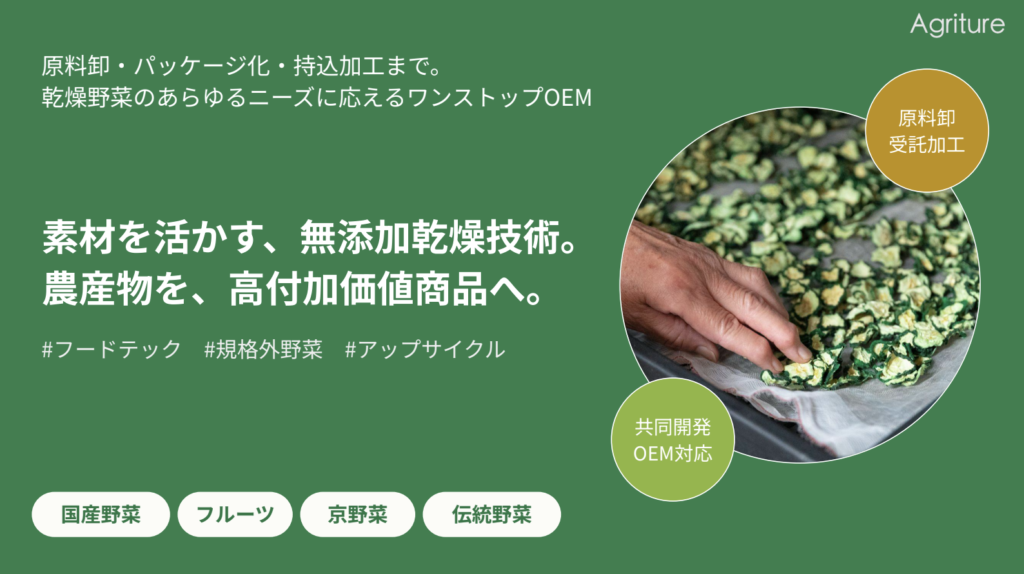
- OEM available from small lots of 10 kg
- Drying of brought-in raw materials also possible
- Support from processing to filling in one place
FOR BUSINESS
乾燥いちごを、原料としてお探しですか
国産のいちごを乾燥・粉砕してお出ししています。カット形状や粒度の指定、継続してのお取引もご相談ください。規格は 乾燥いちご に掲載しています。
いちごの少量販売は姉妹ブランドの OYAOYA では取り扱いがありません。ほかの品目はカタログをご覧ください。
FAQ
What’s the market price for commercial freeze-dried strawberry?
As a finished unit price per kg, the guide is ¥8,000–15,000 for domestic (such as Kyotango) and ¥3,000–5,000 for imported (China, Chile, etc.). It varies further with shape (whole, slice, dice, powder) and minimum lot.
Which shape should I choose?
The basics are whole or slice for visual appeal such as cake decoration and gifts, dice for kneading into baked goods and ice cream, and powder for blending into drinks and cream. Once the use and sale price are set, it narrows down automatically.
How do I choose between domestic and imported?
Domestic suits products that can command a sale price, such as gifts, premium sweets, and health foods; imported suits use as a mass-production, general-purpose raw material. A strength of domestic is that it can differentiate through label appeal such as “Kyotango-grown” or “made with Benihoppe.”
What’s the minimum lot for strawberry?
The guide for mass production is around 500kg of fresh raw material, finishing at about 25–50kg. Because some factories handle prototypes from 10–50kg, staged operation—prototype in a small lot, then switch to mass production—is common. For details, see Minimum lot.
How should I handle packaging and storage?
Aluminum-laminate packaging + oxygen absorber is the basis. Because freeze-dried strawberry changes texture when it absorbs moisture, even a commercial large bag needs airtight sealing combined with a desiccant. Whole breaks easily in transport, so design it with cushioning and individual packaging to prevent breakage.
Summary
Commercial freeze-dried strawberry is selected across five axes—shape (whole / slice / dice / powder), raw-material origin (domestic / imported), lot, quality control, and packaging. Domestic Kyotango-grown, at ¥8,000–15,000 per kg, is premium yet a material with differentiating power in that it can appeal on the label with origin and variety names.
For details by shape, see Whole/diced/Sliced; for cost, see Processing cost; for lot, see Minimum lot. For OEM inquiries, Food OEM no Madoguchi (Agriture).
Download the OEM contract processing materials
We will send the materials to your email address based on the information you provide.
If you are considering product development with off-spec or your own farm's vegetables:From planning to processing, materials, package printing and novelties, you can consult us through a single point of contact. → Learn more about one-stop product development
- Freeze-Dried Strawberry Dice | Kneading Uses in Confectionery and Baking
- Freeze-Drying Processing Costs | Price Ranges by Product and Lot
Author of this article
Related articles
-
 Original coffee marketing strategy | Ways to grow sales
 -
 ベジタリアンとは?国の規格が分けている4つの区分と食べられないもの
 -
 長ねぎと白ねぎは同じもの?ねぎの種類と呼び名を国の資料で確かめる
 -
 柚子の種類は何種類あるのか、公の資料で名前が残る系統を数えた
 -
 ゆずの時期は年に二度、青ゆずは7月から黄ゆずは10月から
 -
 ゆずの産地は高知が半分を占め、二位は徳島から愛媛に変わった
 -
 Preventing Food OEM Failures: Common Failure Cases and Countermeasures for Success
 -
 How to find a food OEM | How to efficiently find the best manufacturing partner