
What Are Dried Tomatoes? A Basic Guide to Types, Flavor and Uses

Summary of this article
Dried tomatoes are a processed food made by drying ripe tomatoes, concentrated to about 10–15% of their fresh weight with concentrated glutamic acid. This article systematically explains, for beginners, the characteristics of the three types—salted, oil-packed, and unsalted/oil-free dried—as well as nutrition such as lycopene, the basics of rehydration, how to make an oil pack, storage methods, quality differences from low-temperature drying, and using high-sugar tomato varieties like Aiko and Frutica.
Dried tomatoes are a processed food made by drying fully ripe tomatoes to greatly reduce their moisture. As the water that makes up about 90% of a fresh tomato is removed, the umami becomes concentrated, making it an ingredient that adds deep richness and color to dishes in small amounts. In Italy they have long been used in pasta sauces and antipasti, and in Japan, farmers in regions such as Kyoto, Hokkaido and Okinawa have begun producing domestic dried tomatoes, drawing growing attention as a cooking ingredient. This article explains the basics of dried tomatoes for beginners, covering what types there are, how the flavor changes and how to use them for different purposes, and points you to dedicated articles for detailed usage, recipes, storage, choosing domestic products and sourcing for commercial use.

TOC
What are dried tomatoes? Characteristics and history
Dried tomatoes are called "Sun-Dried Tomato" in English and are a preserved food that has been made along the Italian and Mediterranean coasts for centuries. Alongside the traditional method of removing moisture by sun-drying, advances in processing such as low-temperature drying and freeze-drying now keep them in circulation worldwide year-round. Compared with fresh tomatoes, three characteristics stand out: the weight is concentrated to about 10–15%, umami components are concentrated, and they keep for a long time at room temperature.
| Comparison item | Fresh tomato | Dried tomato |
|---|---|---|
| Moisture | About 90% | About 10–15% |
| Umami | Contains glutamic acid but faint | Glutamic acid concentrated and rich |
| Storage period | About a week refrigerated | 6 months or more at room temperature |
| Flavor | Juicy and refreshing | Rich, with concentrated umami |
| How to use | Eating raw, salads | Stews, pasta, preserving in oil |
Types and processing styles of dried tomatoes
Dried tomatoes are divided into types along two axes: "variety" and "processing style." The differences by variety come from first-hand information gained at Agriture's production floor—practical, working-level knowledge not written in typical web articles.
Differences by variety
Having dried multiple varieties at Agriture, we've found that high-sugar cherry-tomato types (Aiko, Chika, etc.; Brix 7–10) bring sweetness to the fore and suit sweets and snacks, while tart large-fruit types (Momotaro, etc.; Brix 4–6) concentrate their umami and suit dashi and soup bases. The cooking-use San Marzano type has thick flesh and low moisture, making it ideal for authentic pasta sauces and pastes.
| Variety | Sugar content | Flavor after drying | Suitable use |
|---|---|---|---|
| Cherry-tomato type | Brix 7–10 | Strong sweetness | Snacks, nibbles, salads |
| Large-fruit type | Brix 4–6 | Balanced acidity and umami | Soup, dashi, simmered dishes |
| San Marzano type | Brix 4–5 | Meaty, concentrated umami | Pasta sauce, paste |
Characteristics by processing style
The three representative processing styles are "fully dried," "semi-dried," and "oil-packed." Fully dried keeps for 6 months or more at room temperature and is rehydrated before use in dishes. Semi-dried leaves some moisture for a juicy texture and requires refrigeration. Oil-packed is a ready-to-use type, suited to antipasti and bread toppings.
Flavor of dried tomatoes and where to use them
Because drying concentrates their umami, dried tomatoes add deep richness and color to dishes even in small amounts. Here is their character from four angles.
- Umami: Drying concentrates glutamate-based umami, so they can even stand in for dashi stock
- Glutamic acid: the same umami component as in kombu and cheese. The reason they work as a dashi or soup base
- Color: The color deepens with cooking, adding redness and gloss to dishes
- Texture: With the moisture gone, they become dense and release more flavor the more you chew
In yakuzen (Chinese medicinal cooking), fresh tomatoes are classified as having a cooling nature. Drying is said to make that nature somewhat milder, and they are used as an ingredient that is easy to include regardless of season.
A detailed guide to dried tomatoes (link collection by purpose)
If you'd like to know more about dried tomatoes, see the dedicated articles below. Starting with the one that fits your purpose is efficient.
| Purpose | Recommended articles | Details |
|---|---|---|
| I want to know uses and recipes | How to use dried tomatoes | Rehydration, recipes, and uses by variety | The basics of rehydration, and recipes for pasta, miso soup, and oil packs |
| I want to know storage methods | How to store dried tomatoes | Tips for room temperature, refrigeration, and freezing | Storage steps for room temperature, refrigeration, and freezing, and how best-before dates change by variety |
| I want to choose domestic products | How to choose dried tomatoes | Domestic, additive-free, no added salt | How to read ingredient labels, how to spot additive-free products, and where to buy |
| I want to source commercially | How to choose commercial dried tomatoes | Quality and OEM case studies | 5 comparison axes, 4 types of suppliers, and OEM examples |
| I want to make them at home | A thorough guide to drying tomatoes | How to make them at home | Three methods: oven, microwave, and sun drying |
| Product details / purchase | Agriture's dried tomato product page | Kyotango-grown, commercial specs, OEM-ready, FAQ |
| Purchase for individuals | OYAOYA's domestic dried tomatoes | 20 g–500 g, Kyoto-grown Momotaro type, additive-free |
We have materials available to help you understand dried processing OEM
Agriture OEM, flexibly handling everything from small lots to large lots
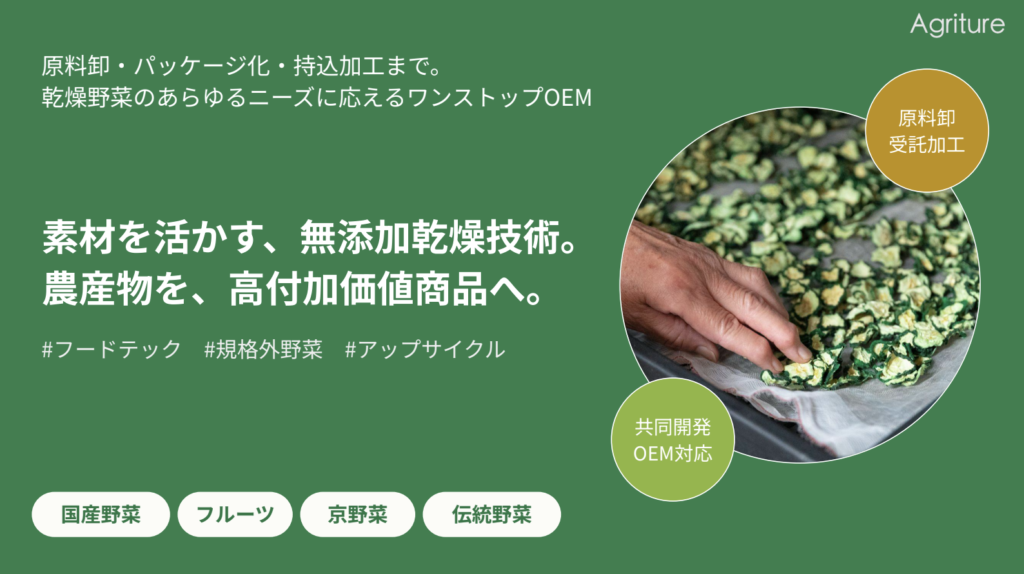
- OEM available from small lots of 10 kg
- Drying of brought-in raw materials also possible
- Support from processing to filling in one place
FOR BUSINESS
乾燥トマトを、原料としてお探しですか
国産のトマトを乾燥・粉砕してお出ししています。カット形状や粒度の指定、継続してのお取引もご相談ください。規格は Dried tomato・Tomato Powder に掲載しています。
少量でのご購入は、姉妹ブランドの通販サイト OYAOYA で承っています。
Summary: Grasp the basics of dried tomatoes and put them to work in cooking
Dried tomatoes are an ingredient with the moisture removed and the umami concentrated. By variety, they divide into sweetness-focused cherry tomato types and umami-focused large tomato types. There are three processed types, fully dried, semi-dried and oil-packed, and the basic approach is to choose according to use. For usage, recipes, storage, choosing domestic products and sourcing for commercial use, see the relevant articles in the links by purpose above.
If you're trying dried tomatoes for the first time, OYAOYA's 20 g trial pack is a good place to start. It's an additive-free type made from Kyotango-grown ripe Momotaro finished with low-temperature drying, enjoyable eaten as is or used in cooking.
Download the OEM contract processing materials
We will send the materials to your email address based on the information you provide.
If you are considering product development with off-spec or your own farm's vegetables:From planning to processing, materials, package printing and novelties, you can consult us through a single point of contact. → Learn more about one-stop product development
- How to Make Dried Tomatoes: Drying Tips, and How Cherry and Large Tomatoes Turn Out Differently
- How to Use Dried Tomatoes: Rehydrating, Popular Recipes, and Uses by Variety
Author of this article
Related articles
-
 ベジタリアンとは?国の規格が分けている4つの区分と食べられないもの
 -
 柚子の種類は何種類あるのか、公の資料で名前が残る系統を数えた
 -
 Adding Vegetables to Your Morning with Dried Vegetables: A Guide to Getting Dietary Fiber Easily
 -
 Predicting the Dried Vegetable Market in 2030! An Explanation of Growth Fields and the Latest Trends
 -
 What Is Vegetable Powder? Features, Shelf Life, Uses and a Guide to OEM
 -
 How to Use Fruit Powder | Substitution Design for Confectionery and Sweets
 -
 What is freeze-dried? A gentle explanation of the drying technology spreading to miso soup, vegetables, and strawberries
 -
 What Are Dried Goods? The Secret of Their Nutritional Value and Uses in the Modern Diet