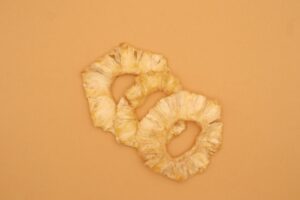
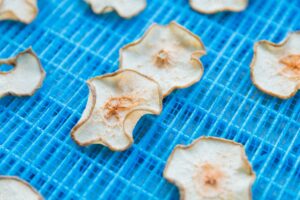
Dried Persimmon

TOC
Product Overview of Dried Persimmon
Dried persimmon is a commercial dried fruit made by cutting Japanese-grown sweet persimmon into slices or dice and drying it. Unlike hoshigaki (korogaki) finished by hanging under the eaves, thinly slicing and removing the moisture finishes it with persimmon's inherent gentle sweetness and a soft yet slightly chewy texture. Because it uses an unsweetened specification with no soaking in sugar or sugar syrup, it suits product designs that make the most of the persimmon's own natural sweetness.
Removing moisture in the drying process concentrates the sweetness, and a persimmon-like flavor spreads the more you chew. Fresh persimmons are perishable and seasonally limited, but the dried product can be handled stably year-round at room temperature, so it can be used as a raw material for a wide range of applications, including confectionery, cereal, bakery, and toppings.
01 A "slice-dried" type, distinct from hoshigaki
Rather than hoshigaki finished by hanging, it is a type thinly sliced or cut into squares and dried. Its texture and use differ from hoshigaki, which develops a bloom (persimmon frost), and it is finished into a shape easy to use for mixing into confectionery and cereal, and for toppings.
02 Using Japanese-grown sweet persimmon
We use as raw material sweet persimmon whose tannin—the source of astringency—has naturally faded. Without relying on de-astringency treatment or sugar-syrup soaking, it is an unsweetened finish that makes the most of the persimmon's own sweetness.
03 Two specifications: slice and dice
You can choose the specification to suit the use—slice for toppings and products where you want to show the cross-section, dice as an ingredient for mixing in and for granola. Adjustment of cut thickness and drying degree can also be discussed.
Product catalog showing the items we handle
Flexible support from small lots to large lots
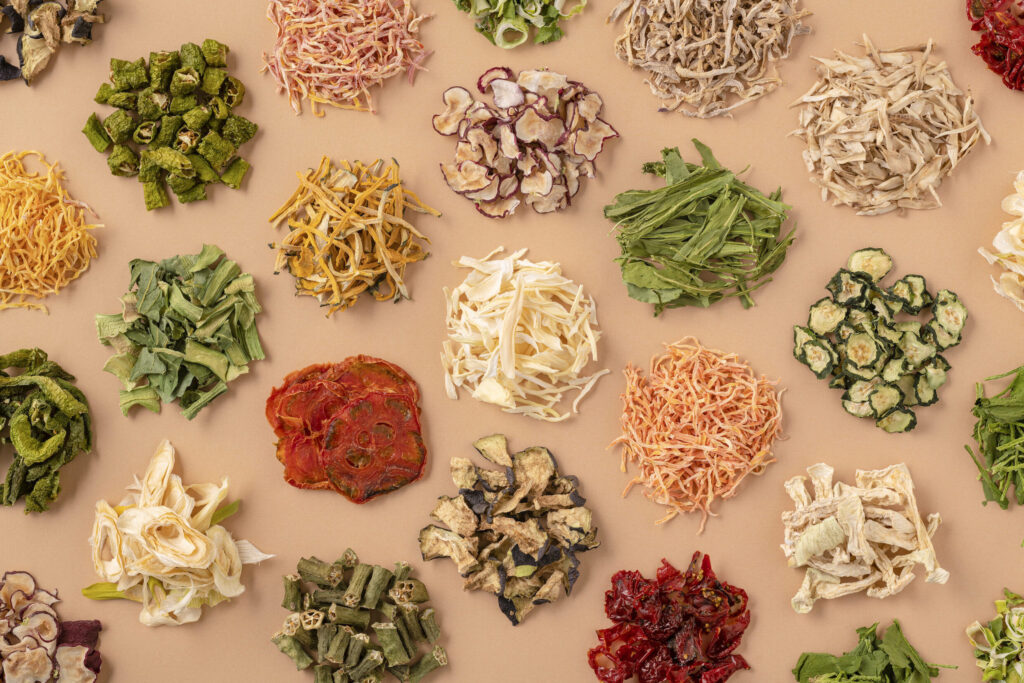
- Sold in small lots from 1 kg
- Handling heirloom vegetables from across Japan
- Dried fruits and herbs also supported
Features of Commercial Dried Persimmon
Persimmon's inherent natural sweetness
As moisture is removed by drying, the persimmon's sweetness concentrates. Because it is an unsweetened finish using no sugar or sugar syrup, it can be developed as-is into clean-label products that make the most of the ingredient's sweetness.
A texture distinct from hoshigaki
Because it is thin-slice dried, unlike the sticky hoshigaki, a light bite remains within its softness. It is a texture easy to handle even when mixed into confectionery or cereal.
Two shapes
We offer two types, slice and dice. Slice is a shape easy to use for toppings and products that show the cross-section, and dice as an ingredient for bread, baked goods, and granola.
Unsweetened specification
An unsweetened specification with no soaking in sugar syrup. It suits products that want to promote light sweetness and additive-free, and confectionery and bakery ingredients that want to make the most of the ingredient's flavor.
Affinity with Japanese ingredients
Persimmon pairs well with wagashi and Japanese-style sweets, and can be put to use for the color and flavoring of Japanese-tasting products such as yokan, monaka, and baked goods. It is also a material easy to develop as an ingredient for autumn-winter seasonal products.
Room-temperature distribution
Through drying that keeps moisture low, it achieves a best-before period of about six months in room-temperature distribution. Refrigerated or frozen logistics are unnecessary, contributing to long-term shelf sales and reduced loss risk for mail-order products.
Product Specifications of Dried Persimmon
Item | Details |
|---|---|
Product name | Dried Persimmon |
Raw material | Persimmon (Japanese-grown) |
Specification | Slice / dice. Cut thickness adjusted to suit the use |
Appearance | Slices/dice in orange to amber tones |
Storage method | Room temperature (store away from heat, humidity, and direct sunlight) |
Best-before date | About 6 months from the shipping date |
Minimum lot | 100g〜 |
Powder | Made to order |
Customization support
Dried persimmon's finish changes with cut shape and drying degree. In addition to the standard slice and dice specifications, adjustment of cut thickness and texture (softer / firmer) can also be discussed.
Item | Details |
|---|---|
Shape adjustment (slice / dice / cut thickness) | Designed to suit the use. Can be discussed from custom orders of 10 kg or more |
Powdering | Made to order (for confectionery, drinks, and powder blending) |
Blend design | Compatible with mixes combining other dried fruit |
OEM productization | Integrated handling through to the final product is possible |
POWDER
For those also considering powder
We also offer powder products that finely powder the dried material. They can be used in a wide range of applications such as confectionery, breadmaking, and drinks, expressing flavor and color even with a small addition. Persimmon powder is made to order.
Commitment to variety and growing region
Persimmon is a fruit tree of the genus Diospyros, family Ebenaceae (scientific name Diospyros kaki), an autumn fruit long familiar in Japan. At Agriture, we select and turn into raw material Japanese-grown sweet persimmon with sweetness suited to drying and firm flesh.
BRAND
Persimmon is broadly divided into sweet and astringent, and the source of astringency is tannin. For dried persimmon, we mainly use sweet persimmon whose astringency has naturally faded (lineages such as Fuyu and Jiro), giving it an unsweetened finish that makes the most of the ingredient's sweetness without relying on sugar-syrup soaking or artificial de-astringency.
REGION
Persimmon is grown nationwide, centered on warm regions, with Wakayama, Nara, Fukuoka, and Gifu known as representative producing areas. At Agriture, we select and turn into raw material persimmon in a flesh condition suited to drying from Japanese-grown fruit.
SEASON
Persimmon is in season in the autumn of October–November, when the sweetness builds up. Fresh fruit has a short shelf life and is seasonally limited, but drying makes it a raw material that can be handled stably year-round.
Drying Technique and Quality Control
Persimmon has soft flesh, a material whose texture and color change greatly with drying conditions. At Agriture, by removing moisture evenly while adjusting temperature and airflow, we finish it with a natural orange-to-amber color and a texture where a bite remains within its softness. If dried too little, shelf life drops; if too strongly, it becomes too hard, so we adjust the degree of moisture removal to suit the use.
In processing, we combine moisture-value checks with visual sorting, shipping only lots from which off-spec browning and fragments have been removed. To keep a best-before period of about six months in room-temperature distribution, we can also accommodate OEM supply in packaging formats containing an oxygen absorber.
💡 TIPS | Trivia About Dried Persimmon
Even within "dried persimmon," hoshigaki hung under the eaves (korogaki, anpogaki) and slice-dried persimmon that is thinly sliced and dried differ in both texture and use. Slice-dried persimmon does not develop a surface bloom (persimmon frost), which is characteristic of it being easy to use for mixing into confectionery and cereal, and for toppings.
Use cases
Dried persimmon suits a wide range of products—confectionery, breakfast, wagashi—in addition to snack use eaten as-is. We have organized how to use it by application.
For confectionery and sweets
As an ingredient for baked goods, granola bars, and pound cakes, it can add a natural sweetness while remaining sugar-free. Fresh persimmon poses production-line challenges of moisture management and browning, but the dried product allows bulk room-temperature inventory management and stable supply of sweetness and flavor without sweetness adjustment. It also flexibly accommodates small-lot, multi-variety OEM production.
For breakfast and cereal
It can be used as an ingredient for granola, muesli, and cereal. The dice type is easy to use for mixing in, and because room-temperature storage and stable color tone and sugar content are assured, it suits designs for clean-label products that use no artificial sweeteners or preservatives.
Wagashi and Japanese-style sweets
Persimmon pairs well with Japanese ingredients and suits Japanese-tasting products such as yokan, monaka, dorayaki, and baked goods. It can be developed as a material for the color and flavoring of autumn-winter seasonal products and Japanese-style gift products.
Snack and gift products
It suits materials for dried-fruit-specialty EC brands and souvenir/gift products. Because long-term room-temperature storage is possible, year-round stable supply is easy, and slices can make the most of the cross-section's color development for gift assortments and small-bag snacks.
Bread and bakery ingredient
It can be used as an ingredient for sweet buns and hard-type breads. Because the dried product can be built into dough at a stable moisture value, it is easy to accommodate mass-production lines with curbed quality variation, and bulk room-temperature storage also reduces the burden of purchasing and inventory management.
No-sugar, health-conscious products
Being able to compose sweetness from fruit-derived sugars with no added sugar suits low-sugar snacks and additive-free-oriented products. Switching to a dried material enables purchasing at stable quality year-round, and blend design also becomes easier to lock in.
Commercial usage and storage method
Use as-is: Dried persimmon needs no rehydration and can be built into products straight from the bag. When using it as a confectionery ingredient, it absorbs the moisture of dough or cream and softens, so we recommend mixing it in just before baking or topping it at the end.
Guideline for amount added: Adjust to a guide of 10–20% of the total in granola and mixes, and 5–10% as an ingredient in baked goods. Because it is a material that produces firm sweetness, it also suits recipe designs that keep the sugar amount down.
Storage and handling after opening: Unopened, the guide is about six months at room temperature (a cool, dark place away from heat and humidity). Because it absorbs moisture easily after opening, we recommend transferring it to an airtight container and using it up within a month in a cool, dark place. Combining an oxygen absorber is effective for portioning from a large bag.
Related Products
- Dried Apple – a crunchy dried fruit
- Dried Pear – dried fruit of Japanese-grown Nijisseiki pears
- Dried Strawberry – for confectionery and toppings
- Dried Vegetables and Dried Fruit Raw-Materials List
- Consult us on food OEM and raw material supply
Product catalog showing the items we handle
Flexible support from small lots to large lots
- Sold in small lots from 1 kg
- Handling heirloom vegetables from across Japan
- Dried fruits and herbs also supported
Frequently asked questions (FAQ)
Q. Is it different from hoshigaki?
A. It is different. Dried persimmon is a slice type made by thinly slicing or dicing sweet persimmon and drying it, and it differs in both texture and use from hoshigaki (korogaki, anpogaki) finished by hanging under the eaves. It is a shape easy to use for mixing into confectionery and cereal, and for toppings.
Q. Do you use sugar or preservatives?
A. It is an unsweetened specification using no sugar, sugar-syrup soaking, or preservatives. Because it makes the most of the persimmon's own sweetness, it can be used as a material for additive-free, clean-label products.
Q. Isn't it astringent?
A. Because we mainly use sweet persimmon whose tannin—the source of astringency—has faded, no astringency appears. Drying concentrates the sweetness, finishing it with the gentle sweetness characteristic of persimmon.
Q. Which is more suitable, slice or dice?
A. Slice suits products for toppings and where you want to show the cross-section, while dice suits mixing into granola, bread, and baked goods. We can also accommodate orders combining both.
Q. Can it be processed into powder?
A. Persimmon powder can be made to order. If you let us know the intended use—confectionery, drinks, powder blending, and so on—we will make a proposal.
Q. What are the minimum lot and best-before period?
A. We handle from small lots of 100 g or more. The best-before period is about six months from the shipping date. Custom specifications and large lots can be discussed separately.
Recommended reading
Download the product catalog
We will send the materials to your email address based on the information you provide.