Dried Hibiscus

Dried hibiscus is an edible floral material made by drying the calyx (gaku) of roselle (Hibiscus sabdariffa), a plant in the Malvaceae family. It is a different plant from ornamental hibiscus, and the raw material is the red calyx that thickens and swells after flowering. Its forte is a vivid red color and clean tartness, and that color and tartness are preserved by low-temperature drying. At Agriture, we run it alongside hibiscus powder made by finely milling the same hibiscus (made to order), proposing a division of use: dried hibiscus for applications where you want to keep the calyx shape and red color, and powder for even coloring of drinks and doughs.
Compared with other red materials such as rosehip and herbs, dried hibiscus can be used differently for its "clear, vivid red color," "clean tartness," and "ability to deliver both color and tartness at once in teas and drinks." It is a material we get many prototype inquiries for, as a raw material for hibiscus tea, blended tea, drinks with a red-color accent, syrups, jellies and jams, and confectionery color.
TOC
Agriture's dried hibiscus: three points of care
1. Low-temperature drying that makes the most of the red color
Dried hibiscus's appeal is the vivid red color that spreads when steeped in water or hot water. At Agriture, we hold down the drying temperature and design the process to remove moisture in a short time, keeping the red color in the finished product as much as possible. Having the red color rise cleanly when put into hot water is a factor that shapes the appearance of teas, drinks, and syrups.
2. Calyx treatment tailored to the application
Hibiscus uses the red, swollen calyx as raw material. The whole (whole calyx) shape extracts color and tartness firmly in teas and blended teas, while cut products are easier to handle in blending for drinks, syrups, and confectionery. The shape can be selected to match the application, and we propose it to match the finished product's appearance and ease of extraction.
3. Selecting lots for color and tartness to make the raw material
At Agriture, we assess the depth of the red color, the tartness, and the calyx size to select lots and turn them into raw material. Because color and tartness vary easily by material, we decide the volume-lot specifications after confirming how the extraction comes out at the prototype stage. Raw material with stable color and tartness is easy to handle in prototypes by tea, drink, and confectionery makers, which is one reason it is chosen.
Product catalog showing the items we handle
Flexible support from small lots to large lots
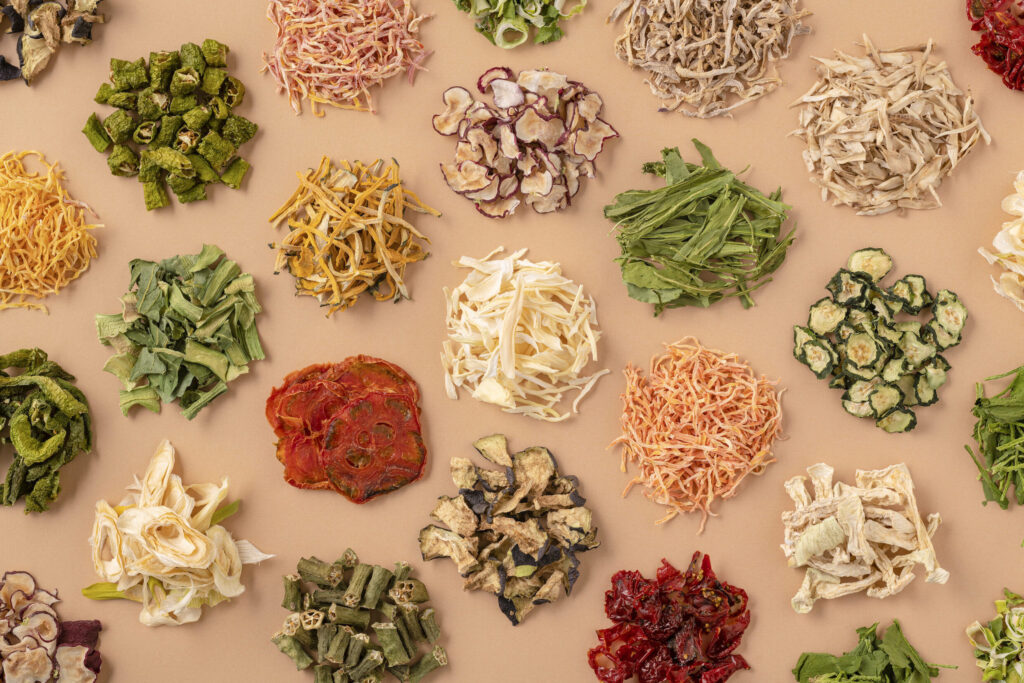
- Sold in small lots from 1 kg
- Handling heirloom vegetables from across Japan
- Dried fruits and herbs also supported
Features of commercial dried hibiscus
Even among red flower and herb materials, dried hibiscus holds a unique position with its red color, tartness, and ease of use in teas and drinks. We organize, from six perspectives, its strengths that can be put to use in either whole or cut form.
Clear, vivid red color
Steeped in hot water or water, a clear, vivid red color spreads. It gives an accent to the appearance of products where you want a red color to work—teas, drinks, syrups, jellies, and more.
Clean tartness
A clean tartness is its forte. Beyond color, it also becomes a flavor accent, a component that supports the freshness of hibiscus tea and drinks.
Staple status in teas and blends
A material long used as the main ingredient of hibiscus tea, and as coloring and tartness for blended teas with other herbs such as rosehip. A dried product that stores at room temperature can be used stably regardless of season.
Color develops in both water and hot water
Red color and tartness can be extracted not only with warm hot water but also with cold-brewing. It has an ease of use that draws out color and taste regardless of serving temperature—from hot tea to iced drinks to cold-brew blends.
Confectionery and drink color material
Making the most of red color and tartness, it can be used as a color material for jellies, jams, syrups, baked goods, and drinks. It suits accents for product designs that highlight a red color.
Use in combination with powder
Used together with finely milled hibiscus powder (made to order), it enables recipe designs that balance teas and drinks used by extraction (calyx) with even coloring of doughs and sauces (powder).
Product specifications (commercial)
Basic specifications at the prototype stage are as follows. Purchase lot, lead time, and packaging format are worked out through individual consultation.
| Item | Details |
|---|---|
| Product name | Dried Hibiscus |
| Raw material | Hibiscus (roselle calyx) |
| Shape | Whole / cut. Selected to match the application |
| Appearance | Vivid red dried calyx |
| Aroma | A clean aroma with a faint tartness |
| Net content | Individual quote according to use and lot |
| Best-before date | About 6 months from the shipping date |
| Storage method | Avoid high temperature, high humidity, and direct sunlight; after opening, seal and store in a cool, dark place |
| Minimum prototype lot | Inquire |
Customization support
You can consult us on form, packaging, and turning it into a final product from the prototype stage. Because we keep records while nailing down the recipe, it is a setup where specifications do not drift between prototyping and mass production.
| Item | Available | Details |
|---|---|---|
| Shape adjustment | Whole / cut | Selected to match the application—whole for tea, cut for drink and confectionery blending |
| Powdering | Fine powder (made to order) | For coloring drinks, confectionery, and doughs, and powder blending |
| Blend design | Combined with other herbs and materials | Blended-tea design with rosehip and other herbs |
| Packaging form | Commercial bulk / small bag / individual wrapping | From bulk for tea bags to packs for confectionery material |
| OEM productization | End-to-end support through the finished product | From concept to production for teas, drinks, syrups, and confectionery |
For those considering the fine-powder type
For applications where you want to spread hibiscus's red color evenly, such as coloring drinks, confectionery, and doughs, or powder blending, our finely milled Hibiscus Powder (made to order) is well suited. Please also see the list of powder raw materials.
Commitments to variety, grower, and growing region
Hibiscus (edible) is the plant roselle in the Malvaceae family, a different thing from ornamental hibiscus. The red, swollen calyx becomes the raw material and has long been enjoyed as color for teas, drinks, and confectionery. At Agriture, we base our raw-material design on the depth of the red color, the tartness, and the calyx condition.
BRAND | Where hibiscus fits as a raw material
Edible hibiscus (roselle calyx) has long been used in applications that make the most of red color and tartness—hibiscus tea, blended tea, red drinks, syrups, jellies, and more. At Agriture, we translate this red color and tartness into a commercial raw material that works across a wide range of finished products, from teas and drinks to confectionery.
PRODUCER | Basic policy for sourcing and coordination
We select lots with uniform depth of red color, tartness, and calyx condition. At the prototype stage we order small quantities from multiple suppliers, evaluating how the red color comes out and the balance of tartness from extraction in hot water and cold water, then build the supply line for volume lots.
REGION | How we think about the raw material
Edible hibiscus (roselle) is a plant that likes a warm climate and is grown all over the world. At Agriture, we base our approach on not limiting the growing region but assessing lots whose red color and tartness are suited to drying to make the raw material. We propose suitable lots matched to the color and tartness direction you seek.
CULTIVATION | Harvest and the red color
Roselle is harvested after flowering, once the calyx enclosing the seeds thickens and swells to a red color. Those whose calyx has colored firmly tend to have a deeper red and a more vivid color development on extraction. At Agriture, we select ones in a well-colored state and turn them into raw material.
Low-temperature drying technology and quality control
Prompt drying after harvest
Hibiscus calyx tends to dull in color as time passes after harvest. By moving promptly from harvest to drying, we finish it under conditions that balance red color and tartness.
Red-color retention through low-temperature drying
High-heat drying dulls the red color and tends to let the clean-tartness nuance escape. By drawing out moisture slowly at low temperatures, we finish it so the red color rises cleanly when steeped in hot water or water. As a raw material for teas and drinks, we aim for a raw material whose color develops cleanly on extraction. For tea, steeping in boiling water for a few minutes brings out the red color and tartness firmly. For cold brew, soaking slowly in cold water finishes it with a mellow tartness and a clear red color.
Use cases
We organize the applications customers bring to us for prototyping into six categories. All are examples of recipe design that make the most of dried hibiscus's red color and tartness.
1. Hibiscus tea
Usable as the main ingredient of hibiscus tea. Extracted in boiling water, a vivid red color and clean tartness emerge, enjoyable hot or iced. It is a frequently requested application as bulk raw material for tea bags and as the lead ingredient of a single-item tea.
2. Blended tea
Usable as coloring and tartness for blended teas combined with rosehip and other herbs. Because you can add a red color while giving definition with tartness, it becomes an accent for the blend's appearance and taste. It can be developed into the design of flavored teas and herb blends.
3. Drinks and soft drinks
Usable as a material for soft drinks, mocktails, squash, and sodas where you want a red color to work. Combining the red liquid extracted by cold-brewing with carbonation or other materials finishes it into a visually striking drink. It can also be developed into summer-oriented iced drinks and seasonal-limited menus.
4. Syrups, jams, and jellies
Usable as a material for syrups, jams, and jellies that make the most of red color and tartness. You can make syrup based on the extracted red liquid, or add red color and tartness to jellies and jams, developing into colorful processed products. It also suits shaved-ice syrups and drink bases.
5. Confectionery and bakery
Usable as coloring and color material for baked goods, steamed sweets, and breads. Making the most of red color and tartness, it can be developed into confectionery and bakery products that highlight a red color, such as hibiscus-flavored baked goods and jelly sweets. Combined with powder, it becomes easier to pair with even coloring of doughs.
6. Blend materials and material proposals
As a raw material for products where you want to bring out a red accent and tartness, we can propose blends with other dried materials and herbs. In any of the fields of tea, drinks, and confectionery, it can be built into recipe designs where you want to add a red-color and tartness accent. Combined with powder, it can balance extraction uses with coloring uses.
Commercial usage and rehydration
Extraction and rehydration basics
- For tea: extracting in boiling water for 3 to 5 minutes brings out red color and tartness firmly
- For cold brew: soaking slowly in cold water finishes it with a mellow tartness and a clear red color
- For syrup and jam: sweeten the extracted red liquid as a base and use it
- Because the calyx after extraction carries color and tartness, it is good to chop it and use it in jellies and confectionery
Blending guide
- Hibiscus tea: extract about 2 to 3g of dried per 200ml of hot water as a guide
- Blended tea: blend about 10 to 20% of the total blend as a guide, balancing color and tartness
- Cold-brew drink: soak about 4 to 6g of dried per 500ml of water as a guide
- Syrup: sweeten the extract to match the application and use it
How to store
- Before opening: store in a cool, dark place at room temperature, away from heat, humidity, and direct sunlight
- After opening: transfer to a zip bag or airtight container and use up within 1 to 2 months
- The best-before date is about 6 months from the shipping date. Note that light and moisture absorption change the red color
- Refrigerated storage is possible. Because condensation forms right after taking it out, return it to room temperature before opening
Related cases and articles
- Dried Edible Rose – a floral material for tea and confectionery
- Dried Moringa – a material for tea and blends
- Dried Mugwort – a Japanese material for tea and confectionery
- List of dried raw materials
- Consult us on food OEM and raw material supply
Product catalog showing the items we handle
Flexible support from small lots to large lots
- Sold in small lots from 1 kg
- Handling heirloom vegetables from across Japan
- Dried fruits and herbs also supported
Frequently asked questions
Is it different from ornamental hibiscus?
Edible hibiscus is a plant called roselle (Hibiscus sabdariffa) in the Malvaceae family, a different thing from ornamental hibiscus. What is used for food is the red, swollen calyx (gaku), which has long been used as color for hibiscus tea, drinks, and confectionery. Dried hibiscus is a raw material made by drying the calyx of this edible roselle.
How much red color develops?
By moving promptly to low-temperature drying after harvest, we give a finish where the red color rises on extraction. A vivid red color develops with cold-brewing as well as boiling water. You can confirm the red color as coloring for teas, drinks, and syrups. Because the color changes easily with high-heat, long-time heating or moisture absorption, care is needed with the finished product's heating conditions and storage design.
Can it be used for cold brew too?
This is one of the applications we get many inquiries about. Soaking it slowly in cold water finishes it with a mellow tartness and a clear red color. It can be used broadly in cold products too—iced hibiscus tea, red cold-brew drinks, summer-oriented seasonal menus, and more. Being able to draw out color and tartness regardless of serving temperature is its easy-to-handle point.
How do I choose between it and hibiscus powder?
The division is that dried hibiscus suits "teas, drinks, and syrups where you extract it to bring out color and tartness," while powder suits "even coloring of doughs, sauces, and drinks, and powder blending." Teas and syrups call for the dried product; coloring confectionery doughs calls for powder. Using both together enables recipe designs that balance extraction uses with coloring uses.
What is the minimum prototype lot?
Prototype lots are accepted after individual consultation. You can run prototypes in parallel across multiple conditions, such as comparing whole and cut shapes, or tea versus drink specifications. You can consult us all the way through to OEM finished-product development. After hearing the specifications, lot, and schedule for your intended finished product, we propose individual quotes and delivery times.
Please tell me the best-before date and how to store it.
The best-before date is about 6 months from the shipping date. Unopened, store in a cool, dark place at room temperature, away from heat, humidity, and direct sunlight. Because dried hibiscus's red color changes easily with light and moisture absorption, we recommend transferring it to a zip-lock bag or light-blocking container after opening and using it up within 1 to 2 months as a guide. Refrigerated storage is also possible, but beware of condensation right after removing it—let it return to room temperature before opening.
Recommended reading
- Dried Edible Rose – a floral-material raw material
- Dried Moringa – a material for tea
- Dried Mugwort – a Japanese tea material
- List of dried raw materials
- List of powders
Download the product catalog
We will send the materials to your email address based on the information you provide.