Dried Lemongrass

Dried lemongrass is a commercial ingredient made by drying the herb lemongrass, a member of the genus Cymbopogon in the grass family. Its hallmark is a refreshing lemon-like aroma, and it is finished with low-temperature drying to preserve that aroma as much as possible. At Agriture, we run this in parallel with a finely powdered dried lemongrass powder (made to order), proposing a division of use: cut dried lemongrass for applications where you want to take advantage of the stem-and-leaf shape and the aroma released during extraction, and the powder for adding aroma to doughs and powdered products.
Compared with herbs that share a citrus aroma, such as lemon verbena and lemon balm, lemongrass differentiates itself through its "clear lemon scent derived from the aroma compound citral," its "staple status in herbal and blended teas," and its "presence in ethnic cuisines starting with Thai food." It's an ingredient we get many prototype inquiries about—for herbal tea, blended tea, ethnic dishes like tom yum kung, adding aroma to curries and soups, and as a material for potpourri and craft uses.
TOC
Three points of pride in Agriture's dried lemongrass
1. Low-temperature drying that makes the most of the aroma
The appeal of lemongrass is its refreshing, lemon-like aroma centered on citral. At Agriture, we design the process to hold down the drying temperature and remove moisture in a short time, keeping as much of the volatile aroma compounds in the finished product as possible. The way the aroma rises when passed through hot water is a factor that shapes the finish of herbal teas, soups, and ethnic dishes.
2. A cut shape that extracts easily
Lemongrass is finely cut from the stems and leaves before drying. A fine cut has a large surface area, so the aroma transfers easily to hot water and dashi, making it usable as is in herbal teas, blended teas, and soups. The cut size can be adjusted to the application—from a fine cut for tea bags to a slightly larger cut for simmering—so you can select it to match your final product's extraction conditions.
3. Choosing the lot that suits the application for ingredient production
At Agriture, we turn lemongrass into an ingredient by assessing aroma strength, color, and cut uniformity. For herbal teas we prioritize aroma release; for cooking, an easy-to-handle cut—shifting the selection axis by application, starting from the intended use. We identify the lot that suits the final product at the prototype stage before setting up the mass-production line.
Product catalog showing the items we handle
Flexible support from small lots to large lots
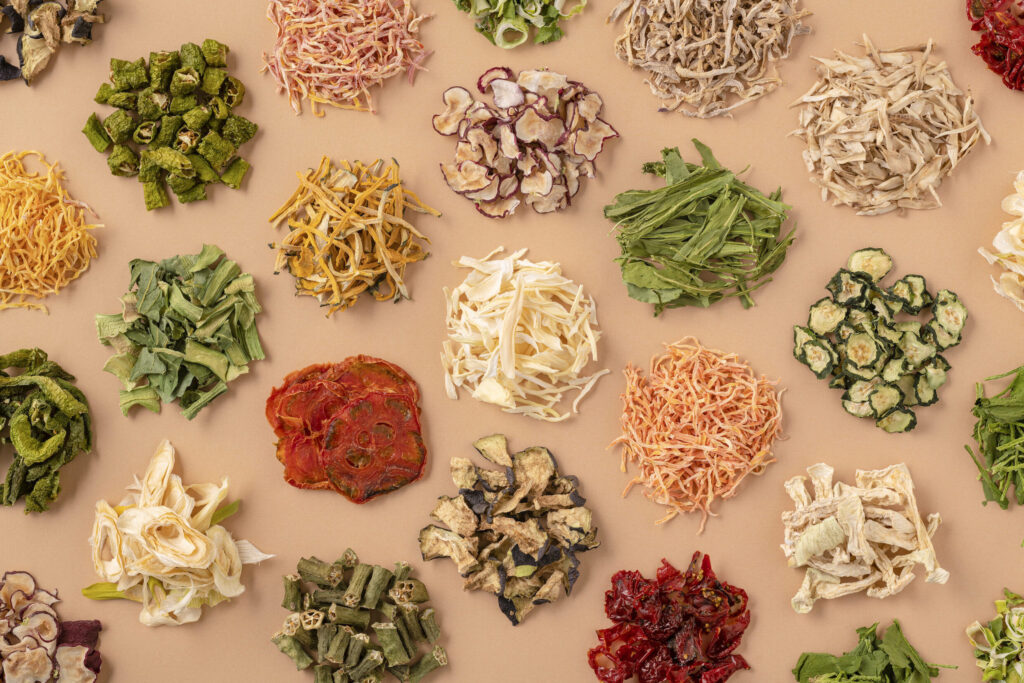
- Sold in small lots from 1 kg
- Handling heirloom vegetables from across Japan
- Dried fruits and herbs also supported
Features of commercial dried lemongrass
Even among dried herb ingredients, lemongrass holds a distinctive position with its refreshing lemon scent, its staple status in herbal teas, and its presence in ethnic cuisine. We organize its strengths, assuming a cut shape, across six perspectives.
A refreshing lemon scent derived from citral
Lemongrass's aroma centers on citral, an aroma compound also found in lemon peel. Unlike actual lemon fruit, it lets you add a citrus aroma without using the plant itself, so it can be used as is to scent herbal teas, soups, and ethnic dishes.
A cut shape that extracts easily
Because it is finely cut, it has a large surface area, giving it a shape whose aroma transfers easily to hot water and dashi. It can be used as is in herbal teas, blended teas, and soups, and keeps extraction time short.
Staple status in herbal teas
Lemongrass has long been enjoyed both as a single-herb tea and as a base for blended teas. As a dried product that can be stored at room temperature, it lets you bring the aroma of lemongrass into a final product regardless of season.
Presence in ethnic cuisine
It's a flavoring ingredient that has been used in Thai and other ethnic cuisines, starting with tom yum kung. A dried product lets you recreate an ethnic aroma in the final product even where fresh lemongrass is hard to obtain.
Ease of use as a blending ingredient
Its aroma pairs easily with other herbs, tea leaves, and spices. You can build it into your formulation as an aromatic accent—in blended teas, spice mixes, seasoning bases, and more.
Use in combination with powder
By using it together with the finely powdered dried lemongrass powder (made to order), you can design recipes that use cut product for extraction and powder for kneading directly into doughs and powdered products, each for its own purpose.
Product specifications (commercial)
Basic specifications at the prototype stage are as follows. Purchase lot, lead time, and packaging format are worked out through individual consultation.
| Item | Details |
|---|---|
| Product name | Dried Lemongrass |
| Raw material | Lemongrass |
| Shape | Cut. Size adjusted to the application |
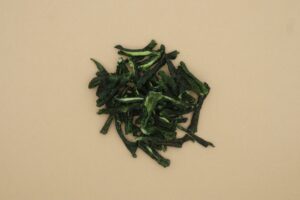
| Appearance | Pale yellow-green to green cut pieces |
| Aroma | A refreshing, lemon-like aroma |
| Net content | Individual quote according to use and lot |
| Best-before date | About 6 months from the shipping date |
| Storage method | Avoid high temperature, high humidity, and direct sunlight; after opening, seal and store in a cool, dark place |
| Minimum prototype lot | From 1 kg of raw material |
Customization support
You can consult us from the prototype stage on cut size, packaging, and finishing the final product. Because we keep records while refining the recipe, our setup keeps specifications from drifting between prototype and mass production.
| Item | Available | Details |
|---|---|---|
| Cut adjustment | Fine cut / slightly larger cut | Designed from tea-bag use to simmering use, matched to extraction conditions |
| Powdering | Fine powder (made to order) | Suited to blending into confectionery, doughs, and powdered seasonings |
| Blend design | Combined with other herbs, tea leaves, and spices | Base design for blended teas and spice mixes |
| Packaging form | Commercial bulk / small bag / individual wrapping | From bulk for tea ingredients to retail packs |
| OEM productization | End-to-end support through the finished product | From planning to production of herbal teas, blended teas, and spice products |
For those considering the fine-powder type
For applications where you want to blend the aroma of lemongrass uniformly as a powder—such as scenting doughs, powdered seasonings, and confectionery—the finely powdered dried lemongrass powder (made to order) is well suited. Please also see the list of powder raw materials.
Commitments to variety, grower, and growing region
Lemongrass is a perennial of the genus Cymbopogon in the grass family, and its lemon-like aroma has made it a familiar flavoring ingredient in herbal teas and cooking. At Agriture, we make aroma strength, cut condition, and the drying finish the axes of our ingredient design.
BRAND|The position of lemongrass as an ingredient
Lemongrass is an aromatic herb that has been used in herbal teas, blended teas, and ethnic dishes like tom yum kung. At Agriture, we translate this refreshing aroma into a commercial ingredient, offering it as a material usable across a wide range of final products—from herbal teas and spice products to ethnic seasonings.
PRODUCER | Basic policy for sourcing and coordination
We select lots with strong aroma and uniform cut in coordination with our suppliers. At the prototype stage we source small amounts from several suppliers, evaluate the aroma release after drying and the flavor during extraction, and then set up the supply line for mass-production lots.
SELECTION|Selection criteria
Even with the same lemongrass, the suitable application changes with aroma strength, color, and cut fineness. We set evaluation criteria starting from the final product's use—prioritizing aroma release for herbal teas and an easy-to-handle cut for cooking, for example—identifying the lot that suits the application and turning it into an ingredient.
QUALITY|Assessing quality
We turn it into an ingredient while checking how the aroma rises when passed through hot water, its condition when rehydrated, and the uniformity of the cut. Because aroma compounds volatilize easily, we aim for a finish that carries the aroma through to the final product, including the drying conditions and storage design.
Low-temperature drying technology and quality control
Prompt drying after cutting
Once lemongrass is cut, the aroma compounds volatilize more easily over time. By moving swiftly from cutting to drying, we finish it under conditions that retain the lemon-like aroma as much as possible.
Retaining aroma through low-temperature drying
High-temperature drying drives off the aroma compounds and dulls the color as well. By removing moisture slowly in a low-temperature range, we produce a finish whose aroma rises when passed through hot water. As a flavoring ingredient for herbal teas and soups, we aim for an ingredient that conveys the character of lemongrass. When using it in herbal tea, steep it in boiling water for a few minutes to fully extract the aroma. When using it in soups and simmered dishes, adding it in the latter half of cooking helps the aroma remain.
Use cases
We organize the applications we get prototype inquiries about at Agriture into six categories. Each is an example of recipe design that takes advantage of lemongrass's refreshing aroma and cut shape.
1. Herb tea and blended tea
It can be used as a single-herb lemongrass tea, or as a base for blended teas combined with other herbs and tea leaves. A fine cut is easy to pack into tea bags and extracts its aroma quickly in boiling water. It can also be held as room-temperature stock, and its stable, year-round supply is valued in commercial use.
2. Ethnic cuisine and Thai food
It can be used as a flavoring ingredient for tom yum kung, green curry, ethnic soups, and more. Even where fresh lemongrass is hard to obtain, a dried product can be rehydrated to recreate an ethnic aroma. It can be developed into recipe design for restaurants or as an ingredient for ethnic seasonings.
3. Soups and simmered dishes
It can be used to scent soups, simmered dishes, and dashi. Adding it in the latter half of cooking helps the refreshing, lemon-like aroma remain. It can be developed into products where you want to add an aromatic accent, such as instant soup mixes and soup-stock bases.
4. Spice mixes and seasonings
It can be blended as a base for curry powder, ethnic spice mixes, and aromatic seasonings. Powdered, it mixes uniformly into powdered seasonings; as a cut product, it suits use as an ingredient for seasoning liquids where you simmer it to transfer the aroma. It can be used in the product design of seasonings that foreground aroma.
5. Beverages and drinks
It can be used as a beverage ingredient for herb waters, flavored syrups, cocktail bases, and more. Taking advantage of its refreshing, lemon-like aroma, it can be developed into summer-oriented refreshing drinks and non-alcoholic flavored beverages. It's a material suited to extraction, where you transfer the aroma.
6. Potpourri, crafts, and sundries
Beyond food, it can also be used as a material for potpourri, sachets, and craft goods. A dried cut product retains its aroma well and suits use as an accent in herb-based sundries and gift products. It can be built into the product design of items meant to be enjoyed for their scent.
Commercial usage and rehydration
Basics of use
- For herbal tea: steep in boiling water for 3–5 minutes to extract the aroma. Also works as a base for blended teas
- For soups and simmered dishes: adding it in the latter half of cooking helps the aroma remain
- For ethnic cuisine: rehydrating it in water or dashi before simmering spreads the aroma through the whole dish
- The extraction liquid carries the aroma, so it can be used as is in drinks or seasoning liquids
Blending guide
- Herbal tea: extract using 1–2g of dried product per cup (200ml) as a guide
- Blended tea: blend 10–20g of dried product per 100g of tea leaves
- Soups and simmered dishes: add 2–4g of dried product per 1L of finished volume as a guide
- Flavored syrup: extract 3–5g of dried product per 500ml of syrup
How to store
- Before opening: store in a cool, dark place at room temperature, away from heat, humidity, and direct sunlight
- After opening: transfer to a zip bag or airtight container and use up within 1 to 2 months
- The best-before date is roughly 6 months from the shipping date. Store airtight since the aroma compounds volatilize easily
- Refrigerated storage is possible. Because condensation forms right after taking it out, return it to room temperature before opening
Related cases and articles
- Dried edible rose – herb ingredient that highlights aroma
- Dried moringa – herb / superfood ingredient
- Dried mugwort – Japanese herb raw material
- List of dried vegetable and herb ingredients
- Consult us on food OEM and raw material supply
Product catalog showing the items we handle
Flexible support from small lots to large lots
- Sold in small lots from 1 kg
- Handling heirloom vegetables from across Japan
- Dried fruits and herbs also supported
Frequently asked questions
What kind of herb is lemongrass?
Lemongrass is a herb of the genus Cymbopogon in the grass family, characterized by a refreshing, lemon-like aroma. This aroma centers on citral, an aroma compound also found in lemon peel. It has long been enjoyed around the world as a flavoring ingredient in herbal teas, blended teas, and ethnic dishes such as tom yum kung.
How much of the aroma remains?
By moving swiftly from cutting to low-temperature drying, we produce a finish that retains the lemon-like aroma. The aroma rises when passed through hot water, and you can confirm it as a flavor in herbal teas and soups. Because the aroma compounds volatilize easily, we recommend uses that make the most of the aroma—storing it airtight after opening, and adding it in the latter half of cooking.
Can it be used in herb tea?
It's one of the applications we get the most inquiries about. A fine cut is easy to pack into tea bags, and steeping in boiling water for 3–5 minutes extracts the aroma. It works both as a single-herb lemongrass tea and as a base for blended teas combined with other herbs and tea leaves. The cut size can be adjusted to match your extraction conditions.
How does it differ in use from lemongrass powder?
Dried lemongrass is for "extraction, where you transfer the aroma, or applications where you want to take advantage of the cut shape," while the powder is for "blending into doughs, powdered seasonings, and confectionery"—that's the division of use. Herbal teas, soups, and ethnic dishes suit the cut product; blending into powdered seasonings and spice mixes suits the powder. Using them together lets you design recipes that use each for extraction and blending applications respectively.
What is the minimum prototype lot?
We accept prototypes from 1kg of raw material. You can run multiple conditions in parallel—comparing cut sizes, or comparing herbal-tea and cooking specifications, for example. Main production is from 10kg, and you can consult us all the way through to OEM finished-product development. After hearing your intended final-product specifications, lot, and schedule, we'll propose an individual quote and lead time.
Please tell me the best-before date and how to store it.
The best-before date is roughly 6 months from the shipping date. Before opening, store it in a cool, dark place at room temperature, away from high heat, high humidity, and direct sunlight. Because lemongrass's aroma compounds volatilize easily, after opening we recommend transferring it to a zip-lock bag or airtight container and using it up within a guideline of 1–2 months. Refrigeration is also possible, but watch for condensation right after taking it out, and bring it back to room temperature before opening.
Recommended reading
- Dried edible rose – herb ingredient that highlights aroma
- Dried moringa – herb / superfood ingredient
- Dried mugwort – Japanese herb raw material
- List of dried vegetables and herbs
- List of powders
Download the product catalog
We will send the materials to your email address based on the information you provide.