Dried Ashitaba

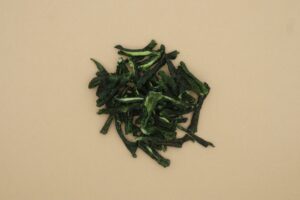
Dried ashitaba is a commercial ingredient made from the leafy vegetable that has drawn attention as a superfood of the Apiaceae family, turned into a raw material in two shapes—leaf (dried leaf) and coarse-crushed (cut). We lock in ashitaba's characteristic chalcone-type compounds and the distinctive richness that spreads within its grassiness through low-temperature drying. At Agriture, we run this in parallel with a finely powdered Ashitaba powder, proposing a division of use: dried ashitaba for use as tea leaves and as a core material for blended teas, and the powder for blending into aojiru, supplements, and health foods.
Compared with other superfood-type materials such as moringa, kale, and goya, ashitaba differentiates itself with its "chalcones (especially 4-hydroxyderricin and xanthoangelol)," its "staple status in aojiru culture," and "the history of the Hachijojima brand." It's a material we get many prototype inquiries about—as an ingredient for health-tea OEM, blended tea, herbal tea, aojiru, supplements, and health foods.
TOC
Three points of pride in Agriture's dried ashitaba
Ashitaba is a leafy plant whose leaves and stems lose freshness quickly and whose color loss and aroma loss during drying determine quality. At Agriture, we manage everything from primary processing after harvest to final packaging consistently at our own processing facility, aiming for a finish suited to both tea leaves and health foods.
1. Low-temperature design that protects chalcones
The chalcones that are ashitaba's signature compounds (the yellow pigment in the yellow sap of the cut surface) are said to be weak to heat and light. At Agriture, we design the process to hold down the drying temperature and remove moisture in an environment shielded from direct light, retaining as much of the compounds contained in the cut surface of the stem in the finished product as possible.
2. Two shapes: leaf and coarse-crushed
The leaf (a spec that retains the shape of the dried leaf) suits use as tea-leaf material for herbal and blended teas, while the coarse-crushed (cut) suits health-tea tea bags, health-food ingredients, and use as the main material of blended teas. Because you can prototype by switching shapes from the same material, you can select it to match the appearance and extraction properties of your final product.
3. A finish that retains the grassy aroma
Ashitaba has a distinctive grassiness and a faint bitterness characteristic of Apiaceae plants. Through a design that removes moisture at low temperature in a short time, we produce a finish in which the grassy aroma and ashitaba's signature richness rise when brewed as tea. We aim for a flavor balance usable both as a base for blended tea and as the star tea leaf.
Product catalog showing the items we handle
Flexible support from small lots to large lots
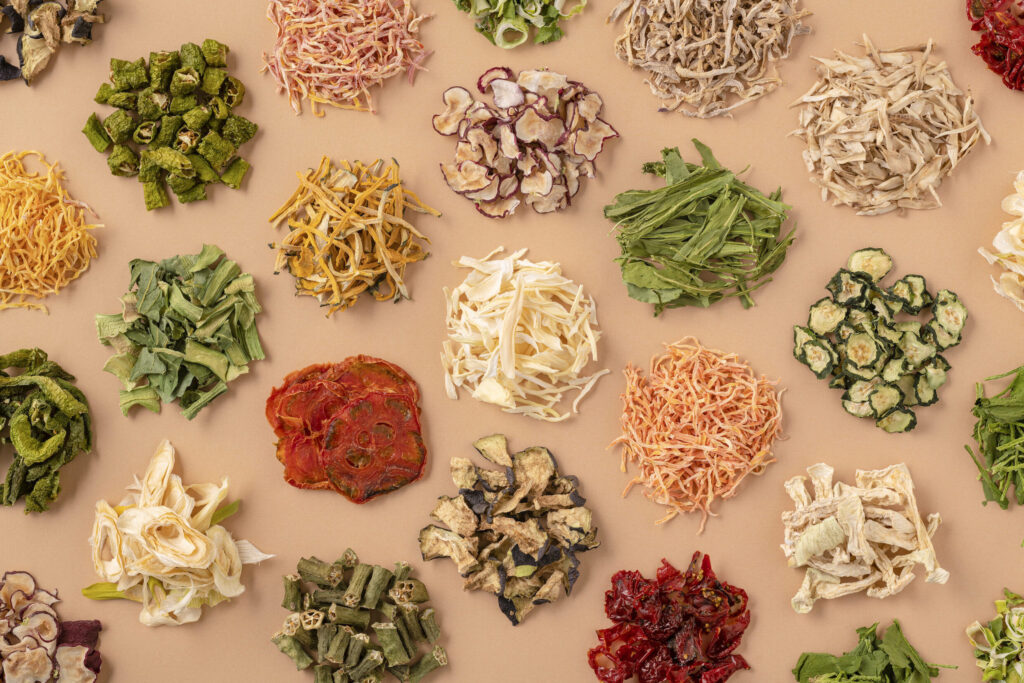
- Sold in small lots from 1 kg
- Handling heirloom vegetables from across Japan
- Dried fruits and herbs also supported
Features of commercial dried ashitaba
Even among leafy dried materials, ashitaba holds a distinctive position with its chalcone-type compounds, staple status in aojiru culture, and ease of use as a blended-tea material. We organize its strengths, assuming the respective uses of leaf and coarse-crushed, across six perspectives.
The focus on chalcone-type compounds
The yellow cut surface of ashitaba's stem is said to contain chalcones (4-hydroxyderricin and xanthoangelol), and it has drawn interest as a signature compound unique to ashitaba. It's a material easy to use as a concept ingredient for aojiru, supplements, and health foods.
Two shapes for application-specific use
The leaf suits tea-leaf material for herbal and blended teas, while the coarse-crushed suits tea bags, health-food ingredients, and blended teas. You can prototype by switching shapes from the same material.
Staple status in aojiru and health-tea culture
A material long enjoyed as a health ingredient centered on Hachijojima and established in the market as a main blend for aojiru and health teas. It's a material easily chosen as a trustworthy core ingredient in health-food OEM.
Ease of blending as a blended-tea material
It has a flavor that blends easily with other tea leaves and tea materials—green tea, hojicha, tochu tea, rooibos, herbs, and more. Whether used alone or as a base tea leaf in a blend, the design possibilities expand.
A caffeine-free material
Because ashitaba is a leafy plant that contains no caffeine, it allows herbal-tea designs usable at night and for pregnant women and children. It's a material easy to use as an ingredient for caffeine-free health teas and mom-oriented blended teas.
Use in combination with powder
Finely milled Ashitaba powder By using it together with , you can design a brand that delivers both tea leaves (dried product) and powder blending into aojiru and supplements (powder).
Product specifications (commercial)
Basic specifications at the prototype stage are as follows. Purchase lot, lead time, and packaging format are worked out through individual consultation.
| Item | Details |
|---|---|
| Product name | Dried Ashitaba |
| Raw material | Ashitaba (domestically grown) |
| Shape | Two shapes: leaf (a spec that retains the shape of the dried leaf) / coarse-crushed (cut) |
| Appearance | Deep green to dark green, with a pale yellow pigment remaining on the cut surface of the stem portion |
| Aroma | The grassy aroma characteristic of Apiaceae, with a richness accompanied by the faint bitterness typical of ashitaba |
| Net content | Individual quote according to use and lot |
| Best-before date | About 6 months from the shipping date |
| Storage method | Avoid high temperature, high humidity, and direct sunlight; after opening, seal and store in a cool, dark place |
| Processing plant | Our own processing plant within Kyoto Prefecture |
| Minimum prototype lot | From 1 kg of raw material |
Customization support
Because we keep records of shape and cut particle size while refining the recipe, our setup keeps specifications from drifting between prototype and mass production.
| Item | Available | Details |
|---|---|---|
| Shape adjustment | Leaf / coarse-crushed | Spec designed to match tea-leaf use or tea-bag use |
| Cut particle size | Coarse / standard / fine | Adjusting tea-bag extraction and blend compatibility |
| Blend design | Combining with other tea leaves and herbs | Blended-tea design with green tea, hojicha, rooibos, and herbs |
| Packaging form | Commercial bulk / tea bags / small packs | From triangular tea bags to bulk for supplements |
| OEM productization | End-to-end support through the finished product | From planning to production of health teas, blended teas, aojiru, and supplements |
For those looking for a finely milled type
For applications where you want to spread ashitaba's compounds uniformly—such as powder blending into aojiru, smoothies, supplements, and health foods—the finely powdered Ashitaba powder is suitable.
Commitments to variety, grower, and growing region
Ashitaba is a perennial of the genus Angelica in the Apiaceae family, a superfood long used for food and medicine, centered on the Izu Islands (Hachijojima, Oshima). At Agriture, we make the growing region, strain, and harvest timing the axes of our ingredient design.
BRAND|The position of ashitaba as an ingredient
From the vitality implied by the origin of its name—"pick it today and a new leaf appears by tomorrow"—ashitaba has become deeply rooted in aojiru and health-tea culture as a superfood. At Agriture, we translate this cultural background into a commercial ingredient, offering it as a material usable across a wide range of final products—from health teas and blended teas to aojiru and supplements.
PRODUCER | Basic policy for sourcing and coordination
We select lots with a good balance of leaf and stem, where a vivid yellow sap appears on the cut surface of the stem, coordinating directly with the growing region. At the prototype stage we source small amounts from several suppliers, evaluate the color retention and flavor stability during drying, and then set up the supply line for mass-production lots.
REGION | Characteristics of the main growing region
The Izu Islands (Hachijojima, Oshima, Miyakejima) are the representative domestic growing regions, where a warm maritime climate and volcanic soil suit ashitaba cultivation. It's also grown on the mainland, in Shizuoka and Chiba, and the leaf thickness, stem thickness, and flavor differ by growing region. At Agriture, we use these growing regions for different purposes according to the application, selecting a raw material with a good balance of flavor and compounds.
CULTIVATION | Harvest timing and flavor
Ashitaba is a perennial that can be harvested repeatedly from spring through autumn, and the leaf thickness, bitterness, and aroma change with the harvest timing. Young leaves in spring to early summer are tender with a strong grassy aroma, while mature leaves in summer to autumn tend to deepen in richness. At Agriture, we use aroma-focused lots for tea leaves and richness-focused lots for health foods.
Low-temperature drying technology and quality control
Drying conditions that avoid light and heat
Ashitaba's signature compounds, including chalcones, have the property of changing easily with light and heat. By low-temperature drying in a light-shielded environment away from direct sunlight, we finish it under conditions that deliver both compound retention and color retention.
Short-time drying that retains the aroma
Long-time drying drives off ashitaba's characteristic grassy aroma. By optimizing the drying time according to moisture content and leaf thickness, we produce a finish that suppresses flavor loss. We aim for an ingredient in which grassiness and ashitaba's signature richness rise when brewed as tea. When using it as a base material for blended tea, combining it with fragrant, roasty tea leaves such as hojicha, tochu tea, or rooibos yields an easy-drinking flavor in which ashitaba's grassiness isn't too pronounced. When designing it as a caffeine-free health tea, it pairs well with herbs (lemongrass, mint) and is easy to use as a mainstay material for a refreshing health-tea brand. For aojiru and smoothie uses, further grinding the coarse-crushed into powder raises its dispersibility in liquid.
Use cases and adoption examples
We organize the applications we get prototype inquiries about at Agriture into six categories. Each is an example of recipe design that takes advantage of ashitaba's focus on chalcone-type compounds and its grassiness.
1. Health teas and blended teas
As a single-ingredient ashitaba health tea, the leaf or coarse-crushed can be enclosed in tea bags for use. It can be developed as the main material of a caffeine-free health-tea series—blended with green tea and hojicha, or with tochu tea, rooibos, and hatomugi.
2. Herbal tea and relaxation tea
It can be used as an ingredient for herbal teas combined with lemongrass, mint, and chamomile. Because it's caffeine-free, it suits the design of targeted health teas—blends for pregnancy and lactation, blends for children, relaxation blends before bed, and more.
3. Aojiru and powdered beverages (ground before use)
As an ingredient for ashitaba aojiru, grinding it further into powder raises its dispersibility in beverages. It's a material suited to health-conscious drink design—complex aojiru combined with kale or moringa, green-smoothie mixes, and base ingredients for powdered health beverages.
4. Supplement and health-food ingredient
Ground, it can be blended as an ingredient for tablet- and capsule-type supplements. It can be used as a blend material for health foods, a formulation ingredient for diet- and wellness-type supplements, and a base for powder- and granule-type health foods.
5. Food processing and confectionery ingredient
It can be used as a knead-in material for health-conscious bread and cookies. It can be developed into products that make use of both color and material character at once—green craft chocolate, natural green coloring for wagashi such as mochi and dango, and kneading into pasta and noodles.
6. Gift and wellness-brand ingredient
It can be used as a mainstay material for health-conscious gift sets and wellness brands. As a tea-leaf material for ashitaba tea, it's easy to build into value-added brand products—amenity teas for hotels and inns, relaxation teas for spa and esthetic facilities, and more.
Commercial usage and rehydration
Extraction and basic use
- Leaf: steep in 80–90°C hot water for 3–5 minutes. Suits extraction in a kyusu or teapot
- Coarse-crushed: fill into tea bags and extract. High extraction properties in 90–95°C boiling water for 2–3 minutes
- Cold brew: put the coarse-crushed in a bottle and extract in cold water for 4–6 hours. For a summer cold-tea design
- Kneading into cooking: grind further and blend at 0.5–2% into bread or pasta dough
Blending guide
- Single-ingredient health tea: 2–3g of dried product per 300ml of hot water
- Blended tea: the ratio to other tea leaves is 30–50% for a star design, 10–20% for a supporting role
- Tea-bag fill: 1.5–3 g per bag is standard
- Supplement tablets: grind and blend to match the functional labeling and daily intake guideline
How to store
- Before opening: store in a cool, dark place at room temperature, away from heat, humidity, and direct sunlight
- After opening: transfer to a zip bag or light-blocking container and use up within about one to two months
- The best-before date is roughly six months from the shipping date. Note that components and color change with light and heat
- Store apart from other strongly aromatic ingredients to prevent aroma transfer
Related cases and articles
- Dried kale – superfood-type material
- Dried moringa – superfood-type material
- Ashitaba powder – fine powder for aojiru and supplements
- List of dried vegetable raw materials
- Consult us on food OEM and raw material supply
Product catalog showing the items we handle
Flexible support from small lots to large lots
- Sold in small lots from 1 kg
- Handling heirloom vegetables from across Japan
- Dried fruits and herbs also supported
Frequently asked questions
How do you use leaf and coarse-crushed for different purposes?
The leaf is a spec that retains the shape of the dried leaf, suited to extraction in a kyusu or teapot, blended teas that show off a leafy look, gift tea leaves, and more. The coarse-crushed is a spec given cut processing, an easy-to-use shape for tea-bag filling, health-food ingredients, and the main material of blended teas. We also accommodate combined orders of both shapes in a single lot.
How much chalcone content is there?
The content of chalcones (4-hydroxyderricin, xanthoangelol, etc.) is said to be higher in the yellow sap contained in the growing region, harvest timing, and cut surface of the stem portion, so choosing a stem-priority lot allows a compound-focused design. If you need concrete content analysis data, we also accept consultations for external analysis at the prototyping stage. Compounds are a guide as a "representative focus point" and vary with conditions.
How does it differ in use from ashitaba powder?
Dried ashitaba is for "applications where you want to retain a herby, leafy character as a core material for tea leaves and blended teas," while the powder is for "dispersion into aojiru, smoothies, supplements, and powdered health foods"—that's the division of use. Use as tea leaves suits the dried product; blending into liquid and powdered products suits the powder. Using them together allows the design of a health-food brand that pairs tea and aojiru.
Is it caffeine-free?
Ashitaba is a leafy vegetable of the Apiaceae family and a material that inherently contains no caffeine. It's easy to use as a core material for designs where you want to avoid caffeine—nighttime health teas, blends for pregnancy and lactation, herbal teas for children, and more. If you blend it with caffeinated tea leaves such as green, black, or oolong tea, consider the caffeine-content labeling of the final product at the design stage.
Any tips for designing blended tea?
It's one of the applications we get the most inquiries about. Because ashitaba is characterized by grassiness and a light richness, combining it with fragrant, roasty tea leaves such as hojicha, tochu tea, or rooibos yields an easy-drinking finish. Among herbs, it pairs well with lemongrass, mint, and chamomile, suiting a refreshing blend. If you want to add sweetness, blends with amacha or stevia leaf can also be prototyped. As a guide, use 30–50% for a star design and 10–20% for a supporting role.
What is the minimum prototype lot?
We accept prototypes from 1kg of raw material. Comparing the leaf and coarse-crushed shapes, main production from 10kg, all the way through to OEM finished-product development—you can consult us on all of it. After hearing your intended final-product specifications, lot, and schedule, we'll propose an individual quote and lead time.
Please tell me the best-before date and how to store it.
The best-before date is roughly 6 months from the shipping date. Before opening, store it in a cool, dark place at room temperature, away from high heat, high humidity, and direct sunlight. Because ashitaba's compounds and color change easily with light and heat, after opening we recommend transferring it to a light-blocking container or zip-lock bag and using it up within a guideline of 1–2 months. Store it separately from other strongly aromatic tea leaves and spices.
Recommended reading
- Ashitaba powder – fine-powder type
- Dried kale – superfood-type
- Dried moringa – superfood-type
- List of dried vegetables
- List of powders
Download the product catalog
We will send the materials to your email address based on the information you provide.