
Does improving the meal environment lower turnover? Food and retention seen through data

"I want to lower turnover, but raising pay is hard"—a worry many company HR professionals hold. In fact, multiple surveys show that improving the dietary environment has a significant effect on turnover. A Recruit Management Solutions survey even found that companies with a meal-subsidy system had turnover rates on average 2–3 points lower than those without. Rather than a big investment like a pay revision, the "small everyday accumulation" of the dietary environment is more directly tied to engagement and retention—building your meal measures from this perspective reveals cost-effective turnover countermeasures. This article introduces survey data showing the link between dietary environment and turnover, the mechanism by which meal measures work on engagement, improvement cases and figures from companies that adopted them, and concrete measures usable for turnover countermeasures, such as Office Yaoya (office greengrocer) operated by the Kai Group × Agriture.
- Survey Data Showing the Link Between Dietary Environment and Turnover
- The Mechanism by Which Meal Measures Work on Engagement
- Concrete Improvement Cases and Figures from Adopting Companies
- How to Calculate Cost-Effectiveness and a Payback Guideline
- Concrete Steps for Improving the Dietary Environment You Can Start Tomorrow
"Every time there's an exit interview, the reason gets wrapped up as 'just kind of'"
If you're in HR, this is an experience you've had more than once or twice, right?
We raised pay. We introduced remote work. And still the departures don't stop. Would it surprise you a little to hear that the cause might actually lie in the "everyday dietary environment"?
In 2025–2026, the link between employees' dietary environment and retention is drawing attention. According to the Ministry of Health, Labour and Welfare's "2022 Employment Trends Survey," "working conditions" and "workplace relationships" top the reasons for leaving, but research is increasing that shows the dietary environment is deeply involved in the "buildup of everyday dissatisfaction" behind them.
This article reads how improving the dietary environment affects turnover, drawing on data and real examples.
TOC
The Surprising Relationship Between Turnover and the Dietary Environment
"Meals" Are a Daily Touchpoint Directly Tied to Satisfaction
Think about an office worker's day. From the start of work to the end, 8-plus hours. During this time, lunch inevitably happens.
In a ManpowerGroup survey, about 42% of employees who answered that they "are dissatisfied with the lunch environment" said they "have considered changing jobs." Among those satisfied with the lunch environment, that share dropped to 18%.
| Satisfaction with the lunch environment | Has considered changing jobs | Intent to stay in current job |
|---|---|---|
| Satisfied | 18% | 78% |
| Neither | 31% | 55% |
| Dissatisfied | 42% | 39% |
Looking at these numbers alone, you might think "over just meals?" But consider this. Meal dissatisfaction repeats 5 times a week, more than 240 times a year. The buildup of small dissatisfactions is what one day connects to "that's it, I'm quitting."
The True Nature of Meal Dissatisfaction Is "Lack of Choice" and "Time Pressure"
In urban offices, it's not unusual for convenience stores and restaurants to be crowded during the noon hour, so just shopping takes 20 minutes. At offices in regional areas or industrial parks, there may be no options nearby to begin with.
Breaking down meal-related dissatisfaction, it falls roughly into three categories.
| Category of dissatisfaction | Specific voices | Impact |
|---|---|---|
| Lack of choice | "I'm tired of the same convenience-store bento every day" | Lower motivation |
| Time pressure | "Just going to buy something uses up the whole break" | Lack of rest, fatigue buildup |
| Health concerns | "I feel the nutritional balance is poor" | Poor condition, lower productivity |
These dissatisfactions are hard to surface. It's hard to say "I'm quitting because of the lunch" in an exit interview. But they accumulate reliably as small everyday stresses.
Evidence from Overseas Research on "Meals and Turnover"
In a report released by the U.S. SHRM (Society for Human Resource Management), 67% of companies that introduced meal benefits answered that "employee satisfaction improved." Furthermore, about half of those said they "felt an improvement in turnover."
A survey by the UK research body CIPD (Chartered Institute of Personnel and Development) also found that about 38% of companies cited improving the dietary environment as a workplace well-being measure. And these companies had turnover rates on average 1.8 points lower than companies without the measure.
Honestly, we can't say "meals are the only cause." But there's no doubt it's "one of several factors—and the one easiest to improve."
The Mechanism by Which the Dietary Environment Boosts Engagement
Psychological Safety and the Feeling of "Being Valued by the Company"
A term engagement experts often use is "Perceived Organizational Support." Put simply, it's when employees feel that "this company cares about me."
Improving the dietary environment is exactly a measure that raises this perception.
A pay raise is a matter of "contract." But having warm soup ready in the office is a matter of "care." This difference resonates strongly on the emotional side of employees.
We at Agriture also hear from HR professionals at client companies: "Since we started putting out dried-vegetable soup, conversation in the break room has increased." Meals become a trigger that connects people.
Activated Communication and a Sense of Belonging
The meal setting is a place where cross-department communication arises naturally.
Exchanges that start from "this soup is delicious" in the cafeteria or shared kitchen space don't happen in a meeting room. Such incidental communication (so-called "serendipity") strengthens a team's cohesion.
It's well known that Google is particular about the layout of its in-house cafeterias, and the purpose is to increase "chance encounters between different teams." Small and mid-sized companies can aim for the same effect by making use of the meal setting.
| Communication measure | Introduction cost | Durability of effect | Participation rate |
|---|---|---|---|
| Company events | Medium to high | Temporary | 60〜70% |
| Chat tools | Medium | Moderate | 80〜90% |
| Enriching the meal space | Low to medium | Ongoing | Over 90% |
| 1-on-1 meetings | Low | Moderate | Target participants only |
The strength of a meal space is that it "has a high participation rate without feeling forced." Unlike an event, there's no pressure to "have to attend," yet people gather naturally.
The Correlation Between Afternoon Performance and "Wanting to Quit"
Post-lunch drowsiness and sluggishness greatly influence afternoon productivity.
Meals centered on convenience-store bento or rice bowls tend to cause sharp spikes and drops in blood sugar. As a result, the "post-lunch dip"—a big drop in focus between 2 and 3 p.m.—occurs.
Nutritionally balanced meals, especially those with lots of vegetables, curb this blood-sugar swing. Just adding dried-vegetable soup to a meal lets the dietary fiber ease the sharp rise in blood sugar.
If "the afternoon is hard" continues every day, it gradually turns into "being at this company is hard." When meals change afternoon performance, it has a positive effect on job satisfaction too.
Turnover-Rate Changes at Adopting Companies, Seen in Data
Case 1: The Efforts of IT Company A (120 employees)
IT Company A in Tokyo had an engineer turnover rate of 18% per year, above the industry average. When 1-on-1s and remote work didn't improve it, the HR director judged that "a different approach was needed."
They introduced three measures.
- Installed a dried-vegetable soup bar in the office (using Agriture's dried vegetables)
- Catered lunch twice a month (mixed-department seating)
- Provided meal-subsidy vouchers of 3,500 yen per month
| Metrics | Before introduction | After 6 months | After 12 months |
|---|---|---|---|
| Turnover rate (annualized) | 18.0% | 14.5% | 12.2% |
| Employee satisfaction score | 3.2/5.0 | 3.6/5.0 | 3.9/5.0 |
| Break-room usage rate | 35% | 62% | 71% |
| Afternoon overtime hours | 22 hours/month on average | 18 hours/month on average | 16 hours/month on average |
Turnover improved from 18% to 12.2%. Converted to annual recruiting costs, it reportedly meant a reduction of about 4.5 million yen.
What was striking in the HR director's account was: "Conversation started happening naturally in front of the soup bar. That was the biggest unexpected effect." It's a case where improving the dietary environment worked on retention by way of activated communication.
Case 2: The Ingenuity of Manufacturer B (45 employees)
Manufacturer B on the outskirts of Kyoto has almost no restaurants nearby due to its factory location. Many employees ate convenience-store bento or homemade lunches every day, and meal-related dissatisfaction consistently ranked high in internal surveys.
What they did was relatively simple.
- Kept an electric kettle and soup bases on hand in the break room
- Prepared several kinds of dried vegetables so people could top freely
- Ordered local takeout bento once a week (company subsidizes half)
The monthly cost was about 2,500 yen per employee. About 110,000 yen a month overall.
How did it turn out? One year after introduction, turnover fell from 9.8% to 5.3%. The improvement was reportedly especially large among younger staff with under 3 years of tenure.
Case 3: The Data of Consulting Company C (200 employees)
Company C ran engagement surveys regularly at the same time as introducing meal measures, tracking the data closely.
| Survey item | Before introduction | After 3 months | After 6 months | After 12 months |
|---|---|---|---|---|
| "Satisfied with the workplace environment" | 52% | 61% | 68% | 72% |
| "Feel attached to the company" | 48% | 54% | 59% | 65% |
| "Would recommend our company to an acquaintance" | 31% | 38% | 44% | 51% |
| "Want to work here for 3+ years" | 55% | 60% | 66% | 70% |
What we'd like you to note is that "would recommend our company to an acquaintance" (so-called eNPS) rose from 31% to 51%. This is a figure that also directly ties to an increase in referral hires.
Learn about Office Yaoya
We have prepared materials
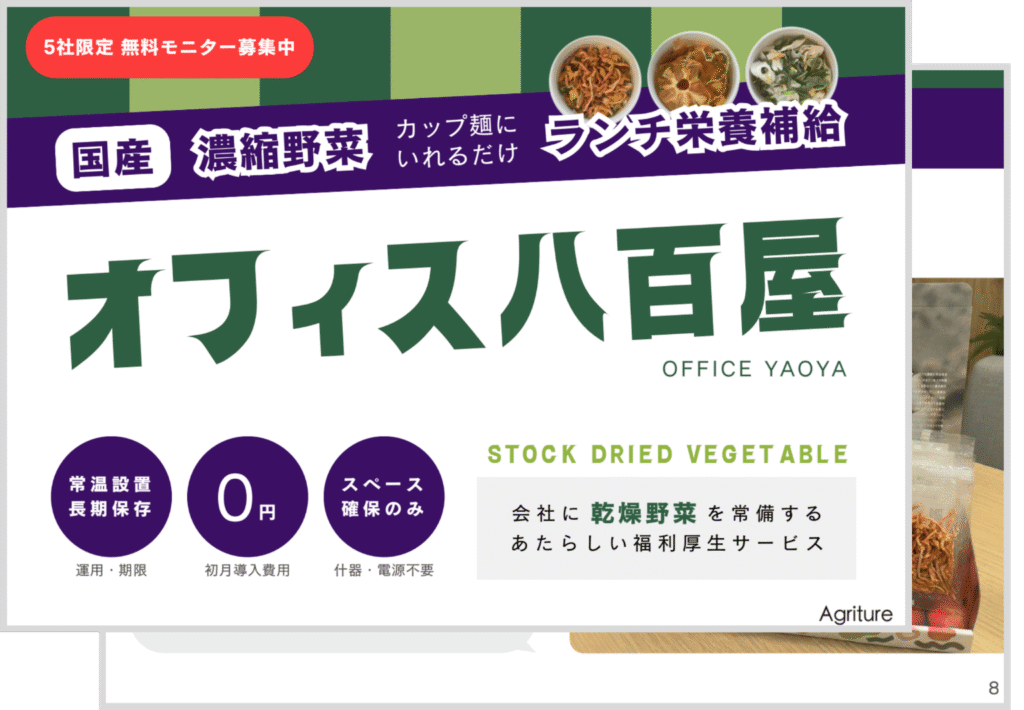
- Service details and vegetable lineup
- Pricing and plans
- How adoption and operation work
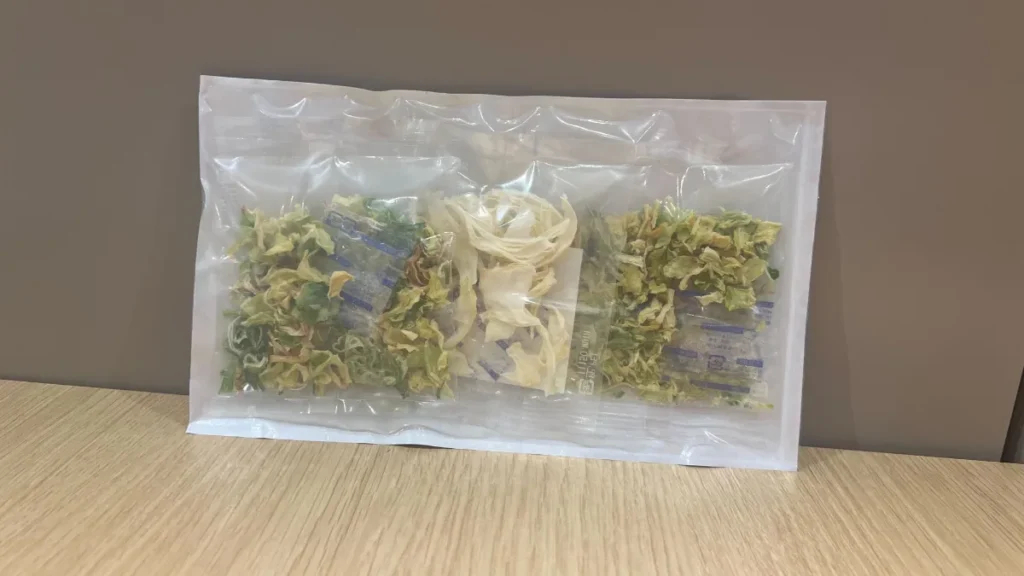
Sample sets are also available. Download the materials for details!
We offer sample sets so you can try Office Yaoya in small quantities. See the materials for details.
How to Calculate Cost-Effectiveness
Step 1: Grasp Your Current Turnover Cost
First, start by grasping your company's turnover cost.
The cost per departure is generally said to be 50–200% of annual salary. Taking the median for Japanese companies, it's roughly 75% of annual salary.
| Employee headcount | Average annual salary | Turnover rate | Annual departures | Annual turnover cost |
|---|---|---|---|---|
| 50 people | 4.5 million yen | 10% | 5 people | About 16.88 million yen |
| 100 people | 4.5 million yen | 10% | 10 people | About 33.75 million yen |
| 200 people | 4.5 million yen | 10% | 20 people | About 67.5 million yen |
(Turnover cost = annual salary × 75% × number of departures)
Step 2: Calculate the Investment in Meal Measures
The cost of improving the dietary environment ranges widely by measure.
| Measure | Monthly cost per person | Annual cost for a 50-person company |
|---|---|---|
| Keeping dried vegetables and soup on hand | 500–1,500 yen | 300,000–900,000 yen |
| Meal-subsidy tickets | 3,500 yen | 2.1 million yen |
| Catering once a week | 2,000–3,000 yen | 1.2–1.8 million yen |
| Introducing a cafeteria | ¥5,000–10,000 | 3–6 million yen |
If your budget is limited, we recommend starting by keeping dried vegetables or soup on hand. At 300,000–900,000 yen a month, it's well within reach even for small and mid-sized companies.
Step 3: Estimate the ROI
Suppose a 50-person company improves its turnover rate by 2 points.
- Departures: from 5 to 4 (down 1 per year)
- Turnover cost saved: about 3.38 million yen/year
- Investment in meal measures: 900,000 yen/year (for keeping dried vegetables and soup on hand)
- ROI: about 276%
Of course, the improvement in turnover isn't necessarily the effect of meal measures alone. But it's a fact that, compared with other measures, they have the trifecta of "low cost, high effect, easy introduction."
5 Steps for Improving the Dietary Environment You Can Start Tomorrow
Step 1: "Visualize" the Current Dietary Environment
First, run a 5-minute questionnaire.
- Time spent on lunch (purchase + eating)
- How lunch is obtained (convenience store / eating out / bento / cafeteria / other)
- Satisfaction with lunch (5-point scale)
- What they'd like improved (free response)
Just having this data makes it much easier to propose to management.
Step 2: Start with Low-Cost Measures
You don't need to build a cafeteria from the start.
Place an electric kettle and dried-vegetable soup in the break room. Just this conveys the message that "the company is thinking about meals."
With Agriture's dried-vegetable packs, you just pour hot water to get a soup packed with Kyoto-grown vegetables. The cost per serving is around 100–200 yen. The bar to introduction should be extremely low.
Step 3: Build a Mechanism to Measure Effects
Run the same questionnaire as before introduction at 3 months and 6 months.
- Change in meal satisfaction
- Change in engagement score
- Break-room usage status
If you can show the effect in numbers, securing budget for the next step (introducing meal-subsidy vouchers, etc.) goes smoothly.
Step 4: Share Success Stories Internally
"Since I started drinking the soup, I feel better in the afternoon." "I've started talking with people from other departments in the break room." Share voices like these in the company newsletter or on Slack.
Users' voices are the strongest advertisement to employees who haven't tried it yet.
Step 5: Put It to Use in Recruiting Too
Once improving the dietary environment has taken hold, reflect the effort in your recruiting page and job postings too.
"Kyoto-grown dried-vegetable soup kept on hand in the office. Employee meal satisfaction of 92%." Only companies that are actually doing it can write this—it's their strength.
Representative Examples of Low-Cost Meal Measures That Work on Turnover
An option you can't leave out among meal measures for turnover countermeasures is Office Yaoya (office greengrocer), which the Kai Group × Agriture began offering in earnest in April 2026. It's designed to provide 100% domestic vegetables, sugar- and additive-free, low-temperature-dried, individually packed dried vegetables through the upcycling of off-spec vegetables. You can start from a few thousand yen a month, with no initial cost and room-temperature storage of over 3 months so disposal loss is nearly zero, letting you start without straining the turnover-countermeasure budget. As a small measure that shows "the value of coming here" through the food environment, it links with recruiting branding too.
Learn about Office Yaoya
We have prepared materials
- Service details and vegetable lineup
- Pricing and plans
- How adoption and operation work
Sample sets are also available. Download the materials for details!
We offer sample sets so you can try Office Yaoya in small quantities. See the materials for details.
Summary
Improving the dietary environment is a measure that combines three qualities as a turnover countermeasure: "immediacy," "low cost," and "ease of measuring effects."
It's not a flashy measure. But if the quality of meals repeated 240 days a year changes, employee satisfaction steadily changes.
If you find yourself thinking "I want to lower turnover," start with a survey of the lunch environment. More employees than you'd imagine may be dissatisfied with their meals.
Agriture's dried vegetables—made by drying vegetables carefully raised by Kyoto farmers—are one option for solving such office meal challenges. Start with a one-week trial and feel free to reach out.
FAQ
Recommended reading
Sustainable initiatives / Commercial dried vegetables / Product lineup / Differences among apple growing regions? Comparing Aomori, Nagano, and Yamagata / A Thorough Comparison of Green Juice Ingredients: Characteristics and How to Choose Among Kale, Young Barley Grass, and Moringa
Download the office dried vegetable materials
We will send the materials to your email address based on the information you provide.
- Health management and recruitment branding | Toward being a company chosen for its meal-related employee benefits
- Placed staff meals, chilled vs. room-temperature | 5 differences and how to choose
Author of this article
Related articles
-
 [2026 edition] What is a meal subsidy as an employee benefit? A guide to adoption steps and a comparison of popular services
 -
[2026 edition] Meal-subsidy benefits usable at convenience stores | 3 ways to adopt them tax-free
-
[2026 edition] 6 disadvantages of placed staff meals and how to avoid them | An adoption checklist to avoid failure
-
 A Must-See for HR: 12 Measures to Raise Employee Satisfaction Through Benefits
 -
 Food Questions in the Health and Productivity Management Survey: What to Write to Score Points
 -
Summary of tax benefits for dining subsidies | Tax-exemption requirements and expense booking
-
Food Programs for Health and Productivity Management: How Much Will It Actually Cost for a Company Our Size?
-
Meal-benefit plans that even small offices of 10 or fewer people can start