Dried kabocha squash


TOC
Product overview of dried kabocha
Domestic kabocha grown at partner farms in Kyoto Prefecture is cut into two types—shredded and large-cut—according to the application and slowly dried at low temperature. Its natural sweetness is tightly concentrated, and even after rehydration you can enjoy a fluffy texture along with the ingredient's natural flavor.
Drying it with the skin on is also a feature, letting you make full use of its color and nutrition. It can handle a variety of cooking methods—simmered dishes, soups, stir-fries, salad toppings—and can also be expanded into powder processing, making it an easy material to use for commercial purposes.
Three commitments Agriture values
01 Two types of cut to match the application
We offer two specifications you can choose to match your menu—shredded for soups and stir-fries, large-cut for simmered dishes and baked goods. A single item enables a wide range of menu development.
02 Color and nutrition preserved by skin-on drying
By drying it without peeling, we keep kabocha's natural green color and nutrition intact. It finishes as an easy-to-use color material as well.
03 A commercial design that holds up to simmering
Since moisture is removed, it holds up to simmering better than raw kabocha and suits long simmering and soup cooking. It also contributes to improving yield at the processing site.
Product catalog showing the items we handle
Flexible support from small lots to large lots
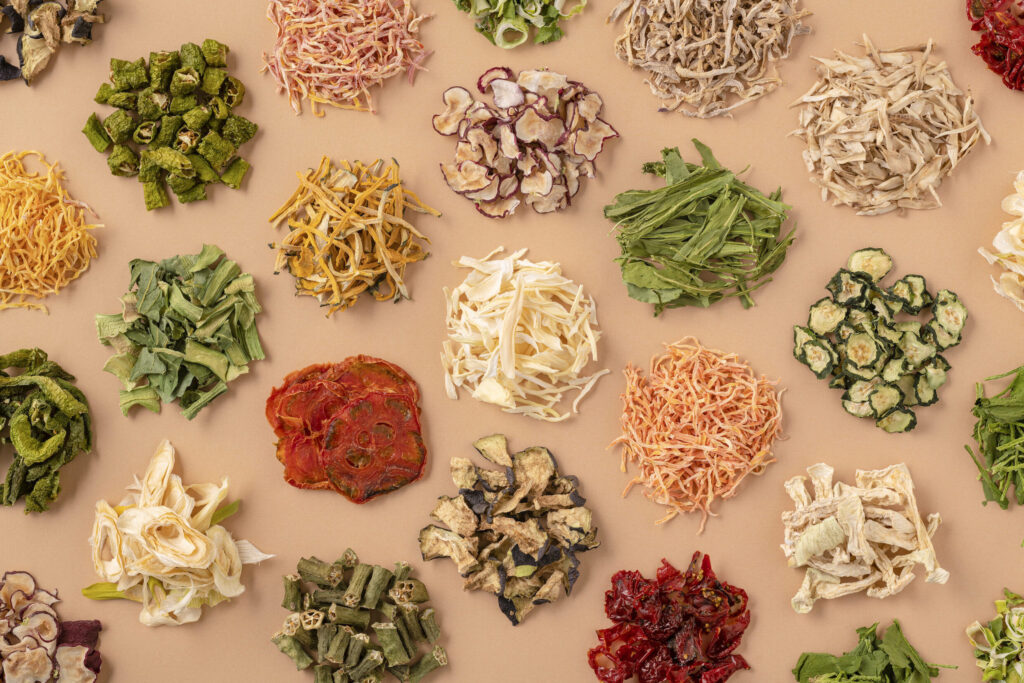
- Sold in small lots from 1 kg
- Handling heirloom vegetables from across Japan
- Dried fruits and herbs also supported
6 reasons to choose kabocha
Fluffy kabocha from Kyotango
We use a fluffy-type variety grown in Kyotango, Kyoto Prefecture, with its temperature swings. Texture and sweetness remain even after drying.
Two types of cut
We offer two specifications you can choose to match your application—shredded for soups and stir-fries, large-cut for simmered dishes and baked goods.
Skin-on finish
By drying without peeling, its vivid green and nutrition are used whole. Ideal for vegetable pastes and soups as well.
Powder available
Powder processing is also supported. It can be expanded as a raw material for coloring, flavoring, and functional foods.
No glucose added
The raw material is 100% kabocha. No sugars, colorants, or preservatives are used at all.
Long-term storage
Storable for 6 months at room temperature. It is a material that takes less space than frozen kabocha and makes inventory management easy.
Product specifications
Item | Details |
|---|---|
Raw material growing region | Kyoto Prefecture (partner farm) |
Specification | Shredded / large-cut |
Storage method | Room temperature (store away from high heat and humidity) |
Best-before date | 6 months from the shipping date |
Minimum lot | From 10 bags / 100 g |
Powder | Available |
Manufacturing period | August |
Customization support
We flexibly accommodate the following customizations to match your OEM product development. Please feel free to contact us for large-lot orders or consultations on specification changes. Even product concepts that can't be fully expressed with the standard specification can be supported by Agriture through combinations of drying conditions and cutting methods.
Item | Details |
|---|---|
Change in cut thickness | 10 kg or more |
Specification | Choice of shredded / large-cut |
Large-lot manufacturing | Advance consultation required three months before the manufacturing period |
Powder processing | Available |
Depending on the customization, there may be constraints on the raw material's procurement timing and lot size. Consulting early to match kabocha's peak season and the manufacturing schedule lets manufacturing to your desired specifications proceed smoothly.
About the raw material kabocha
Agriture's dried kabocha is procured through long-term relationships with partner farmers within Kyoto Prefecture. By managing it with links down to the growing region, producer, and variety, we have established a system to deliver commercial raw material of stable quality every year.
BRAND
Variety:Kyoto-grown kabocha (fluffy type)
PRODUCER
Producer:Partner farmers including those in Kyotango, Kyoto Prefecture. At the summer peak, we carefully select fully ripened kabocha and supply it as raw material for processing.
REGION
Growing region:Kyotango, Kyoto Prefecture. The sunlight near the sea and the soil's minerals nurture a fluffy texture and strong sweetness.
CULTIVATION
Cultivation method:A summer-harvest variety by open-field cultivation. Harvested after full ripening, it is processed under a system that minimizes freshness loss up to drying.
*Reference: OYAOYA product page
Agriture's low-temperature drying technology
To make the most of kabocha's character, Agriture uses its own drying process that removes moisture slowly at low temperature. Compared with high-temperature drying it takes time, but its greatest benefit is that it lets us value the ingredient's color, aroma, and nutrition. A defining feature of Agriture's low-temperature drying is that finely controlling three things—temperature, humidity, and airflow—lets us draw the optimal drying curve for each ingredient.
Raw material delivered from partner farmers is processed on an integrated line—washing, cutting, and drying—all on the same day. While reducing raw material loss, we lock the fresh flavor into the dried product. Being able to keep the time from harvest to processing short is a strength that comes precisely from having a processing base in the growing region of Kyoto.
After processing, we check the moisture value and color tone of each lot one by one and ship only those meeting the quality standards. Even for commercial lots, because we check on both the visual and measurement sides, we can deliver kabocha at a stable quality of finish.
💡 TIPS | Drying-processing trivia
Because kabocha has high sweetness and moisture, drying it at high temperature all at once makes the skin too hard and worsens the mouthfeel. Removing moisture slowly at low temperature achieves both a softness that lets you eat it skin and all, and a fluffy quality.
Use scenes and OEM case studies
Dried kabocha is used across a wide range of business types, from food manufacturers to restaurants and EC mail-order brands. Beyond menus that make the most of the ingredient itself, adoption is also spreading as an OEM raw material for processed foods, seasonings, and blended products. Here we introduce representative use scenes.
Soups and potages
In commercial adoption for soup and potage applications, dried kabocha is a raw material that leads to a major reduction in prep processes. Raw kabocha takes considerable labor for peeling, cutting, and pre-heating, but dried slices or dice can be managed in bulk at room temperature, and simply putting them into the soup base and heating gives a sweet finish. Since the rehydration liquid also contains umami components, it can be repurposed for simmering, contributing to improved yield and reduced food loss at foodservice chains and frozen-soup makers.
Baked goods and steamed buns
It is a material that can be adopted with stable quality for the sweets lines of confectionery makers and food OEM companies. Raw kabocha's seasonal variation in sweetness and moisture is a barrier to formulation design, but dried kabocha powder or flake-form raw material can secure uniform sweetness and color tone year-round, making it smooth to knead into the dough of muffins, scones, steamed buns, and the like. Since we can also handle small-lot prototyping, you can consult us in an integrated way from the new-product development stage through OEM orders.
Frozen prepared foods and chilled prepared foods
It is an effective raw material choice when frozen and chilled prepared-food makers and deli departments want to stabilize year-round supply of kabocha prepared foods. Raw kabocha has large seasonal quality variation and a heavy burden of pretreatment and steaming, but dried kabocha can be stored in bulk at room temperature and ordered in a planned way, contributing to leveling the production line. Since we can provide it in cut shapes matched to the application—simmered dishes, dressed dishes, kabocha salad—please feel free to consult us as a differentiating material for SKU expansion.
Baby food and nursing-care food
Adoption is spreading among baby-food makers and nursing-care-food manufacturers as a material where stable sweetness and color tone are required. Raw kabocha has the challenge of large labor for peeling and heat treatment and quality that easily varies by season and growing region, but dried raw material can be stored in bulk at room temperature and supply stable color and sweetness year-round. Since you can choose the shape from flake to powder, we flexibly accommodate viscosity adjustment by month of age and expansion into swallowing-friendly foods.
About commercial OEM / processing consultations
Domestic kabocha that can be stored at room temperature is a material that makes it easier to reduce the burden of inventory and logistics compared with frozen raw materials. It is adopted across a variety of business types—prepared-food makers, sweets brands, baby food, and more.
Agriture also supports launching private-brand products centered on dried kabocha and renewing existing products. We accompany you across the entire development process—recipe design, prototyping, preparing specification sheets, and package proposals.
Custom-size support (change in cut thickness, shape adjustment): consultation available from orders of 10 kg or more. OEM support: available. Large-lot manufacturing: available (advance consultation required three months before the manufacturing period). We guide you consistently through everything from quotation to sample arrangement to match your requests.
Past initiative case studies are here
Please also see related initiative case studies and columns.
- Summer Kyoto Vegetables: The Season of Fushimi Togarashi and Shishigatani Kabocha
- Shishigatani Kabocha: A Kyoto Vegetable Prized for Its Distinctive Shape and Gentle Sweetness
- Make Baby Food Easy with Vegetable Powder: Safe Uses and Recipes by Age
Product catalog showing the items we handle
Flexible support from small lots to large lots
- Sold in small lots from 1 kg
- Handling heirloom vegetables from across Japan
- Dried fruits and herbs also supported
Frequently asked questions
Q1. Which should I choose, shredded or large-cut?
Shredded suits ingredients for soups, stir-fries, and bread; large-cut suits simmered dishes, baked goods, and vegetable chunks.
Q2. Can it be eaten with the skin on?
Yes. Since low-temperature drying softens it right down to the skin, after rehydration you can eat it as is.
Q3. Do you support powder processing?
Q4. What is the best-before date?
It can be stored for 6 months from the shipping date at room temperature (avoiding high heat and humidity).
Q5. Does it contain additives or colorants?
No glucose, preservatives, or colorants are used at all.
Q6. Can you handle halal compliance?
Please consult us individually. After explaining the raw material and processing, we will consider the necessary support.
Q7. When is the manufacturing period?
We manufacture centered on August each year. For large orders, please consult us at least 3 months in advance.
RETAIL
For those looking to purchase in small packs
For those who want to try a small quantity outside of commercial use, we offer dried kabocha from our sister brand OYAOYA in small packs of 20 g to 500 g. It is also recommended for home prototyping and in-house verification.
Yakuzen (medicinal) benefits (in the case of fresh kabocha)
In the world of yakuzen, kabocha is known as an ingredient that supplements the "spleen" and "stomach" and nourishes qi. It is an ingredient to incorporate when you have indigestion or strong fatigue, or when stamina tends to drop at the change of seasons.
Kabocha, which has a sweet nature, is expected to have an action that supplements qi while warming the body, and it has been widely enjoyed by everyone from children to the elderly. Incorporating it in simmered dishes and soups gently regulates the body from within.
💡 TIPS | Yakuzen trivia
Dried kabocha is thought to concentrate its sweetness and warming action as moisture is removed. It is an easy material to incorporate when you want to regulate your body toward the cold season, or when your appetite is down.
Because it is dried with the skin on, the nutrition contained in the skin can be used as is. Its appeal is also that it can be added as is to your usual dishes—potages, simmered dishes, steamed buns.
YAKUZEN
For those who want to know more about kabocha from a yakuzen perspective
For how to incorporate kabocha according to season and physical condition, and combinations with compatible ingredients, our sister site "Yasai Yakuzen" explains in detail.
Samples and inquiries
We can also prepare trial samples first. For the initial transaction, samples are supplied for a fee. Please feel free to contact us for consultations on OEM development and stable supply as well.
Commercial-use dried vegetable OEM is here
Commercial vegetable powder is here
Recommended reading
- Summer Kyoto Vegetables: The Season of Fushimi Togarashi and Shishigatani Kabocha
- Shishigatani Kabocha: A Kyoto Vegetable Prized for Its Distinctive Shape and Gentle Sweetness
- Make Baby Food Easy with Vegetable Powder: Safe Uses and Recipes by Age
- Kabocha squash powder
Download the product catalog
We will send the materials to your email address based on the information you provide.