Dried mizuna


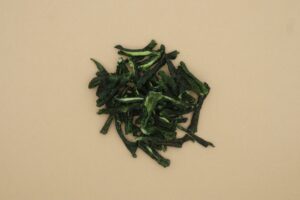
*The first image is mizuna, the second image is Benihoshi mizuna
"Mizuna," a Japan-native vegetable long grown mainly in Kyoto. Agriture's commercial dried mizuna uses as its main raw material "Benihoshi mizuna," part of the Phyto Rich series developed by a Kyoto seed maker, and is finished by low-temperature drying of material grown by partner farmers in Kyotango, Kyoto. The crisp texture of the raw vegetable transforms into a crunchy texture whose umami spreads the more you chew, an aromatic-vegetable ingredient able to handle a wide range of menu items from soups to pasta and bakery ingredients.
TOC
Three Commitments Behind Agriture's Dried Mizuna
01 The functional variety "Benihoshi mizuna" as the main raw material
At Agriture, we use "Benihoshi mizuna," whose red stalks contain the functional compound anthocyanin, as the main raw material. A valuable variety that achieves both visual appeal and functionality, it is one reason food makers choose it when seeking a differentiating ingredient. Its color and texture, which cannot be expressed by ordinary white-stalked mizuna, are its charm.
02 Stable procurement through partner farmers in Kyotango
Mizuna grown by partner farmers in Kyotango, Kyoto is brought into our own plant right after harvest and processed. By minimizing the lead time from harvest to drying, we turn it into an ingredient without losing the aroma characteristic of mizuna. Through ongoing information sharing with growers, we work to keep down year-to-year quality variation.
03 A crunchy texture that broadens your cooking range
Raw mizuna has a crisp, cleanly snapping texture, but when dried it changes to a crunchy, chewy texture. The distinctive texture, whose hidden umami floods out the more you chew, holds a unique position even among commercial dried vegetables and is an ingredient easy to use as an added-value material in menu development.
Product catalog showing the items we handle
Flexible support from small lots to large lots
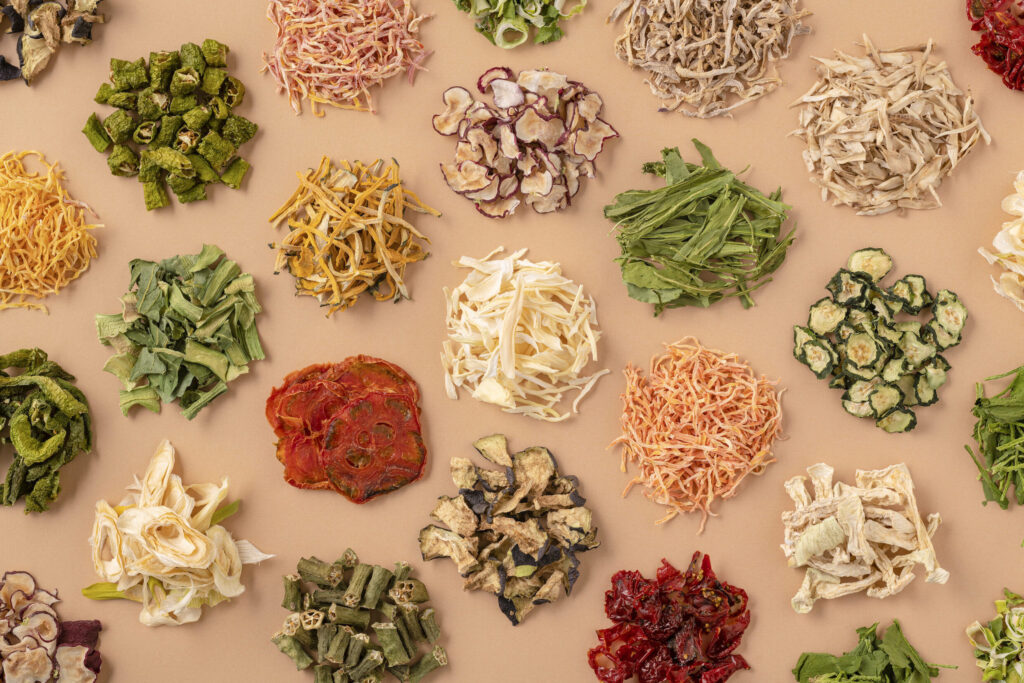
- Sold in small lots from 1 kg
- Handling heirloom vegetables from across Japan
- Dried fruits and herbs also supported
Features of Commercial Dried Mizuna
Adoption of a functional variety
With "Benihoshi mizuna," whose red stalks contain anthocyanin, as the main raw material, we can also propose its value as a coloring ingredient. Its color is more vivid than ordinary mizuna, and it suits product photography and packaging appeal.
Crunchy texture
Drying transforms the raw crispness into a crunchy texture whose umami spreads the more you chew. The aroma is concentrated too, and the aftertaste is clean. It pairs superbly with soups, pasta, and bakery ingredients.
No glucose added
Because it is processed just as the ingredient is, without glucose coating or additives, it can be adopted as-is in additive-free-oriented product development. It suits products where you want to keep the ingredient declaration simple.
A Kyoto-grown Kyoto-vegetable brand
Made with Kyoto-grown mizuna cultivated by partner farmers in Kyotango, Kyoto. It is easy to promote as Kyoto-grown and as a Kyoto vegetable, and can be used in product-making with a story.
Powder handling can also be discussed
We can handle everything from coarse grinding to powdering, and adjust to your use as a kneading-in for bread and dough or as a blending ingredient.
Long-term room-temperature storage of 6 months
Long-term storage of six months from the shipping date is possible, achieving the year-round supply impossible with fresh mizuna. Less affected by seasonal fluctuation, it contributes to planned product manufacturing.
Product specifications
Item | Details |
|---|---|
Raw material growing region | Kyoto Prefecture (partner farm) |
Specification | Round slices |
Storage method | Room temperature (store away from high heat and humidity) |
Best-before date | 6 months from the shipping date |
Minimum lot | From 10 bags / 100 g |
Powder | △ Possible depending on coarseness |
Manufacturing period | July |
Customization support
At Agriture, cooperation with partner farms and our own processing facility achieve a stable raw material supply and high-quality manufacturing. We can flexibly handle OEM manufacturing and welcome consultations on specification changes and packaging. Custom-size handling (cut-thickness change, shape adjustment) is available for consultation from orders of 10 kg or more, and for large-lot manufacturing please consult us three months before the manufacturing period.
POWDER
For those looking for mizuna powder or other vegetable powders
With coarse grinding, we can also handle powdering of mizuna. In line with powder needs such as kneading into bread and pizza dough or as a sub-ingredient for yakuzen tea, we can also propose blend designs combining it with other vegetable powders.
Commitments to variety, grower, and growing region
The raw material used in our dried mizuna is mizuna grown by partner farmers in Kyotango, Kyoto, with the central variety being "Benihoshi mizuna." It is a variety in a functional series developed by Takii Seed, a seed maker representative of Kyoto, characterized by its red stalks. The stalk color comes from the functional compound anthocyanin, a point that differentiates it from ordinary white-stalked mizuna.
BRAND
Variety: Benihoshi mizuna. Part of the Phyto Rich series developed by Takii Seed; its red stalks are due to its containing the functional compound anthocyanin. A functional variety with high aroma and a crunchy texture to enjoy.
PRODUCER
Producer: Partner farmers in Kyotango, Kyoto. We work with farmers who aim for agriculture considerate of the environment and people, growing with homemade compost. Cultivation that makes the most of Kyotango's advantages of place draws out mizuna's umami and aroma firmly.
REGION
Growing region: Kyotango, Kyoto. The Sea of Japan-side climate and day-night temperature swings deepen mizuna's flavor for a richly flavored raw material. Being the birthplace of mizuna, its appeal also lies in being easy to promote as Kyoto-grown mizuna, a Kyoto vegetable.
CULTIVATION
Cultivation method: An environmentally considerate cultivation using homemade compost, emphasizing the nutritional balance of the soil. It adopts a cultivation policy that keeps chemical fertilizer and pesticide use low and draws out mizuna's inherent flavor.
*Reference: OYAOYA product page
Low-temperature drying technology and quality control
For leafy vegetables such as mizuna, the balance of temperature and airflow during drying determines color, aroma, and texture. At Agriture, we run a low-temperature drying program dedicated to leafy vegetables, arranging the process to lower water activity to the appropriate level while keeping the green of the leaves and the red of the stalks. In a method that removes moisture all at once at high heat, the green of the leaves browns easily and the character of a hard-won functional variety is lost, so time-taking low-temperature drying is essential.
At our own plant we manage everything integrally, from receiving mizuna through drying, foreign-matter removal, and packaging. In OEM transactions we also handle issuance of analysis tables and raw-material origin certificates. We have a system able to accommodate document submissions such as Kyoto-grown origin certification and additive-free certification.
💡 TIPS | Drying-processing trivia
When drying a functional variety such as Benihoshi mizuna, lowering the temperature even further than usual and taking time can keep the degradation of anthocyanin in check. At Agriture, we change the drying program by variety to maximize the added value of the raw material.
Use cases and adoption examples
As an ingredient for soups, miso soup, and stocks
Dried mizuna, as an ingredient for miso soup, hot pot, and nibitashi, absorbs the broth and finishes juicy. For commercial use, in combination with instant miso soup and freeze-dried soups, it is adopted as an ingredient that easily delivers mizuna's characteristic flavor and texture.
As an ingredient for pasta and Japanese-style noodle menus
It can be used as an ingredient for pasta, Japanese-style paella, and yakisoba, adding an accent of aroma and texture. It is a prized ingredient for fusion menus of Japanese and Italian cuisine, and for menu development that promotes a Kyoto character.
Kneading into bakery and pizza dough
Kneading powdered dried mizuna into bread or pizza dough lets you make colorful products that make the most of the green. As a bakery product using a functional vegetable, we also receive inquiries from health-conscious bakeries.
As an OEM product ingredient and dried condiment material
There is demand as a blending ingredient for aromatic greens, red-stalk mixes, dried condiment materials, and the like. A dried condiment mix combining it with other Kyoto vegetables is a material easy to develop as a souvenir OEM or wholesale packaged product.
As a prepared-food and ready-meal ingredient
As a sub-ingredient for convenience-store and supermarket prepared foods, it can be used in Japanese-style salads and dressed dishes that make the most of mizuna's texture. The ability to use mizuna year-round as a dried material, when its inventory is hard to manage as a fresh vegetable, is a commercial strength.
Commercial usage and rehydration
Dried mizuna can be used either by rehydrating or by heat-cooking. When rehydrating, the leaves and stalks come back in about 5–10 minutes, ready for dressed dishes and salads. For soups and simmered dishes, it can be added directly without rehydrating, finishing with a juicy texture by letting it absorb the broth.
When using it in pasta or stir-fries, adding it just before finishing preserves mizuna's flavor and texture. For bakery use, mixing the powdered form together with the flour spreads mizuna's flavor and color throughout the dough.
Related cases and articles
- Kyo-mizuna: characterized by a crisp texture and refreshing flavor (Kyoto vegetable column)
- Mibuna: The Characteristics and History of a Kyoto Vegetable with Little Heat (Kyoto vegetable column)
- Winter Kyoto vegetables: the deep umami of Shogoin daikon and Kujo green onion (Kyoto vegetable column)
Product catalog showing the items we handle
Flexible support from small lots to large lots
- Sold in small lots from 1 kg
- Handling heirloom vegetables from across Japan
- Dried fruits and herbs also supported
Frequently asked questions
Q. What is the minimum lot and prototype handling?
A. The minimum lot is available from 10 bags (in 100 g units). OEM prototyping can be discussed from 10 kg or more, and spec changes and packaging can be considered together. Because the harvest season of Benihoshi mizuna is limited, we recommend discussion under an annual ordering plan.
Q. What is the price range?
A. The functional variety Benihoshi mizuna is higher in unit price than ordinary white-stalked mizuna, but it has value as a differentiating ingredient. Because specific pricing varies with lot count, cut specification, and packaging format, please feel free to consult us via the inquiry form.
Q. What is the lead time?
A. For stocked items, we can ship within 1–2 weeks of order. Mizuna's production period is mainly July, and we build an annual plan timed to the summer harvest. For large lots, consulting us three months before the production period allows a smooth response.
Q. Can you issue a raw-material origin certificate?
A. We can issue a raw-material origin certificate for Kyotango, Kyoto. We can also accommodate labeling such as "made with Kyoto-grown mizuna" or "made with Japanese-grown mizuna" on product packaging. It can also be used as promotional material as a Kyoto-vegetable brand.
Q. Can you submit pesticide residue results or analysis tables?
A. We can submit quality documents such as microbiological inspection reports and general composition analysis. Our partner farmers work on cultivation that keeps chemical-pesticide use low, making it a material easy to meet the quality requirements of OEM projects. Please discuss required items in advance.
Q. Can you handle HACCP and export?
A. Our own processing facility can submit HACCP-compliant documents. Export projects are handled case by case, but there are examples of developing it as a Kyoto-grown Kyoto vegetable for overseas Japanese-cuisine markets and Japanese supermarkets. If you have a concrete export plan, please consult us.
Q. Please tell me the OEM consultation flow
RETAIL
For those looking to purchase in small packs
For prototype use or personal consumption, small-quantity packs can also be purchased at the online shop of our sister brand OYAOYA. It is recommended for those who want to check the flavor and texture with a small quantity before commercial use.
Recommended reading
- Kyo-mizuna: characterized by a crisp texture and refreshing flavor (Kyoto vegetable column)
- Mibuna: The Characteristics and History of a Kyoto Vegetable with Little Heat (Kyoto vegetable column)
- Winter Kyoto vegetables: the deep umami of Shogoin daikon and Kujo green onion (Kyoto vegetable column)
- Mizuna powder
Download the product catalog
We will send the materials to your email address based on the information you provide.