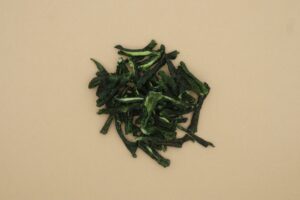
Dried mibuna


Mibuna, a heirloom vegetable of Kyoto also familiar from Kyoto pickles. Among them, mibuna grown in Hiyoshi Town, the designated growing region for Kyo-mibuna, is a gem praised for being highly aromatic with a sharp pungency almost like an herb. Drying softens its slightly bitter flavor, giving a refined finish in which the pungency draws out the umami. The leaves are fluffy and the stems are crisp. The differing texture by part is also an appeal, and it is a commercial aromatic-vegetable material that, added to dishes, creates a dish with an accent.
TOC
Three points of care behind Agriture's dried mibuna
01 Raw material from the designated growing region of the brand Kyoto vegetable "Kyo-mibuna"
Agriture uses as its main raw material mibuna grown in Hiyoshi Town, Kyoto Prefecture, the designated growing region for the brand Kyoto vegetable "Kyo-mibuna." Mibuna from the designated growing region has an exceptional balance of aroma, pungency, and texture, a quality that sets it apart from mibuna of other regions. It carries value that can be appealed directly as the raw material for brand Kyoto-vegetable products.
02 A dual texture — fluffy leaves and crisp stems
It is characteristic of mibuna that the leaf portion is soft while the stem portion is crisp, giving different textures. Drying makes this difference in texture stand out even more, letting you add a lively accent across the whole menu. Rather than a single texture, it can be used as an aromatic material that shows a different face with each bite.
03 A hint of pungency that draws out umami
The pungency characteristic of mibuna becomes milder through drying while striking an exquisite balance as a supporting role that draws out the umami of other ingredients. Its herb-like flavor is easy to pair with Japanese or Western cuisine alike, and as an aromatic vegetable it can be used in a wide range of products such as prepared dishes, toppings, and mix ingredients.
Product catalog showing the items we handle
Flexible support from small lots to large lots

- Sold in small lots from 1 kg
- Handling heirloom vegetables from across Japan
- Dried fruits and herbs also supported
Features of commercial dried mibuna
A brand Kyoto vegetable from the designated growing region
It uses mibuna from Hiyoshi Town, the designated growing region of the brand Kyoto vegetable "Kyo-mibuna." With strong appeal as a Kyoto-vegetable brand, it is a rare, high-value raw material that allows differentiation on product packaging.
An herb-like aroma
A sharp pungency and rich aroma give it a presence like an herb. Easy to pair with Japanese and Western cuisine alike, it is a material that opens up new ways to use it as an aromatic vegetable.
A dual texture of leaf and stem
The leaves are fluffy and soft, and the stems have a crisp bite. Because you can enjoy the differing texture by part at once, it is ideal for adding variation across the whole menu.
No glucose added
It is processed as is, without using sugar coating or additives. It is a raw material that keeps the ingredient labeling simple even in product development that appeals to additive-free, domestic ingredients.
Powder processing available
Dried mibuna can also be processed into powder. As a flavor material, it has the flexibility to be used as a raw material for powdered products such as oils, sauces, and furikake.
Stable production outside summer
Mibuna's production period is outside summer. It comes into season from autumn to spring, and by concentrating processing during the period when the flavor is richest, we can supply raw material of stable quality year-round.
Product specifications
|
Item |
Details |
|---|---|
|
Raw material growing region |
Kyoto Prefecture (partner farm) |
|
Specification |
Fine-cut |
|
Storage method |
Room temperature (store away from high heat and humidity) |
|
Best-before date |
6 months from the shipping date |
|
Minimum lot |
From 10 bags / 100 g |
|
Powder |
Available |
|
Manufacturing period |
Except in summer |
Customization support
At Agriture, cooperation with partner farms and our own processing facility achieve a stable raw material supply and high-quality manufacturing. We can flexibly handle OEM manufacturing and welcome consultations on specification changes and packaging. Custom-size handling (cut-thickness change, shape adjustment) is available for consultation from orders of 10 kg or more, and for large-lot manufacturing please consult us three months before the manufacturing period.
POWDER
For those looking for mibuna powder or other vegetable powders
Dried mibuna can also be processed into powder. Please consider it as a raw material for furikake, flavored oil, or paste that makes use of its hint of pungency and herb-like character. We also accept blend design in combination with other vegetable powders.
Commitments to variety, grower, and growing region
The raw material used in our dried mibuna is Kyo-mibuna grown in Hiyoshi Town, Kyoto Prefecture. It is a region certified as the designated growing region for the brand Kyoto vegetable "Kyo-mibuna," a land where quality control and traditional cultivation methods go hand in hand. Our partner grower is a specialized farm that has continued since the Edo period, and we place our trust in it as one of the few family-run farms in Hiyoshi Town dedicated to Kyo-mibuna.
BRAND
Variety: Kyo-mibuna. A heirloom vegetable of Kyoto, certified as one of the brand Kyoto vegetables. It has a refinement that lets you enjoy it raw after washing, and it is a variety whose vivid, yellowish green is beautiful. It is tender and exceptional in flavor.
PRODUCER
Producer: Our partner farm. In Hiyoshi Town, designated as the growing region of the brand Kyoto vegetable Kyo-mibuna, it is a specialized farm that has continued since the Edo period. Even in Hiyoshi Town, growers who make Kyo-mibuna are few, and it is the only three-generation family-run farm among our partners. The 15th-generation partner farmer carries on the family business.
REGION
Growing region: Hiyoshi Town, Kyoto Prefecture. A region certified as the brand Kyoto-vegetable designated growing region for Kyo-mibuna, it meets the conditions — a large day-night temperature difference and a cool climate — that draw out mibuna's aroma and pungency. It is a land where the quality of Kyo-mibuna is especially fine even within Kyoto Prefecture.
CULTIVATION
Cultivation method: Cultivation is by a specialized farm that carries on the traditional cultivation methods continued since the Edo period while incorporating modern quality control. The farming method handed down through three generations of the family is meant to draw out to the fullest the aroma and texture that characterize Kyo-mibuna.
*Reference: OYAOYA product page
Low-temperature drying technology and quality control
When drying leafy vegetables like mibuna, the leaves and stems dry at different speeds, so keeping a balance of temperature and airflow is the key to an even finish. Drying at high temperature volatilizes the aromatic components of the leaves and loses the hard-won herb-like character, so a program that removes moisture slowly at low temperature is essential. Agriture operates a drying program dedicated to leafy vegetables where aroma matters, achieving processing that retains the hint of pungency and herb-like character characteristic of mibuna.
💡 TIPS | Drying-processing trivia
When drying aromatic vegetables like mibuna, you can retain each texture to the fullest by drying the leaves and stems separately or by adjusting the cutting timing. Agriture draws out the individuality of each ingredient by varying the processing conditions for each aromatic vegetable.
Use cases and adoption examples
As an aromatic-vegetable topping
This is a use whose adoption is spreading at ramen specialty shops, chilled-noodle chains, and deli and bento manufacturers as a Japanese-style herb with a unique pungency and aroma not found in scallions or myoga. Fresh mibuna poses challenges in freshness management and securing an even topping amount, but the dried product makes room-temperature storage and a steady portion guide easy to achieve, greatly reducing the operational burden on-site. Because we can supply it in cut shapes matched to the use, such as flakes or fine cut, please also consider it as a PB ramen OEM specification or a differentiation material for convenience-store deli products.
As a Japanese-style prepared-dish and soup material
It is adopted by prepared-food manufacturers and Japanese-cuisine chains as a differentiation material for pickles, dressed dishes, and miso soup. Fresh mibuna burdens the site with procurement risk from seasonal fluctuation and prep labor hours, but the dried type can be stored year-round at room temperature, and simply rehydrating the needed amount in water lets you add the pungency and aroma characteristic of Kyo-mibuna to the menu. We also handle requests for fine-cut sizes and small-portion specifications, so please consider it for incorporation into the production line of standard products or as a material for seasonal-limited products.
OEM product raw material / spicy leafy-greens mix
This is a use adopted as a raw material for compound seasoning products such as furikake, condiment mixes, and ochazuke materials. Fresh mibuna has the drawback of discoloration after harvest and moisture management on the processing line, but the dried product allows batch storage at room temperature and fixed-quantity blending, making it easy to design formulations with chili pepper or shredded nori. Mibuna, which can appeal "made with Kyoto vegetables," also functions as a differentiation material for Kyoto souvenir sets and EC brands, and we handle blend-specification consultations from small lots.
As a flavor material
This is a raw-material use for food manufacturers and OEM contractors who handle seasonings, furikake, and flavored oils. Fresh mibuna discolors quickly after harvest, and securing raw material suited to powder processing can be difficult, but dried mibuna, once powdered, can be incorporated into the production line in a state stable in both flavor and color. Because it can be considered for prototyping from small quantities as a differentiation material for Japanese-style herb salt or flavored oil, it can also be used for test specifications when launching a new line.
For bakery and pasta menus
This is a use with a track record of adoption as an accent material for Japanese-style pasta or as a raw material kneaded into bakery dough. Fresh mibuna is a material whose arrival volume is easily swayed by harvest timing, making incorporation into a year-round menu difficult, but the dried product allows stable stock at room temperature and can be used at consistent quality regardless of season. For cafes and dining chains that want to highlight the origin note "produced in Kyoto," or OEM products of EC brands that make local character a differentiation axis, we can supply it in cut shapes matched to your requests.
Commercial usage and rehydration
Dried mibuna is used after rehydrating in water for about 5–10 minutes. Because it rehydrates in a short time, adding it directly to the finish of a soup or miso soup is no problem. When used in pasta or stir-fries, adding it just before finishing lets you retain the aroma and texture.
When used in pickles or dressed dishes, after rehydrating, wring out the water and then combine with the seasoning liquid. Rehydrating the stem portion a little longer revives the crisp texture, so please adjust the rehydration time to the use. The powdered form can be mixed directly into flavored salt, seasoning oil, furikake, and the like.
Related cases and articles
- Mibuna: The Characteristics and History of a Kyoto Vegetable with Little Heat (Kyoto vegetable column)
- Spring Kyoto vegetables: the seasonal taste of Kyoto bamboo shoots, mibuna, and Kujo green onion (Kyoto vegetable column)
- [Kyoto Vegetable Calendar] Seasonal Kyoto Vegetables That Color the Four Seasons and Famous Kyoto Cuisine (Kyoto vegetable column)
Product catalog showing the items we handle
Flexible support from small lots to large lots
- Sold in small lots from 1 kg
- Handling heirloom vegetables from across Japan
- Dried fruits and herbs also supported
Frequently asked questions
Q. What is the minimum lot and prototype handling?
A. Orders can be placed from 10 bags (in 100 g units). OEM prototyping can be discussed from 10 kg or more. Because Kyo-mibuna growers are limited, we recommend a contract based on an annual order plan. Advance reservation lets you secure a stable supply.
Q. What is the price range?
A. Because it uses raw material from the Kyo-mibuna designated growing region, the unit price is somewhat higher than generally distributed mibuna. However, it has added value as a brand Kyoto vegetable and is a raw material that makes it easy to raise the product's unit price. For a detailed quotation, please consult us via the inquiry form.
Q. What is the lead time?
A. Stock items can be shipped 1–2 weeks after order. Mibuna's production period is outside summer, and we carry out batch processing matched to the autumn-to-spring harvest timing. For large lots, consulting us three months before the production period lets us handle it in a planned way.
Q. Can you issue a raw-material origin certificate?
A. We can issue a certificate of raw-material origin for product from Hiyoshi Town, Kyoto Prefecture. We can also prepare documents certifying that it is raw material from a brand Kyoto-vegetable designated growing region, which can also be used when labeling "made with Kyo-mibuna" or "Kyoto-vegetable designated growing region" on product packaging.
Q. Please tell me the OEM consultation flow
A. We proceed in the flow of inquiry → concept hearing → sample shipment → paid prototyping → specification finalization → main production. In developing brand Kyoto-vegetable products, we can also proceed together from consultation on story design and packaging concept.
RETAIL
For those looking to purchase in small packs
For prototype use or personal consumption, small-quantity packs can also be purchased at the online shop of our sister brand OYAOYA. It is recommended for those who want to check the flavor and texture with a small quantity before commercial use.
Recommended reading
- Mibuna: The Characteristics and History of a Kyoto Vegetable with Little Heat (Kyoto vegetable column)
- Spring Kyoto vegetables: the seasonal taste of Kyoto bamboo shoots, mibuna, and Kujo green onion (Kyoto vegetable column)
- [Kyoto Vegetable Calendar] Seasonal Kyoto Vegetables That Color the Four Seasons and Famous Kyoto Cuisine (Kyoto vegetable column)
Download the product catalog
We will send the materials to your email address based on the information you provide.