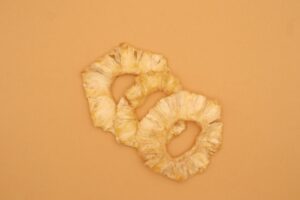
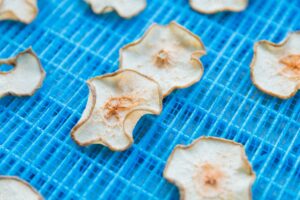
Dried mango

Mango is a tropical fruit characterized by rich sweetness and a mellow aroma. Our dried mango uses fully ripe fruit grown in Miyazaki and is dried slowly at low temperature, sealing in the natural sweetness and aroma. With beautiful flesh color as well, it can be used in a wide range of product development, including confectionery, granola, smoothies, and drink toppings.
Three Commitments Behind Our Dried Mango
Agriture's dried mango is built with thorough quality design so it can be adopted as a commercial ingredient. Here we introduce three points we regard as particular strengths.
01 Made with fully ripe mangoes from Miyazaki and Okinawa
Centered on Japanese-grown fully ripe mangoes (Miyazaki and Okinawa), we select fruit with strong aroma and sugar content. To achieve natural sweetness without adding sugar, we use only raw material managed thoroughly for ripeness.
02 No added sugars, expressing the ingredient's own sweetness
Commercially sold dried mango is mostly sugar-added and bleached, but Agriture's dried mango uses no sugars or additives. It can be adopted as a natural-oriented ingredient that keeps the fruit's inherent sweetness and color.
03 Low-temperature drying that protects color and aroma
To avoid ruining aroma and color, we use low-temperature hot-air drying with the temperature and airflow held down. The finish makes it easy to carry the vivid orange color and ripe aroma through to the final stage of the product.
Product catalog showing the items we handle
Flexible support from small lots to large lots
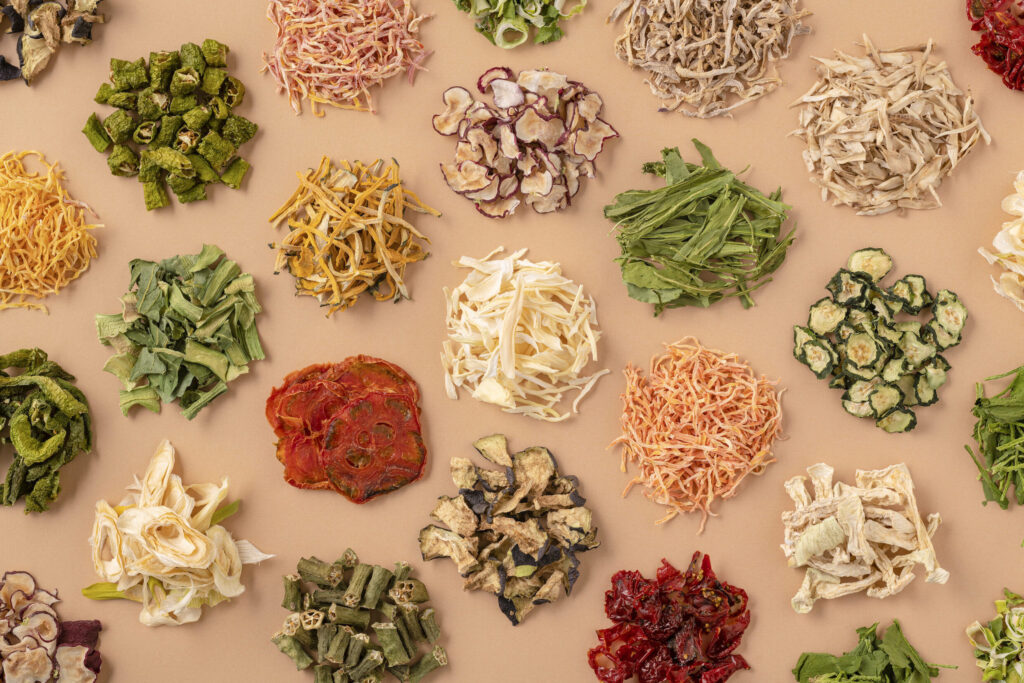
- Sold in small lots from 1 kg
- Handling heirloom vegetables from across Japan
- Dried fruits and herbs also supported
TOC
Characteristics as a commercial raw material
We summarize, from six perspectives, what advantages there are in choosing dried mango as an OEM ingredient. Use it as a reference both for replacing existing materials and for new-product development.
Natural sweetness with no added sugar
Because no sugars such as sugar or high-fructose syrup are added, it can differentiate as a clean-label-oriented ingredient for confectionery, granola, and smoothies.
Vivid flesh color
Because low-temperature drying preserves the flesh color, it is an ingredient that pairs well with confectionery and cereal products where you want to raise the visual appeal of the finished item.
Handles both rehydration and kneading-in
It can of course be used as slices as-is, but it also has a high degree of processing freedom, such as being finely chopped for use as a kneading-in material.
Long shelf life makes inventory planning easier
Room-temperature storage with a best-before period of six months. Because mango, whose harvest season is limited, can be supplied year-round, you can lower the risk of raw-material procurement.
Differentiation through a regional origin story
"Japanese-grown fully ripe mango" from Miyazaki and Okinawa leads to differentiation from imported products and is a material easy to promote on product packaging.
One-stop from prototype to volume production
We can handle everything from 1 kg prototypes to 10 kg or more in full production. Additional blending and portion-packing can also be done seamlessly on our own line in Kyoto.
Product specifications (commercial)
The product's basic specs are as follows. Cut specifications and packaging specs can be individually adjusted on a contract basis, so please consult us to match your OEM requirements. We have organized raw-material origin, best-before date, production method, and minimum lot so they can be checked at a glance.
Item | Details |
|---|---|
Raw material | Mango (grown in Miyazaki / Okinawa) |
Net content | 100g (commercial unit) |
Production method | Low-temperature hot-air drying |
Best-before date | About 6 months from production |
Annual supply volume | About 100kg (varies by season) |
Processing plant | Kyoto or Okinawa plant |
Shipping unit | 100g〜 |
Minimum-lot OEM | Prototype from 1kg / full production from 10kg |
Customization support
For each OEM project, we respond flexibly to changes in cut shape, powdering, small-lot prototyping, blending, and packaging specs. In addition to the response table below, please consult us about individual adjustments to match your requirements.
Item | Available | Details |
|---|---|---|
Size change | ◎ | Slicing available |
Powdering | × | Not possible |
Small-lot OEM prototyping | ◎ | Available from 2kg |
Mixed materials and blends | ◎ | Blending with other raw materials available |
Packaging changes | ◎ | Both commercial and individual packaging available |
POWDER
We also offer powder products
At Agriture, we also handle powder processing of dried mango. From the vegetable powder list, you can also check combinations with other ingredients and processing examples.
Variety, grower, and origin information
Agriture's dried mango keeps quality stable through procurement from partner farmers and contract regions. Please also refer to this when you want to make use of origin information at the product-planning stage.
BRAND
Variety: Fully ripe mangoes grown in Miyazaki and Okinawa. Using sugar content and aroma as criteria, we select fruit that achieves natural sweetness even without added sugar.
PRODUCER
Producer: We work with partner farmers and processing partners in Miyazaki and Okinawa. We have built a flow that sends fruit to processing after assessing ripeness.
REGION
Growing region: Domestic growing regions centered on Miyazaki and Okinawa. A mild climate and ample sunlight draw out mango's sweetness.
CULTIVATION
Cultivation method: Cultivation by partner farmers or contract purchasing. Fruit grown on the tree until fully ripe is sent for primary processing.
Low-temperature drying to protect the ingredient's natural flavor
At Agriture, to protect mango's aroma, color, and umami, we use low-temperature hot-air drying with finely controlled temperature and airflow. Our strength lies in retaining components easily lost in high-temperature drying, through process design matched to the material's nature.
Because we take in the raw material at our own processing facility in Kyoto and manage the whole flow in one place—sorting, cutting, drying, and inspection—we can hold quality variation between lots to a minimum. Combining procurement from partner farmers and contracted regions, we can start the drying process while the raw material is still fresh, which ties directly to finished quality.
💡 TIPS | Drying-processing trivia
Mango's aromatic compounds and vivid color are prone to being lost on contact with heat or oxygen. Low-temperature hot-air drying removes only moisture while keeping oxidation to a minimum, so the fruit's inherent sweetness, aroma, and color remain even without added sugar. Finishing it in chip form gives it a shape easy to use for confectionery, granola, and topping applications.
Commercial use cases
Because dried mango has ample aroma, texture, and umami even on its own, it can develop into multipurpose product development with a single ingredient. Here we introduce five representative scenarios.
Confectionery and bakery ingredient
It is adopted as a kneading-in or topping material for madeleine, pound cake, cookies, baked doughnuts, chocolate, and more. Because no sugar is added, the ingredient's own deep sweetness and aroma come alive, and even chopped and mixed into dough, the color and flavor remain after baking. Its long room-temperature shelf life and stable, year-round preparation are also valued by confectionery makers.
Granola and cereal ingredient
It can be used as a staple ingredient for muesli and premium granola. Its vivid orange color and sweet aroma stand out even through the bag, defining the product's first impression. Because grain size and thickness can be adjusted to the use, it can also accommodate the texture design of cereals.
Smoothie and drink ingredient
It can be used as a smoothie base, an iced-latte topping, or a fruit-tea ingredient. Because no sugars are added, it pairs well with products making a healthy appeal such as no-added-sugar or natural. Rehydrated with water or a warm liquid, the flesh comes back, letting you give drinks a sense of real ingredient body.
Fruit bars and nut mixes
It can be used as a component of protein bars, dried-fruit mixes, and nut mixes. Its chewiness and natural sweetness become an accent, raising the satisfaction of snack and supplemental-food products. It distributes at room temperature and offers a choice of supply formats such as individual packs or loose material, which also suits mass production.
Premium confectionery and differentiating ingredient
With the rich aroma and vivid color unique to Japanese-grown fully ripe mango, it can be developed as a differentiating ingredient for premium-oriented confectionery, snacks, and drinks. Because the material's origin can be clearly stated, it is also easy to build into planning for gifts and craft products that promote a regional-origin story.
Commercial usage and case examples
For commercial use, we can handle everything from 1 kg prototypes to 10 kg or more in full production. It is adopted as an OEM ingredient by confectionery makers, granola brands, and smoothie makers, and by upmarket PB brands as a "made with Japanese-grown fully ripe mango" ingredient.
At Agriture, we provide end-to-end support on our own line in Kyoto, from raw-material selection and primary processing to cutting, powdering, blending, and small-portion packaging. Because we can adjust specifications to match an OEM client's spec sheet and design recipes for launching new brands, you can entrust everything with confidence from the prototype stage through volume production and ongoing supply.
We welcome first-time inquiries and considerations of switching from existing raw materials. For sample provision, quotes, and technical questions about the production process, feel free to reach out via the inquiry form.
Related case examples and reference articles:
- Freeze-dried popular-ingredient ranking | Recommendations by application and points on how to choose, thoroughly explained
- Where Can You Buy Dried Fruit? A Thorough Explanation of the Characteristics of Each Source and How to Choose
- How to Combine Dried Fruit and Nuts: 10 Rules for Boosting Nutritional Value
Product catalog showing the items we handle
Flexible support from small lots to large lots
- Sold in small lots from 1 kg
- Handling heirloom vegetables from across Japan
- Dried fruits and herbs also supported
Frequently Asked Questions (OEM / Commercial Dried Mango)
We have gathered the questions we are asked most often about OEM and commercial dried mango. Please use them as a reference for your decision before contracting.
Q. About what are the minimum lot and unit price?
A. Prototyping starts from 1 kg, and full production from 10 kg as a guide. Unit price varies with slice specification and packaging. Please request a quote via the inquiry form.
Q. When is the price / unit price determined?
A. Because the harvest volume of Japanese-grown fully ripe mango is limited, we present pricing each time based on the market rate of the harvest season and the contract quantity. For annual contracts, we use the unit price at the time of contracting as the basis.
Q. About how long are the delivery time and lead time?
A. Around two weeks for stocked items, and three to six weeks for full production as a guide. Because ripeness of the fruit needs adjusting, additional lead time may be required depending on the season.
Q. Can you provide raw-material origin certification or origin information?
A. We can prepare origin information showing that it is grown in Miyazaki or Okinawa. It can also be used as explanatory documentation for OEM clients and buyers. Please specify inspection items at the time of consultation.
Q. Can you handle HACCP and export requirements?
A. Our production line complies with HACCP. We can also prepare English-language documents and hygiene certificates, and we accept inquiries about export projects.
Q. What is the flow for an OEM consultation?
A. We proceed in the flow of (1) inquiry, (2) requirement hearing, (3) sample provision, (4) quote and contract, (5) prototype, (6) full production, and (7) delivery.
Yakuzen properties (for fresh mango)
From the yakuzen perspective, mango has been treated as an ingredient that removes excess heat and moistens a dry throat.
Eaten in the hot season, it is regarded as a fruit that helps regulate the body, and is incorporated broadly in smoothies, salads, and desserts. In product development it pairs well with "summer," "cool-down," and "seasonal-limited" angles, and its vivid, SNS-photogenic color is also a strength.
💡 TIPS | Yakuzen trivia
Mango is often eaten cold, but combining it with warming ingredients such as ginger and cinnamon strikes a balance so as not to overcool the body. This offers a hint when designing yakuzen sweets and drinks.
Because Agriture's dried mango is finished to keep natural sweetness and color with no added sugar, it can be adopted as-is as an ingredient for yakuzen-style sweets, summer-oriented functional foods, and wellness-brand drinks.
YAKUZEN
For those who want to know more about mango from a yakuzen view
At Yasai Yakuzen, we explain the yakuzen workings of vegetables including mango, and recommended ways of eating them by constitution and season. Please make use of it as a hint for product development as well.
Recommended reading
- Freeze-dried popular-ingredient ranking | Recommendations by application and points on how to choose, thoroughly explained
- Where Can You Buy Dried Fruit? A Thorough Explanation of the Characteristics of Each Source and How to Choose
- How to Combine Dried Fruit and Nuts: 10 Rules for Boosting Nutritional Value
Download the product catalog
We will send the materials to your email address based on the information you provide.