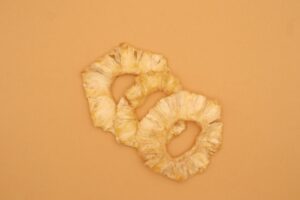
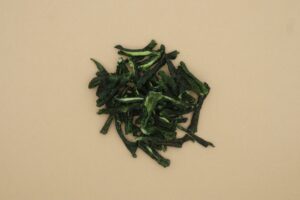
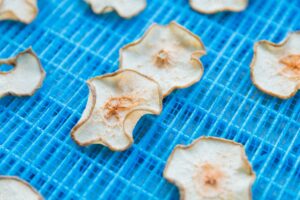
Dried green papaya

Green Papaya is drawing attention as a vegetable using the unripe fruit, and because it is rich in the enzyme papain, its popularity as a health material is rising. Dried green papaya is domestically grown fruit carefully dried at low temperature, finished without impairing flavor or nutrients. It is a highly versatile raw material usable across a wide range of applications—salads, stir-fries, soups, health foods, and more.
TOC
Agriture's dried green papaya: three points of care
01 Low-temperature drying that preserves enzymes and flavor
The enzymes papain and chymopapain, which are green papaya's appeal, are components easily inactivated by high-heat processing. At Agriture, we use low-temperature hot-air drying with finely controlled temperature and airflow, finishing it in a state that keeps the ingredient's natural character. It is one reason it is valued by health-food makers.
02 Powdering support for functional foods too
03 A stable supply route for domestic green papaya
Because green papaya is harvested as an unripe fruit, judging the harvest timing is difficult. At Agriture, we adjust the unripe-fruit harvest timing in advance through partner-farmer routes, building a supply system where raw-material shortages are unlikely. A stable procurement capacity that can also handle continuous release of new products is a strength.
Product catalog showing the items we handle
Flexible support from small lots to large lots
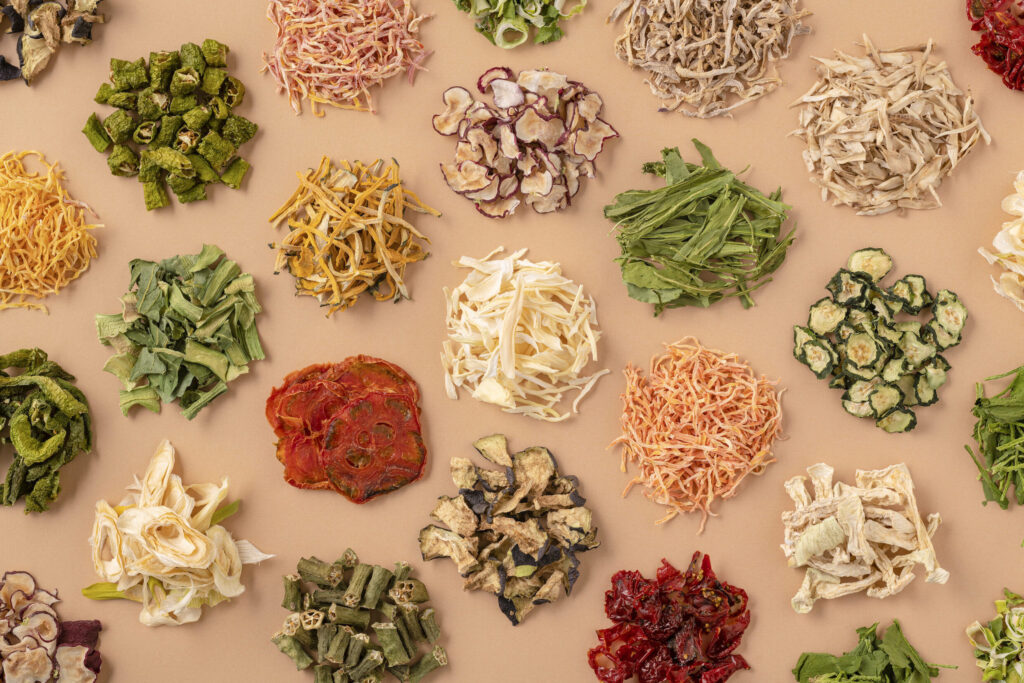
- Sold in small lots from 1 kg
- Handling heirloom vegetables from across Japan
- Dried fruits and herbs also supported
Features of commercial dried green papaya
Attention as a health-conscious material
Green papaya, containing the enzyme papain and dietary fiber, is seeing spreading adoption as a material for health-conscious foods. Because low-temperature drying curbs damage to the enzymes, it can maintain value as a raw material.
Mild flavor
Green papaya's characteristic off-note is slight, making it a material easy to combine across Japanese, Western, and Chinese cuisines. Used across a wide range of genres such as prepared dishes, soups, and drinks, it is also an easy raw material to adopt for strengthening an existing product lineup.
Powdering support
It also supports a fine-powder type, and can be proposed in specifications easy to blend evenly as a base raw material for supplements, drinks, and health foods.
Additive-free
We finish it in the ingredient's natural state, using no glucose or other coating or additives. A raw-material design that can be adopted without discomfort into additive-free-oriented product development.
Long-term room-temperature storage of 6 months
Because it is finished with reduced water activity, room-temperature storage of about 6 months is possible. Ordinary green papaya can only be handled through fresh distribution, but drying enables year-round inventory.
Small-lot prototyping from 2kg
Even when you want to consult from the prototype stage in developing a new product, prototype support is possible from 2kg. We maintain a system that can support the bridge from prototype to full production in one place.
Product specifications (commercial)
Item | Details |
|---|---|
Raw material | Green papaya (domestically grown) |
Net content | 100g (commercial unit) |
Production method | Low-temperature hot-air drying |
Best-before date | About 6 months from production |
Annual supply volume | About 100kg (varies by season) |
Processing plant | Factory in Kyoto Prefecture |
Shipping unit | 100g〜 |
Minimum-lot OEM | Prototype from 1kg / full production from 10kg |
Customization support
Item | Available | Details |
|---|---|---|
Size change | ◎ | Slices, chips, grinding, and more available |
Powdering | ◎ | Fine-powder processing available |
Small-lot OEM prototyping | ◎ | Available from 2kg |
Mixed materials and blends | ◎ | Blending with other raw materials available |
Packaging changes | ◎ | Both commercial and individual packaging available |
POWDER
For those looking for green papaya powder or other vegetable powders
Commitments to variety, grower, and growing region
For our dried green papaya, we use raw material from partner farmers who work at green-papaya cultivation domestically. Because for green papaya, harvested at the unripe stage, the timing before ripening is the deciding factor for quality, we draw up harvest plans while keeping in close contact with the growers.
BRAND
Variety: Domestic green papaya. We mainly use varieties with firm flesh that withstand heated cooking. To optimize ripeness for processing, we arrange the harvest timing with growers in advance.
PRODUCER
Producer: In partnership with domestic partner farmers, we have built a production system that can harvest unripe fruit in a planned way. By sourcing from growers who understand raw-material cultivation for food OEM, we balance quality and volume stability.
REGION
Growing region: Sourced mainly from warm regions with abundant sunlight. Green papaya is a crop suited to warm-region climates, and cultivation in optimal areas yields thick-fleshed raw material with high enzyme value.
CULTIVATION
Cultivation method: In partnership with farmers who work at cultivation with curbed pesticide use. After harvest, it is brought into our own processing facility in Kyoto while freshness is preserved, and by shortening the lead time to processing, we turn it into raw material in a state that maintains enzyme activity.
Low-temperature drying technology and quality control
What is especially important in processing green papaya is temperature management that does not inactivate the enzymes. While high-heat hot-air drying can remove moisture in a short time, much of the functional components denature from heat, impairing its value as a health-food raw material. At Agriture, we have a low-temperature drying program dedicated to green papaya, drawing out moisture slowly over time to retain its usefulness as a raw material.
Production is at our own factory in Kyoto, managing the entire flow in one place—intake → sorting → cutting → drying → foreign-matter removal → packaging.
💡 TIPS | Drying-processing trivia
For enzyme-type materials like green papaya, a difference of just 10 degrees in drying temperature greatly changes the retention rate of functional components. At Agriture, during test drying we prototype across several temperature ranges, identifying the optimal temperature setting for the product concept.
Use cases and adoption examples
As a raw material for health foods and supplements
Cases of adoption as a raw material for supplements and health foods that want to make the most of the enzyme papain are increasing. Because delivery to powdered spec is also possible, it can handle raw-material design for tablets and capsules too.
As a secondary ingredient for soups and prepared dishes
Green papaya's fibrous quality shows its presence in soups and simmered dishes. There are cases of adoption at prepared-food makers who base dishes on Southeast Asian cuisine, as a material that handles both flavoring and ingredient texture at once.
Drink and smoothie mixes
Powdered dried green papaya is used as a mix raw material for green smoothies and functional drinks. Blended with other vegetable powders, it lets you build a unique lineup of health materials.
OEM product raw material, for foods with function claims
Inquiries as a base raw material for foods with function claims and nutritional supplements are also increasing. We can propose it as a stably supplied domestic raw material to health-food makers looking for raw materials with evidence.
As a bakery and sweets material
Green papaya, as a fruit without sweetness, creates a unique texture as a secondary material for sweets. There are also cases of it being used experimentally in developing low-sugar sweets and functional confectionery.
Commercial usage and rehydration
As a rule, dried green papaya is used after rehydrating in water, in stir-fries, soups, dressed dishes, and more. The rehydration time is 5 to 10 minutes as a guide; adjust it shorter when you want to keep bite and longer when you want a soft finish. For heated cooking, there is no problem adding it directly to soups or stews without rehydrating.
The powdered type is used by mixing it straight with other powder raw materials as a secondary ingredient for smoothies, drinks, and baked goods. Because it readily absorbs moisture, we recommend sealed storage after opening the package and using it up promptly.
Related cases and articles
- We Prototyped "Green Papaya Powder" Using Domestically Grown Green Papaya (News)
- Buddy’s Farm (Adoption case)
Product catalog showing the items we handle
Flexible support from small lots to large lots
- Sold in small lots from 1 kg
- Handling heirloom vegetables from across Japan
- Dried fruits and herbs also supported
Frequently asked questions
Q. What is the minimum lot and prototype handling?
A. Prototypes are from 2kg and full production from 10kg as a guide. Simultaneous prototyping in multiple specifications—powder spec, slice spec, and so on—is also possible, and we maintain a system where you can identify the optimal specification while we run alongside you from the product-development stage. Please consult us to match your development plan.
Q. What is the price range?
A. Because domestic green papaya is a scarce raw material, the unit price rises compared with imported products. Since the price varies with lot size, cut shape, and powder spec, please contact us via the inquiry form for a specific quote. We propose a price range tailored to the application.
Q. What is the lead time?
A. When stock is available, it can be shipped in 1 to 2 weeks. When starting from prototyping with a new specification, expect 2 to 3 weeks for prototyping and 3 to 4 weeks for full production. Because green papaya has harvest-timing constraints, we recommend consulting on ordering under an annual plan.
Q. Can you issue a raw-material origin certificate?
A. It can be issued. Because we can prepare a raw-material origin certificate that makes clear the supply route with our partner farmers, it can be used even in cases where the product package is labeled "made with domestic raw material." Please let us know the necessary documents at the time of contract. We can also meet the high quality requirements sought in health-food and supplement OEM, so please consult us in advance on the necessary items.
Q. Can you handle HACCP and export?
A. Our own processing facility in Kyoto can submit HACCP-compliant documentation and has a track record with export projects. We also accept consultations on developing Japanese green papaya as a health-food material for Asian, European, and American markets, so please consult us on projects with overseas expansion in view.
Q. Please tell me the OEM consultation flow
A. The basic flow is: inquiry → concept interview → free sample → paid prototyping → specification finalization → full production. If you want to make the most of functional components, by testing multiple temperature-condition patterns at the prototype stage, we identify the optimal drying conditions together.
Recommended reading
- We Prototyped "Green Papaya Powder" Using Domestically Grown Green Papaya (News)
- Buddy’s Farm (Adoption case)
- Corn powder is a raw material made by drying sweet corn and then micro-pulverizing it. In uses such as corn soup, cornbread, confectionery dough, beverage blending, and seasonings, it aims to spread corn's inherent sweetness and yellow color evenly. It achieves the "uniform dispersion into liquids and powders" that's hard to manage with fresh or canned corn, thanks to the fine grain size only a powder can offer. At Agriture,
Download the product catalog
We will send the materials to your email address based on the information you provide.