
What are Tochigi’s heirloom vegetables? Features, season, and ways to eat the 14 items explained

Tochigi's heirloom vegetables are varieties preserved amid the diverse terrain stretching from the Nikko mountains to the Kanto Plain, within an agricultural culture continuing since the Edo period. The Japan Traditional Vegetable Promotion Association recognizes 14 items, including Tochigi specialties such as kanpyo, Miya negi, and Nissato negi.
This article organizes the 14 items in a list and gives a detailed look at 7 representative ones. It introduces heirloom varieties, each with a story rooted in its own land — kanpyo with about 300 years of history, Tochigi's glove-shaped "Miya negi," and mizukake-na grown in Nikko's spring water.
TOC
The definition of "heirloom vegetable" and the scope of this article
There is no nationwide unified definition of “heirloom vegetables,” and criteria differ by certifying body. To help you accurately understand this article's content, we first lay out the criteria of the main certifying bodies.
| Certifying body | Main criteria |
|---|---|
| Kyoto Prefecture "Kyoto Heirloom Vegetables" | Introduced and cultivated before the Meiji era / covering the whole of the former province / including bamboo shoots / including extinct varieties |
| Osaka Prefecture "Naniwa Heirloom Vegetables" | Cultivated within Osaka Prefecture from roughly 100 or more years ago |
| Nara Prefecture "Yamato Heirloom Vegetables" | Items whose production in this prefecture is confirmed from before the war |
| Akita Prefecture "Akita Heirloom Vegetables" | Cultivated within the prefecture from before the Showa 30s |
| Yamagata Prefecture "Yamagata Heirloom Vegetables" | Cultivated within the prefecture from before Showa 20 |
| The Japan Traditional Vegetable Promotion Association | Independent certification criteria (broader) |
This article introduces 14 items using the certification of the Japan Heirloom Vegetable Promotion Association as its main source. Tochigi Prefecture has no clearly established unified certification system for heirloom vegetables, and the criteria are not clear-cut, but preservation and revival activities for each item are advancing as regional brands. That said, varieties such as Koka negi — whose cultivation once died out and which is now aiming for a postwar revival — are organized separately in the "Other local specialty varieties" section at the end of the article.
What are Tochigi's heirloom vegetables? Varieties linking Nikko and the Kanto Plain
Tochigi Prefecture spreads out with the Nikko mountains and Oku-Nikko in the north, the plains of Utsunomiya and Tochigi city in the center, and the kanpyo-producing area of Shimotsuke and Mibu in the south. Terrain with sharp elevation differences, and an inland climate with frequent summer thunderstorms, have nurtured distinctive heirloom varieties in each region.
The Edo-period highway culture and the formation of heirloom varieties
| Region | Representative items | Historical background |
|---|---|---|
| Southern prefecture (Shimotsuke, Mibu) | Kanpyo | Cultivation began about 300 years ago on the banks of the Kurokawa River in Mibu |
| Central prefecture (Tochigi city, Utsunomiya) | Miya negi, Nissato negi | The bent-onion farming method dating from the Edo period |
| Northern prefecture (Nasukarasuyama, Otawara) | Nakayama kabocha, Tochigi Santaka togarashi | Took root during the pioneer era of the Nasunogahara plain |
| The Nikko mountains | Karafuro daikon, mizukake-na, Funaishi-imo | Nurtured by mountain spring water and volcanic-ash soil |
A traffic hub where the Nikko Kaido, Oshu Kaido, and Nikko Reiheishi Kaido met, Tochigi shows many cases where varieties brought from Edo and the Kamigata region adapted to the land and became fixed varieties. The transmission of kanpyo to Mibu is also said to have been prompted by the traffic along the Nikko Kaido.
The spring-water culture of the Nikko mountains and its winter vegetables
- Mizukake-na and Noguchi-na — A distinctive farming method in the Noguchi district of Nikko that channels spring water between the furrows. Even in winter it doesn't freeze, and its sweetness increases
- Karafuro daikon — A reddish-purple daikon from the Ashio area of Nikko. Low in moisture and keeps well
- Funaishi-imo — A small taro from the Ashio area. Rich in flavor
- Kawamata-na — A turnip-green from the Kuriyama area of Nikko. Jagged, thick, fleshy leaves
- Hosoo-na — A kaki-na green from the Hosoo district of Nikko. Thick, juicy stems
The spring water and volcanic-ash soil of the Nikko mountains are an important stage for Tochigi's heirloom vegetables. In particular, mizukake-na's "between-the-furrows spring-water cultivation" is known nationwide as a rare, distinctive farming method.
FOR BUSINESS
乾燥野菜を業務用でお探しですか
国産の野菜・果物を乾燥し、必要に応じて粉砕してお出ししています。扱っている品目は100種前後で、規格は 乾燥品の一覧・パウダーの一覧 に掲載しています。
少量でのご購入は、姉妹ブランドの通販サイト OYAOYA で承っています。
Tochigi's heirloom vegetables: full list of 14 items and seasonal calendar
Here is a list of the 14 Tochigi heirloom vegetables certified by the Japan Heirloom Vegetable Promotion Association, together with their category, growing region, and season.
Quick-reference table of 14 items
| # | Item | Category | Main growing region | Season |
|---|---|---|---|---|
| 1 | Kanpyo | Cucurbit (bottle gourd) processed product | Shimotsuke, Mibu | Year-round (harvested July–August) |
| 2 | Kanuma-na | Pickling greens | Kanuma | October to the following April |
| 3 | Nissato negi | Negi | Nissato, Utsunomiya | December to March |
| 4 | Miya negi | Negi | Miya, Tochigi city | Mid-November to late December |
| 5 | Sano sodachi-na | Kakina | Ryomo district, Sano | October to the following April |
| 6 | Tochigi Santaka togarashi | Chili pepper | Otawara | Mid-October to November |
| 7 | Nakayama kabocha | Squash | Nasukarasuyama and elsewhere | July–August |
| 8 | Karafuro daikon | Daikon | Ashio area, Nikko | Mid-October–mid-December |
| 9 | Kawamata-na | Turnip-green | Kuriyama area, Nikko | Late August to late October |
| 10 | Funaishi-imo | Taro | Ashio area, Nikko | Autumn–early winter |
| 11 | Hosoo-na | Kakina | Hosoo district, Nikko | Mid-January–late February |
| 12 | Mizukake-na and Noguchi-na | Leafy green | Noguchi district, Nikko | Late December to March |
| 13 | Nokado no aka-jagaimo | Potato | Nokado district, Nikko | Limited cultivation |
| 14 | Koka negi | Negi | Koka district, Yaita | Mid-October |
Three onion varieties (Nissato, Miya, Koka) and six leafy-green types (kaki-na, turnip-greens, pickling greens) — leafy vegetables and onions make up more than 60% of the whole. Note that No. 14, "Koka negi," is a variety whose cultivation once died out and was revived at Yaita High School in 2017, so it is excluded from the 7 representatives and detailed separately in "Other local specialty varieties" at the end. Distributed widely across the Nikko mountains and the central and southern prefecture, distinct heirloom varieties are preserved region by region even within a narrow area.
Seasonal calendar (by month)
| Month | Items coming into season |
|---|---|
| Mid-January–late February | Hosoo-na, Sano sodachi-na (late season), Kanuma-na (late season) |
| July–August | Nakayama kabocha, kanpyo (harvest period) |
| Throughout the prefecture | Kawamata-na |
| October–November | Kanuma-na, Sano sodachi-na, Tochigi Santaka togarashi, Karafuro daikon, Funaishi-imo, Koka negi |
| November–December | Miya negi, Nissato negi (starting), Karafuro daikon |
| December to the following March | Mizukake-na and Noguchi-na, Nissato negi |
Tochigi's heirloom vegetables cluster their harvests in the autumn-winter period from October to March, and December to February in particular lets you enjoy Nissato negi, mizukake-na, and Miya negi at the same time. Summer vegetables are limited to about Nakayama kabocha, giving the whole a winter-vegetable-heavy makeup.
A product catalog that shows around 100 items we handle
Agriture, flexibly handling everything from small lots to large lots
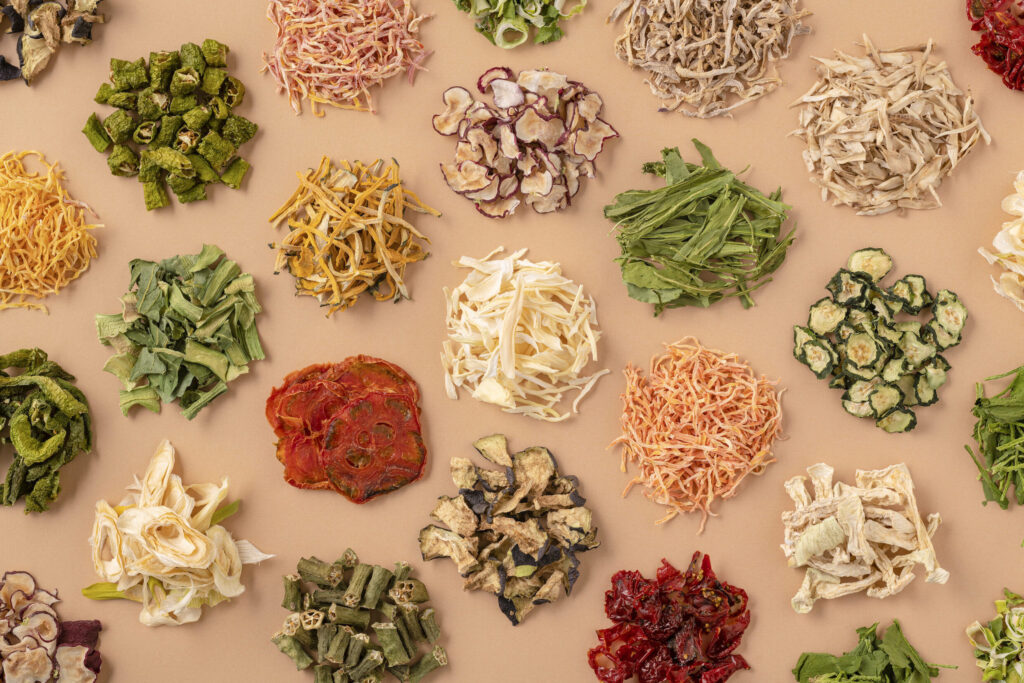
- Available for purchase in small lots from 1 kg
- We handle heirloom vegetables from across Japan
- Dried fruit and herbs also supported
Seven representative Tochigi heirloom vegetables: characteristics and how to eat them
From among the 14 items, we selected 7 representatives based on recognition, distribution volume, and influence on food culture. Here are each one's characteristics and recommended ways to eat them.
Kanpyo — a Mibu specialty continuing for about 300 years
| Season | Year-round (raw bottle gourd harvested July–August) |
| Growing region | Shimotsuke, Mibu, and elsewhere |
| Well-suited dishes | Kanpyo-maki, simmered dishes, clear soup, oden |
Kanpyo is a preserved food made by peeling the fruit of the bottle gourd into long thin strips and sun-drying them. Cultivation began about 300 years ago (mid-Edo period) on the banks of the Kurokawa River in Mibu, and Tochigi still accounts for over 90% of national production, a major producing area. Soil with excellent water retention and breathability, and a climate with frequent thunderstorms on summer evenings, suit the growth of bottle gourd.
Milky-white with a sweet fragrance, thick and springy — those are the marks of good kanpyo. "Kanpyo-maki" rolled sushi is known nationwide, but locally it is also used routinely as an ingredient in simmered dishes and clear soup. Rehydrated kanpyo seasoned sweet-savory with soy sauce, sugar, and mirin is a staple of Tochigi home cooking.
Miya negi — the thick onion of Tochigi city that branches into a glove shape
| Season | Mid-November to late December |
| Growing region | Miya, Tochigi city |
| Well-suited dishes | Hot pot, sukiyaki, grilled onion, miso soup |
Miya negi is a distinctive onion grown in Miya, Tochigi city. It is an unusual variety where several onions branch from a single plant and grow in a shape resembling a (baseball) glove, with thick stalks and short leaves.
Thick and fleshy, it develops strong sweetness when cooked, giving it real presence in hot pot and sukiyaki. Its growth differs from Sendai magari-negi of Miyagi and Fukushima's Akutsu magari negi in other prefectures, and the fact that "you can harvest several from a single plant" is the character unique to Miya negi.
Nissato negi — the bent onion of Utsunomiya continuing from the Edo period
| Season | December to the following March |
| Growing region | Nissato, Utsunomiya |
| Well-suited dishes | Hot pot, grilled onion, tempura, sukiyaki |
Nissato negi is an heirloom bent onion grown from saved seed in Nissato, Utsunomiya, since the Edo period. The distinctive farming method — digging up the seedlings once and replanting them at an angle to naturally create the bend — concentrates sweetness in the white portion, and it is carried on to this day.
Soft and strongly sweet, it is essential to Utsunomiya's winter table. Alongside Sendai magari-negi and Akutsu magari-negi, it is a member of the "bent-onion cultural sphere" stretching from Tohoku to northern Kanto.
Kanuma-na — a pickling green where sweetness and bitterness harmonize
| Season | October to the following April |
| Growing region | Kanuma |
| Well-suited dishes | Ohitashi, simmered dishes, miso soup, pickles |
Kanuma-na is a deep-green, glossy pickling green grown in Kanuma. Its distinctive flavor, where rich sweetness and a gentle bitterness harmonize nicely, is its strong point, and because it has almost no harshness it needs no pre-boiling.
Made into ohitashi or simmered dishes, the fleshy body of its leaves comes through, and it is an all-purpose vegetable that also works well as a miso-soup ingredient. With a long harvest period from autumn through the following spring, it plays an active role on Kanuma-area tables for an extended time.
Sano sodachi-na — a kaki-na whose sweetness increases with winter frost
| Season | October to the following April |
| Growing region | Ryomo district, Sano |
| Well-suited dishes | Ohitashi, mustard dressing, stir-fries, miso soup |
Sano sodachi-na is a kaki-na grown in the Ryomo district of Sano. Because the stems are "picked off" as the flower buds begin to appear and eaten, such greens are collectively called "kaki-na," and they have been beloved in the Ryomo area spanning Tochigi and Gunma.
It is notable for a crisp bite and a sweetness that increases when exposed to winter frost. Ohitashi and mustard dressing are the classics, letting you enjoy the harmony of a faint bitterness and sweetness like rape blossoms.
Tochigi Santaka togarashi — the strongly pungent chili of Otawara
| Season | Mid-October to November |
| Growing region | Otawara |
| Well-suited dishes | Shichimi togarashi, mapo tofu, adding heat to pickles, tsukudani |
Tochigi Santaka togarashi is a pungent chili grown in Otawara. A red variety with thick flesh and a pointed tip, it is notable for heat and aroma stronger than the ordinary takanotsume chili. "Santaka" has nothing to do with Mitaka city in Tokyo; it refers to a Tochigi heirloom of the takanotsume lineage.
Besides being dried and used in shichimi togarashi or to add heat to mapo tofu, pickling it in soy sauce while green as a preserved food is also a local way of eating it. It is valued for spicy dishes that make use of heat stronger than takanotsume chili.
Nakayama kabocha — the spindle-shaped squash of Nasukarasuyama
| Season | July–August |
| Growing region | Nasukarasuyama and elsewhere |
| Well-suited dishes | Simmered dishes, miso soup, potage, tempura |
Nakayama kabocha is a spindle-shaped (rugby-ball-shaped) squash grown around Nasukarasuyama. Its blackish-green skin is thin, it has a good mouthfeel, and when simmered it holds its shape and finishes with a moist texture.
Unlike ordinary Western squash (the fluffy, starchy type), its strong point is a sticky, dense sweetness, and its flavor stands out in miso soup or potage. Because the harvest period is short, July to August, and it doesn't keep especially well, obtaining it locally during its season is the surest bet.
Regional character by area — central, southern, northern, and Nikko
Tochigi's heirloom vegetables are distributed across four areas: the central prefecture centered on Utsunomiya, the kanpyo-producing southern prefecture, the northern prefecture of Nasunogahara, and the Nikko mountains. Each area's climate and terrain are reflected in its lineup of items.
Central area (Utsunomiya, Kanuma)
- Nissato negi (Nissato, Utsunomiya) — a bent onion dating from the Edo period. Soft and sweet thanks to the replanting method
- Nokado no aka-jagaimo (Nokado district, Nikko) — high in starch, with a trait of stretching when pounded. Limited cultivation
- Kanuma-na (Kanuma) — a glossy pickling green. Low in harshness and all-purpose
Southern area (Tochigi city, Shimotsuke, Mibu, Sano)
- Kanpyo (Shimotsuke, Mibu) — about 300 years of history, over 90% of national production
- Miya negi (Miya, Tochigi city) — a distinctive thick onion that branches into a glove shape
- Sano sodachi-na (Ryomo district, Sano) — representative of the Ryomo area's kaki-na culture
Northern area (Nasukarasuyama, Otawara)
- Nakayama kabocha (Nasukarasuyama and elsewhere) — a blackish-green spindle-shaped squash
- Tochigi Santaka togarashi (Otawara) — a strongly pungent heirloom chili
Nikko area (all of Nikko)
- Karafuro daikon (Ashio area) — a reddish-purple local daikon, low in moisture and keeps well
- Kawamata-na (Kuriyama area) — a kind of turnip-green. Jagged, thick, fleshy leaves
- Funaishi-imo (Ashio area) — a small, richly flavored taro harvested from autumn to early winter
- Hosoo-na (Hosoo district) — a kind of kaki-na. Thick, juicy stems
- Mizukake-na and Noguchi-na (Noguchi district) — a distinctive farming method channeling spring water between the furrows. Sweet even in winter
The Nikko area alone boasts the largest concentration, with six items. The special growing environment of mountain spring water, volcanic-ash soil, and a cold climate has produced heirloom varieties that differ from settlement to settlement.
How to buy Tochigi's heirloom vegetables and tips for storing them
Because Tochigi's heirloom vegetables are produced in limited quantities, the basic approach is to use farm stands, roadside stations, and online mail order in the producing areas. Kanpyo is distributed nationwide as a processed product, but fresh onions and leafy greens are limited to their seasons.
In-prefecture direct-sales outlets / roadside stations
| Item | Main sources | Timing |
|---|---|---|
| Kanpyo | Farm stands in Mibu and Shimotsuke, Michi-no-Eki Mibu | Year-round |
| Miya negi | Farm stands in Tochigi city, Michi-no-Eki Mikamo | November–December |
| Nissato negi | Farm stand in Nissato, Utsunomiya | December to March |
| Kanuma-na | Farm stands in Kanuma | October to April |
| Sano sodachi-na | Farm stands in Sano, Michi-no-Eki Domannaka Tanuma | October to April |
| Nakayama kabocha | Farm stands in Nasukarasuyama | July–August |
| Mizukake-na and Noguchi-na | Farm stand in the Noguchi district of Nikko (limited) | December to March |
Mail order / hometown tax to outside the prefecture
- Kanpyo — Available year-round as a dried good at supermarkets nationwide and by mail order. Also frequently featured as a hometown-tax gift from Mibu and Shimotsuke
- Tochigi Santaka togarashi — Dried products and shichimi-togarashi processed goods distributed by mail order
- Hometown tax donation — Heirloom varieties are included as gifts by municipality, such as Tochigi city (Miya negi), Kanuma (Kanuma-na), and Sano (sodachi-na)
- Direct-from-farm e-commerce (Tabechoku, Pocket Marche) — Individual farmers list them in season. Quantities are limited and reservations are needed
Storage methods by item
| Item | Short-term storage | Long-term storage |
|---|---|---|
| Kanpyo | Store at room temperature in a sealed bag | About a year refrigerated (use up promptly after opening) |
| Miya negi and Nissato negi | Wrapped in newspaper, one week in the vegetable compartment | Chop and freeze (1 month) |
| Kanuma-na and Sano sodachi-na | In moist newspaper in the vegetable compartment for 3 days | Boil quickly and freeze (2 weeks) |
| Karafuro daikon | In newspaper in a cool, dark place for 2 weeks | Salt pickles and takuan (2–3 months) |
| Nakayama kabocha | Whole, in a cool dark place for 1–2 months | Once cut, remove the seeds and pith and freeze |
| Mizukake-na and Noguchi-na | Moisten and keep 3 days in the vegetable compartment | 1–2 months when salt-pickled |
| Tochigi Santaka togarashi | Dried products stored at room temperature | Can be kept long with soy-sauce pickling or shichimi processing |
Kanpyo, being a dried good, keeps for a long time, but most fresh vegetables lose quality in 3 days to 2 weeks. Using processed preservation (pickling, freezing, drying) lets you enjoy them outside their season too.
A product catalog that shows around 100 items we handle
Agriture, flexibly handling everything from small lots to large lots
- Available for purchase in small lots from 1 kg
- We handle heirloom vegetables from across Japan
- Dried fruit and herbs also supported
Efforts to protect Tochigi's heirloom vegetables
To sustain the 14 heirloom varieties, activities linking farmers, educational institutions, and municipalities continue. Here are good examples of revival and mechanisms for handing them down.
The Koka negi revival project by Yaita High School
| Timing | Event |
|---|---|
| The 1955–1970s (Showa 30s–40s) | Actively grown in the Koka district of Yaita. Well received at high-end Tokyo restaurants |
| Late Showa to Heisei | Production plummeted and died out due to susceptibility to red rust and distribution difficulties |
| 2017 | Yaita High School began revival cultivation as a local specialty product |
| Present | Small-scale cultivation continues in tandem with high-school agricultural education |
The revival of Koka negi is a rare case in which an educational institution became the bearer of heirloom-variety preservation. Students in Yaita High School's agriculture department work on preserving the seed and passing on cultivation techniques, drawing attention as a new model of not just "protecting by eating" but "protecting by learning."
Nikko's spring-water cultivation and environmental conservation
- Mizukake-na and Noguchi-na — A distinctive farming method channeling spring water between the furrows is carried on
- Karafuro daikon, Funaishi-imo, and Hosoo-na — Small-scale cultivation continues in the mountainous Ashio and Hosoo areas
- Kawamata-na — Saved-seed cultivation is carried on settlement by settlement in the Kuriyama area
The heirloom vegetables of the Nikko mountains depend on the environmental conditions of clean water and volcanic-ash soil. Because farming method and environment are handed down as a set, many varieties are hard to revive once they die out, while in regions where they are protected, transmission continues on a scale of hundreds of years.
FOR BUSINESS
乾燥野菜を業務用でお探しですか
国産の野菜・果物を乾燥し、必要に応じて粉砕してお出ししています。扱っている品目は100種前後で、規格は 乾燥品の一覧・パウダーの一覧 に掲載しています。
少量でのご購入は、姉妹ブランドの通販サイト OYAOYA で承っています。
FAQ
Other regional specialty varieties
Though included in the Japan Heirloom Vegetable Promotion Association's list, we introduce separately here — as a "local specialty variety" — an item whose main cultivation period came after the war, which once died out and is now mid-revival.
| Item | Category | Growing region | Characteristics and standing |
|---|---|---|---|
| Koka negi | Negi | Koka district, Yaita | An heirloom onion actively grown in the Koka district of Yaita in the 1955–1970s (Showa 30s–40s) and well received at high-end Tokyo restaurants. Production died out due to susceptibility to red rust and other issues, and Yaita High School began revival cultivation in 2017. Because of its unusual course of postwar cultivation, extinction, and revival, it is introduced in a separate category |
Summary
Tochigi's 14 heirloom vegetables are a group of varieties born at the intersection of three backgrounds: the spring-water culture of the Nikko mountains, the kanpyo farming of the Kanto Plain, and the influence of Edo-period highway culture. They gather personalities you won't meet in other prefectures — kanpyo's 90% national share, Miya negi's glove shape, and mizukake-na's spring-water cultivation.
Kanpyo can be obtained nationwide, but for fresh heirloom vegetables the surest way to get them is to visit the producing area in season. Visiting Tochigi while shifting your target item by season — Nakayama kabocha in July–August, Miya negi in November–December, Nissato negi and mizukake-na in December–March — lets you taste the character of the heirloom varieties from many angles.
References / information sources
- Japan Heirloom Vegetable Promotion Association, "Tochigi's heirloom vegetables" — Certified list of 14 items and their characteristics
- Tochigi Prefecture, "Oasis of Food" — Brand information on prefecture-grown ingredients
- National Agriculture and Food Research Organization Genebank "Native Variety Database" — information on native varieties nationwide
Related articles
- Japan's Heirloom Vegetables: Precious Varieties Handed Down in Each Region
- Kyoto heirloom vegetables: Kyoto specialties with a long history
- Heirloom vegetables of Miyagi (including Sendai magari negi)
- Heirloom vegetables of Fukushima (including Akutsu magari negi)
- Heirloom vegetables of Ibaraki
- Heirloom vegetables of Naniwa
Download the product catalog
We will send the materials to your email address based on the information you provide.
- What are Ibaraki’s heirloom vegetables? Features, season, and ways to eat the 5 items explained
- What are Gunma’s heirloom vegetables? Features, season, and ways to eat the 22 items explained
Author of this article
Related articles
-
 Okinawa island vegetables: individualistic vegetables nurtured by a subtropical climate
 -
 Kaga vegetables: Kanazawa brand vegetables where tradition lives on
 -
 The appeal of Kansai heirloom vegetables | Specialties of Naniwa, Kyoto, and Yamato thoroughly explained
 -
 Kyoto heirloom vegetables: Kyoto specialties with a long history
 -
 A list of heirloom vegetables of the 8 prefectures of Kyushu and Okinawa|A thorough introduction to characteristics, growing regions, and seasons
 -
 Know the heirloom vegetables of Edo Tokyo | The city’s vanishing food culture
 -
 They'll make you smile! The fun names of heirloom vegetables and their origins
 -
 5 cases and strategies that succeeded in branding heirloom vegetables