
Shogoin Daikon: The Round, Sweet Standard-Bearer of Kyoto Vegetables

Summary of this article
Shogoin daikon is a round Kyoto heirloom vegetable whose cultivation began in the late Edo period, in the Bunsei era, when a long daikon from Owari Province was received and grown in Shogoin, Sakyo Ward, Kyoto City. It is about 20 cm in diameter and weighs 1.5-3 kg. From the early Showa period, cultivation flourished in Kumiyama Town (Yodo area) and Kameoka City in Kyoto Prefecture, earning it the name "Yodo daikon." In season from November to February, it holds its shape well when simmered and has a strong sweetness, making it ideal for oden and furofuki daikon. We introduce it alongside Kyoto's winter food culture, including the daikon-daki (radish-simmering) at Senbon Shakado on December 7-8.
Shogoin daikon (shogoin daikon) is one of Kyoto's traditional Kyoto vegetables, characterized by its large, round shape. Born in Shogoin, Sakyo Ward, Kyoto City in the Edo period, it takes its name from there. In the early Showa period, cultivation flourished in the Yodo area of Mimaki Village in southern Kyoto City (near present-day Kumiyama Town), and it came to be called "Yodo daikon" after this area.
TOC
Features and appearance of Shogoin daikon
It is a sphere about 20 centimeters in diameter, characterized by a thick, short root. The surface is smooth and white, and it is meatier and firmer than an ordinary daikon. Its dense fibers keep it from falling apart when simmered, and it has a gentle sweetness. Suited to simmered dishes and pickles, it is an indispensable ingredient in Kyoto cuisine.
Difference from ordinary daikon
| Comparison item | Shogoin daikon | Aokubi daikon (ordinary daikon) |
|---|---|---|
| Shape | Round / about 20 cm in diameter | Long and slender / 30-40 cm in length |
| Weight | 1.5~3kg | 500g~1.5kg |
| Flesh | Dense and soft | Juicy with a firm bite |
| Turnip and daikon look similar, but there is a clear difference in their characteristics after drying. Please use this as a reference for material selection. | Strong | Varies by part (sweeter at the top, more pungent at the bottom) |
| Falling apart when simmered | Not prone | Prone |
| Heat | Little | The bottom is somewhat pungent |
| Well-suited dishes | Simmered dishes, furofuki daikon, oden | Grated daikon, salad, simmered dishes |
Season and production area
Shogoin daikon is in season in the winter, from November to the following February. The main growing regions are Kumiyama Town (Yodo area) and Kameoka City in Kyoto Prefecture, where it is also known by the name "Yodo daikon." Kyoto winters bring a penetrating cold, and this cold builds up sugar in the daikon, growing a sweeter Shogoin daikon. On the winter Kyoto table it is indispensable as oden or furofuki daikon.
JA Kyoto official site – Shogoin daikon
The history and origin of Shogoin daikon
The history of Shogoin daikon dates back to the Bunsei era at the end of the Edo period. At one point, a long daikon from Owari Province was dedicated to Konkai Komyoji temple in Kurodani-cho, Sakyo Ward. Because that daikon was finer than the daikon then grown in the Shogoin area, the people of Kyoto are said to have all been amazed.
Among them, a devoted farmer received that daikon, saved its seeds, and continued cultivating it, and as a result cultivation spread throughout the Shogoin area. The reason Shogoin daikon is round is said to be that the long daikon gradually changed into a round shape. Kyoto's soil has a shallow tillage layer, making it hard for roots to grow deep, so it is thought to have adapted to that environment and evolved into a round shape. Reference: Kyoto City Information Museum
Difference from Shogoin kabu
Shogoin daikon and Shogoin turnip look alike and are easily confused, but botanically they are entirely different varieties. Shogoin daikon is of the genus Raphanus in the Brassicaceae family, with somewhat firm flesh and a solid bite, suited to simmered dishes. Shogoin turnip is of the genus Brassica in the Brassicaceae family, with smooth, soft flesh, suited also to raw eating such as senmaizuke. The way to tell them apart is that Shogoin daikon is somewhat flatter and may have some green at the neck, while Shogoin kabu is a smooth white sphere.
FOR BUSINESS
乾燥聖護院大根を、原料としてお探しですか
国産の聖護院大根を乾燥・粉砕してお出ししています。カット形状や粒度の指定、継続してのお取引もご相談ください。規格は Dried Shogoin daikon に掲載しています。
少量でのご購入は、姉妹ブランドの通販サイト OYAOYA で承っています。
Certification as a Kyoto heirloom vegetable
Shogoin daikon is certified as a "Traditional Kyoto Vegetable." With a cultivation history of about 200 years since the Bunsei era, it is a variety deeply tied to Kyoto's food culture. Even now its seeds are handed down as a fixed variety, and traditional cultivation methods are preserved. List of Kyoto vegetable varieties, where you can also check other traditional varieties.
The secret of Shogoin daikon's sweetness and dense flesh
The reason Shogoin daikon is loved in simmered dishes is that it combines two qualities: a strong sweetness and dense flesh that holds its shape when simmered. These traits are nurtured by Kyoto's shallow tillage layer, its penetratingly cold winter climate, and cultivation handed down over many years.
Sweetness drawn out by winter cold
Shogoin daikon's sweetness is deeply tied to Kyoto's winter climate. When the temperature drops, daikon has a property of storing sugar to protect itself, so those harvested in the cold period from November to February are sweeter. Shogoin daikon grown in Kyoto Prefecture regions with wide day-night temperature swings, such as the Yodo area of Kumiyama Town and the Kameoka basin, has this sweetness stand out all the more. Simmered slowly, the sweetness dissolves into the dashi, producing a refined flavor in furofuki daikon and oden.
Dense flesh that resists falling apart when simmered
Another quality is its dense-fibered flesh that resists falling apart when simmered. Because the flesh is firmer than the long, slender aokubi daikon, the corners do not crumble even after long cooking, and it soaks up plenty of dashi. Grated raw, on the other hand, it has little pungency and a mellow mouthfeel, making it easy to eat as grated daikon too. The depth of enjoying its distinct qualities whether heated or raw is why it has been prized in Kyoto cuisine.
Recommended ways to eat Shogoin daikon
With its soft flesh and shape-holding quality when simmered, it is especially suited to simmered dishes. Representative dishes include "oden" and "furofuki daikon." It does not fall apart even when simmered and the flavor soaks in well, so you can enjoy both texture and taste.
How to make furofuki daikon
"Furofuki daikon" is a traditional Kyoto dish in which thickly cut daikon is simmered slowly in dashi and eaten topped with miso. Shogoin daikon's gentle sweetness harmonizes exquisitely with the saltiness of the miso. To make it, cut the Shogoin daikon into 3-4 cm thick rounds, peel it, and bevel the edges. Parboiling it in rice-washing water removes pungency and bitterness for a clear white finish. Once parboiled, simmer it in kombu dashi over low heat for about 30 minutes. It's ready when a bamboo skewer passes through smoothly. Top with a dengaku miso of white miso plus sugar and mirin, garnish with yuzu peel, and it's done.
Tips for oden and simmered dishes
Shogoin daikon is excellent as an oden ingredient too. Because it resists falling apart, it keeps a clean shape even after long simmering while soaking up plenty of dashi. The key is to parboil it before adding it to the oden pot; this removes the daikon's bitterness and lets the dashi flavor soak in well. Shogoin turnip Simmered together with, it makes a luxurious mixed simmer where you can enjoy the contrast in texture. Kintoki carrot Adding gives a bright touch of color as well.
Daikon-daki: Shogoin daikon and a rite for good health
Shogoin daikon has been deeply woven into the lives of Kyoto's people as a familiar vegetable. Every year around December, the "daikon-daki" (radish-simmering) is held at Senbon Shakado. Sanskrit characters are written on Shogoin daikon, prayers and rites are performed, and the daikon simmered in a great cauldron is served to worshippers. Eating this daikon is said to grant good health for the year, and many worshippers visit every year. The daikon-daki is cherished as a seasonal feature of Kyoto's winter and an important rite for those who wish for good health.
The history and origin of daikon-daki
The origin of daikon-daki is said to date back to the Kamakura period. It is passed down that Jizen Shonin, the founding priest of Senbon Shakado (Daihoonji), wrote Sanskrit characters on the cut face of daikon and served them to worshippers — this is said to be the beginning. Held every year on December 7 and 8, worshippers are said to gain the merit of warding off illness by eating the daikon. Simmered together with fried tofu in a large cauldron, the Shogoin daikon is a heartfelt dish that warms the body on a cold winter's day. Soda Kyoto – daikon-daki
Other daikon-daki rites in Kyoto
Daikon-daki is held not only at Senbon Shakado but at several temples in Kyoto City. At Ryotokuji, a "Hoonko daikon-daki" is held as a rite to remember the virtue of Shinran Shonin. Myomanji also holds a "daikon-daki," and you can enjoy daikon-daki with a different character at each temple. When visiting Kyoto in winter, timing a visit to coincide with a daikon-daki rite lets you experience Kyoto's culture where food and faith are one.
How to choose and store Shogoin daikon
How to spot a fresh Shogoin daikon
For a fresh Shogoin daikon, choose one with a white, glossy surface that feels heavy. Few whiskery roots and no scratches or dents on the surface are signs of good quality. If it has leaves, ones that are green and lively are fresh. Avoid those with a blackened neck, as freshness may have declined. Kyoto vegetable calendar Please check the season of winter Kyoto vegetables at .
Storage Tips
If it has leaves, the basic rule is to cut the leaves and root apart for storage. Wrap the root in newspaper, put it in a plastic bag, and store it in the vegetable compartment of the fridge to keep it for about two weeks. If cut, wrap it in plastic wrap, refrigerate, and use it up within 3-5 days. To freeze, parboil it first so the texture is preserved. If you have a large quantity, there is also the option of drying it for storage, like kiriboshi daikon.
Using Shogoin daikon as a dried vegetable
Shogoin daikon can also be dried and used as a preserved food. Drying removes the moisture and concentrates the umami, so adding it to simmered dishes or soups lets you enjoy a deeper flavor.
How to use dried Shogoin daikon
Dried Shogoin daikon is rehydrated in water for 20-30 minutes before cooking. The fine-grained flesh unique to Shogoin daikon turns, when dried, into a "plump, springy texture," and as the moisture is removed the umami and sweet richness are tightly concentrated. Because the daikon's umami dissolves into the soaking liquid too, you can use it as part of the dashi. Agriture's Shogoin daikon — grown with self-made compost by partner farmers in Kyotango and dried at low temperature — resists falling apart and soaks up flavor well, making it suited not only to oden and furofuki daikon but also to commercial simmered dishes for school lunches and boxed meals. Dried Shogoin daikon you can actually taste it as.
FOR BUSINESS
乾燥聖護院大根を、原料としてお探しですか
国産の聖護院大根を乾燥・粉砕してお出ししています。カット形状や粒度の指定、継続してのお取引もご相談ください。規格は Dried Shogoin daikon に掲載しています。
少量でのご購入は、姉妹ブランドの通販サイト OYAOYA で承っています。
Frequently asked questions about Shogoin daikon
Recommended reading
List of Kyoto vegetable varieties / Kyoto vegetable calendar / Commercial dried vegetables / What Is Horikawa Gobo? A Thorough Explanation of Its Characteristics, Cultivation, How to Eat It, and Nutrition / Vessels and Kyoto Vegetables. Creating the Scenery of Plating.
We have materials available to help you understand dried processing OEM
Agriture OEM, flexibly handling everything from small lots to large lots
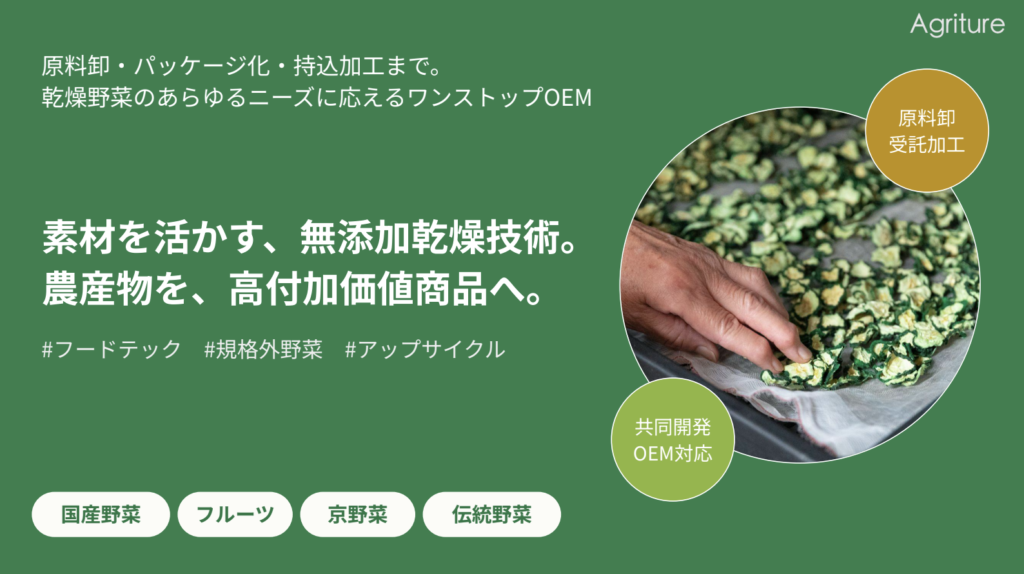
- OEM available from small lots of 10 kg
- Drying of brought-in raw materials also possible
- Support from processing to filling in one place
Related articles
- Shogoin kabu | The difference from a look-alike Kyoto vegetable
- Kintoki carrot | The winter Kyoto vegetable that colors Kyoto simmered dishes
- Kamo eggplant — a round, rich summer Kyoto vegetable
- A list of Kyoto vegetable varieties — famous heirloom vegetables and their characteristics
- Kyoto vegetable calendar — check the seasons of the four seasons at a glance
Download the OEM contract processing materials
We will send the materials to your email address based on the information you provide.
- Shogoin Kabu: A Kyoto Vegetable with a Smooth, Refined Flavor
- Winter Kyoto vegetables: the deep umami of Shogoin daikon and Kujo green onion
Author of this article
Related articles
-
 京野菜は何品目あるのか、読み方の一覧と認定の枠組みから確かめる
 -
 Drying Is Another Kind of Cooking
 -
 The Technology to Lock In the Season. The Seasonal Story Dried Vegetables Connect.
 -
 The Cut Face of a Vegetable. The Difference the Cut Makes.
 -
 Tasting Kyoto Vegetables by Aroma. The Pleasure of Cooking That Begins at the Tip of the Nose
 -
 Vessels and Kyoto Vegetables. Creating the Scenery of Plating.
 -
 Vegetables and Heat Control. Between High and Low Flame
 -
 Kyoto Vegetables and Sake. The Happy Relationship of a Dish and a Cup.