
Mibuna: The Characteristics and History of a Kyoto Vegetable with Little Heat

Summary of this article
Mibuna is a Brassicaceae Kyoto heirloom vegetable originating in Mibu, Nakagyo Ward, Kyoto City, said to have arisen from natural crossbreeding in the 1800s as a variant of mizuna. It is characterized by leaves that have no serrations and are round and spoon-shaped, with a soft texture and a moderate pungency and sweetness. Its season is December–March, and it is rich in vitamin C, beta-carotene, potassium, and calcium. We explain pickles, ohitashi, stir-fries, its use as color in senmaizuke, its connection to the Mibu area associated with the Shinsengumi, and how to make light pickles and mustard pickles.
mibuna,Mibuna is one of Kyoto's traditional Kyoto vegetables, characterized by long, slender leaves and a soft texture. It looks similar to mizuna, but its leaves have no serrations and have a rounded shape. Its moderately clean pungency and delicate flavor have long been used in a wide range of dishes—pickles, ohitashi, stir-fries, and more.
TOC
The characteristics and appearance of mibuna
A Brassicaceae vegetable that looks similar to mizuna, but its leaves are wider than mizuna's and have a round, spoon-like shape. Having no serrations on the leaves is the major difference from mizuna. Its flavor is gentle, with a moderate, clean pungency, and it has long been used in a wide range of dishes—pickles, ohitashi, stir-fries, and more.
The difference from mizuna
Mibuna is a Kyoto vegetable that arose from a variant of mizuna, and they are very similar in both appearance and flavor. For details, please also see the article The characteristics, varieties, and ways to eat Kyoto mizuna. We have organized the main differences between the two in a table.
| Comparison item | mibuna, | mizuna |
|---|---|---|
| Leaf shape | Rounded, spoon-shaped, no serrations | Jagged serrations present |
| Texture | Soft and supple | Crisp with a good bite |
| Flavor | A moderate pungency and sweetness | Little off-note and mild |
| Use | Pickles, ohitashi, stir-fries | Salads, hot pots, ohitashi |
| Season | December–March | November–March |
| Production volume | Low (a traditional variety) | High (grown nationwide) |
Season and production area
Mibuna's season is winter, from December to March. The Mibu area of Nakagyo Ward, Kyoto City, which is also the origin of its name, is the birthplace, but it is now grown in various parts of Kyoto Prefecture. Because greenhouse cultivation is also carried out, it is available year-round, but those grown outdoors and harvested in winter have markedly greater sweetness and flavor. The winter cold optimizes mibuna's balance of pungency and sweetness, finishing it in a state best suited to pickles.
JA Kyoto official site – mibuna
The history and origin of mibuna
It is said to have arisen from natural crossbreeding of a variant of mizuna in the 1800s. It is unclear when a clear distinction from mizuna began, but in a document from Bunka 1 (1804), the description "mibuna grown in Mibu" is confirmed. The name mibuna derives from the Mibu area in Nakagyo Ward, Kyoto City, and is said to have been named for having long been grown in this area.
The connection between the Mibu area and mibuna
Mibu, which became the production area of mibuna, is a historic area known for Mibu-dera, where the Shinsengumi had their quarters. Blessed with groundwater, it was an environment suited to growing greens. Mibuna was grown in this area along with mizuna and has supported Kyoto's food culture. Even now, farmers connected to the Mibu area continue to grow mibuna, and it has become one of the area's identities. List of Kyoto vegetable varieties, where you can also check other traditional varieties.
Reference: Ministry of Agriculture, Forestry and Fisheries, "Our Local Cuisine"
FOR BUSINESS
乾燥壬生菜を、原料としてお探しですか
国産の壬生菜を乾燥・粉砕してお出ししています。カット形状や粒度の指定、継続してのお取引もご相談ください。規格は Dried mibuna に掲載しています。
少量でのご購入は、姉妹ブランドの通販サイト OYAOYA で承っています。
Certification as a Kyoto heirloom vegetable
Mibuna is a variety certified as a "Kyoto heirloom vegetable." With a cultivation history of over 200 years since the Edo period, it has been closely tied to Kyoto's pickling culture. Mibuna, which arose as a variant of mizuna, has become indispensable to Kyoto cuisine with its unique flavor and texture, and its fixed-variety seed is still handed down today.
The nutrition and characteristics of mibuna
Mibuna is a green-and-yellow vegetable containing vitamin C, beta-carotene, potassium, calcium, and more. It is an easy-to-eat green with little off-note, and its appeal is that made into pickles or ohitashi it is easy to incorporate into the winter table.
Abundant vitamin C and beta-carotene
Beta-carotene is efficiently taken in when cooked together with oil. Quickly stir-frying it in oil or dressing it with sesame oil finishes it deliciously while making the most of mibuna's greenness. Because the green is vivid, it is also handy as a dish that adds color to the winter table.
A green that also contains potassium and calcium
Mibuna, easy to eat with little off-note, can be incorporated into daily meals without strain when made into pickles, ohitashi, or soups. Its ease of use lies in being able to color a dish with a Kyoto-like flavor when you want greens in winter.
Recommended ways to eat mibuna
Raw, you can enjoy its soft texture and moderate pungency, so it is often used in salads and dressed dishes. Quickly blanched, its sweetness is drawn out and it also finishes deliciously in simmered dishes and ohitashi. Pickles are a representative way to eat mibuna, and you can enjoy a variety of pickles that make the most of mibuna's flavor—light salt pickles, and pickles seasoned with soy sauce or vinegar. It is also used as color in Kyoto's traditional pickle "senmaizuke."
How to make mibuna pickles
Mibuna light pickles can be made easily at home too. Cut the mibuna into 3–4 cm lengths, coat with salt, rub lightly, place a weight on top, and leave for 2–3 hours. Wring out the moisture and refreshing light pickles are done. For mustard pickles, add a pickling liquid of mustard, sugar, and soy sauce to the salt-rubbed mibuna and leave in the refrigerator overnight. Mibuna's pungency combines with the mustard's flavor, making a dish ideal to accompany rice or serve with tea. Shogoin turnip Adding mibuna to senmaizuke of adds a green accent, making it look gorgeous too.
Stir-fries and soups
Mibuna is also perfect for stir-fries and soups. Quickly stir-fried with aburaage, mibuna's sweetness and pungency stand out. Stir-fried in sesame oil, aroma and richness are added, making a side dish that goes with rice. Added to soup, its clean flavor spreads throughout, making a light, delicious dish. It pairs well with chicken-bone or dashi-based soups, and adding it at the finish and just briefly heating it is the point to make the most of mibuna's texture. Kujo green onion A soup combined with is a winter classic.
How to choose and store mibuna
How to tell fresh mibuna
For fresh mibuna, choose leaves that are a vivid green, juicy, and not wilted. Firm stems with no breaks or damage are proof of good quality. That the cut end at the base has not discolored is also a guide to freshness. A bundle of uniform thickness with densely attached leaves is proof that the growing conditions were good. Kyoto vegetable calendar Please check the season of winter Kyoto vegetables at .
How to store it and tips for keeping it fresh
Mibuna is a leafy vegetable whose freshness readily declines, so the basic rule is to use it up soon after purchase. To store it, wrap it in damp paper towels, put it in a plastic bag, and store it standing upright in the refrigerator's vegetable compartment, and it keeps for 2–3 days. To freeze it, quickly salt-boil it, wring out the moisture, divide it into easy-to-use amounts, and freeze. It keeps for about a month, and after thawing it can be used directly in ohitashi and stir-fries.
Combining mibuna with other Kyoto vegetables
Combining mibuna with other Kyoto vegetables broadens the variety of dishes. Shogoin turnip Adding mibuna ohitashi to a simmered dish of makes a menu with a balance between the warm simmered dish and the refreshing greens. Shogoin daikon Scattering mibuna over furofuki daikon of makes a beautiful dish where the green accent stands out. Kintoki carrot The combination with has a gorgeous color contrast and also works as color in osechi. Kamo eggplant The combination of serving mibuna ohitashi as a side to dengaku of is also a Kyoto-cuisine classic.
Using mibuna as a dried vegetable
Mibuna can be eaten deliciously even made into a dried vegetable. Reconstituted in water, it can add a refreshing flavor like fresh mibuna to salads, soups, simmered dishes, and more. It can be used easily even on busy days, and is perfect for dishes where you want to add color and greenness.
How to use dried mibuna and its appeal
Just adding dried mibuna directly to soup or miso soup can add mibuna's flavor and a green color. Since it also becomes an instant Kyoto-vegetable soup simply by pouring hot water into a bowl, it is handy on busy mornings too. Because it can be used quickly when you want to add a bit of color, it is a strong ally in daily life when you are busy and your nutrition tends to be unbalanced. Dried-vegetable OEM, which handles the drying of Kyoto vegetables including mibuna, and can also contribute to a sustainable diet.
Agriture's efforts — Kyoto mibuna grown together with partner farmers
Our company Agriture collaborates with farmers within Kyoto Prefecture and, through the use of off-grade vegetables and the sixth-industrialization of production areas, works on sustainable food distribution. Kyoto mibuna is one of these, and our sister brand OYAOYA's dried Kyoto mibuna uses mibuna grown by partner farmers in Hiyoshi Town, Nantan City, Kyoto. This production area is a specialized farm continuing since the Edo period, using vinyl greenhouses year-round and growing mibuna from seed handed down for generations. For over 30 years since the father's generation, they have worked on year-round cultivation, making the most of water-retentive soil derived from paddy fields. It is mibuna shipped with care given to fertilizer and watering, mindful not only of taste but even of the visual color.
At our company, we slowly dry this Kyoto mibuna grown in this way at a low temperature, delivering the production area's flavor and vivid green to home and commercial tables. Even seasonal greens that tend to lose their place due to specification and distribution circumstances can be used up while retaining their value by putting them into dried form. The effort to make full use of Kyoto vegetables without waste becomes a sustainable option for both makers and users.
Recommended reading
List of Kyoto vegetable varieties / Kyoto vegetable calendar / Commercial dried vegetables / The Work of "Subtraction" That Makes the Most of Kyoto Vegetables / Fushimi Togarashi: A Kyoto Vegetable with Little Heat and Standout Sweetness
We have materials available to help you understand dried processing OEM
Agriture OEM, flexibly handling everything from small lots to large lots
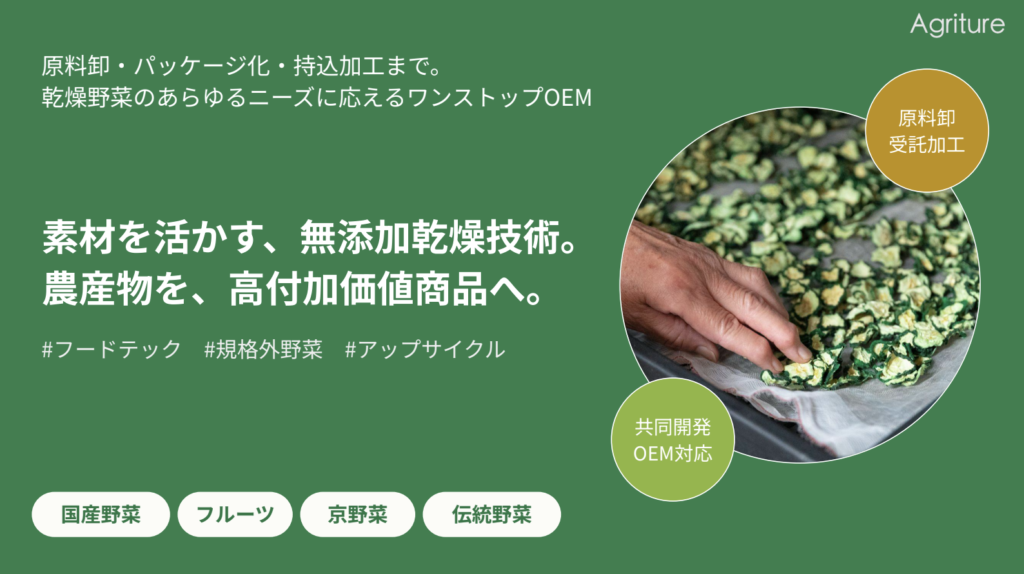
- OEM available from small lots of 10 kg
- Drying of brought-in raw materials also possible
- Support from processing to filling in one place
FOR BUSINESS
乾燥壬生菜を、原料としてお探しですか
国産の壬生菜を乾燥・粉砕してお出ししています。カット形状や粒度の指定、継続してのお取引もご相談ください。規格は Dried mibuna に掲載しています。
少量でのご購入は、姉妹ブランドの通販サイト OYAOYA で承っています。
Related articles
- What is Kyoto mizuna? Characteristics, varieties, and ways to eat
- What is the Kyoto heirloom vegetable Kujo negi? The difference from green negi, its season, and ways to eat
- Shogoin Kabu: A Kyoto Vegetable with a Smooth, Refined Flavor
- Shogoin Daikon: The Round, Sweet Standard-Bearer of Kyoto Vegetables
- A list of famous Kyoto vegetable varieties and their characteristics
- Kyoto vegetable calendar — seasonal Kyoto vegetables that color the four seasons
Download the OEM contract processing materials
We will send the materials to your email address based on the information you provide.
- As If Meeting a Different Vegetable—Manganji Togarashi and the Story of "Season"
- Summer Kyoto Vegetables: The Season of Fushimi Togarashi and Shishigatani Kabocha
Author of this article
Related articles
-
 京野菜は何品目あるのか、読み方の一覧と認定の枠組みから確かめる
 -
 Drying Is Another Kind of Cooking
 -
 The Technology to Lock In the Season. The Seasonal Story Dried Vegetables Connect.
 -
 The Cut Face of a Vegetable. The Difference the Cut Makes.
 -
 Tasting Kyoto Vegetables by Aroma. The Pleasure of Cooking That Begins at the Tip of the Nose
 -
 Vessels and Kyoto Vegetables. Creating the Scenery of Plating.
 -
 Vegetables and Heat Control. Between High and Low Flame
 -
 Kyoto Vegetables and Sake. The Happy Relationship of a Dish and a Cup.