
How to choose novelties that strengthen corporate branding | 7 points and adoption cases

Summary of this article
This article explains 7 points for choosing a novelty effective for corporate branding: clarifying purpose and target, consistency with corporate image, practicality and long-term use, differentiation and originality, the balance of quality and cost, distribution scene and timing, and awareness of SDGs and social value. It also introduces concrete examples—like SDGs-aligned novelties using dried vegetables—that achieve both food-loss reduction and differentiation.
Novelties just handing them out doesn't lead to corporate branding. Getting the recipient to “remember you” and “relate to you” is the essential value.
In reality, though, cases where a company hands out cheap ballpoint pens in bulk for budget reasons and leaves no impression on anyone are not uncommon. A novelty's effect is determined less by “what you hand out” than by “to whom, when, and in what context you give it.” What you'll learn in this article:
- The 7 points for choosing a novelty that leads to branding
- Recommended items and budgets by distribution scene (trade shows, greetings, recruiting, anniversaries)
- Concrete adoption cases at major companies like Nissin Foods and Crecia
- The specs and scope of Agriture's dried-vegetable novelties
TOC
Why novelties work for corporate branding
A communication tool that conveys a company's values
A novelty is a free item a company hands out for promotional purposes. Beyond raising recognition through a logo or company name, “what you chose” conveys the company's stance directly.
If a company working on SDGs hands out eco-material goods, that effort comes across naturally, and if a health-related company chooses wellness-type items, consistency with its brand image is born. Conversely, handing out something unrelated to the company's philosophy gives an impression of “just handing stuff out”—that's exactly why it backfires from a branding standpoint.
The risk of choosing wrong
As a touchpoint with customers, a novelty's quality or a mistake in selection ties directly to corporate image. Handing over something cheap and shoddy can lead to the impression that “this company doesn't care about quality.” Also, handing out the same ballpoint pen or clear folder as competitors leaves no impression, and the promotional budget can go to waste. Choosing a novelty needs the viewpoint of “brand investment,” not “cost reduction.”
The 7 points for choosing a novelty
So what viewpoints are needed to choose a novelty that leads to corporate branding? Grasping the following 7 points gets you closer to a novelty that feels “happy to receive” and “so like this company.”
| Point | Details | Examples |
|---|---|---|
| 1. Purpose and target | Clarify the purpose—raising recognition, retaining customers, recruiting | New → eye-catching design, existing → practical and fine |
| 2. Consistency with corporate image | A design that doesn't contradict your brand colors and philosophy | Eco-conscious company → eco material, IT company → gadget type |
| 3. Practicality and long-term use | Have them touch the company name repeatedly through daily use | Tumblers, eco bags, calendars, and the like |
| 4. Differentiation | Not run-of-the-mill; a memorable uniqueness | Food novelties stay in memory through the “eating experience” |
| 5. Quality and cost | Shoddy items hurt your image. Small-lot testing is possible | Test the reaction with 50–100 units before scaling up |
| 6. Distribution timing | Selection matched to season or event | Summer → cooling towel, winter → hand warmer, year-end → calendar |
| 7. SDGs and social value | Add environmental consideration, food-loss reduction, and community contribution | Use of non-standard vegetables, recycled material, regional specialties |
How item choice changes with purpose and target
The first thing to think about in choosing a novelty is “why hand it out” and “to whom.” If the purpose is new-customer acquisition, an eye-catching, unique design suits; if it's raising existing customers' satisfaction, a fine, highly practical item suits.
- For new customers: an eye-catching, unique design. A hook to make them stop at your booth at a trade show
- For existing customers: a fine, highly practical item. Have them recall the company name through daily use
- For recruiting: an Instagram-worthy design. Make younger people think “this company is interesting”
- For business partners: a quality-focused item with a premium feel. To strengthen a relationship of trust
Concretely picturing “who uses it, in what scene” is the starting point of effective novelty selection.
The key to differentiation is storytelling
If competitors are handing out the same style of ballpoint pen or clear folder, it won't stay in customers' memory. The more an item conveys the story of “why we chose this novelty,” the more it leads to goodwill toward the company.
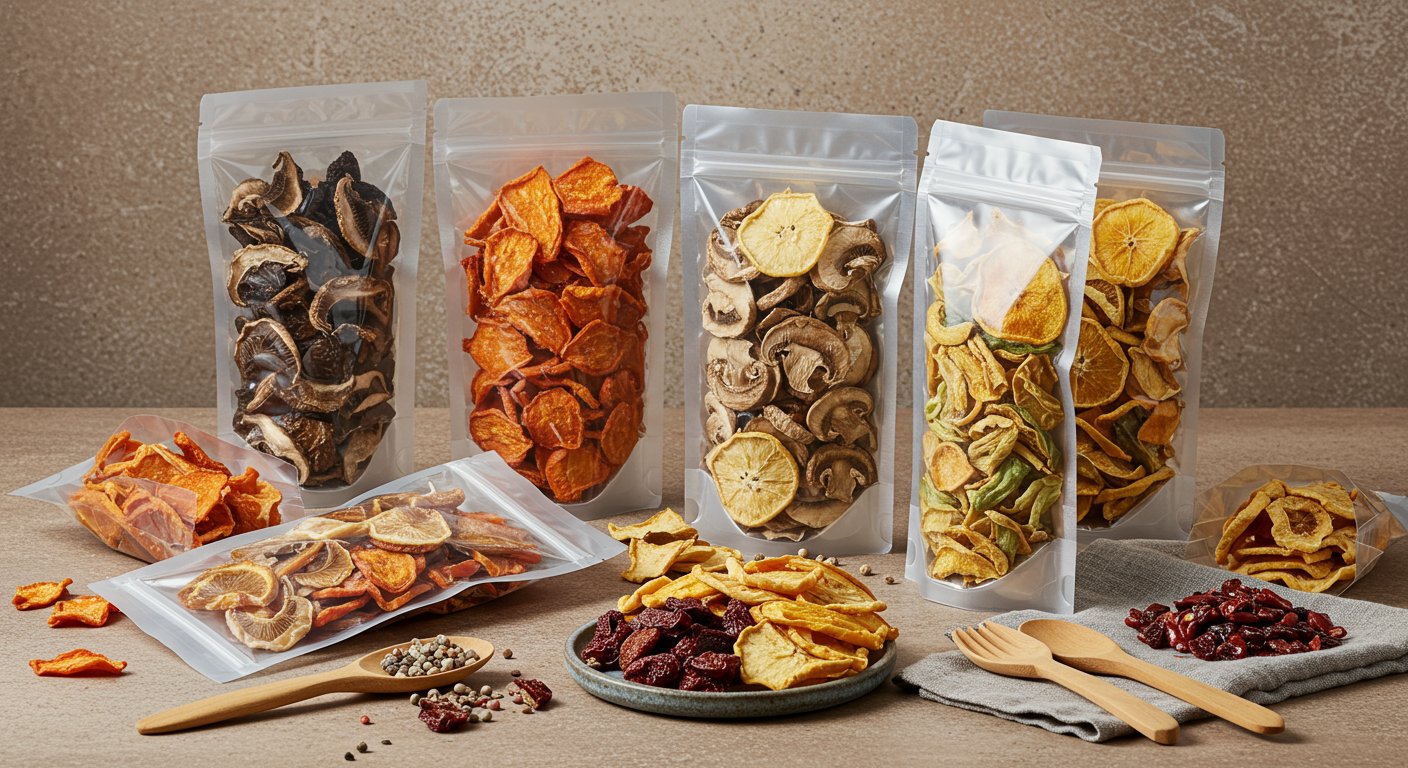
For example, a dried-vegetable novelty using non-standard vegetables conveys the concrete message “a company working on food-loss reduction.” Unlike typical novelty goods, the fact that it leaves a deeper impression through the experience of “eating” is a big differentiator too. SDGs-aligned gifts are also worth considering.
Consistency with corporate image builds trust
A novelty needs to match not just your brand colors and logo but the direction of your business. A contradiction in message arises if an eco-conscious company hands out plastic goods, or a health-related company chooses junk-food-type novelties.
| Industry | Example of a consistent novelty | NG pattern |
|---|---|---|
| Food manufacturers | A food novelty using your own ingredients | Plastic goods unrelated to food |
| Environment / energy | Recycled-material goods, plant-derived products | Items premised on single use |
| IT / tech | Mobile batteries, USBs, gadget types | Low-price stationery unrelated to technology |
| Agriculture / regional | Regional specialties, gifts of local ingredients | Mass-produced generic novelties |
Practicality creates long-term brand exposure
The more the recipient actually uses a novelty, the more chances arise to touch the company name and logo repeatedly. A calendar enters view every day, exposing the company name throughout the year. Tumblers and eco bags are used daily too, so long-term promotional effect can be expected.
By contrast, items premised on single use are short-lived and don't stay in memory easily. “Whether it can be used repeatedly” is an important criterion in selection. In the case of food novelties, the experience of “eating” itself stays in memory, so despite being consumable, they have the unique strength of being memorable.
Test quality and cost with a small lot
A novelty's quality ties directly to your company's quality image, so choosing on cheapness alone should be avoided. Still, since budget is limited, ordering a small lot first to test customers' reaction and placing an additional order if you feel a response is a low-risk way to proceed.
Personalized items get cheaper per unit as quantity rises, so it is wise to plan on scaling up after a test run. Agriture's dried vegetable novelties start from 500 bags, so you can begin with a test distribution at that quantity and see how people respond.
The distribution timing changes the effect
To maximize a novelty's effect, the timing of distribution is also an important factor. Items matched to the season, or novelties matched to a specific event, tend to stay in memory more.
- Spring: new-life support goods (eco bags, tumblers). For entrance ceremonies and new-fiscal-year greetings
- Summer: cooling towels, folding fans, mini uchiwa. Practical at outdoor events and trade shows
- Autumn: food novelties matched to the appetite of autumn. Tie-ins with “Food Loss Reduction Day (10/30)” too
- Winter: hand warmers, blankets. For year-end greetings, calendars and planners are the classics
At trade shows and seminars, items of a size easy to carry home on the spot are also more efficient to hand out.
SDGs support should be backed by substance
Novelties that appeal to environmental consideration are increasing, but handing out eco goods unrelated to your core business is seen through by consumers. SDGs support tied to your own business carries persuasive power.
For a food-related company, Upcycling of off-spec vegetables food-loss reduction through it; for an agriculture-related company, the use of regional specialties—consistency with the brand message is required. Whether you can explain to customers “why we chose this novelty” is what divides the true value of an SDGs-aligned novelty.
Novelty recommendations by distribution scene
The best item changes by the scene of distribution. Bearing the 7 points above in mind, choose to match the scene.
| Distribution scene | Recommended item | Unit-price guide | Viewpoint for selection |
|---|---|---|---|
| Trade shows & events | Individually wrapped food novelty, memo pad | 100–300 yen | Light, easy to carry home. Good for bulk distribution |
| Greetings to business partners | Calendar, tumbler, premium stationery | 500–1,500 yen | Quality-focused. Practicality that gets it kept on the desk |
| Recruiting | Eco bag, mobile battery | 300-800 yen | A design that resonates with younger people. Instagram-worthy too |
| Anniversary / gratitude | A specially packaged food gift, leather goods | ¥1,000–3,000 | A special, limited feel. Add a story |
| Company events | T-shirt, mug, healthy snack | 300–1,000 yen | A design that boosts team unity |
At trade shows, the key is something light, easy to take home and memorable. Stationery is useful but tends to overlap with competitors, so handing out unexpected items like food novelties at the right moment makes a stronger impression. For how to choose food novelties by category, see Food Novelty Complete Guide, where the details are summarized.
We have materials available to help you understand vegetable-based novelties
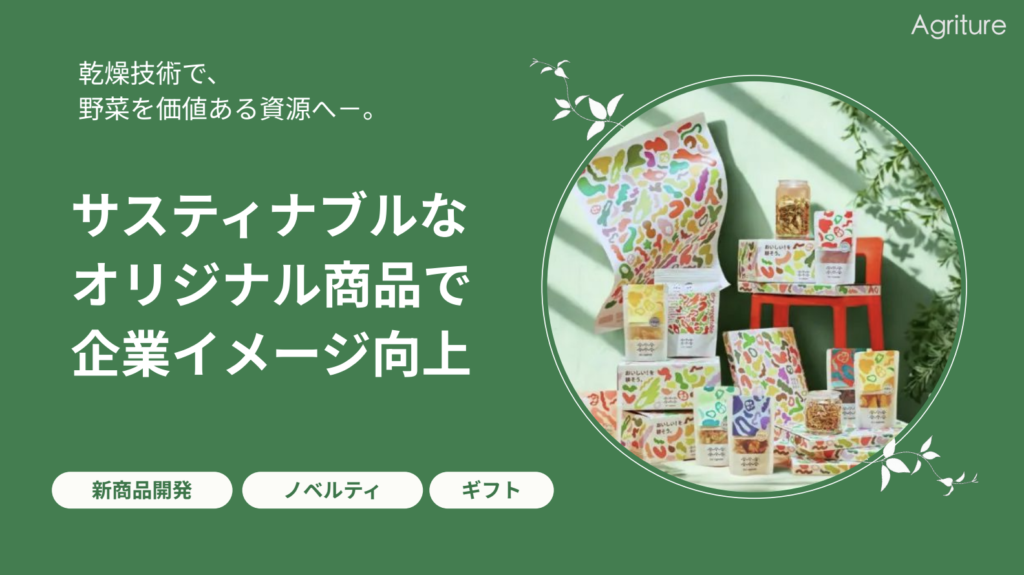
- SDGs-friendly products using non-standard vegetables
- Delivery possible in as short as two weeks
- Small lots from 500 bags
A novelty adoption case: Agriture's dried vegetables
Agriture manufactures original novelties using domestic dried vegetables in cooperation with Kyoto farmers. We have a track record of adoption at major companies, which you can view in detail on the case list.
Products and specs we can handle as novelties
| Item | Details |
|---|---|
| Product type | Dried vegetables, dried fruit, vegetable coffee, vegetable tea |
| Minimum lot | From 500 bags |
| Shortest lead time | 2 weeks (shorter still with existing raw material) |
| Naming / packaging | Supports logo printing, original packaging, and gift specs |
| Raw materials | Domestic vegetables (including Kyoto vegetables). Upcycling of non-standard vegetables |
| Appeal point | Appeals to SDGs (food-loss reduction) + health + talk-worthiness all at once |
Adoption cases at major companies
Agriture's dried-vegetable novelties have been adopted by a wide range of companies, regardless of industry.
| Company name | Use | Details |
|---|---|---|
| Nissin Foods | A Food Loss Reduction Day novelty | Planned dried-vegetable sets matched to each flavor of “Nissin Raoh.” 6 combinations such as soy-sauce flavor × Kujo leek and miso × onion |
| Nippon Paper Crecia | Campaign prize | Adopted the OYAOYA 8-item dried-vegetable set as the prize for the second round of the “Action for Smile campaign” |
| ZIGExN | Sports-team novelty | Manufactured dried vegetables using Kyoto vegetables based on the character of the 3x3 pro team “ZIGExN UPDATERS” |
| Kubota | Internal gift | Processed tomatoes from its own farm “Beppin Farm” into dried tomatoes. Distributed to employees |
Nissin Foods: appealing food-loss reduction with “Nissin Raoh” × dried vegetables
For “Food Loss Reduction Day” on October 30, we planned a set combining dried vegetables upcycled from non-standard produce with “Nissin Raoh.” For the soy-sauce flavor, Kujo negi, for the miso, Onion, and for the tantanmen, shiitake—one optimal dried vegetable was selected for each flavor. It was communicated internally and externally as a measure linking corporate CSR activity with the company's own products.
Nippon Paper Crecia: adopted as a sustainable-campaign prize
The OYAOYA 8-item dried-vegetable set was adopted as the prize for the second round of the “Action for Smile campaign,” which used used tissue boxes and toilet-paper cores as entry materials. A case where the campaign philosophy of “realizing a sustainable society” resonated with the backdrop of upcycling non-standard vegetables.
ZIGExN: a novelty of sports × regional revitalization × Kyoto vegetables
We turned Shogoin turnip (radish), the motif of “Shogotan,” the character of the 3x3 pro team “ZIGExN UPDATERS,” into dried vegetables and manufactured them as a novelty distributed at game venues. With the unique angle of sports promotion × regional revitalization × Kyoto vegetables, it contributes to the team's branding.
The point common to these cases
What all these cases share is a clear story of “why this company chose this novelty.” Precisely because the novelty connects to the company's own business and efforts, it stays in the recipient's memory.
Other adoption cases can be viewed on the case list page. If you thought “could our company use this too,” see the novelty detail page. The production flow for original novelties is also a helpful reference.
FAQ on choosing novelties
We have materials available to help you understand vegetable-based novelties
- SDGs-friendly products using non-standard vegetables
- Delivery possible in as short as two weeks
- Small lots from 500 bags
Summary: strengthen corporate branding with novelty selection
What matters in choosing a novelty is clarifying “to whom, in what context, and what you want to convey.” Selecting on the 7 points (purpose, consistency, practicality, differentiation, quality, timing, SDGs) turns it into a branding tool that goes beyond a mere handout.
Especially in scenes where SDGs and health consciousness are called for, food novelties using non-standard vegetables are effective. Major companies like Nissin Foods and Crecia have adopted them too, and they're drawing attention as a new option for conveying a company's stance through the “eating experience.” First, novelty detail page.
Download the novelty materials
We will send the materials to your email address based on the information you provide.
If you are considering product development with off-spec or your own farm's vegetables:From planning to processing, materials, package printing and novelties, you can consult us through a single point of contact. → Learn more about one-stop product development
- Improve your company’s image! New promotional novelties that stand out with dried vegetables
- How to Put Off-Spec Vegetables to Use in Business | Clearly Explained with Upcycling Cases
Author of this article
Related articles
-
 Food industry trade show trends 2025 | The latest developments to keep in mind
 -
 A guide to preparing for a trade show | Schedule, costs, and checklist
 -
 Prevent trade show failures! 8 common failure patterns and countermeasures
 -
 Kyoto-style food development | Gift-oriented product development OEM using Kyoto vegetables
 -
 Creating a regional brand with a Kyoto-vegetable OEM | The complete flow from planning to sales
 -
 Kyoto ingredient processing OEM | How to make the most of Kyoto vegetables and quality control
 -
 How to source commercial vegetable powder in small lots, and how to use it
 -
 Heirloom vegetable OEM | A commercialization case guide using Kyoto vegetables and local ingredients