Contributing to corporate branding! How to choose sustainable novelties

Summary of this article
Dried vegetables are drawing attention as a sustainable novelty that contributes to corporate branding. Conventional types such as plastic products have a high disposal rate and are hard to differentiate. Food-type novelties achieve zero disposal and can appeal to health, the environment, and regional contribution all at once. We explain specifically the upcycling of off-spec vegetables, growing-region storytelling, and examples of use at trade shows and in gift boxes.
As companies work toward realizing a sustainable society, novelty goods too have come to be required to reduce environmental burden and be sustainable. Amid this, dried vegetables are sometimes used as a new kind of novelty that can contribute to SDGs (the Sustainable Development Goals).
In this article, we introduce in detail the challenges of conventional novelties, market trends in sustainable novelties, the benefits of adopting Dried vegetables as a novelty, and the concrete introduction flow.

TOC
Challenges of conventional novelties
Disposability and a high disposal rate
Many novelties distributed at trade shows and events are items premised on being disposable—ballpoint pens, clear folders, fans, plastic products. Cases where the recipient actually keeps using them are few, and as a result many end up discarded.
Novelties with a high disposal rate are also poor in cost-effectiveness as a company's promotional effect. Even if there is impact the moment they are handed over, if they go straight into the trash, they do not lead to an improved brand image. Rather, it has become an era where they risk giving the negative impression that "this company is handing out things that become trash."
Concerns about environmental burden
Plastic novelties emit CO2 in the process from manufacturing to disposal and burden the environment. While companies champion SDGs and ESG management, such conventional novelties carry the risk of contradicting their own initiatives. Occasions where they are asked by clients, consumers, and investors "are you really working on sustainability?" are also increasing.
Differentiation is difficult
When every company distributes similar novelties, they are less likely to remain in the recipient's memory. Ballpoint pens and clear folders are convenient, but the reality is they are hard to differentiate from other companies. Unless a novelty conveys the company's story and values, the branding effect is limited. At B2B trade shows in particular, since dozens of companies hand novelties to the same visitors on the same day, unmemorable items may be discarded right along with the business card.
Market trends in sustainable novelties
Companies' SDGs response is accelerating
Centered on listed companies, the publication of sustainability reports is spreading, and environmental consideration is coming to be emphasized in novelty selection too. Cases where procurement or CSR departments specify "sustainable novelties" are also increasing.
Partly due to the influence of campaigns such as the Ministry of the Environment's "Plastics Smart," the move to avoid plastic products is spreading across companies as a whole. It can be called a natural flow for "low environmental burden" to be added to the criteria for selecting novelties. In fact, at B2B trade shows, cases of being viewed favorably as "a company distributing sustainable novelties" are increasing. It has become an era where a single choice of novelty can convey a company's stance.
Categories drawing attention
Categories drawing attention as sustainable novelties include the following.
| Category | Examples | Reason it is sustainable |
|---|---|---|
| Food type | Dried vegetable gifts, organic tea | Consumed as food, zero disposal |
| Textile type | Eco-bags, organic cotton products | Reusable, natural materials |
| Paper and wood products | Recycled-paper notebooks, bamboo cutlery | Recycled resources, biodegradable |
| Upcycling | Accessories made from waste materials | Reuse of waste |
Among these, food novelties are "welcome to receive" and "sure to be consumed," so there is almost no concern about them being thrown away. Dried vegetables in particular are drawing attention as items that can promote health, the environment and local contribution all at once. They can be stored at room temperature and have a long best-before date, which also makes inventory easy to manage. For a comparison of food novelties overall and how to choose, see our guide to choosing food novelties.
Why dried vegetables become a sustainable novelty
Upcycling of off-spec vegetables
Dried vegetables are fresh vegetables that have been dried, and because moisture is removed in the process, their storability increases and quality can be maintained over a long period. Also, since drying reduces the weight, it leads to savings in transport costs and storage space as well.
Furthermore, because they are often made by upcycling Non-standard vegetables produced at the producer, they directly reduce food loss. Being able to make effective use of vegetables that are merely irregular in shape but have no problem in taste or nutrition is a strength unique to drying. It is also a mechanism that leads to increased income for farmers.
Because it is food, "zero disposal" is achieved
The greatest feature of a dried vegetable novelty is that the recipient eats and consumes it, making disposal zero. Ordinary novelties become trash when no longer used, but if it is food, it is used in cooking and consumed deliciously.
With the rising health consciousness too, gifts that let you take in vegetables easily are welcomed by everyone regardless of age or gender. Since they can be used just by adding them to miso soup or soup, even those poor at cooking can use them casually. With a long best-before date, another advantage is that the recipient can use them at their preferred timing. It resolves the problem common to conventional novelties of "I received it but don't know how to use it."
Strengthening brand power with storytelling
A dried vegetable novelty can carry information about the growing region and a story of food-loss reduction. By stating background on the package such as "made with off-spec carrots from Kyoto" or "processed through agriculture-welfare collaboration," it becomes a tool that conveys the company's values beyond a mere novelty. If the recipient shares it on SNS, the effect of the company's social contribution activities spreading organically can also be expected.
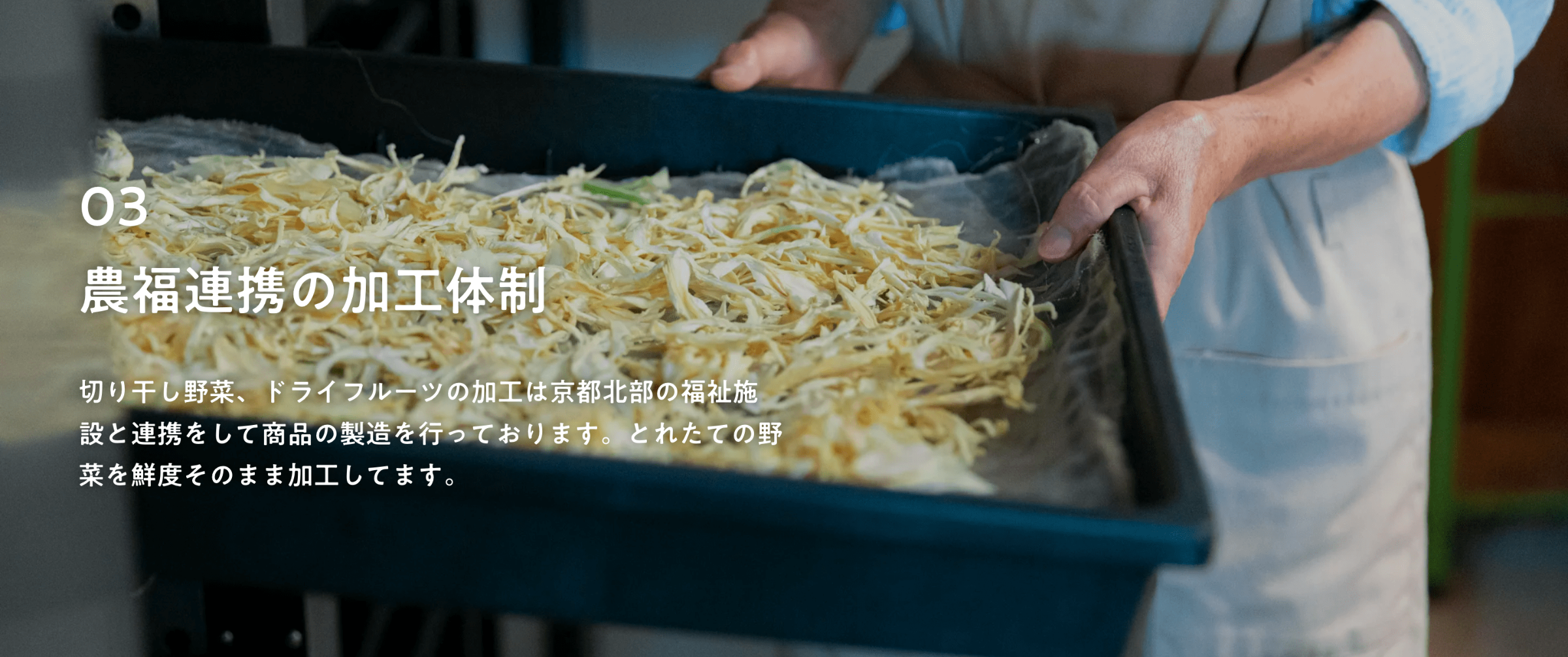
Agriture's dried vegetables use off-spec vegetables produced by partner farmers and are processed through agriculture-welfare collaboration. It is possible to deliver this whole supply-chain story as a novelty.


We have materials available to help you understand vegetable-based novelties
Agriture OEM, flexibly handling everything from small lots to large lots
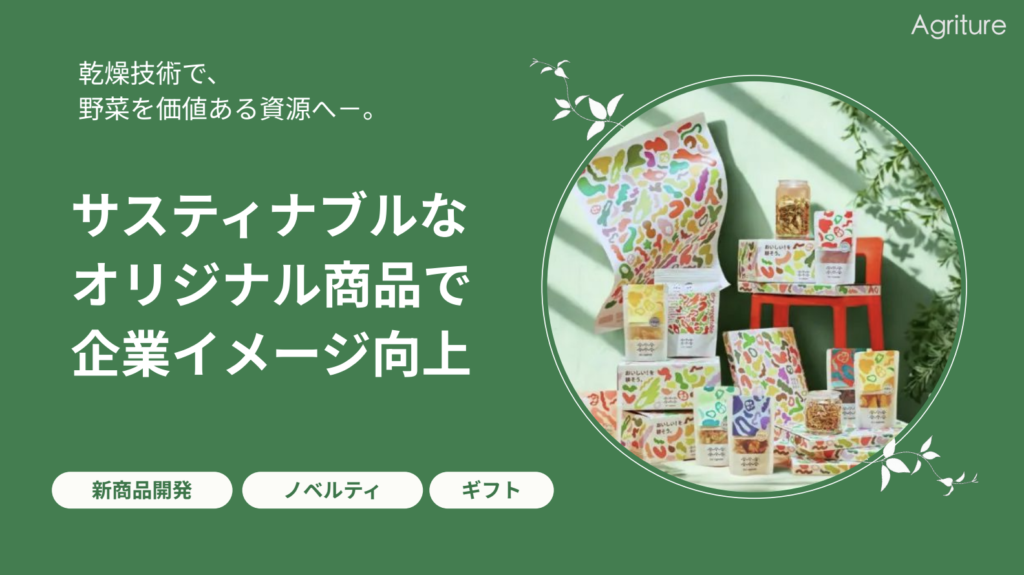
- SDGs-friendly products using non-standard vegetables
- Delivery possible in as short as two weeks
- Small lots from 500 bags
Examples of use as a corporate novelty
A promotional item for events
By adopting dried vegetables as a product to distribute at events such as trade shows and seminars, you can appeal to your company's sustainability initiatives. Also, by drying and processing vegetables from the region where the company's headquarters is located, you can appeal to regional character too. In that case, using OEM you can do drying and processing with regional raw materials. For example, a company headquartered in Kyoto could have a novelty using Kyoto vegetables; a Hokkaido company, a novelty using Hokkaido-grown carrots or kabocha—expansion with regional color is possible. Since it also becomes a conversation starter with visitors, it leads to an improved business-card exchange rate at trade shows.
A sustainable gift box
By providing an assortment of dried vegetables in a gift box that conveys a company's anniversary or gratitude to customers, it is valued as an environmentally friendly present. For example, presenting dried vegetables together with miso makes a box that lets people easily make miso soup at home. Compositions matched to the season—such as a "seven spring herbs set" or a "warming winter soup set" combining seasonal vegetables—are also well received. Achieving both the sense of luxury of a gift and practicality is the appeal of dried vegetable gifts.
As a bonus for products sold
It can also be used in scenes such as a present for buyers of products you sell. For example, one idea is to add a dried product of a vegetable said to be good for beauty as a purchase bonus for vegetable-related cosmetics. Cases of enclosing it with an order on an EC site are also increasing, and it suits creating a surprise on opening as well. Being storable at room temperature and lightweight, its small impact on shipping cost is another reason it is compatible with the mail-order business.

The introduction flow for dried vegetable novelties
Planning and hearing
First, we hear about the application, target, distribution scene, and budget. Whether it is for a trade show, a keepsake for a shareholders' meeting, or an enclosure for an EC site changes the optimal vegetable type and package design. Sharing the distribution quantity and desired delivery date at this stage also lets things proceed smoothly.
Sample creation and design confirmation
Based on the hearing content, we create a sample and have you confirm the actual product. The package design can also be customized to match the company logo and colors. SDGs initiatives and the growing region's story can be incorporated into the package. We also accommodate touches that let recipients use it right away, such as printing a recipe on the back.
Manufacturing and delivery
After the design is finalized, dry processing we carry out and packaging. Agriture supports from a minimum of 100 bags, so even companies incorporating dried vegetables into a novelty for the first time can start from a manageable lot. A guide of 2–3 weeks from planning to design finalization and 3–4 weeks to manufacturing and delivery, with a total lead time of about 6–8 weeks. For large lots the manufacturing period may extend, so if the event date is set, consulting early is recommended.
| Process | Details | Period guide |
|---|---|---|
| Planning and hearing | Decide the application, budget, and vegetable type | 1 week |
| Sample creation | Production of an actual sample | 1–2 weeks |
| Design finalization | Final decision on the package design | 1 week |
| Manufacturing | Drying, processing, and packaging | 2–3 weeks |
| Delivery | Inspection and shipping | 1 week |
Relevance to the SDGs
SDGs goals it can contribute to
Dried vegetable novelties can contribute to multiple SDGs goals. Conveying these relevancies when distributing the novelty makes the appeal as a company's CSR activity more effective.
- Goal 2 "Zero Hunger": Effective use of food through food-loss reduction
- Goal 8 "Decent Work and Economic Growth": Employment support for people with disabilities through agriculture-welfare collaboration, and revitalization of regional agriculture
- Goal 12 "Responsible Consumption and Production": Upcycling of off-spec vegetables, a zero-disposal novelty
- Goal 13 "Climate Action": CO2 reduction in transport through lighter weight
Inclusion in a sustainability report
A track record of introducing dried vegetable novelties can be described in a sustainability report or CSR report as a concrete initiative case. Showing numerical results such as "zero novelty disposal rate" and "food-loss reduction through the use of off-spec vegetables" raises external persuasiveness. It can also be repurposed for IR materials for investors and clients, directly leading to an improved social evaluation of the company.
Using dried vegetables as a company's novelty goods draws attention as a sustainable option that can contribute to the SDGs sustainable. Dried vegetables, which have many advantages such as retaining nutritional value, reducing waste, and reducing environmental burden, can help achieve a company's sustainability goals.
We have materials available to help you understand vegetable-based novelties
Agriture OEM, flexibly handling everything from small lots to large lots
- SDGs-friendly products using non-standard vegetables
- Delivery possible in as short as two weeks
- Small lots from 500 bags
Consult Agriture about dried vegetable novelties
Why not use dried vegetables'OEM service to broaden your business possibilities?
Agriture can offer OEM and wholesale of dried vegetables using off-spec vegetables from small lots. Novelties using dried vegetables we handle in a one-stop way from planning to manufacturing and delivery. Please feel free to contact us with inquiries and consultations. Even for companies adopting dried vegetables in a novelty for the first time, we propose the optimal plan based on past introduction cases. Flexible support matched to the distribution scene and budget is possible.
A list of commercial dried vegetables we handle

FAQ
Download the novelty materials
We will send the materials to your email address based on the information you provide.
Recommended reading
sustainable / Commercial dried vegetables / Product list / Novelties / dry processing / Powder