
Flavored coffee OEM | Design guide for beans and adding aroma

Summary of this article
How to design flavored coffee OEM across four axes—bean, roast level, flavoring method, and form. Major growing regions and flavor suitability, using flavoring, real-ingredient blending, and natural extraction selectively, examples combining Japanese ingredients with coffee. Agriture provides ingredients only; maker introductions go through foodoem.jp.
Flavored coffee OEM is an arrangement in which you outsource to a roaster or coffee specialist maker the production of original coffee scented with flavors such as vanilla, hazelnut, caramel, chocolate, Yuzu, and Japanese ingredients. There are stages, from label changes on an existing base to full-order design covering bean selection, roast level, and flavoring, and adoption is spreading across cafés, D2C, gifts, tourist souvenirs, and employee benefits.
This article organizes the ordering steps for flavored coffee OEM, suitability by bean origin and roast level, flavoring methods, lot feel by form (bean / ground / drip bag / capsule), and through to differentiation and sales strategy. Agriture itself is not a coffee production factory; its area is providing Japanese ingredients and formulation consultation, and introductions to coffee OEM makers go Food OEM Directory through. Related articles: Black tea OEM/Flavored tea development。

TOC
The Big Picture of Flavored Coffee OEM
Flavored coffee OEM outsources bean selection → roasting → flavoring → grinding/extraction processing → packaging to an OEM maker. The scope you outsource is staged, so even a first-time order can start from a prototype.
Ordering steps
- (1) Concept design: Decide the target, price range, sales channel, and flavor direction
- ② Selecting bean and roast level: Decide the base from origin, variety, and roast level
- ③ Flavoring method: Choose from flavoring, real-ingredient blending, or natural extraction
- ④ Deciding the form: Bean / ground / drip bag / instant / capsule
- ⑤ Prototype → mass production → packaging → shipping: Confirm taste and aroma in a prototype before moving to mass production
Scenes Where It’s Often Adopted
- Café, bakery: Selling store-original beans and drip bags
- D2C brands: Lineup for subscription and recurring delivery
- Hotel, restaurant: For guest-room amenities and souvenir retail
- Office benefits: Mass distribution of drip bags
- Tourist souvenirs and regional brands: Differentiation with local flavors
Bean Origin, Roast Level, and Flavor Suitability
The foundation of flavored coffee is decided by the bean and roast level. There are beans where flavor comes through and beans where it doesn’t, and the base selection changes the product’s direction.
Characteristics of Major Origins
As a starting point for flavored coffee, Brazil and Colombia—which have little quirk and take flavor well—are a safe bet. Strongly characterful beans like Ethiopia and Mandheling suit keeping the flavor restrained or a more straight-leaning design.
| Growing region | Features | Flavors That Suit |
|---|---|---|
| Brazil | Straightforward nutty, chocolatey taste | Vanilla, hazelnut, caramel |
| Colombia | Balanced, light acidity | Cinnamon, caramel, fruit |
| Guatemala | Smoky, full-bodied | Chocolate, whiskey |
| Ethiopia | Fruity, floral | Berry, citrus (restrained flavor recommended) |
| Mandheling (Indonesia) | Full-bodied, spicy | Chai-type, chocolate |
Suitability by Roast Level
- Light roast: Fruity, the bean’s own aroma. Keep flavoring restrained; pairs with berry and citrus types
- Medium roast: Balanced. Goes with almost any flavor; the mainstay for mass production
- Dark roast: Bitter, smoky. Vanilla, caramel, and chocolate create a contrast with the sweetness
The Three Flavoring Methods
Aroma-adding for flavored coffee divides into two systems—putting aroma directly onto the roasted beans, and blending in ingredients—and can specifically be organized into three methods: flavoring, real-ingredient blending, and natural extraction. Choose by product price range and pitch axis.
Comparison by Method
Flavoring for mass production, chains, and price appeal; real-ingredient blending for gifts, tourist souvenirs, and ingredient appeal; natural extraction for high-price specialty—these are the basic choices.
| Method | Features | Cost | Well-suited products |
|---|---|---|---|
| Flavoring (spray after roasting) | Uniform, strong aroma | Low | Mass production, chains |
| Real-ingredient blending (herbs, fruit, spices) | Ingredient feel, appearance | Medium to high | Premium, gift |
| Natural extraction (vanilla beans, cacao) | Natural aroma, rich | High | High-price, specialty |
List of Popular Flavors
- Classics: Vanilla, hazelnut, caramel, chocolate, mocha
- Spices: Cinnamon, cardamom, ginger, chai
- Fruit types: Orange, berry, coconut, banana
- Liquor types: Irish, amaretto, rum, whiskey (non-alcoholic flavoring)
- Japanese-ingredient types: Yuzu, matcha, hōji, kinako, brown sugar
Options by Form
Choose the shipping form of flavored coffee by outlet and unit price. Cafés and D2C mainly use drip bags, high-price goes with whole beans, and mass distribution uses instant or capsules—the best answer changes by sales channel.
Characteristics by Form
The standard is drip bags for café retail, gifts, and offices; whole beans for high-price specialty-shop sales; and sticks/capsules for mass distribution.
| Form | Main sales channels | Sense of lot size | Unit price |
|---|---|---|---|
| Beans (whole bean) | Specialty shop, D2C high-price | Small to medium | High |
| Ground (pre-ground) | D2C, supermarket | Medium | Medium |
| Drip bag (individually packaged) | Café retail, gift, office | 1,000 and up | Medium to high |
| Stick (instant) | Office, promotion, mass distribution | Hotel amenity | Low to medium |
| Capsule | Hotel, office, home | Hotel amenity | Medium |
The Appeal of Drip Bags
- Individual packaging gives a clean feel and high gift suitability
- Often adopted for café retail, hotel rooms, and office employee benefits
- Original printing carries a minimum lot of 1,000–3,000 units
- Some factories handle existing-product + sticker labels from 500 units
Differentiation and Sales Strategy
Because flavored coffee has many competitors, you’ll get buried without a clear axis of differentiation. Create originality through combinations of bean, flavor, origin, and story.
Axes of Differentiation
- Origin story: Clearly state the bean’s provenance—single estate, fair trade, organic JAS, etc.
- Japanese-ingredient blend: Differentiate from overseas competitors with yuzu, matcha, hōjicha, brown sugar, and the like
- Roast design: An original flavor through combinations of roast level and flavor
- Additive-free appeal: Pitch flavoring-free with natural extraction or real-ingredient blending
- Scene suggestion: Time-of-day lines such as morning, afternoon, and before bed
Examples of Japanese Ingredients × Flavored Coffee
- Yuzu × light roast: For a morning refresh. Designed to layer the light roast’s fruitiness with the freshness of yuzu
- Matcha × dark roast: An afternoon dessert coffee. For a Japanese-style café au lait layering matcha’s astringency over rich bitterness
- Hōjicha × medium roast: Leaning low-caffeine for before bed. A gentle flavor from the synergy of toastiness
- Brown sugar × medium-dark roast: For the office afternoon. Satisfying even unsweetened thanks to the sweetness of Okinawan brown sugar
- Kinako × light roast: For breakfast. A Japanese-style café au lait feel from the toastiness of soybean
Guide to Lot, Cost, and Delivery Time
For flavored coffee OEM, cost varies greatly by form and method. We organize the numbers to confirm at the first consultation.
- Drip bag (existing product + label): 500 and up, ¥80–150 each
- Drip bag (semi-order): 1,000–3,000, ¥120–250 each
- Drip bag (full order): 5,000 and up, ¥150–400 each
- Beans (whole bean): 10kg and up, ¥2,500–8,000 per kg
- Stick, capsule: 5,000 and up, mass production assumed
- Lead time: Semi-order 4–8 weeks, full order 8–16 weeks
Points for Choosing a Vendor
- In-house roastery: Whether they can handle everything from roasting
- Bean procurement network: Handling of special beans such as single-origin and fair trade
- Flavoring technology: Support for all three methods—flavoring, real-ingredient blending, natural extraction
- Packaging equipment: Shipping forms such as drip bag, stick, and capsule
- Certification: Status of HACCP, organic JAS, and fair trade certification
- small-lot support: Scaling from prototype/limited sales to mass production
We have materials available to help you understand dried processing OEM
Agriture OEM, flexibly handling everything from small lots to large lots
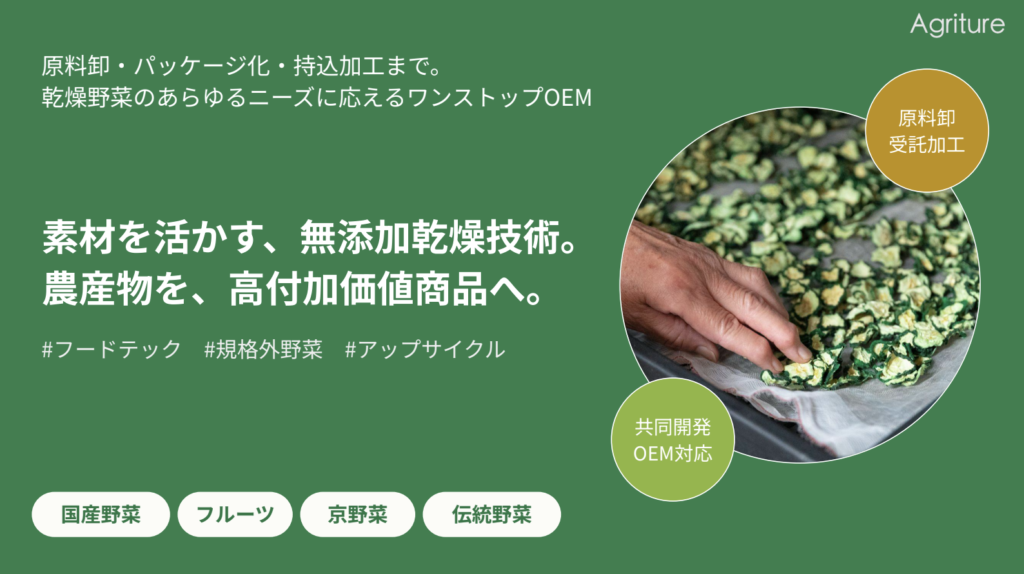
- OEM available from small lots of 10 kg
- Drying of brought-in raw materials also possible
- Support from processing to filling in one place
FAQ
What’s the minimum lot for flavored coffee?
The guide is 500 units for existing-product + label-change drip bags, 1,000–3,000 for semi-order, and 5,000 and up for full order (roasting and flavoring specified). Whole beans are often ordered in 10kg units.
Which bean and roast level should I choose?
A medium roast of Brazil or Colombia is a safe starting point for flavored coffee. Dark roast pairs well with vanilla, caramel, and chocolate types, and light roast with berry and citrus types—choose combinations that bring out the flavor.
How does flavoring differ from real-ingredient blending?
Flavoring produces a uniform aroma stably, suits mass production, and keeps the unit cost down, but requires “flavoring” on the label. Real-ingredient blending conveys ingredient feel and story and is easy to pitch as premium, but tends to increase lot variation and the number of prototypes. Choose by sale price and sales channel.
Is Japanese ingredients × flavored coffee possible?
Yes. There are examples of local flavored coffee blending yuzu, matcha, hōjicha, kinako, brown sugar, and the like. It’s adopted for tourist souvenirs, regional brands, and hotel room amenities that want to differentiate from overseas competitors.
Where is the OEM consultation point?
Introductions to coffee OEM makers are handled by Shokuhin OEM no Madoguchi (foodoem.jp), and Japanese-ingredient provision and formulation consultation are handled directly by Agriture. For consultation on Japanese ingredients × coffee, see Food OEM no Madoguchi (Agriture) is the way to reach us.
Summary
Flavored coffee OEM is designed across four axes—bean, roast level, flavor, and form. Drip bags have wide outlets in café retail, gifts, and office employee benefits, and you can scale in stages from existing-product + label at 500 units to full order at 5,000 units and up. Differentiation is an area you can build through Japanese-ingredient blends, origin story, and roast design.
Related article: Black tea OEM・Flavored tea development. For Japanese-ingredient provision, see Food OEM no Madoguchi (Agriture), and for coffee OEM maker introductions, see Food OEM Directory.
Download the OEM contract processing materials
We will send the materials to your email address based on the information you provide.
If you are considering product development with off-spec or your own farm's vegetables:From planning to processing, materials, package printing and novelties, you can consult us through a single point of contact. → Learn more about one-stop product development
FOR BUSINESS
乾燥野菜のOEM・受託加工を承ります
国産の野菜・果物の乾燥、100メッシュ相当までの粉砕、10g以上の小袋充填までをお受けしています。小ロットの試作から量産までご相談ください。寄せられた相談の実例は OEM・卸のご相談 に掲載しています。
乾燥品の賞味期限は、出荷日から6ヶ月程度を目安にご案内しています。
- How to Develop Vegetable Tea for Business People: Product Planning That Captures Health Demand
- Flavored Tea Development: Differentiating Aroma with 3 Elements × 4 Axes
Author of this article
Related articles
-
 Original coffee marketing strategy | Ways to grow sales
 -
 ベジタリアンとは?国の規格が分けている4つの区分と食べられないもの
 -
 長ねぎと白ねぎは同じもの?ねぎの種類と呼び名を国の資料で確かめる
 -
 柚子の種類は何種類あるのか、公の資料で名前が残る系統を数えた
 -
 ゆずの時期は年に二度、青ゆずは7月から黄ゆずは10月から
 -
 ゆずの産地は高知が半分を占め、二位は徳島から愛媛に変わった
 -
 Preventing Food OEM Failures: Common Failure Cases and Countermeasures for Success
 -
 How to find a food OEM | How to efficiently find the best manufacturing partner