
How to Store Dried Tomatoes: Tips for Room Temperature, Refrigeration, and Freezing, Plus Best-Before Dates

Summary of this article
We explain in detail three patterns for storing dried tomatoes—room temperature, refrigeration, and freezing. Fully dried types keep at room temperature, semi-dried for 1–2 months refrigerated, and frozen for 3–4 months. We cover airtight storage in glass jars, handling oil packs, guarding against moisture and direct sunlight, what to do in case of mold or off odors, how to judge the best-before date, and quality checks using your five senses—introducing practical tips for keeping them longer with specifics.
The basic way to store dried tomatoes is to use three patterns—room temperature, refrigeration, and freezing—as the situation calls for. An unopened fully dried type keeps for 6 months or more at room temperature, but after opening it absorbs moisture and the quality changes, so the rule of thumb is to put it in an airtight container and move it to the fridge. Freezing lets you stock them for 3–4 months or more, but since the texture changes after thawing, sticking to heat-cooked uses like pasta sauce and soup avoids trouble. This article explains storage steps for room temperature, refrigeration, and freezing, plus "why the best-before date changes by variety," learned at Agriture's production floor. Since uses and recipes by dish、and how to choose domestic products are compiled in separate articles, refer to those too if you already know your use.

TOC
The basics to grasp for storing dried tomatoes
The optimal temperature range and container for storing dried tomatoes change depending on "what state you store them in." Since the storage method differs by whether they're unopened or opened and whether they're a fully dried or semi-dried type, first check the state of the dried tomatoes you have, then choose the storage method.
(1) Room-temperature storage (unopened, fully dried type)
An unopened, fully dried type of dried tomato with sufficiently low water activity keeps for 6 months or more at room temperature. The three key points are "avoid direct sunlight," "keep it in a low-humidity spot," and "place it on a shelf with little temperature change." Avoid the area next to the stove, where temperatures rise easily; a food shelf or pantry where the temperature stays stable is suitable.
- Avoid direct sunlight: UV degrades color and flavor
- A low-humidity spot: take special care from the rainy season through summer. Including a desiccant gives peace of mind
- A spot with little temperature change: avoid next to the stove or by a window
Agriture's sister brand OYAOYA sets a best-before date of 180 days (about 6 months) from the production date for its dried tomatoes. Made from Kyotango-grown ripe Momotaro-type large-fruit tomatoes finished with low-temperature drying, they can be stored at room temperature while unopened.
(2) Refrigerated storage (managing after opening)
After opening, store dried tomatoes in a zipper storage bag or airtight container in the fridge. To reduce the surface area exposed to air, the trick is to press out as much air as possible from the bag before sealing. Refrigerated, quality holds for 1–2 months. Semi-dried types and homemade dried tomatoes with residual moisture can't be stored at room temperature, so be sure to refrigerate them.
| Storage method | Suited type | Storage period guide | Container needed |
|---|---|---|---|
| Room temperature | Fully dried, unopened | 6 months or more | As-is (store in the dark) |
| Refrigerated | Opened, semi-dried | 1 to 2 months | ジッパー袋または密閉容器 |
| Frozen | Long-term stock, bulk purchases | 3–4 months | Portioned freezer bags |
| Oil-packed | Ready-to-use appetizers, pasta ingredients | 2–3 weeks refrigerated | Glass jar (sterilized by boiling) |
(3) Freezer storage (long-term stock)
If you bought a large commercial bag or it looks like it'll take a while to use up, freezing is the safe choice. Portion out each single use, wrap in plastic wrap, put it in a zipper bag, and place it in the freezer. Frozen, quality holds for 3–4 months. To thaw, either let it thaw naturally in the fridge or add it still frozen to soups and simmered dishes. Rapid thawing in the microwave changes the texture, so for heat-cooked uses, adding it frozen is the fail-safe method.
There's also the method of storing them oil-packed. Put dried tomatoes and olive oil—plus herbs or garlic to taste—in a boiling-sterilized glass jar and store in the fridge; they stay tasty for 2–3 weeks. You can use them oil and all in pasta sauce, widening your cooking options. For a detailed oil-pack recipe, see The complete guide to using dried tomatoes.
The relationship between dried tomatoes' best-before date and variety
The best-before date of dried tomatoes varies greatly by variety. This is knowledge learned from actually drying multiple varieties at Agriture—working-level information rarely written in general web sources. In short, high-sugar cherry-tomato types have a shorter storage period, while tart large-fruit types are better suited to storage.
(4) Why the best-before date differs between cherry and large-fruit tomatoes
Cherry-tomato types (Aiko, Chika, fruit types) have a high sugar content of Brix 7–10, and much of the sugar remains after drying. High sugar makes them prone to "deliquescence," a phenomenon of absorbing moisture from the air, which can make the surface sticky during storage or cause mold. For this reason, cherry-tomato dried tomatoes have a shorter best-before date after opening, and it's realistic to eat them up soon after buying or store them frozen.
Large-fruit types (Momotaro, First, etc.), on the other hand, have a lower sugar content of Brix 4–6 and firm acidity. With less sugar, deliquescence is less likely and the post-drying state is stable, so quality is easy to maintain even in room-temperature storage. Agriture's sister brand OYAOYA uses Kyotango-grown Momotaro-type large-fruit tomatoes and sets a best-before date of 180 days from the production date. That period is supported by the high storage stability of the large-fruit variety.
| Variety group | Sugar content | Deliquescence risk | Shelf stability | Recommended storage method |
|---|---|---|---|---|
| Cherry-tomato type | Brix 7–10 | High | Shorter (within 2 weeks refrigerated after opening) | 小袋で購入、開封後すぐ冷蔵または冷凍 |
| Large-fruit type | Brix 4–6 | Low | Longer (6 months at room temperature while unopened) | Room-temperature storage OK; 1–2 months refrigerated after opening |
When buying commercial dried tomatoes, check the variety in the ingredient column, or check whether the package states the sugar content or storage method. Imported products without a stated variety are often large-fruit types, but domestic products using high-sugar cherry tomatoes may have a shorter storage period. How to choose domestic dried tomatoes compiles how to read ingredient labels—refer to it before buying.
FOR BUSINESS
乾燥トマトを、原料としてお探しですか
国産のトマトを乾燥・粉砕してお出ししています。カット形状や粒度の指定、継続してのお取引もご相談ください。規格は Dried tomato・Tomato Powder に掲載しています。
少量でのご購入は、姉妹ブランドの通販サイト OYAOYA で承っています。
Troubles in storing dried tomatoes and how to handle them
Here we summarize troubles that tend to occur while storing dried tomatoes and how to handle them. Most troubles are caused by "moisture getting in" or "a temperature-management mistake." If you notice something off, try the countermeasures below, and if you can't judge, don't force yourself to eat it—discard it.
| Trouble | Cause | How to handle it | When to discard |
|---|---|---|---|
| Surface turned white | カビまたは糖の結晶化 | If the white part is powdery, it's sugar crystals (edible). If it's fluffy, it's white mold (discard) | Discard fluffy white deposits |
| Surface is sticky | Deliquescence (absorbed moisture) | Move to an airtight container with a desiccant and refrigerate. If stickiness progresses, switch to freezer storage | Discard if there's an off odor |
| Discolored to a blackish tone | 酸化または高温 | Often still edible but the flavor has faded. Use it up in heat-cooked dishes | Discard if there's an off odor or sliminess |
| Has an off odor | Mold or spoilage | Discard without eating | Discard immediately |
To keep quality high during storage, putting a desiccant (silica gel) in the storage bag or airtight container is an easy, reliable method. Food-grade desiccants available at 100-yen shops work well enough. Also, if you leave the bag open when taking them out of the fridge, condensation lets moisture rush in all at once, so the trick to keeping them longer is to take out only what you'll use and close the bag right away.
Detailed specs for commercial dried tomato products (water activity, best-before date, storage temperature) are listed on Agriture's dried tomato product page. When sourcing commercially, confirming that the water activity value (Aw) stated in the product spec sheet is 0.6 or below gives a benchmark for room-temperature-distributable quality. For the basics of dried tomatoes, also see What are dried tomatoes? A beginner's guide.
We have materials available to help you understand dried processing OEM
Agriture OEM, flexibly handling everything from small lots to large lots
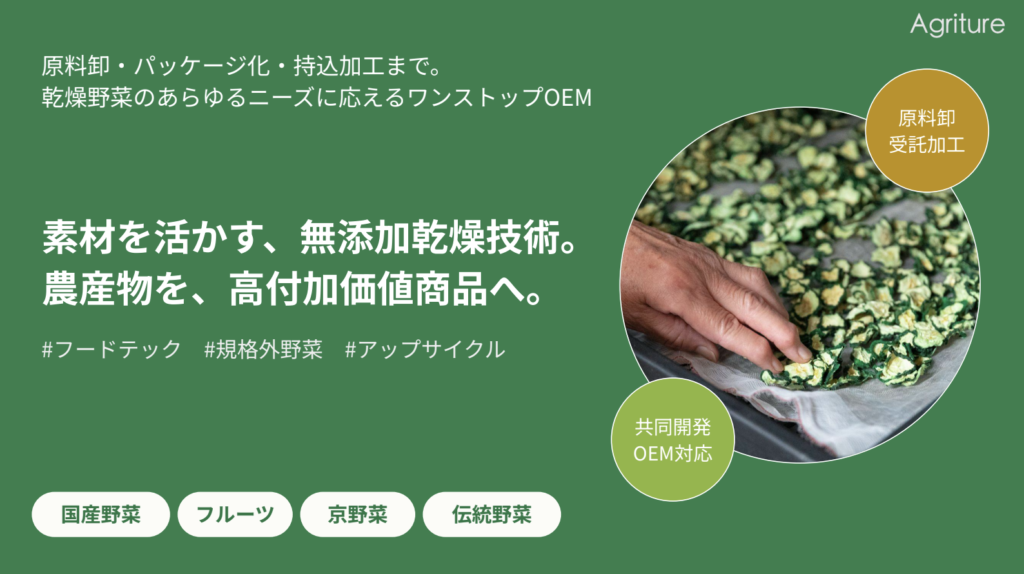
- OEM available from small lots of 10 kg
- Drying of brought-in raw materials also possible
- Support from processing to filling in one place
FOR BUSINESS
乾燥トマトを、原料としてお探しですか
国産のトマトを乾燥・粉砕してお出ししています。カット形状や粒度の指定、継続してのお取引もご相談ください。規格は Dried tomato・Tomato Powder に掲載しています。
少量でのご購入は、姉妹ブランドの通販サイト OYAOYA で承っています。
FAQ
How long is the best-before date of dried tomatoes?
Fully dried types generally keep 6 months or more at room temperature while unopened. OYAOYA's Kyotango-grown dried tomatoes are 180 days from the production date. After opening, a guideline is 1–2 months refrigerated or 3–4 months frozen. There's variation by variety—high-sugar cherry-tomato types keep a shorter time than large-fruit types.
How should I store dried tomatoes after opening?
Put them in a zipper storage bag or airtight container, press out as much air as possible, and refrigerate. Including a desiccant prevents moisture from returning. When using them, the trick to keeping them longer is to take out only what you need and close the bag right away.
The surface of my dried tomatoes turned white—is it mold?
If the white part is powdery and dry, it's sugar crystallization and safe to eat. Fluffy, cotton-like white deposits are likely mold, so discard them. If you can't decide, check for off odors; if there's even a slight off odor, it's safer not to eat them.
Can I freeze dried tomatoes?
Yes. Portion them into single uses, wrap in plastic wrap, put them in a zipper bag, and freeze. Quality holds for 3–4 months. To thaw, let them thaw naturally in the fridge or add them still frozen to soups and simmered dishes.
How long does an oil pack keep?
Put dried tomatoes and olive oil in a boiling-sterilized glass jar and store in the fridge, and they stay tasty for 2–3 weeks. The key is to close the lid firmly so they don't touch air. You can use them oil and all in pasta sauce, so it's popular as a method that combines storage and cooking.
Summary: Storage points for keeping dried tomatoes longer
Guidelines for storing dried tomatoes: (1) unopened fully dried types, 6 months or more at room temperature; (2) after opening, 1–2 months refrigerated in an airtight container; (3) for long-term stock, 3–4 months in portioned freezer storage; (4) oil-packed, 2–3 weeks refrigerated. Storage stability changes by variety—high-sugar cherry-tomato types deliquesce easily and have a short best-before date, while large-fruit types have low sugar and suit storage.
Made from Kyotango-grown Momotaro-type large-fruit tomatoes, OYAOYA's dried tomatoes are a fully dried type with a 180-day best-before date and room-temperature storage. For those who want to source large lots for commercial or processing use, see Agriture's dried tomato product page.
Download the OEM contract processing materials
We will send the materials to your email address based on the information you provide.
If you are considering product development with off-spec or your own farm's vegetables:From planning to processing, materials, package printing and novelties, you can consult us through a single point of contact. → Learn more about one-stop product development
- How to Use Dried Tomatoes: Rehydrating, Popular Recipes, and Uses by Variety
- How to choose commercial dried tomatoes | Quality and OEM case studies
Author of this article
Related articles
-
 柚子の皮の使い道は干すと広がる、果汁と種まで使い切る手順
 -
 Adding Vegetables to Your Morning with Dried Vegetables: A Guide to Getting Dietary Fiber Easily
 -
 Predicting the Dried Vegetable Market in 2030! An Explanation of Growth Fields and the Latest Trends
 -
 How to Use OEM Matching Sites: Efficiently Finding the Optimal Manufacturing Partner
 -
 How to proceed with hometown-tax product development | OEM techniques that make the most of local ingredients
 -
 How to source commercial vegetable powder in small lots, and how to use it
 -
 What is vegetable paste? The difference from powder, dried vegetables, purée, and extract
 -
 How to Use Fruit Powder | Substitution Design for Confectionery and Sweets