
How to Make an Original Tea OEM: Points of Differentiation and the Planning Process

Summary of this article
A complete guide to creating an original tea OEM. It organizes all the practical know-how needed to launch your own tea brand: the four directions (flavored, blend, functional, regional), the differentiation positioning map (price × rarity), the character and best fit of six base teas, the golden blending ratios across five genres, the tea × ingredient pairing matrix, five patterns behind prototypes that never come together, the brand-story 4W1H, the right specifications by sales channel, the reverse-calculation formula for retail price, what best-selling original teas have in common, and leading manufacturers.
Original tea is a bespoke tea designed to match your own brand concept, rather than off-the-shelf tea leaves. You pack a "brand story" into every cup by combining five elements: the choice of base tea, the pairing ingredients, the blend ratio, the packaging, and the story. Rather than simply repackaging store-bought tea, designing everything yourself, from the combination of raw materials to the flavor profile,is what makes an original tea truly worthwhile.
In this article, The design thinking and practical work of creating an original tea is laid out here end to end. From differentiation positioning, golden-ratio blending, the brand-story 4W1H, and diagnosing prototypes that never come together, to specifications by sales channel and the reverse-calculation formula for price, this is a practical guide dedicated to original tea OEM. It is not an introduction to OEM in general, but content that goes all-in on "creating an original tea."
What you'll learn in this article
- The four directions for an original tea and how to find the open space
- The character and best fit of six base teas
- Golden-ratio blend patterns (5 genres)
- Five categories of causes when prototypes never come together, and how to address them
- Tea × ingredient pairing chart
- The right specifications by sales channel and the reverse-calculation formula for retail price
- What best-selling original teas have in common

We have materials available to help you understand dried processing OEM
Agriture OEM, flexibly handling everything from small lots to large lots
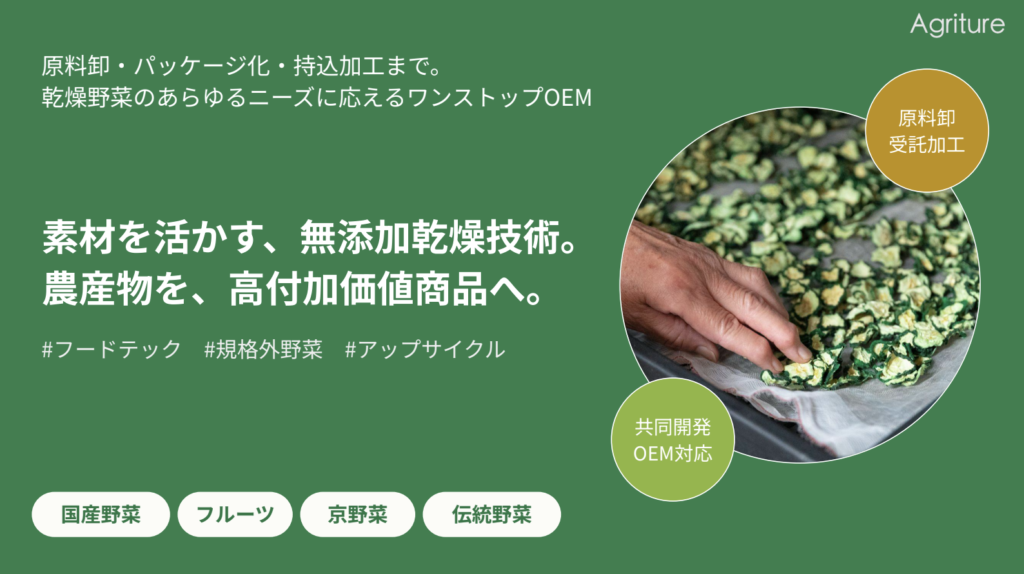
- OEM available from small lots of 10 kg
- Drying of brought-in raw materials also possible
- Support from processing to filling in one place
TOC
The four directions for an original tea
An original tea broadly falls into four directions. Deciding which direction to compete in first naturally settles the design of raw materials, blend, story, and sales channel. Mixing several directions blurs your appeal, so the basic rule is to narrow to one and make your axis clear.
| Direction | Features | Typical appeal |
|---|---|---|
| Flavored | Adding aroma to tea leaves | Earl Grey, yuzu, peach flavors |
| Blend | Combining several teas or ingredients | Herbal blends, Japanese-Western fusion, vegetable tea |
| Functional | Appealing to component effects | GABA, theanine, catechin-enriched |
| Regional / origin | Differentiating by origin or variety | Single-origin, rare varieties, Japanese black tea |
Flavored is easy to enter but a field where it is hard to differentiate from established staples like Earl Grey. Blend lets you create endless variations depending on the formulation, making it a direction where individuality is easy to express. Functional requires building up notifications and scientific evidence, so the barrier to entry is high; but if you succeed, it becomes easier to appeal on price. Regional / origin has strong story appeal, and combining it with a regional brand can lift it into a high price bracket.
Differentiation positioning map
The success or failure of an original tea comes down to whether you can read your market position on two axes: price bracket × rarity. Avoiding zones crowded with existing brands and aiming for open space makes differentiation effective. Rarity can be created through any of three things: the scarcity of the raw material, the originality of the blend, or the uniqueness of the story.
| Quadrant | Price range | Rarity | Where to aim |
|---|---|---|---|
| Mass volume | Low | Low | Large players are strong; new entry is difficult |
| Premium | High | Low | The classic high-end tea route; many competitors |
| Niche high-price | High | High | Tends to be open space / can win through differentiation |
| Limited and rare | Medium | High | Run it in small lots and seasonal limited editions |
The quadrant where a new brand is most likely to win is the "niche high-price" quadrant. Mass volume is occupied by established heavyweights such as Ito En, Kirin, and Lupicia, and the premium zone is firmly held by long-established tea houses and brands aimed at starred hotels. On the other hand, the combination of "rare ingredients × original blend × a clear story" is one that large players find hard to touch, and even an individual brand can compete. The vegetable teas that Agriture handles fit easily into this the "niche high-price" quadrant position, letting you carve out a spot with little competition through rare ingredients × original blends. For details, see Vegetable tea OEM or Agriture's wholesale / OEM information.
FOR BUSINESS
乾燥野菜のOEM・受託加工を承ります
国産の野菜・果物の乾燥、100メッシュ相当までの粉砕、10g以上の小袋充填までをお受けしています。小ロットの試作から量産までご相談ください。寄せられた相談の実例は OEM・卸のご相談 に掲載しています。
乾燥品の賞味期限は、出荷日から6ヶ月程度を目安にご案内しています。
How to choose the base tea leaf
An original tea's 8 out of 10 parts are determined by the base tea. No matter how much you adjust the pairing ingredients, the flavor will not come together if the base is wrong. Understanding how the character of the base tea matches your chosen direction is the first step.
| Base tea | Flavor character | Suited directions |
|---|---|---|
| Green tea (sencha) | Astringency, umami, freshness | Japanese-modern, functional, herbal |
| Hojicha / genmaicha | Toastiness, gentle bitterness | Japanese spice, chai-style |
| Black tea | Body, astringency, floral brightness | Fruit, floral, milk-based |
| Oolong tea | Toastiness × sweetness | Floral, spice, sweet-based |
| Rooibos | Caffeine-free, earthy | Relaxation; for expectant mothers and children |
| Japanese black tea | Gentle astringency; pairs well with Japanese ingredients | Regional brands, gifts |
Green-tea base is delicate and not too assertive, so it stands up to a wide range of pairings. At the same time, quality differences show directly in the flavor, so choosing the grade of tea leaves matters. Hojicha / genmaicha brings toastiness to the fore, so it pairs superbly with spices and brown sugar. Black tea has its brightness stand out in combination with fruit and flowers. Oolong tea has a dual character of toastiness and sweetness, suiting differentiation in the Taiwanese-tea vein. Rooibos is caffeine-free, allowing you to take a position for evening use, children, or expectant mothers. Japanese black tea occupies the unique position of domestically grown tea leaves processed as black tea; it pairs very well with Japanese ingredients and suits regional brands and gift products.
Golden blending ratios
Blend design is thought of as a three-layer allocation of base, accent, and aroma. The base forms the skeleton of the flavor, the accent gives it individuality, and the aroma sets the impression of the finish. We have organized representative golden ratios by genre.
| Genre | Base | Accent | Aroma |
|---|---|---|---|
| Classic blend | Green tea / black tea 60% | Herbs / flowers 30% | Spice / citrus 10% |
| Japanese-modern | Hojicha / genmaicha 70% | Japanese herbs / yuzu 20% | Ginger / sansho 10% |
| Relaxation-style | Chamomile / rooibos 50% | Lavender / mint 30% | Vanilla / orange 20% |
| Functional appeal | Green tea / oolong 55% | Functional ingredients 35% | Flavor-adjusting herbs 10% |
| Vegetable tea | Base tea 60% | Vegetable powder 25% | Spice / citrus 15% |
In the first prototype, if you fix the base ratio and vary only the accent and aroma allocation across two or three patterns for comparison, you settle on your preferred direction faster. Moving the base allocation at the same time makes it impossible to trace what changed the flavor, and the prototyping wanders. Move one variable at a time is the iron rule for streamlining prototyping.
Keeping the aroma ratio to "10–20%" is the basic rule. Adding too much spice or citrus hides the character of the base tea. Conversely, if the aromatic component is too scarce, the product's first impression is weak, and the repeat rate at stores and online tends to fall.
Tea × ingredient pairing examples
The ingredient you pair with the base tea decides your direction of differentiation. Vegetables, herbs, spices, fruit, flowers Combining one or two kinds from these five categories yields a product with strong originality. Pairing three or more kinds tends to make the individual characters clash and the flavor thin out, so in the initial plan the safe choice is to keep it to one or two kinds.
| Pairing ingredient | Examples | Well-matched base teas |
|---|---|---|
| Vegetables | Spinach, kale, carrot, beet, Kujo scallion | Green tea, hojicha, rooibos |
| Herb | Chamomile, mint, lavender | Black tea, green tea, rooibos |
| Spice | Ginger, cinnamon, cardamom, black pepper | Black tea, hojicha |
| Fruit | Yuzu, lemon, strawberry, mango | Black tea, green tea |
| Flower | Rose, jasmine, elderflower | Green tea, black tea, herbal tea |
Vegetable × tea is a field Agriture specializes in; it pairs well with health-oriented brands and is a combination that makes differentiation easy. Herb × tea is a classic pattern with broad brand range, but differentiating from existing brands requires digging down to "origin" and "harvest timing."Spice × tea has an established market in the chai vein, so bringing out individuality with an original formulation of black pepper, sansho, and the like is effective. Fruit × tea run as seasonal limited editions can drive repeat purchases and social-media sharing. Flower × tea is strong for gift demand, where visual beauty and packaging design become decisive purchase factors.
Five causes when prototypes never come together
When prototyping repeats five or more times without settling, in many cases the cause lies not in the flavor but in the design. Knowing the types of trouble in advance also streamlines meetings with the manufacturer. The five typical patterns of a wandering prototype are as follows.
| Cause | Symptom | Remedy |
|---|---|---|
| Vague concept | The direction changes every time | Put the concept into words in one or two terms |
| Flavor inconsistency | The flavor differs from lot to lot | Fix the raw-material origin and harvest period |
| Color / aroma loss | Deterioration from prototype to mass production | Review the packaging material and drying process |
| Poor solubility | Powdered tea clumps | Adjust particle-size distribution and moisture content |
| Excessive cost | Does not fit the selling price | Lower the raw-material grade or increase the lot |
Vague concept is the most frequent trouble. Abstract expressions like "a relaxing flavor" or "a refreshing flavor" leave the manufacturer's interpretation and the client's intent perpetually out of sync. Specifying down to the scene, as in "a flavor to drink in bed 30 minutes before sleep,"concretely down to the scene aligns the direction of the prototype.
Flavor inconsistency often surfaces at the mass-production stage and is hard to notice in the first prototype. Because flavor changes greatly with the tea's harvest timing (first flush, second flush) and origin (Sayama, Shizuoka, Kagoshima, etc.), at mass production you negotiate price on the premise of securing raw material from the same lot and same harvest period.
Color / aroma loss often happens when different packaging materials are used for the prototype and mass production. When the prototype uses small pouches and mass production uses large bags plus individual wrapping, and so on, differences in the air layer and light transmission of the packaging change the rate of flavor deterioration even with the same formulation。
Brand story 4W1H
An original tea's brand story, when you Why / Who / What / Where / How fill in these five items, creates a consistent narrative across product descriptions, social media, and the EC product page. If the story is weak, the repeat rate will not grow even if the flavor is good, and no social-media sharing occurs.
| Item | Story element |
|---|---|
| Why (why you make it) | The issue, sense of the problem, development motive |
| Who (who makes it) | The face of the brand, the grower, the development team |
| What (what you make) | The product's concept, value, and originality |
| Where (where the raw material is from) | Origin, field, production base |
| How (how you make it) | Method, care, transparency of the process |
In particular, Why (why you make it) is the most important. A target setting like "for health-conscious people" or "for busy businesspeople" can be written by anyone, so it is no differentiator. Whether you can tell of a specific personal motive— such as "I started looking for additive-free tea because of my child's atopy" or "I took over the family tea fields and wanted to make a product blended with local vegetables" — is what decides the strength of the brand.
We have materials available to help you understand dried processing OEM
Agriture OEM, flexibly handling everything from small lots to large lots
- OEM available from small lots of 10 kg
- Drying of brought-in raw materials also possible
- Support from processing to filling in one place
The right specifications by sales channel
Even for the same original tea, the right specifications change with the sales channel. We have organized the design policy for lot, packaging, and unit price for each of the four channels: EC, store, gift, and subscription. Rolling out to all channels from the start worsens capital efficiency, so the basic rule is to validate in one channel before expanding.
| Sales channel | Recommended lot | Packaging | Unit-price range |
|---|---|---|---|
| EC | 1,000–5,000 units | Mail-delivery compatible, lightweight | 1,500–3,000 yen |
| Store | 3,000–10,000 units | Shelf-catching design | 1,000–2,500 yen |
| Gift | 500–3,000 units | Gift-box and noshi compatible | 3,000–10,000 yen |
| Subscription | 500–2,000 units per month | Mini packaging for recurring delivery | 2,000–5,000 yen per month |
The EC channel greatly lowers shipping costs when designed to fit a mail-delivery size (thickness of 2.5 cm or less). Post-box delivery also avoids delivery losses from absences and raises the repeat rate. The store channel is won by the appeal at the instant it sits on the shelf, requiring a design whose product features are clear even from two meters in front of the package. The gift channel has the buyer and the consumer being different people, so "elements that please the recipient" (noshi, individual wrapping, ample best-before dating) become the deciding factors in being chosen. Subscription sends the same product every month, so people tire of it; keeping both continuity and freshness — for example, "keep the base tea fixed and change the blend ingredients by season" —balancing continuity and freshness is the key.
Reverse-calculation formula for retail price
Reverse-calculating the upper limit of the OEM cost from the retail price reveals the specifications that are feasible within budget. We have organized calculation examples by gross-margin rate. Deciding the retail price first at the planning stage and reverse-calculating the OEM cost from it reduces specification changes during prototyping.
| Gross-margin rate | Retail 1,500 yen | Retail 3,000 yen | Retail 5,000 yen |
|---|---|---|---|
| 30% (for mass retail) | OEM cost ≤ 1,050 yen | ≤ 2,100 yen | ≤ 3,500 yen |
| 40% (standard) | OEM cost ≤ 900 yen | ≤ 1,800 yen | ≤ 3,000 yen |
| 50% (for D2C) | OEM cost ≤ 750 yen | ≤ 1,500 yen | ≤ 2,500 yen |
| 60% (premium) | OEM cost ≤ 600 yen | ≤ 1,200 yen | ≤ 2,000 yen |
For a D2C brand selling on its own, mainly through EC, a 50% gross margin is a rough guide. After subtracting advertising, packaging, shipping, and returns handling, even a 50% gross margin settles to an actual operating profit of around 15–25%. When expanding into wholesale or mass retail, the wholesale price is around 50–60% of retail, so you need an OEM cost design that still leaves a gross margin from the wholesale price. In the gift channel, the outer-packaging cost of "gift box, noshi, and carrier bag" often accounts for 20–30% of the product cost, so it is practical to budget the outer-packaging cost as a separate line item when designing costs.
What best-selling original teas have in common
Original teas that hit in the market share several traits in common. A narrowed target, a unique appeal axis, and consistency of experience— when these align, differentiation from similar products becomes clear and repeat purchases arise more easily.
| Common trait | Design point |
|---|---|
| Clear target | Narrow the persona to one person and make the use scene concrete |
| Uniqueness of the appeal axis | Break through on a single point — ingredient, blend, or story |
| Balance of price and experience | Design the right price from cost × channel × brand position |
| Continuous communication | Deliver the worldview steadily through social media, blog, and recipes |
| Transparency of quality | Build brand trust by showing origin, production process, and certifications |
Clear target is especially important. "A health-conscious woman in her 30s" is weak; drilling down to one scene for one persona, as in "a single woman in her early 30s who wants to relax at home avoiding caffeine, before stopping by the convenience store on her way home from work," makes both the product-page copy and the social-media posts consistently resonate with that person.
Uniqueness of the appeal axis follows the principle of "breaking through on a single point." A greedy design — distinctive ingredients, an elaborate blend, and a rich story all at once — tends to leave each of them half-finished. Narrowing to one and pushing it all the way through is how an early-stage brand fights.
Leading companies for original tea OEM
As places to consult when considering an original tea OEM, we introduce the main companies listed on Food OEM Directory. Compare and evaluate companies that match your brand concept and required certifications and lots.
| Company name | Area of strength |
|---|---|
| Agriture Inc. | Vegetable tea / vegetable-powder blends |
| Encha Inc. | Tea planning, development, and sales |
| Be in Museum Co., Ltd. | Tea, herbs, health teas |
| Nitto Foods Co., Ltd. | Powdered tea, matcha processing |
| Foodie Connect Inc. | Beverage and tea OEM |
| Kurohime Wakan-yaku Research Institute Inc. | Health teas, herbal teas |
You can find all tea OEM companies from the Food OEM Portal "Coffee & Tea" list.
FOR BUSINESS
乾燥野菜のOEM・受託加工を承ります
国産の野菜・果物の乾燥、100メッシュ相当までの粉砕、10g以上の小袋充填までをお受けしています。小ロットの試作から量産までご相談ください。寄せられた相談の実例は OEM・卸のご相談 に掲載しています。
乾燥品の賞味期限は、出荷日から6ヶ月程度を目安にご案内しています。
Summary of how to create an original tea
The key to creating an original tea is to build it up in the order: choose the direction → base tea → blend ratio → pairing ingredient → brand story. In particular, mastering the golden blend ratios and the cause diagnosis for prototypes that never come together lets you minimize the back-and-forth of prototyping.
Using the right specifications by channel and the reverse-calculation formula for retail price, you can prevent a mismatch between the sales plan and the OEM specifications. Aiming for the open space of "niche high-price" through rare ingredients × original blends × a clear story is the shortest route for a new brand.
If prototyping gets stuck, first check "can you put the concept into one or two words" and "is the scene narrowed to one". Once these are settled, the base tea and golden ratio fall into place automatically, and prototyping communication with the manufacturer goes smoothly.
Download the OEM contract processing materials
We will send the materials to your email address based on the information you provide.
Recommended reading
How to request tea OEM manufacturing
If you are considering product development with off-spec or your own farm's vegetables:From planning to processing, materials, package printing and novelties, you can consult us through a single point of contact. → Learn more about one-stop product development
- Original coffee marketing strategy | Ways to grow sales
- Tea OEM Price Ranges: 5 Ways to Keep Costs Down and 7 Points for Quotes
Author of this article
Related articles
-
 Original coffee marketing strategy | Ways to grow sales
 -
 ベジタリアンとは?国の規格が分けている4つの区分と食べられないもの
 -
 長ねぎと白ねぎは同じもの?ねぎの種類と呼び名を国の資料で確かめる
 -
 柚子の種類は何種類あるのか、公の資料で名前が残る系統を数えた
 -
 ゆずの時期は年に二度、青ゆずは7月から黄ゆずは10月から
 -
 ゆずの産地は高知が半分を占め、二位は徳島から愛媛に変わった
 -
 Preventing Food OEM Failures: Common Failure Cases and Countermeasures for Success
 -
 How to find a food OEM | How to efficiently find the best manufacturing partner