
What is furikake OEM? A dried-vegetable maker explains small-lot, vegetable-furikake manufacturing

Summary of this article
Vegetable shortfall at the office can't be made up by convenience-store food and vegetable juice alone. Comparing cut vegetables, green juice, vegetable powder, and dried vegetables by ease, satisfaction, and storability, dried vegetables — which finish right at your desk while also giving the satisfaction of chewing — are the realistic option. As an individual, make a habit of keeping them at your desk and adding one item; at the company, make the installation of room-temperature-manageable vegetables a mechanism, and a vegetable habit continues without strain. As a move to lift afternoon performance, start small first.
You want to make your own brand's furikake. You want to try an original product drawing on local vegetables in small lots. What you can use at such times is furikake OEM (contract manufacturing). That said, not knowing "where to ask" or "how much the minimum lot and cost are," not a few staff stall at the first step.
On this page, from the standpoint of a maker producing dried vegetables, we organize the basics of furikake OEM, the kinds of products, how to make vegetable furikake using dried vegetables, how to start in small lots, the flow from order to delivery, and the points for choosing a maker — with a practical eye.
TOC
What is furikake OEM
OEM (Original Equipment Manufacturer) refers to manufacturing products sold under another company's brand. With furikake OEM, you can leave everything to the maker — from consulting on the recipe and raw materials to production, filling into small packets, and packaging — and concentrate on planning and sales yourself.
The scope you can entrust with OEM
What you can outsource in furikake OEM is not just the production process. You can request as a package the steps needed for commercialization — raw-material selection and blend design, seasoning, small-packet filling, and package design. Because you can use the equipment and know-how the maker provides, being able to start with almost no capital investment is also a major advantage.
- Raw-material and ingredient selection and blend design
- Recipe development for seasoning and formulation
- Processing and production such as drying and grinding
- Filling into small packets and individual packaging, seal application
- Package design and printing
Cases suited to furikake OEM
The scenes where furikake OEM shines are wide-ranging — companies that want an original product without owning a factory, businesses that want to plan tourist souvenirs or regional products, companies that want to hand it out as a novelty or promotional item. It is also used in cases where you want to roll it out as a private brand (PB) for retail.
FOR BUSINESS
乾燥野菜のOEM・受託加工を承ります
国産の野菜・果物の乾燥、100メッシュ相当までの粉砕、10g以上の小袋充填までをお受けしています。小ロットの試作から量産までご相談ください。寄せられた相談の実例は OEM・卸のご相談 に掲載しています。
乾燥品の賞味期限は、出荷日から6ヶ月程度を目安にご案内しています。
The kinds and forms of furikake OEM products
Even in one word "furikake," the finish and use change with the process and form. In deciding the product's direction, pinning down the kinds first makes the consultation go smoothly.
Dry process and soft process
Furikake divides broadly into a dry type with a dry texture and a soft type with a moist feel. Dry keeps well long at room temperature, and soft can produce the moist feel characteristic of furikake. From the aisle you're aiming for and the best-before date, you choose which process to use.
| Production method | Texture | . Equipment differs greatly by supplier, and the higher the gift's unit price, the more the presence of nitrogen flushing becomes the deciding factor in selection. | Suitable products |
|---|---|---|---|
| Dry process | A crisp, dry texture | Long (suited to room-temperature storage) | Souvenirs, commercial use, novelties |
| Soft process | A moist texture | Short (mainly refrigerated) | For specialty ingredients and specialty shops |
Container and package forms
For form, you choose by use — a household bag or bottle, easy-to-hand-out small packets and individual packaging, commercial pouches for restaurants and school lunches. Individual packaging is easy to hand out and suits novelties and sampling. Once the form is decided, the required filling method and package-printing spec also firm up. Individual-packaging design is How to choose stick-filling OEM, and the print surface is small-lot package printing is also a helpful reference.
Decide the direction by the flavor base
The impression of a product changes greatly with the flavor base — soy sauce, salt, miso, dashi-based, and so on. In addition to standard ingredients such as nori, sesame, and bonito flakes, making the dried vegetables described below the star makes it easy to create a differentiated product that stands out in the market.
"Vegetable furikake" OEM made with dried vegetables
Furikake with vegetables as the star is easy to set apart from other products through color and ingredient presence, a field we are often consulted about as a plan. For a maker that handles dried vegetables from the raw-material stage, it is an area with high freedom in designing flavor and appearance, where the maker's strengths come alive.
Nearly 100 dried vegetables available as ingredients
We dry-process nearly 100 items of vegetables, including Kyoto vegetables and heirloom vegetables (in-house research). Because we can handle everything from slicing, chipping, grinding, to blending in-house, we can design the color and particle size of the vegetables used in furikake to match the product. Being able to proceed at a close distance from raw material to production is the advantage of dried-vegetable-based furikake OEM.
Making use of off-spec and local vegetables
Off-grade vegetables that are misshapen and usually hard to distribute can also be used as furikake raw material by drying and grinding them. Using local vegetables also gives rise to a story as a souvenir or regional product. Achieving both food-loss reduction and a product's originality is an element easy to appeal to at the planning stage. Contract processing of the dried vegetables themselves is Dried vegetable OEM and contract processing introduced in detail on.
The finish changes with the raw material's shape
Even with the same vegetable, the look and texture of the furikake change with which shape you use — flake, chip, or powder. Flakes and chips can keep the presence of the vegetable, and powder blends into the whole to make the color and flavor uniform. Being able to finely adjust particle size and blend is a design only a maker that handles the raw material's processing can do.
| The raw material's shape | Appearance and texture | Suitable use |
|---|---|---|
| Flake / chip | The vegetable's presence remains | Products that want to show ingredient character |
| Powder | Blends into the whole | Products that want uniform color and flavor |
| Blend | Adjust multiple ingredients | Products that fine-tune flavor and color |
Color design and powder use
Drawing on vegetables' color makes it easier to consider a formulation using no coloring. Using vegetable powder lets you finely adjust color and flavor. The thinking behind design using powder is Contract manufacturing of vegetable powder filling and Vegetable Sweets OEM.
Dried vegetables suited to furikake, chosen by color and flavor
For vegetable furikake, which vegetables you choose decides the direction of color and taste. From among the vegetables we dry-process, we have organized examples of color and flavor tendencies and how to make use of them in furikake (in-house research). As above, the shape can be chosen from flake, chip, or powder to match the product.
| Dried vegetables | Color | Flavor tendency | How to use it in furikake |
|---|---|---|---|
| beets, | Red / pink | A faint sweetness | Rehydrated it colors red, becoming the star of the color scheme |
| Tomato | Red | Acidity and umami | Good compatibility with Western and cheese-based seasonings |
| Carrot | Orange | A gentle sweetness | Easy to use for a color scheme aimed at children |
| Onion | Pale yellow | Sweetness and umami that increase with heating | Suited to building the flavor base |
| Spinach / kale | Green | The flavor of leafy greens | Brings out green color and a vegetable feel |
| ginger | Pale yellow | Heat and aroma | Works with a small amount as a flavor accent |
| purple chili pepper | Purple / red | Pungency | Adds an adult-oriented kick and color |
Being able to build a range of colors — red, orange, green, purple — with vegetables alone is the strength of dried vegetables. Deciding 1–2 items as the star of the color scheme and adding a flavor base and accents makes it easier to fix the product's direction.
Points to note when making dried vegetables into furikake
Furikake with vegetables as the star has several points to watch from the maker's viewpoint. Pressing them at the prototyping stage stabilizes the finish after volume production (in-house research).
- Because it dampens easily through moisture absorption, address it with the degree of drying and the packaging
- The ease of keeping green or red color changes with the drying temperature and time management
- For ginger and herb aromas, make them less prone to escaping through the particle size added and the process
- Because light powder tends to settle to the bottom of the bag, make the particle size uniform and design the blend
- Make the mixing process uniform so seasoning doesn't concentrate in one part
We have materials available to help you understand dried processing OEM
Agriture OEM, flexibly handling everything from small lots to large lots
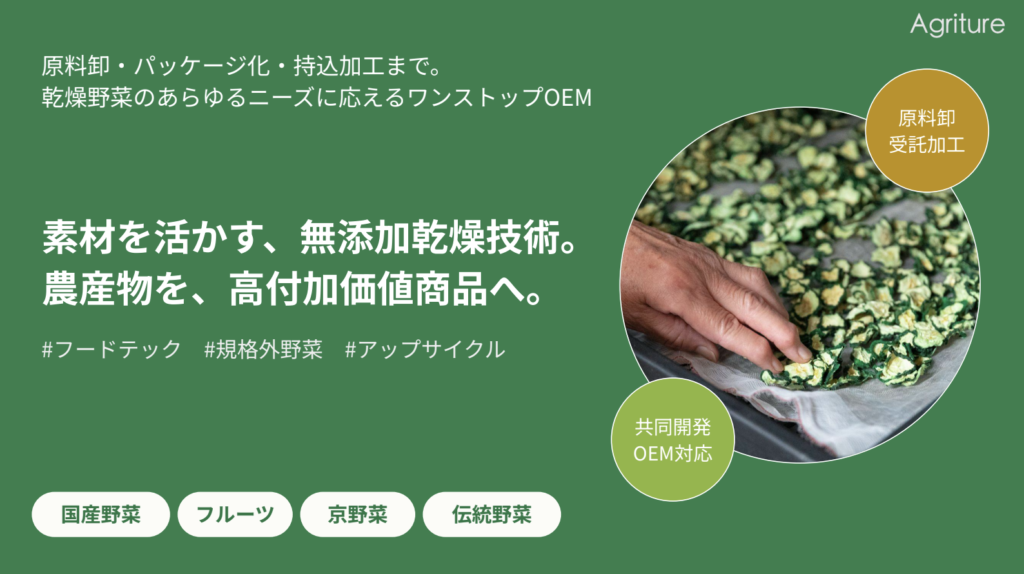
- OEM available from small lots of 10 kg
- Drying of brought-in raw materials also possible
- Support from processing to filling in one place
Vegetable furikake like this can be made (planning ideas)
Using dried vegetables, you can change the product's direction to match the aisle you're aiming for. We introduce 3 common planning types. All are structures achievable just by changing the raw-material selection and packaging form.
Regional / tourist-souvenir vegetable furikake
Drying local vegetables and using them for color finishes it as a souvenir that conveys the character of that place. Making use of off-grade vegetables, you can also add a story of local production for local consumption and food-loss reduction. Putting the regional name or an illustration on the package also raises its appeal as a gift.
Health-oriented, salt-reduced vegetable furikake
Drawing on the umami and aroma of vegetables makes it easier to build a design that doesn't feel lacking even with reduced salt. Using plenty of colorful vegetables, you can present it as a product to enjoy a vegetable feel sprinkled over daily rice. Following labeling rules, we decide the formulation together in consultation.
Novelty / promotional small-packet furikake
If distribution is the premise, promotional furikake in small packets or individual packaging with a logo or design added is suitable. If single-use is the premise, uniforming the particle size and designing it so the color shows when opened leaves an impression on the recipient. It can be used to create a hook to get people to pick it up — event or in-store distribution, a product freebie, and so on.
Starting furikake OEM in small lots
With your first product development, making a large quantity all at once is nerve-wracking. A realistic approach is to prototype in small lots first, then move to mass production while watching how it sells.
Minimum-lot guide
There are two minimum lots: the lot of the finished furikake product, and the processing lot of the dried vegetables that become the raw material. Thinking of them separately to avoid confusion prevents misreading the quote. Volume production of the finished product runs on the order of several thousand bags, while dried processing of the raw material can, for some items, be handled from a small 100 g lot, making it easy to prototype and check the ingredient in small quantities.
| Stage | Lot guideline | Aim |
|---|---|---|
| Prototyping | Small quantity / small lot | Lock in flavor and specs |
| Test sales | Small to medium lot | Gauge the shelf response |
| Mass production | Medium to large lots | Roll out at lower cost |
Tips for holding down initial cost
To hold down initial cost, it helps to draw on existing raw materials and standard-spec containers, start packaging from small-lot printing, and narrow the flavor types when prototyping. Designing on the premise of not building it up too much at first and growing it while watching the response lets you start with small risk.
Combine with other categories such as soup
Using the same dried vegetables, you can extend to products like soup and dashi with an idea close to furikake. Planning as a series makes it easier to hold down cost by sharing raw materials. How to start another category using dried ingredients is How to start soup OEM manufacturing is also a helpful reference.
The flow of furikake OEM from order to delivery
Knowing the flow when you actually request furikake OEM reveals what you need to prepare. Broadly, it proceeds in 4 steps: consultation, prototyping, volume production, and delivery.
From consultation to prototyping, volume production, and delivery
It starts with a consultation to convey the image of the product you want to make. After that, prototyping firms up the taste and spec, and once agreed, volume production, inspection, and delivery follow. Sharing what to check at each stage reduces rework.
- Consultation: align on product image, quantity, and budget
- Prototyping: decide the specs for taste, particle size, and packaging
- Volume production: manufacture to the agreed spec
- Delivery: after inspection, deliver to the designated destination
Requests to decide before consulting
To make the consultation go smoothly, organizing your requests in advance helps. The clearer the requests, the more concrete the maker's proposals and the faster development speeds up.
- Flavor direction (soy sauce, salt, dashi, vegetable-centered, etc.)
- Envisioned sales channel (souvenir, retail, commercial, novelty)
- Package form (bag, bottle, small packet, individual packaging)
- The desired lot and budget guide
- The delivery-date guide
Quality management, labeling, and certification
Since it's a food, confirming hygiene management, ingredient labeling, and allergen information is essential. Depending on the sales channel, certification or inspection may be required. Confirming the following points before requesting production gives peace of mind.
- The hygiene-management system (production environment, presence of inspection)
- Whether they can handle ingredient and allergen labeling
- Whether it meets the certifications and standards required by the sales channel
- The setting of best-before dates and handling of storage tests
How to choose a furikake OEM maker
The finish and smoothness change greatly with the choice of maker you request. The point is to compare not just price but also the range they can handle and their track record together.
Look at whether it's integrated or divided
A maker that can handle everything integrated — from raw-material processing to production and small-packet filling — has the point of contact consolidated into one, so development proceeds quickly. Especially for products like vegetable furikake, where raw material governs quality, a setup that can make it at a close distance from the raw material is a strength.
Compare on track record, quality management, and small-lot support
Confirm past production track record, the quality-management system, and whether they can handle your desired lot. If you want to test small and grow it, a maker flexible with small lots and prototyping suits you. The care in responding to inquiries is also a point to watch in a long relationship.
Compare multiple makers
Rather than deciding with just one company, comparing makers with different handling ranges and specialties makes it easier to find the partner that fits your plan. If you're searching across food OEM makers, including furikake, the furikake OEM manufacturing guide of the Food OEM Concierge is recommended for comparison.
We have materials available to help you understand dried processing OEM
Agriture OEM, flexibly handling everything from small lots to large lots
- OEM available from small lots of 10 kg
- Drying of brought-in raw materials also possible
- Support from processing to filling in one place
FOR BUSINESS
乾燥野菜のOEM・受託加工を承ります
国産の野菜・果物の乾燥、100メッシュ相当までの粉砕、10g以上の小袋充填までをお受けしています。小ロットの試作から量産までご相談ください。寄せられた相談の実例は OEM・卸のご相談 に掲載しています。
乾燥品の賞味期限は、出荷日から6ヶ月程度を目安にご案内しています。
Frequently asked questions
Summary: differentiate with furikake OEM that draws on vegetables
Furikake OEM is a means to plan and sell an original product even without owning equipment yourself. By pressing the process, form, and flavor base, and growing it from small-lot prototyping, you can advance commercialization while holding down risk.
Vegetable furikake with dried vegetables as the star especially rides the health-oriented trend easily, an area where the strength of a maker that can make it integrated from the raw material comes alive. If you're thinking of product-making that draws on local or off-grade vegetables, first organize the image you want to make and the quantity, and consult us.
Download the OEM contract processing materials
We will send the materials to your email address based on the information you provide.
If you are considering product development with off-spec or your own farm's vegetables:From planning to processing, materials, package printing and novelties, you can consult us through a single point of contact. → Learn more about one-stop product development
- How to Start a Herbal Tea OEM in Small Lots: Ingredients, Formats, and the Ordering Flow
- How to start a dashi OEM | A dried-vegetable maker explains vegetable dashi and dashi packs
Author of this article
Related articles
-
 Original coffee marketing strategy | Ways to grow sales
 -
 ベジタリアンとは?国の規格が分けている4つの区分と食べられないもの
 -
 長ねぎと白ねぎは同じもの?ねぎの種類と呼び名を国の資料で確かめる
 -
 柚子の種類は何種類あるのか、公の資料で名前が残る系統を数えた
 -
 ゆずの時期は年に二度、青ゆずは7月から黄ゆずは10月から
 -
 ゆずの産地は高知が半分を占め、二位は徳島から愛媛に変わった
 -
 Preventing Food OEM Failures: Common Failure Cases and Countermeasures for Success
 -
 How to find a food OEM | How to efficiently find the best manufacturing partner