
How to Start a Herbal Tea OEM in Small Lots: Ingredients, Formats, and the Ordering Flow

Summary of this article
We explain, for food manufacturers, how to start herbal-tea OEM in small lots: the factors that drive minimum lot and cost, the ordering flow, ingredient design that combines staple herbs with domestic herbs, dried vegetables, and edible flowers, choosing between loose-leaf and tea-bag forms, and integrated support from ingredient sourcing through filling and boxing.
You want to make your own brand of herbal tea, but ordering a large quantity all at once is daunting—that is where small-lot herbal-tea OEM comes in. Because you can prototype and produce from small amounts, you can bring an original blend to market while keeping inventory risk down.
This article organizes how to start herbal-tea OEM in small lots: the minimum lot and ordering flow, the ingredients you can use, how to choose the form, and integrated support from ingredient sourcing through filling. Small-lot commercialization using domestic herbs and dried vegetables is Tea OEM service you can also consult us at.
TOC
What it means to start herbal-tea OEM in small lots
Herbal-tea OEM means having your own brand of herbal tea made by entrusting a maker that has the production equipment. Choose a maker that handles small lots, and you can produce an original blend from a small quantity. It suits situations where you first want to test the market's reaction in small amounts—prototyping, test sales, events, and gifts.
The advantage of small lots is keeping initial cost and inventory risk down. Because you can move to full production after seeing the reaction, it pairs well with a low-volume, high-variety approach. It is used especially in the following situations.
- Launching a new brand and wanting to test the market's reaction first
- When you need only a small amount—seasonal, collaboration, or novelty items
- When you want to prepare a small quantity ahead of a crowdfunding campaign or trade show
- When you want to make several blend proposals a little at a time and identify the best sellers
Minimum lot and ordering flow
The minimum lot for herbal-tea OEM varies by maker and form. Some makers take orders from a few dozen bags, while others, given the blending process, assume several hundred to a thousand pieces. Knowing what drives the minimum lot and cost makes it easier to compare quotes.
| Behind Japan being chosen as the "first in Asia" are the following factors. | Effect on lot and cost |
|---|---|
| Ingredient sourcing unit | Rare herbs or materials available only in small amounts tend to push up the minimum lot |
| Form (loose-leaf / tea bag) | Tea-bag processing uses machinery, so a certain volume together is advantageous |
| Individual wrapping, tags | Adding individual wrapping or tagging increases the process and cost |
| Labels, boxing | Asking for label creation and boxing into a gift box adds initial cost |
If you want to try from a small amount, confirming the minimum-lot quantity and how far into the process you will outsource, up front, makes it easier to plan.
Ordering generally proceeds as follows.
- Inquiry and consultation: share the flavor direction you want, the use, quantity, and budget
- Material selection and blend prototyping: choose ingredients and prototype the blend to confirm taste and aroma
- Deciding the spec and packaging: decide the form (loose-leaf or tea bag), packaging, and label content
- Production and delivery: run the main production and finish with individual wrapping and boxing for delivery
With small lots, rather than jumping straight to production, it is reassuring to firm up the taste and aroma with a blend prototype before starting the main production. Adjusting the blend and fill weight at the prototype stage prevents a mismatch with the image after production. Because the preparation period varies with ingredient stock and the blending process, working backward from your desired launch date and starting the consultation early gives you schedule leeway.
The general take on cost benchmarks and choosing a maker is Tea OEM price benchmarks and How to request tea OEM manufacturing. For blends that incorporate yakuzen thinking, How to start yakuzen-tea OEM please also refer to.
FOR BUSINESS
乾燥野菜のOEM・受託加工を承ります
国産の野菜・果物の乾燥、100メッシュ相当までの粉砕、10g以上の小袋充填までをお受けしています。小ロットの試作から量産までご相談ください。寄せられた相談の実例は OEM・卸のご相談 に掲載しています。
乾燥品の賞味期限は、出荷日から6ヶ月程度を目安にご案内しています。
The range of ingredients usable in small lots
Herbal-tea ingredients aren't limited to staple herbs. By combining domestic herbs, dried vegetables, and even edible flowers, you can finish a blend with character you won't find elsewhere. It is precisely because it's a small lot that you can try rare materials in small amounts—another advantage.
- Staple herbs: chamomile, mint, lemongrass, rooibos, and more
- Domestic herbs and Japanese materials: wild Japanese mint, mugwort, yuzu peel, and more
- Dried vegetables and edible flowers: as materials that add color and flavor
A blend is built by layering small amounts of materials that complement flavor and color onto a lead material. We have organized the role of each ingredient category.
| Ingredient category | Example | Role in the blend |
|---|---|---|
| Base | Rooibos, lemongrass, wild Japanese mint | The lead that builds the flavor base |
| Accent | Chamomile, mint, yuzu peel | Adds character to aroma and taste |
| Color and flavor | Dried vegetables, edible flowers | Adds appearance and a sense of the season |
Because Agriture's strength is handling dried vegetables, powder, and domestic materials, you can consult us from the planning stage on seasonal blends that combine herbs with dried vegetables and flowers. Our thinking on blend-ratio balance is explained in detail in How to make herbal tea blends. Note that expressions claiming an effect on a specific condition are restricted under the Pharmaceutical and Medical Device Act, so we design around taste, aroma, and enjoyment.
We have prepared materials that explain small-pouch filling
Agriture, flexibly handling everything from small lots to large lots
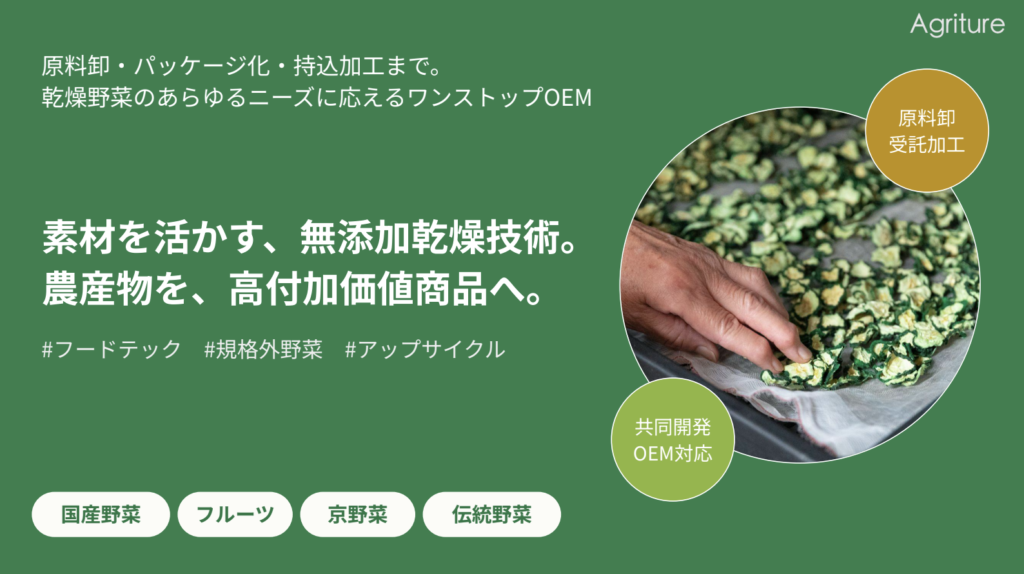
- Small-bag filling from 500 bags
- Tea and coffee also supported
- Sealing carried out in a single seamless flow
How to choose the form: loose-leaf or tea bag
Herbal-tea forms broadly split into loose-leaf (the leaves as they are) and tea bags. Choose to match your sales channel and the setting where it's used.
- Loose-leaf: you can enjoy the look of the materials. Suits gifts and specialty shops. Brewing takes some effort
- Tea bag: easy to brew, suited to everyday use and office demand
For tea bags, choose from the tetrahedral (tetra) type, which is three-dimensional and extracts well, or the flat-bag type, which is easier on cost. Because herbs are bulky with their stems and leaves, decide the shape and bag size to match the contents. For a detailed guide to shape and material selection, see Tea Bag OEM.
The strength of handling everything from ingredient sourcing to filling
When shaping herbal tea in small lots, the process spans many steps—sourcing ingredients, drying and cutting, blending, filling into tea bags or small bags, and boxing. Splitting these across multiple vendors tends to create losses in communication and lead time.
Agriture's strength is handling dried vegetables, powder, and domestic materials, and we take on everything from drying, cutting, and milling the ingredients to filling small bags and tea bags, printing the best-before date, and boxing—all in-house and from small lots. Because we can design the blend and filling with a full grasp of the ingredients' condition, there is less friction in moving from prototype to production than when the work is split among outside vendors. You can consult us from the planning stage on ideas like combining herbs with dried vegetables or Japanese materials such as Yuzu peel. For details on the filling process, see A complete guide to choosing filling-processing OEM, and for planning a health tea with function claims, see How to start health-tea OEM.
We have prepared materials that explain small-pouch filling
Agriture, flexibly handling everything from small lots to large lots
- Small-bag filling from 500 bags
- Tea and coffee also supported
- Sealing carried out in a single seamless flow
FOR BUSINESS
乾燥野菜のOEM・受託加工を承ります
国産の野菜・果物の乾燥、100メッシュ相当までの粉砕、10g以上の小袋充填までをお受けしています。小ロットの試作から量産までご相談ください。寄せられた相談の実例は OEM・卸のご相談 に掲載しています。
乾燥品の賞味期限は、出荷日から6ヶ月程度を目安にご案内しています。
FAQ
Summary
With herbal-tea OEM, choosing a maker that handles small lots lets you shape an original blend from a small amount. Confirm the minimum lot and ordering flow first, and by combining staple herbs with domestic herbs, dried vegetables, and edible flowers, you can plan a blend you won't find elsewhere. Choose the form—loose-leaf or tea bag—to match your sales channel, and by using a setup that runs everything from ingredient sourcing through filling and boxing in one, you can commercialize from prototype to production with less effort.
Recommended reading
- How to Request Tea OEM Manufacturing: A Complete Guide to the Industry's 5 Types and a Cost Breakdown
- How to make an herbal tea blend | Formulation design balanced with bitterness, tartness, and umami
- What Is a Tea Bag OEM? How to Choose the Shape, Material, and Contents, and the Small-Lot Ordering Flow
- How to start a health tea OEM | How to build a brand chosen for functional beverages
- Tea OEM Price Ranges: 5 Ways to Keep Costs Down and 7 Points for Quotes
Download the small-pouch filling materials
We will send the materials to your email address based on the information you provide.
If you are considering product development with off-spec or your own farm's vegetables:From planning to processing, materials, package printing and novelties, you can consult us through a single point of contact. → Learn more about one-stop product development
- What Is a Tea Bag OEM? How to Choose the Shape, Material, and Contents, and the Small-Lot Ordering Flow
- What is furikake OEM? A dried-vegetable maker explains small-lot, vegetable-furikake manufacturing
Author of this article
Related articles
-
 Original coffee marketing strategy | Ways to grow sales
 -
 ベジタリアンとは?国の規格が分けている4つの区分と食べられないもの
 -
 長ねぎと白ねぎは同じもの?ねぎの種類と呼び名を国の資料で確かめる
 -
 柚子の種類は何種類あるのか、公の資料で名前が残る系統を数えた
 -
 ゆずの時期は年に二度、青ゆずは7月から黄ゆずは10月から
 -
 ゆずの産地は高知が半分を占め、二位は徳島から愛媛に変わった
 -
 Preventing Food OEM Failures: Common Failure Cases and Countermeasures for Success
 -
 How to find a food OEM | How to efficiently find the best manufacturing partner