
What Is a Tea Bag OEM? How to Choose the Shape, Material, and Contents, and the Small-Lot Ordering Flow

Summary of this article
For food manufacturers, we organize and explain, from the basics of tea-bag OEM, how to choose shapes such as pyramid and flat bags and materials such as Soilon and nylon mesh, contents usable from green tea, black tea, and herbs to dried vegetables and edible flowers, the ordering flow and small-lot handling, and how to proceed end-to-end through filling, individual wrapping, and boxing.
When you want to make your own brand's tea, making it into tea bags rather than selling loose leaves gives the convenience of brewing just by pouring hot water, making it easy to turn into a product for gifts and everyday use. Outsourcing tea-bag manufacturing to a specialist maker is tea-bag OEM. The finish and cost change with the choice of shape, contents, and lot.
This article organizes, from the basics of tea-bag OEM, the types of shape and material, raw materials usable as contents, the ordering flow and small-lot handling, and how to proceed end-to-end through filling and boxing. For how to proceed when you want to turn dried vegetables or herbs into tea bags in small lots, Tea OEM service and Small-bag filling OEM service you can also consult us at.
TOC
What is tea-bag OEM?
Tea-bag OEM is making your own brand's tea-bag products by outsourcing to a maker with production equipment. You can leave part or all of the processes—raw-material selection, blend design, cutting the tea leaves, filling into tea bags, individual wrapping, and boxing into outer bags or gift boxes. Because you can have an original product without capital investment, it is used broadly, from D2C brands to cafes, retail, and novelty uses.
Types of tea-bag shape and material
Tea bags are chosen by the combination of shape and material. Decide according to the size of the tea leaves inside, how you present them, and ease of brewing.
| Shape | Suitable contents | Presentation and sales channel | Small-lot suitability | Cost sense |
|---|---|---|---|---|
| Pyramid (tetra) type | Larger leaf black tea, herbs, blends | Gifts and cafes where you want to show the contents | High | Somewhat high |
| Flat-bag (double) type | Green tea, health teas, fine tea leaves | In-store mass sales, everyday use | High | Easy to keep down |
| With string and tag | A specification that can be added regardless of shape | Brand name printed on the tag, gifts | Ordinary | Processing cost is added |
As a guide for choosing, working backward from the sales channel makes it easier to decide: pyramid type for gifts where you want to show the leaves, flat-bag type for everyday products that sell in volume in stores, and with-tag when you want to push the brand name.
For materials, there are plant-derived, biodegradable Soilon and PLA, translucent nylon mesh, and easy-to-keep-down nonwoven fabric, among others. If you consider the environment, choose a biodegradable material; if you want to show the contents, choose mesh. Affinity with the particle size of the contents is also important, but this is covered in detail in the design points later. For thinking on eco-conscious materials, Sustainable packaging please also refer to.
FOR BUSINESS
乾燥野菜のOEM・受託加工を承ります
国産の野菜・果物の乾燥、100メッシュ相当までの粉砕、10g以上の小袋充填までをお受けしています。小ロットの試作から量産までご相談ください。寄せられた相談の実例は OEM・卸のご相談 に掲載しています。
乾燥品の賞味期限は、出荷日から6ヶ月程度を目安にご案内しています。
The range of raw materials usable as contents
The contents of tea bags are not only standard teas such as green tea and black tea. A wide range of raw materials can be turned into tea bags—herbs, health teas, and even dried vegetables and edible flowers.
- Standard teas such as green tea, black tea, and Chinese tea
- Herbs, health teas, blended teas
- Distinctive blends using dried vegetables and edible flowers
Dried vegetables, herbs, and flowers in particular, by being involved from the raw material's drying, cutting, and blend design, can be finished into one-of-a-kind tea bags that make use of aroma and color. For designing black-tea blends, Black tea OEM, and for blending herbs, How to make herbal tea blends please also see. Since the suitable bag material changes with the fineness of the raw material, we design with ease of brewing in mind as well.
We have prepared materials that explain small-pouch filling
Agriture, flexibly handling everything from small lots to large lots
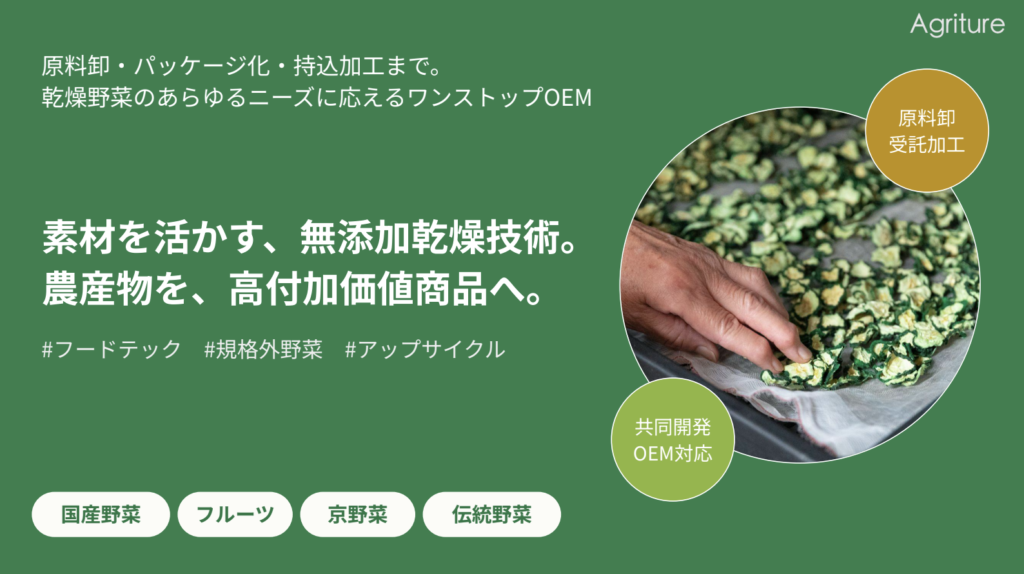
- Small-bag filling from 500 bags
- Tea and coffee also supported
- Sealing carried out in a single seamless flow
The ordering flow and small-lot handling
Ordering tea-bag OEM generally proceeds in the following flow. Since the minimum lot varies by maker and shape, confirming it at an early stage makes planning easier.
- Inquiry and meeting: share the contents, shape, quantity, and budget
- Sample and quote: check the finish and decide the fill amount (amount per bag) and specifications
- Production and delivery: do the main production and deliver, finished through individual wrapping and boxing
With major OEM makers, several thousand to tens of thousands of units may be assumed, but for prototyping and test sales there are many situations where you want to start from a small quantity. Choosing a maker that handles small lots lets you try productization while keeping inventory risk down.
Thinking on fill amount and cost
The cost of tea-bag OEM is determined by stacking up several elements. To read a quote, knowing what moves the unit price makes comparison easier.
- Fill amount: the amount of contents per bag. The more, the higher the raw-material cost. Tea leaves are easy to decide by weight, but for bulky herbs, dried vegetables, and flowers, check not only weight but also the volume that fits in the bag
- Shape and material: pyramid type and mesh materials tend to raise the unit price above flat bags
- Accompanying processing: tagging, individual wrapping, boxing into outer bags or gift boxes, and printing the best-before date each add cost
- Lot quantity: small lots have a high unit price per piece, which falls as the quantity increases
When requesting a quote, conveying the contents, shape, fill amount, desired quantity, and the scope of packaging finish all together makes the exchange smooth. The fill amount in particular is directly tied to raw-material usage, so deciding it first curbs fluctuation in the total.
Design points for turning dried vegetables, herbs, and flowers into tea bags
When turning raw materials other than tea leaves into tea bags, achieving both ease of brewing and appearance and aroma is the key. Design tailored to the raw material's condition leads to a difference in the finish. We have organized the points to master by raw-material type.
| Raw-material type | Particle-size guide | Suitable bag material | Failures that tend to occur |
|---|---|---|---|
| Tea leaves (green tea, black tea) | Fine to medium | Fine-mesh or flat bags | Too fine, so the brew turns cloudy |
| Herbs (leaves, stems) | Medium to coarse | Three-dimensional pyramid type | Bulky and does not fit in the bag |
| Dried vegetables and root vegetables | Medium | Pyramid type or fine-mesh material | Hard and takes time to brew |
| Edible flowers | Whole to coarse | Translucent mesh pyramid type | Crumble and their appearance is spoiled |
Match particle size and bag material
The finer the raw material, the more easily the components come out, but with a coarse-mesh bag, powder can leak or the brew can turn cloudy. Conversely, packing bulky herbs or flowers into a small flat bag means they do not fit and brewing also becomes weak. The tip is to decide the bag's size and material by looking not only at weight but also at bulk. For dried vegetables and flowers, there are many cases of reviewing the bag material once at the prototype stage; checking leakage, cloudiness, and appearance with samples before proceeding to main production avoids failure.
Preserve color and aroma
Dried vegetables and flowers are raw materials whose color and aroma change easily with processing heat and time. By carefully managing the drying and cutting processes and combining strongly aromatic ingredients with mild ones, you can finish a blend that is easy to drink and also enjoyable to look at. The basic build is to layer a small amount of ingredients that supplement flavor and color onto the starring ingredient.
Proceed end-to-end through filling, individual wrapping, and boxing
A tea bag does not become a product just by being processed. It is finally ready for sale once it is individually wrapped, packed into an outer bag or gift box, and printed with the best-before date. Arranging processing and filling/boxing with separate contractors tends to create losses in communication and delivery time.
Agriture can handle everything from small lots end-to-end—from procuring raw materials such as dried vegetables, herbs, and powders, to filling into tea bags and small bags, individual wrapping, and boxing. Because we make raw-material drying, cutting, and blend design our strength, we can give shape not only to tea leaves but also to distinctive teas using dried vegetables and flowers. We also handle a process of starting from prototypes and expanding to mass production while watching the response. For details of the filling process, A complete guide to choosing filling-processing OEM.
We have prepared materials that explain small-pouch filling
Agriture, flexibly handling everything from small lots to large lots
- Small-bag filling from 500 bags
- Tea and coffee also supported
- Sealing carried out in a single seamless flow
FOR BUSINESS
乾燥野菜のOEM・受託加工を承ります
国産の野菜・果物の乾燥、100メッシュ相当までの粉砕、10g以上の小袋充填までをお受けしています。小ロットの試作から量産までご相談ください。寄せられた相談の実例は OEM・卸のご相談 に掲載しています。
乾燥品の賞味期限は、出荷日から6ヶ月程度を目安にご案内しています。
FAQ
Summary
Tea-bag OEM is a method for giving shape to an original tea through the combination of shape, material, and contents. The key point is to work backward from the sales channel—pyramid type for gifts, flat bags for mass sales—and choose a bag material that matches the particle size of the contents. Ordering proceeds in the flow of inquiry, meeting, sample, and production, and choosing a maker that handles small lots lets you try it while keeping inventory risk down. Using a structure that lets you entrust everything end-to-end from processing to filling and boxing, you can productize teas using dried vegetables and herbs while keeping the effort down.
Recommended reading
- How to Request Tea OEM Manufacturing: A Complete Guide to the Industry's 5 Types and a Cost Breakdown
- Black Tea OEM Original Blends: Origin and Flavor Design
- How to make an herbal tea blend | Formulation design balanced with bitterness, tartness, and umami
- How to start a health tea OEM | How to build a brand chosen for functional beverages
- The Complete Guide to Choosing a Filling OEM | Points for Selecting a Contractor Without Regret
Download the small-pouch filling materials
We will send the materials to your email address based on the information you provide.
If you are considering product development with off-spec or your own farm's vegetables:From planning to processing, materials, package printing and novelties, you can consult us through a single point of contact. → Learn more about one-stop product development
- What Is Small-Lot Package Printing? Methods, Costs, and Tips for Submitting Data in Small Quantities
- How to Start a Herbal Tea OEM in Small Lots: Ingredients, Formats, and the Ordering Flow
Author of this article
Related articles
-
 Original coffee marketing strategy | Ways to grow sales
 -
 ベジタリアンとは?国の規格が分けている4つの区分と食べられないもの
 -
 長ねぎと白ねぎは同じもの?ねぎの種類と呼び名を国の資料で確かめる
 -
 柚子の種類は何種類あるのか、公の資料で名前が残る系統を数えた
 -
 ゆずの時期は年に二度、青ゆずは7月から黄ゆずは10月から
 -
 ゆずの産地は高知が半分を占め、二位は徳島から愛媛に変わった
 -
 Preventing Food OEM Failures: Common Failure Cases and Countermeasures for Success
 -
 How to find a food OEM | How to efficiently find the best manufacturing partner