
Lessons from Office Convenience-Store Testimonials: Keys to Successful Adoption and How to Choose Without Failing

"Just walking to the convenience store and back at lunch eats up 15 minutes"; "stepping out is a change of pace, but by the time you're back the break is already over"—if you're an office worker, you've surely felt this at least once. If there were a little convenience store inside the office, those 15 minutes could turn straight into rest and refueling. That's the essential proposition of an office convenience store.
An office convenience store is a welfare service that keeps snacks, drinks, light meals, side dishes, health snacks, and the like on hand in the office so employees can buy them anytime, on their own schedule. The mainstream setup places a refrigerator or dedicated shelf in the office, and the service provider restocks regularly. It has come to be positioned as a leading candidate for the dietary-improvement measures in Certified Health & Productivity Management Outstanding Organization certification, and the number of companies adopting it has grown significantly from 2025 into 2026.
Behind this are shifts in how we work and the diversification of employee needs. With hybrid work now established, the meaning of "a day you come into the office" has changed, and companies are being asked how to design not merely a workspace but "a place worth coming to." The food environment sits at the heart of this, and what you can choose for each daily lunch and short break ties directly to both the motivation to come in and the numbers on your health checkup.
That said, services split into dozens of types, with price ranges spanning free to hundreds of thousands of yen a month, so choosing wrong leads to sluggish usage rates or a heavier operational burden. In this article, drawing on the accounts of companies that adopted it, we organize—from a practical standpoint—comparisons of the major services, five selection checkpoints, a four-step adoption procedure, and even new options such as the one run by the Kai Group × Agriture, Office Yaoya (office greengrocer) which we cover here.
TOC
Three issues an office convenience store solves
Listen to companies considering an office convenience store, and the worries that surface come down to three: "the time of convenience-store round trips," "nutritional imbalance," and "insufficient communication." Each looks like an independent issue—work efficiency, health, and organizational culture—but in fact they connect at a single point: "the food environment in the office."
| Challenge | Background | Solved by an office convenience store |
|---|---|---|
| Lost time going out during breaks | In high-rise buildings, waiting for the elevator plus the convenience-store round trip takes 15–20 minutes. Lunchtime crowds add even more time | Because it's done in-house, employees can procure meals and snacks with zero travel time |
| Nutritional imbalance | In desk-work-centered workplaces, diets tend to skew toward bread, rice balls, and cup noodles. An MHLW survey finds that Japanese people fall short of vegetables by about 70 g a day on average | Keep healthy snacks and vegetable-based options on hand in the office to promote everyday dietary improvement |
| Insufficient inter-department communication | Combined remote work and floor dispersion reduce points of contact among employees | The stocking area becomes a natural place for interaction, generating conversation that crosses departments |
Especially noteworthy is the "communication effect." As people naturally gather at the office convenience store's location, conversation arises among employees who have no work-related contact. Some companies combine it with a benefit allowance to build a "culture of gifting snacks to one another," and effects beyond mere improvement of the food environment can be expected.
In IT and creative workplaces, an environment where you can refuel easily at moments when focus breaks also contributes to sustaining productivity. Simply changing "15 minutes going to the convenience store" into "5 minutes eating at your desk while you rest" adds up to 10 minutes of time created per day.
A comparison of the major office convenience-store services
We compared representative office convenience-store services. Choose to match the type your own employees want.
| Service name | Type | Initial cost | Monthly guide | Features |
|---|---|---|---|---|
| Office Glico | Snacks & drinks | Free | Free (product cost only) | No. 1 in adoption rate. Setup and restocking handled by staff |
| Seven Vending Machine | Drinks & light meals | Free | Free (electricity cost only) | The reassurance of a convenience-store brand. High drink satisfaction |
| Office Okan | Meals & side dishes | Free | About 30,000 yen and up | Side dishes supervised by a registered dietitian. From 100 yen per item |
| Office de Yasai | Vegetables & fruit | Free | About 30,000 yen and up | Centered on fresh vegetables and fruit. High satisfaction for meal-type items |
| Taberel | Frozen bento, bread, rice balls, snacks | 50,000 yen | 39,000 yen and up | Carries tasty foods from all over the country and products talked about in the media. |
| Office Yaoya (office greengrocer) | Dried vegetables | Free | Free (product cost only) | Room-temperature storage, no waste. From 100 yen per meal |
Services broadly split into "snacks & drinks type" and "meals & side dishes type." The snack type can start with both no initial fee and no monthly fee, making it good for companies that want to try it first. The meal type carries a cost of around 30,000 yen a month, but has a bigger effect on employees' health improvement and satisfaction.
Agriture's "Office Yaoya" stands out for achieving the health benefits of the meal type at the cost profile of the snack type (no initial fee, no monthly fee). Since it's just adding dried vegetables to existing lunches, it can be adopted without changing employees' eating habits.
The snacks & drinks type is easy to start with, while the meal type costs more but contributes more to health management. In adoption rate, Office Glico ranks first, but in satisfaction, Seven vending machines rate highly among drink types and Office de Yasai among meal types.
Learn about Office Yaoya
We have prepared materials
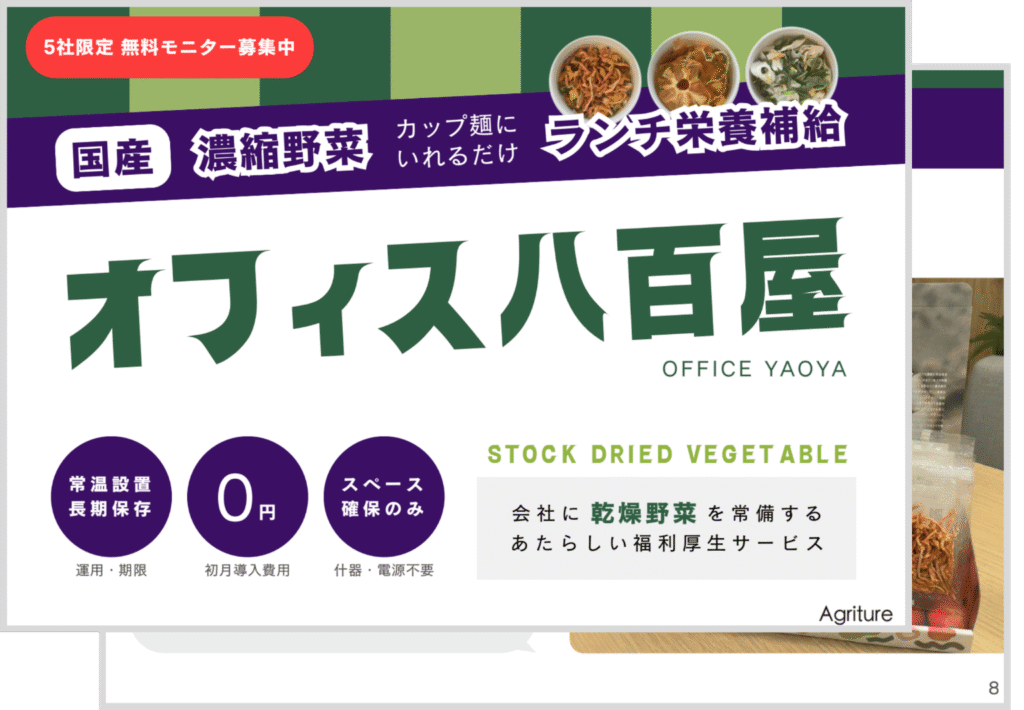
- Service details and vegetable lineup
- Pricing and plans
- How adoption and operation work
Sample sets are also available. Download the materials for details!
We offer sample sets so you can try Office Yaoya in small quantities. See the materials for details.
How to choose an office convenience store: five checkpoints
| Checkpoint | What to check | Points to note |
|---|---|---|
| 1. Initial fee and running cost | Whether setup is free, whether there's a monthly fee, who bears the electricity cost | The meal type runs about 30,000 yen a month. Decide the budget in advance |
| 2. Product lineup | Lunch demand, snack demand, or health-focused | Note that space constraints limit the range you can carry |
| 3. Payment method | Whether cashless is supported (electronic money, QR, etc.) | Since unattended sales are the norm, also check theft and misuse countermeasures |
| 4. Installation space | Refrigerator size, whether there's a power source, candidate placement locations | Locations near the break room or pantry tend to have higher usage rates |
| 5. Restocking and support system | Restocking frequency, response to out-of-stocks, whether there's a dedicated contact | Check in advance the risk of stockouts during busy seasons or for popular items |
Choosing on cost alone tends to bring complaints about product quality or restocking response. In fact, after adoption you also hear voices like "the products we expected weren't stocked" or "restocking was infrequent, so stockouts continued." Survey employee needs in advance, and while referring to A detailed comparison of office stocked-snack services as well, judge comprehensively.
The four steps to adopting an office convenience store
| Step | What to do | Point |
|---|---|---|
| 1. Grasp the needs | Survey employees' wishes via an internal questionnaire or interviews | Grasp tendencies such as "healthy meals," "quick light meals," and "a refresh" |
| 2. Compare services | Narrow the candidates to three or more and compare quotes and terms | Evaluate using the five checkpoints above |
| 3. Trial adoption | Check usage rate and reactions over a 1–3-month trial period | Choosing a service you can cancel with no penalty gives peace of mind |
| 4. Regular review | Survey satisfaction quarterly even after full adoption | Maintain the usage rate by improving the product lineup and placement |
During the trial period, surveying employees to grasp "which products are popular" and "what's missing" raises satisfaction after full adoption. As for placement, in some cases positioning it near the work area, not just the break room, raises the usage rate.
Using an office convenience store for health management
In desk-work-centered workplaces, lunch is often just bread or rice balls, making vegetable shortfalls and nutritional imbalance an issue. Dietary improvement is included among the certification items for "Certified Health & Productivity Management Outstanding Organization," and office convenience stores are rated as an effective measure.
Services with a rich lineup of health-conscious options—healthy snacks, low-GI foods, snacks that supplement fiber—tend to be favored. According to an MHLW survey, Japanese people fall short of vegetables by about 70 g a day on average. Improving the office food environment is one realistic means of filling that gap. 16 healthy snacks popular in the office please also use as a reference.
Easily resolve vegetable shortfalls with dried vegetables: Agriture's "Office Yaoya"
Conventional office convenience stores carried three operational burdens: "refrigeration is needed," "short shelf life leads to waste," and "they take up installation space." The option that solves these, which began in earnest in April 2026, is the one run by Kai Group's Agriture Inc., Office Yaoya (office greengrocer). Keep dried vegetables on hand in the office, and employees just add a bag at a time to cup noodles, miso soup, or soup on their own schedule—topping up hard-to-get vegetables in small daily portions without changing existing lunches.
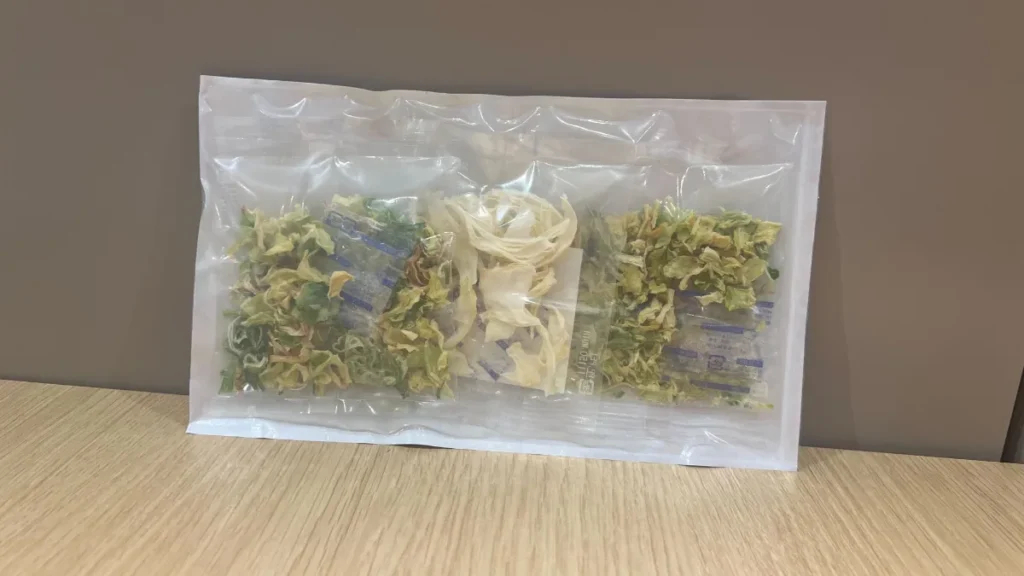
The ingredients are 100% domestic vegetables, use no sugar or additives whatsoever, and are individually wrapped, low-temperature dried to concentrate flavor and nutrition. On top of that, a major feature is that it buys off-spec vegetables that are misshapen and cannot go to market from producers at a fair price, and upcycles them. Adopting companies can implement both the dietary improvement of health management and food-loss reduction in a single service. The fact that it targets busy business people in their 20s–40s is also why it pairs well with those who don't want time taken up by convenience-store round trips.
Agriture's representative, Rei Kojima, comments: "Through efforts to broaden the possibilities of familiar vegetables, we will work to help support Japan's food and health." As a B2B2C service combining the Kai Group's food-related businesses (Chefon, corporate meal kits, etc.) with Agriture's dried vegetables, it is becoming a new option for corporate employee benefits.
| Item | Details |
|---|---|
| Mechanism | Keep individually wrapped dried vegetables on hand in the office. Add them straight to soup or miso soup |
| Price | From about 100 yen per meal. No initial fee, no monthly fee |
| Storage | Room-temperature storage, long-term shelf life of three months or more. No refrigeration needed |
| Raw materials | Uses domestic off-spec vegetables. Also helps cut food loss |
| Nutrition | One pack (about 7 g) can top up a day's worth of the vegetable shortfall |
| Management | Room-temperature storage makes restocking and inventory management easy. Virtually zero waste |
Unlike refrigerated salads, it's less prone to waste and needs no equipment or power. Salad-type services face the issue of "short expiry dates increasing waste," but dried vegetables keep at room temperature for three months or more, so even small offices can operate without worrying about waste. As part of measures to raise employee satisfaction through benefits,you can also start with a test rollout in a single department first.
Workplaces where Office Yaoya fits
Office Yaoya is a service that pairs well with workplaces that want to lift the food environment without adding equipment or operational burden. Agriture receives inquiries from workplaces like the following.
- Small offices with no space for a refrigerator (room-temperature storage means minimal power and shelving)
- Companies setting numerical targets for "vegetable intake" in health management (one pack makes topping up vegetables easy)
- Companies that value food-loss reduction and the SDGs (upcycling off-spec vegetables is easy to convey as an internal initiative)
- Companies combining remote work that want to raise the value of in-office days (on an in-office day, you can add vegetables to a warm cup)
Starting with a test rollout of one department, around 10 people, to gauge the usage rate before company-wide deployment is the low-failure way to proceed. Because room-temperature storage keeps stock from spoiling easily, even if restocking lags during busy seasons, waste is unlikely.
Frequently asked questions about office convenience stores
Learn about Office Yaoya
We have prepared materials
- Service details and vegetable lineup
- Pricing and plans
- How adoption and operation work
Sample sets are also available. Download the materials for details!
We offer sample sets so you can try Office Yaoya in small quantities. See the materials for details.
Summary
What companies that successfully adopt an office convenience store have in common is that they find three values: "effective use of time," "livelier communication," and "contribution to health management." When choosing a service, compare against five checkpoints: cost, product lineup, payment method, installation space, and restocking system.
The right answer to adoption is not "choosing one perfect company from the start" but "confirming firsthand whether it fits your company's needs." Gather usage rates and employee voices over a 1–3-month trial period, and proceed to full deployment while fine-tuning restocking frequency and product lineup, and the failure probability drops sharply.
Companies that "want to try snacks & drinks first" have Office Glico and Seven vending machines; those that "want to hit health-management numerical targets" have Office de Yasai or Office Yaoya (office greengrocer), and those that "want to provide meals" have Office Okan as options. Office snack adoption guide | A comparison of pricing and selection across 8 stocking-service providers and 16 healthy snacks popular in the office Checking as well helps the combination best suited to your company come into view.
Download the office dried vegetable materials
We will send the materials to your email address based on the information you provide.
- A thorough comparison of office snack services! 10 points for how to choose
- [2026 edition] What is a meal subsidy as an employee benefit? A guide to adoption steps and a comparison of popular services
Author of this article
Related articles
-
 [2026 edition] What is a meal subsidy as an employee benefit? A guide to adoption steps and a comparison of popular services
 -
[2026 edition] Meal-subsidy benefits usable at convenience stores | 3 ways to adopt them tax-free
-
[2026 edition] 6 disadvantages of placed staff meals and how to avoid them | An adoption checklist to avoid failure
-
 A Must-See for HR: 12 Measures to Raise Employee Satisfaction Through Benefits
 -
 Food Questions in the Health and Productivity Management Survey: What to Write to Score Points
 -
Summary of tax benefits for dining subsidies | Tax-exemption requirements and expense booking
-
Food Programs for Health and Productivity Management: How Much Will It Actually Cost for a Company Our Size?
-
Meal-benefit plans that even small offices of 10 or fewer people can start