
Five tips for getting a health-management meal measure approved | Data and cost-effectiveness

"I want to introduce a meal benefit"—even when HR or general-affairs staff think this, the biggest wall is getting approval from management. In most cases, they're asked about cost-effectiveness and stall because they can't answer in numbers. In fact, meal measures have more material you can speak to in terms of ROI than other benefits—"improved health-checkup scores," "lower turnover," "recruiting branding," and more. The knack is not to push only with the qualitative "employee satisfaction" but to translate "return on investment" into management's terms with quantitative numbers. This article organizes, from a practical viewpoint and based on data from companies that actually got approval, 5 tips for creating a persuasive proposal document, a concrete template for calculating ROI, how to measure post-introduction effects to secure next year's budget, and cases of meal measures that pass approval easily, such as Office Yaoya (office greengrocer) operated by the Kai Group × Agriture.
- 5 Points to Nail Down to Pass Approval for Meal Measures
- How to Calculate Cost-Effectiveness That Convinces Management
- The Data and Structure Template to Build into the Proposal Document
- Angles of Persuasion Learned from Other Companies' Cases
- How to Secure Next Year's Budget Through Post-Introduction Effect Measurement
Even if you think "I want to introduce a meal benefit," nothing starts unless the approval goes through.
If you're a general-affairs or HR person, you've probably experienced it at least once. You consult your boss and get "come back with the cost-effectiveness," and there your work stalls.
Honestly, showing the cost-effectiveness of meal measures in numbers isn't easy. But if you nail the knack, you can create a document that moves management to think "this is worth investing in."
This article shares how to create a persuasive proposal document, based on cases and data from companies that actually got approval.
TOC
The Positioning of Meal Measures in Health Management and the Wall of Approval
Why Meal Measures Tend to Stall at Approval
Health-management measures include various things—exercise programs, mental-health measures, and so on—but meal measures in particular tend to face a high approval bar.
The reason is simple: the perception that "aren't meals a personal matter?" runs deep.
Summing up the objections that often come from management looks like this.
| Common objection | The thinking behind it |
|---|---|
| Meals are self-responsibility | The necessity of investing as a benefit isn't clear |
| The effect is hard to see | ROI is harder to measure than for exercise or quitting smoking |
| Worried whether it will last | Seems like it'll end as a temporary fad |
| The cost is unpredictable | Running costs are opaque due to headcount fluctuation |
| There are other things to do | Mental-health measures are a higher priority |
Preparing answers to these objections in advance is the first step to breaking through approval.
The Relevance to METI's "Certified Health & Productivity Management Outstanding Organization" Recognition
It tends to be overlooked, but meal measures also relate to the recognition requirements for Certified Health & Productivity Management Outstanding Organizations.
Recognized companies can gain an edge in both recruiting and evaluation from business partners, so the angle of "a measure necessary to obtain recognition" resonates easily with management.
In fact, there's data suggesting that the stock performance of companies recognized as Certified Health & Productivity Management Outstanding Organizations tends to outperform TOPIX. Just building in this perspective of "raising corporate value" significantly boosts the persuasiveness of the approval document.
An Overview of Meal-Measure Types and Cost Sense
Before creating the approval document, first grasp the options for meal measures.
| Measure type | Monthly guideline (per person) | Ease of introduction | Ease of seeing results |
|---|---|---|---|
| Cafeteria / company canteen | 8,000–15,000 yen | Low (large capital investment) | High |
| Placed-cafeteria service | 3,000–6,000 yen | High | Medium to high |
| Delivered bento | 4,000–8,000 yen | Medium | Medium |
| Meal-subsidy tickets | 3,500–7,000 yen | High | Medium |
| Keeping healthy foods on hand | 500–2,000 yen | Very high | Low to medium |
| Nutritional guidance program | ¥1,000–3,000 | Medium | Medium |
What we'd like you to note is "keeping healthy foods on hand." Healthy foods that can be kept in the office, such as dried-vegetable soup and snacks, can be started at a low cost of 500–2,000 yen a month.
We at Agriture also make proposals for offices using Kyoto-grown dried vegetables, and we find that an approach of starting small, measuring effects, and expanding in phases is the easiest to get approved.
How to Calculate Cost-Effectiveness That Moves Management
Work Backward from the Loss Cost of Presenteeism
The most powerful thing for calculating cost-effectiveness is data on "presenteeism."
Presenteeism is the state of being at work but with reduced productivity due to poor physical condition. According to research by the University of Tokyo, presenteeism accounts for about 80% of a company's health-related costs.
The concrete formula is as follows.
Loss from presenteeism = number of employees × average annual salary × productivity-decline rate
The productivity-decline rate is said to average 3–5% for meal-related reasons (nutritional imbalance, post-lunch drowsiness, etc.).
Calculating for a 100-person company……
| Item | Figure |
|---|---|
| Number of employees | 100 people |
| Average annual salary | 5 million yen |
| Meal-related productivity-decline rate | 4% |
| Annual loss | 20 million yen |
Even introducing a 3,000-yen/month meal measure for 100 people is 3.6 million yen a year. That works out to just 18% of the 20-million-yen loss.
Just showing this number greatly weakens the objection that "meals are a personal matter."
Add the Reduction Effect on Absenteeism
On top of presenteeism, build in the reduction effect on absenteeism (absence due to illness) as well.
There's data showing that companies that introduced meal-improvement programs saw annual sick-leave days fall by an average of 1.2 days.
For a 100-person scale, 1.2 days × 100 people = 120 person-days. If the labor cost per person-day is 20,000 yen, that's an annual reduction effect of 2.4 million yen.
Quantify the Effect of Curbing Medical Costs
Another effect not to be missed is curbing medical costs.
The health-insurance premiums companies bear are rising year by year, and preventing lifestyle-related diseases through meal measures directly leads to reducing medical costs over the mid-to-long term.
Companies engaged in health management report a per-person annual medical-cost reduction of 10,000–30,000 yen. For a 100-person scale, that's an impact of 1–3 million yen a year.
Summing up the three so far……
| Effect item | Annual reduction (100-person scale) |
|---|---|
| Presenteeism improvement | Part of 20 million yen (2 million yen at 10% improvement) |
| Absenteeism reduction | 2.4 million yen |
| Medical-cost curbing | 1–3 million yen |
| Total | 5.4–7.4 million yen |
| Measure cost (3,000 yen/month × 100 people) | 3.6 million yen |
| ROI | 150〜206% |
If the ROI exceeds 100%, it's fully rational as an investment. With these numbers, management can more easily judge that "it's worth trying."
Learn about Office Yaoya
We have prepared materials
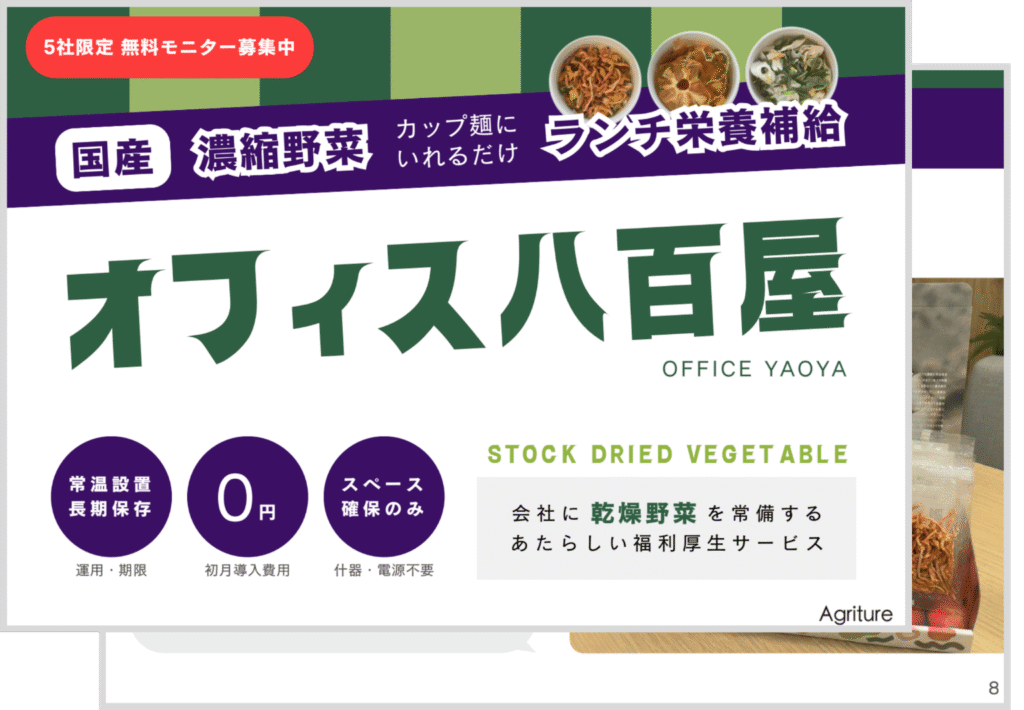
- Service details and vegetable lineup
- Pricing and plans
- How adoption and operation work
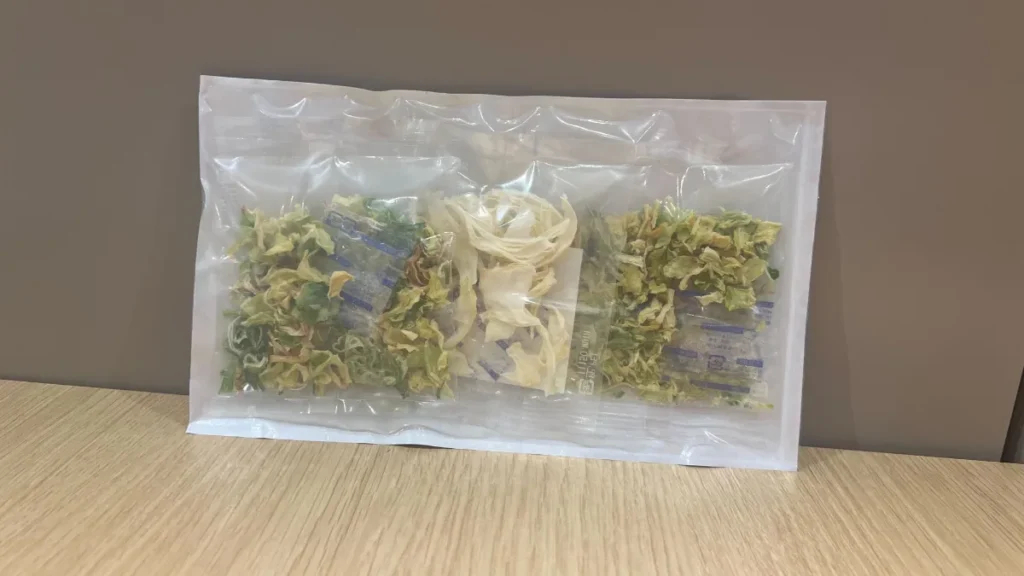
Sample sets are also available. Download the materials for details!
We offer sample sets so you can try Office Yaoya in small quantities. See the materials for details.
5 Points for Creating an Approval Document That Passes
Point 1: Use a Three-Part Structure of Issue → Measure → Effect
The basic structure of an approval document is a three-part structure: "why it's needed → what you'll do → what effect it has."
A common failure is jumping straight into explaining the measure. The rule is to first present the fact that "our company has this issue."
A concrete structure like this is recommended.
- Current issue (health-checkup abnormal-finding rate, presenteeism survey results)
- Overview of the measure (what, for whom, over what period and cost)
- Expected effect (cost-effectiveness figures)
- Risks and countermeasures (anticipated risks and how to avoid them)
- Schedule (steps from trial → full introduction)
Point 2: Always Build in Your Own Company's Data
General statistical data alone tends to be met with "that might not apply to our company."
To pass approval, it's essential to present it as "our company's story"—your own health-checkup data, employee-survey results, and the like.
For example, try gathering data like this.
- The proportion and trend of employees classified as obese in health checkups
- The proportion of employees who answered "I get sleepy after lunch"
- The proportion of employees who skip lunch
- Stress-check results (meal-related items)
Just placing these at the top of the approval document conveys the felt sense that "our company needs meal measures too."
Point 3: Set a Trial Period and Make It a "Start Small" Proposal
What management dislikes most is "the risk of making a big initial investment and failing."
That's exactly why, rather than proposing a company-wide rollout from the start, propose a 3-month trial.
| Phase | Period | Audience | Budget guide |
|---|---|---|---|
| Trial | 3 months | 1 department (20 people) | 60,000 yen/month |
| Effect verification | 1 month | Same as above | None |
| Full adoption | 12 months onward | Company-wide (100 people) | 300,000 yen/month |
For a trial, it's around 60,000 yen a month. At this amount, it likely passes on a department-head's sign-off at many companies.
Point 4: Include at Least 3 Other-Company Cases
Information that "other companies are doing it too" is a big factor that pushes management along.
Including at least 3 cases of same-industry or same-scale companies that have introduced it works on the psychology of "we can't afford to fall behind either."
When including cases, listing the following information as a set is effective.
- Company scale (number of employees)
- The content of the introduced measure
- The concrete post-introduction effect (in numbers)
- The cost of introduction
Point 5: Also State the "Risk of Not Doing It"
Surprisingly overlooked is the "risk of not doing meal measures."
- The possibility that employees' health worsens further and more take leave
- The risk of missing Certified Health & Productivity Management Outstanding Organization recognition and falling behind in recruiting competition
- The risk of a widening benefits gap with competitors
People react more strongly to "what they'll lose" than to "what they'll gain." Use this psychology skillfully to give the impression that "not doing it carries higher risk."
Approval Success Patterns Learned from Adopting Companies' Cases
Case 1: IT Company A (80 employees)
At Company A, when a general-affairs staffer ran an employee survey, 67% answered they were "dissatisfied with lunch." Armed with this data, they proposed a trial of a placed-cafeteria service.
The key to approval was adding HR data that "the frequency of being asked about benefits in recruiting interviews is increasing." By tying it not just to cost reduction but to the management issue of "strengthening recruiting power," the sign-off reportedly came through smoothly.
Three months after introduction, the employee satisfaction survey score rose 12 points. The following year they doubled the budget and moved to a company-wide rollout.
Case 2: Manufacturer B (200 employees)
Company B runs a factory with night shifts, and the dietary environment during the night shift had long been an issue.
What the staffer focused on was that the industrial-accident rate during the night shift was 1.5 times that of the daytime. They put up the approval with the logic that "improving the dietary environment directly ties to safety management."
They started by keeping foods you can eat just by pouring hot water—dried-vegetable soup, miso soup, and the like—on hand in the night-shift break room. The monthly cost was kept to about 800 yen per person, so being able to handle it within the safety-management budget was also a key point.
Case 3: Service Company C (50 employees)
Company C's high turnover rate was a management issue. Because "thin benefits" ranked high as a reason in interviews with departing employees, they decided to introduce a meal subsidy.
The key data for approval was "recruiting cost." The cost of hiring one person was about 800,000 yen. They persuaded management with an estimate that a 5% improvement in turnover would mean an annual recruiting-cost reduction of more than 2 million yen.
How to Secure Next Year's Budget Through Post-Introduction Effect Measurement
The KPIs to Measure and Their Timing
Even after passing approval, you can't secure next year's budget unless you keep measuring effects.
We've summarized the KPIs to measure and their measurement timing.
| KPI | Measurement Method | Measurement timing |
|---|---|---|
| Usage rate | Service usage data | Monthly |
| Employee satisfaction | Survey | Quarterly |
| Health-checkup abnormal-finding rate | Checkup data | Annually |
| Presenteeism | Survey forms such as WHO-HPQ | Semiannually |
| Sick-leave days | Attendance data | Monthly |
| Medical costs | Insurer data | Annually |
How to Create a Report That "Visualizes" the Effect
When reporting to management, create a dashboard-style document that's understandable at a glance.
The key is showing the "before-and-after comparison" visually. A graph where the change is clear at a glance is more persuasive than a list of figures.
The four items to include in the report are these.
- A summary of usage status (usage-rate trend)
- Employees' voices (excerpts from the survey)
- Changes in health indicators (abnormal-finding rate, sick-leave days)
- Actual cost-effectiveness figures
Present a Roadmap for Phased Expansion
Based on the trial's success record, propose the next step.
For example, a phased expansion plan: start by keeping dried-vegetable soup on hand, add a bento service in the next phase, then combine a nutritional guidance program.
Clearly stating the "cost incurred" and "expected effect" for each phase makes it easier for management to make investment decisions.
Learn about Office Yaoya
We have prepared materials
- Service details and vegetable lineup
- Pricing and plans
- How adoption and operation work
Sample sets are also available. Download the materials for details!
We offer sample sets so you can try Office Yaoya in small quantities. See the materials for details.
Summary
The key to passing approval for meal measures is speaking in "numbers," not "gut feeling."
The loss cost of presenteeism, the reduction effect on absenteeism, the curbing effect on medical costs. Just quantifying these three lets you present it as an investment case with an ROI of 150% or more.
And what you mustn't forget is the way of proposing to "start small." Begin with a 3-month trial and expand company-wide after proving the effect. This phased approach is the point that minimizes management's anxiety.
The Office Yaoya (office greengrocer) that the Kai Group × Agriture began offering in earnest in April 2026 is a dried-vegetable benefit service you can start from a few thousand yen a month. 100% domestic vegetables, sugar- and additive-free, low-temperature-dried to concentrate umami and nutrition, with off-spec vegetables purchased from producers at a fair price and upcycled—being able to use the double story of "health management" and "food-loss reduction" in getting approval is also a tailwind for breaking through. We've also prepared small trial packs, so if you're interested, feel free to reach out.
Download the office dried vegetable materials
We will send the materials to your email address based on the information you provide.
FAQ
Recommended reading
Sustainable initiatives / Commercial dried vegetables / Product lineup / Types of dried vegetables | 4 drying methods and how to choose / [2025 edition] Top 10 ranking of vegetables rich in dietary fiber
- 5 benefits to resolve the vegetable shortage of telework employees
- Meal-benefit plans that even small offices of 10 or fewer people can start
Author of this article
Related articles
-
 [2026 edition] What is a meal subsidy as an employee benefit? A guide to adoption steps and a comparison of popular services
 -
[2026 edition] Meal-subsidy benefits usable at convenience stores | 3 ways to adopt them tax-free
-
[2026 edition] 6 disadvantages of placed staff meals and how to avoid them | An adoption checklist to avoid failure
-
 A Must-See for HR: 12 Measures to Raise Employee Satisfaction Through Benefits
 -
 Food Questions in the Health and Productivity Management Survey: What to Write to Score Points
 -
Summary of tax benefits for dining subsidies | Tax-exemption requirements and expense booking
-
Food Programs for Health and Productivity Management: How Much Will It Actually Cost for a Company Our Size?
-
Meal-benefit plans that even small offices of 10 or fewer people can start